

You’re reading the web version of Foreign Exchanges. If you’d like to get it delivered straight to your inbox, sign up today:
GiveDirectly is raising funds to help families affected by the Ebola outbreak in the Democratic Republic of the Congo. If you’re able to contribute, please do so!
PROGRAMMING NOTE: Remember last weekend when I said there will be forthcoming disruptions to my usual schedule related to my daughter’s high school graduation? Well today involves one of those disruptions, so I’m doing an earlier roundup and will catch up tomorrow. This newsletter was also very hastily rewritten in response to breaking news so please forgive any errors that may have created. Additionally, there will be no newsletter on Tuesday at all so we’ll double up on Wednesday.
TODAY IN HISTORY
June 6, 1982: The Israeli military invades Lebanon, beginning a new phase in the Lebanese Civil War that’s also known as the Lebanon War.
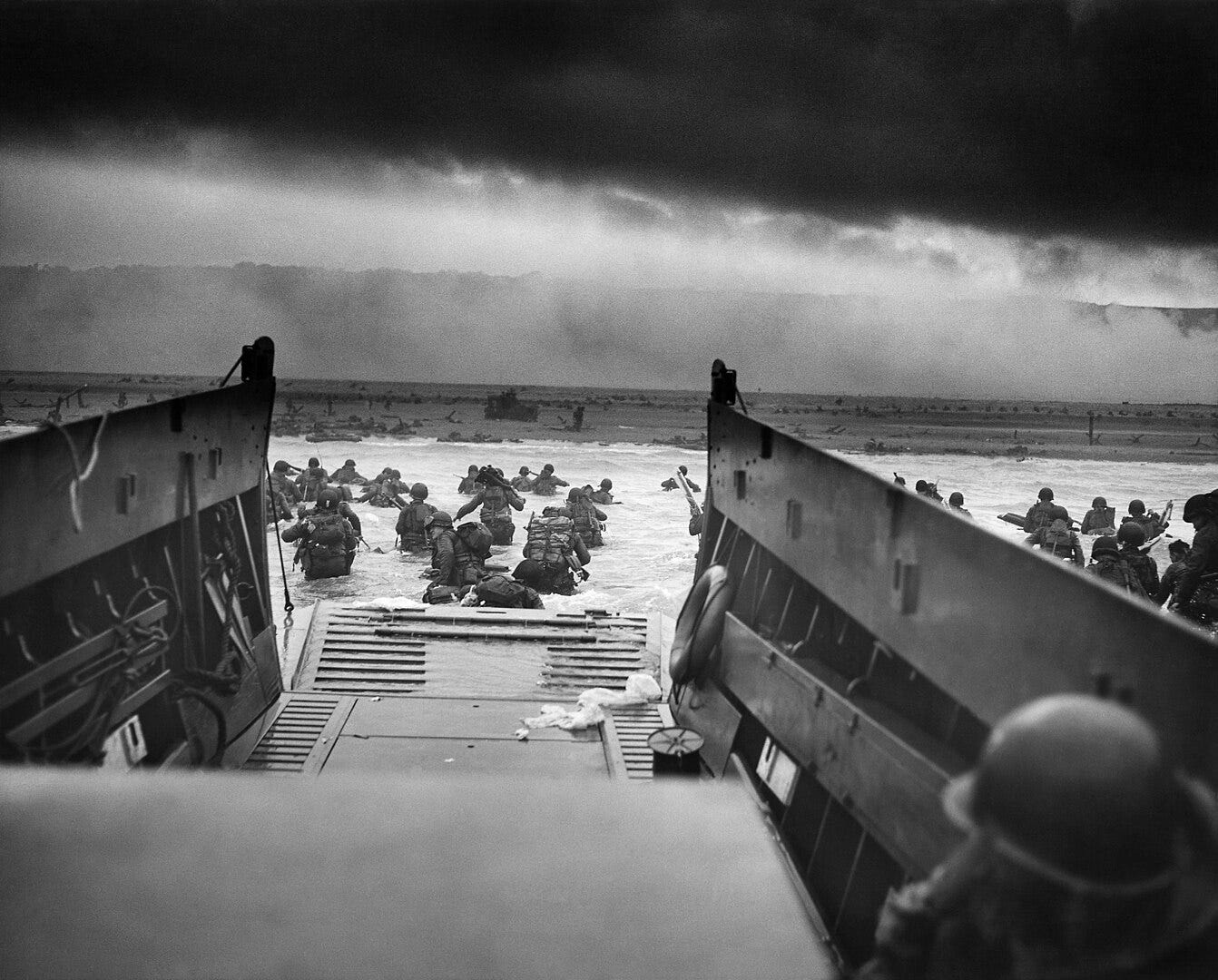
June 6, 1944: The Allied invasion of France begins with the “D-Day” amphibious landings in Normandy, the largest amphibious military operation in history. Despite heavy losses, the Allies were able to establish five beachheads and by mid-June (though it took longer than planned) they secured a small but crucial foothold in northern France. From there they began the final phase of World War II on its Western Front.
June 7, 1494: In the Treaty of Tordesillas, Spain and Portugal agree to divide the world, or at least any “newly discovered” parts of it, along a north-south meridian that runs through the eastern half of modern Brazil. The negotiations superseded a decree previously issued by Pope Alexander VI that threatened both Portugal’s control of the around-Africa sea route to India and any claims it had on India itself. The agreement, which was mostly undefinable (and therefore unenforceable but did the job in terms of avoiding a Spanish-Portuguese war), left most of the recently-“discovered” Americas in Spanish hands save what eventually became Brazil. It was duly ignored by later expansionist European powers—particularly Protestant England, which viewed the treaty as a Catholic accord that it was not obliged to honor.
June 7, 1942: After a four day battle and thanks in large part to having decrypted Japan’s pre-battle communications, the US Pacific Fleet defeats a larger Japanese naval force at the Battle of Midway, around the Midway Atoll west of Hawaii. One of a handful of naval battles in the running for most decisive in history, Midway was the first major US victory in World War II’s Pacific Theater and permanently degraded the Japanese fleet, which lost four large aircraft carriers and almost 250 planes. The US victory gave it an opening to go on the offensive following the Pearl Harbor attack in December, helping to shift the balance of power in the Pacific.
MIDDLE EAST
LEBANON
The Israeli military (IDF) killed at least 12 people in Lebanon on Saturday, including a brigadier general in the Lebanese army and two other soldiers. Israeli officials say they’re investigating the airstrike that killed those military personnel, but put the initial blame on the Lebanese military for failing to coordinate with the IDF regarding movement in an “active combat zone.” The Lebanese military condemned “the continuation of the deliberate and repeated brutal Israeli aggression,” while President Joseph Aoun called the incident a “flagrant violation of Lebanese sovereignty and of international laws and norms” and Prime Minister Nawaf Salam called it “a heinous crime and an attack on Lebanon and all Lebanese people.” None of their outrage will extend beyond rhetoric, of course. At least two Israeli soldiers were also killed in clashes with Hezbollah fighters.
On Sunday the IDF buried whatever remained of last week’s “ceasefire” announcement by bombing southern Beirut’s Dahieh suburb, killing at least two people in what Israeli officials characterized as a response to Hezbollah fire into northern Israel. Iranian officials had previously suggested that further Israeli attacks on the Lebanese capital could end the US-Iran ceasefire.
UPDATE: Sure enough, as I was about to send out today’s newsletter Iran fired missiles at Israel for the first time since the US-Iran ceasefire took effect on April 8. Hezbollah likewise fired drones and artillery at IDF positions on both sides of the Israel-Lebanon border. The ramifications here are potentially massive including a resumption of the US-Iran shooting war but it’s too early to draw any conclusions and unfortunately given my constraints this will have to wait for tomorrow’s newsletter.
ISRAEL-PALESTINE
The IDF killed at least nine people in Gaza on Sunday after killing at least ten people in the territory the previous day. One of Saturday’s airstrikes hit a displaced persons encampment near Gaza city while one of Sunday’s struck a police outpost near another displaced persons encampment near Khan Younis. The Egyptian government, meanwhile, hosted a meeting involving Hamas and other Palestinian political factions to try to advance the “ceasefire” process or at least to present a united demand that the Israelis meet their obligations under the first phase of that agreement. The meeting is expected to last several days.
Elsewhere, a gunman (or gunmen) killed at least one person and wounded five more in a spree that took him/them through several towns in central Israel on Sunday. Israeli security forces subsequently reported killing two suspects, at least one of whom is believed to be a Palestinian citizen of Israel. There’s no indication of any organizational involvement, though Hamas did praise the attack without taking responsibility for it.
IRAN
The US military celebrated day 100 of its glorious war on Iran by shooting down two Iranian drones in the Strait of Hormuz on Sunday. This was after the Saturday morning exchange of hosilities that eventually saw the Iranians fire missiles at Bahrain and Kuwait again, causing some damage but apparently no casualties (at least as far as I’ve seen). There were a couple of minor indications of diplomatic activity, both involving the Pakistani government. Pakistani Interior Minister Mohsin Naqvi turned up in Tehran on Saturday carrying what he said was a “special letter” from Pakistani army commander Asim Munir, while Lebanese army commander Rodolphe Haykal was in Islamabad to meet with Munir. I haven’t seen any other details about those developments so far.
Reuters reported on Sunday that US Treasury Secretary Scott Bessent has been exploring the idea of using Iranian assets to pay reparations to Gulf Arab states that have suffered damage due to the war. This could be a major impediment to a peace deal given that the Iranians are demanding their frozen assets back and those would be the easiest for the US government to access and repurpose. Legally (not that legalities are a huge consideration for the US government) this seems quite dubious as well. It would be one thing if the Iranians were the clear aggressors in this conflict but that honor goes to the US and Israel, and Tehran can argue (and has argued) that the Gulf governments were co-aggressors in that they allowed the US to carry out attacks from bases in their countries.
Speaking of those frozen Iranian assets, Donald Trump told NBC News on Sunday that he won’t unfreeze them until “after” a genuine ceasefire agreement and then it will depend on whether or not the Iranians “behave.” As you may recall Mohsen Rezaee, an adviser to Iranian Supreme Leader Mojtaba Khamenei, told CNN on Friday that Tehran wants half of a $24 billion pot of assets released at the signing of such an agreement, so those are not compatible positions.
ASIA
ARMENIA
There are three elections on Sunday that seem to be drawing a fair amount of attention, none more than the parliamentary election in Armenia. Polling has tended to give Prime Minister Nikol Pashinyan’s Civil Contract party a fairly hefty lead, which if it holds up would be viewed as a public show of support for his efforts to negotiate with Azerbaijan and Turkey while steering the country’s foreign policy closer to the European Union and away from Russia. However, to satisfy Azerbaijani demands Pashinyan needs a two-thirds supermajority to amend the Armenian constitution to remove any territorial claim on the Nagorno-Karabakh region, so just winning the election won’t be enough. That issue in particular has been the opposition’s focus and has added a level of hostility to the campaign.
Armenian authorities arrested six candidates from the opposition Strong Armenia party on Saturday without giving any reason. Party boss Samvel Karapetyan is also under house arrest for allegedly calling for the overthrow of the Armenian government, an allegation he denies. These things don’t necessarily scream “free and fair election” though I’m not really in a position to judge their legitimacy.
AFRICA
SUDAN
Sudan’s Emergency Lawyers activist group is reporting that drone strikes in the town of Hamrat al-Sheikh in Sudan’s North Kordofan state killed at least 13 people on Friday and Saturday. At least 11 were killed in one strike that hit a market in the Abu Zuaima neighborhood on Saturday. Hamrat al-Sheikh is controlled by the Rapid Support Forces militant group so these were presumably military attacks.
MALI
The New York Times reports that the new alliance between Tuareg rebels and jihadist militants in Mali is the result of ideological compromises on both sides:
On one side are the jihadists known as the Group for the Support of Islam and Muslims, or JNIM. On the other side are Tuareg rebels of the Azawad Liberation Front, or F.L.A., a separatist group fighting for independence in northern Mali.
The alliance began over a year ago when the F.L.A. agreed to accept a moderate form of Shariah law, and JNIM convinced the F.L.A. to seek autonomous rule rather than formal independence, according to Wassim Nasr, a researcher and Sahel expert.
As the piece notes, the rebels (the basis of the FLA) and al-Qaeda affiliated jihadists (who would eventually coalesce into one of the groups that merged to form JNIM in 2017) tried to work together during the Tuareg uprising in northern Mali in 2012. That arrangement fell apart quickly as the jihadists were not then offering a “moderate form of Shariah” and coexistence proved impossible. This time around JNIM appears to be taking a more collaborative approach, perhaps hoping to make itself a viable governing option (a la Hayat Tahrir al-Sham in Syria) in addition to forming a more durable alliance with the FLA.
NIGERIA
The Nigerian army announced on Sunday that its forces had freed some 360 people from captivity in a Boko Haram outpost. It’s unclear when this operation took place or whether there were any casualties involved in seizing the facility, located in the southern part of northeastern Nigeria’s Borno state. Two infants among the captives died but the army is attributing their deaths to the conditions they endured in captivity rather than anything to do with their release.
MAURITIUS
The Telegraph reported on Sunday that the Trump administration may try to purchase the Chagos Islands from Mauritius, thereby forfeiting the UK government’s frozen (due to US opposition) proposal to transfer control of the archipelago to the Mauritian government. The administration has alternately signed off on and rejected that proposal, which would carry with it a 99 year UK/US lease of Diego Garcia, the largest of the Chagos islands and home to arguably the US military’s most important overseas base. It has cited concerns about potential Chinese espionage (based mainly on the fact that the Mauritian government is on friendly terms with Beijing) to justify resisting the transfer. In this scenario it would allow the transfer to take place and then buy the islands.
It’s unclear how much this purchase would cost (the US government would first have to actually make the offer to its Mauritian counterpart) but the UK was prepared to pay roughly $46.7 billion for that 99 year lease on just Diego Garcia so we can assume the price to buy the entire archipelago will be considerably higher, and that’s assuming the Mauritian government would even be willing to sell. Similarly unclear, and likely irrelevant from the administration’s perspective, is what would happen to the Chagossian people in this arrangement. The UK expelled the Chagossians from the archipelago in the late 1960s-early 1970s at US behest, and their repatriation (though not to Diego Garcia) was supposed to be part of the Mauritian takeover.
EUROPE
UKRAINE
Overnight Saturday-Sunday Russian strikes killed at least five people across Ukraine. Even more troubling, they apparently damaged a nuclear storage facility in Chernobyl. There’s been no detected surge in radioactivity but the damage does appear to have been significant. The facility is located near the Chernobyl disaster site but is used to store spent fuel from Ukraine’s current working reactors. In Russia, a Ukrainian strike killed at least one person in Belgorod oblast. The Ukrainian military also carried out another major bombardment of St. Petersburg on Saturday, its second in less than a week. The attack injured at least three people but the intent was mainly symbolic, striking Russia’s “second city” at the close of the St. Petersburg International Economic Forum or Vladimir Putin’s “Davos.”
KOSOVO
The second entry in our election triumvirate is Kosovo, where lucky duck voters participated on Sunday in their third parliamentary election since February 2025 after the parliament they elected in December failed to choose a president. Prime Minister Albin Kurti’s Vetëvendosje party will likely win the election as it did in December (indeed early returns show it leading), but he needs at least 80 members of the 120 member parliament to participate in a presidential election1 and he wasn’t able to muster that after the previous contest.
AMERICAS
BOLIVIA
France 24 reports on the ongoing violence between police and anti-austerity protesters in Bolivia, in this case in the agriculturally important eastern part of the country:
The Bolivian Chamber of Deputies passed legislation on Sunday authorizing President Rodrigo Paz to deploy military forces to clear the protesters’ roadblocks while also establishing legal impunity for the use of force against the protesters. The Chamber of Senators had already passed that measure, so once Paz signs it into law a more violent crackdown could ensue in short order.
PERU
In our third election story, Peruvian voters headed to the polls on Sunday for the second round of that country’s presidential contest, pitting right-wing perennial candidate Keiko Fujimori against left-wing Congressperson Roberto Sánchez. Fujimori won the first round in April and has had a narrow lead in polling ahead of the runoff, but there are a large number of people who seem either undecided or checked out (about 17 percent submitted either a fouled or blank ballot in the first round) so the polling may not be all that reliable.
UNITED STATES
Finally, NBC News reported late Friday that the US military is sounding an alarm about spying by America’s bestest friend in the whole wide world:
The Pentagon is increasingly concerned about Israel ramping up its spying on the U.S., recently raising the counterintelligence threat level from America’s top ally in the Middle East to the highest level, according to two U.S. officials and one former U.S. official.
The Pentagon’s Defense Intelligence Agency in recent weeks issued the new counterintelligence threat assessment amid rising tensions between Israel and the U.S. over the way forward in the war with Iran, the officials said. They said the DIA posted an internal message, viewed by one of the current officials, that raised the level for Israel to “critical.”
The designation stems from concerns within the Pentagon that Israel is making a particular effort to surveil top U.S. officials to get information on the Trump administration’s internal deliberations and decision-making on the conflicts in the Middle East, the officials said.
The DIA assessment includes a seven-page document and features a chart, according to one of the current U.S. officials. The document says the assessment of Israel is that its ability to conduct human espionage and technical collection is at a “critical level,” according to the official.
The Israeli embassy in Washington insisted that any claim that Israel would spy on the United States is “completely false,” an assertion that is itself demonstrably false unless the Israeli government has changed its policy over the past few years. More interesting than the story itself may be the fact that “US officials” decided to leak it to the media. This fits into a pattern of unflattering leaks related to the Iran war that suggest there is discontent behind the scenes regarding that conflict and/or the US-Israel relationship. Anyway, if you’re worried that the Trump administration might do something to clamp down on the (alleged) spying, rest easy; the White House issued a statement saying that “this entire story is false and sourced to someone who doesn’t have any knowledge of what’s going on.” That’s a relief.
By law a Kosovan presidential election requires a two-thirds majority (80 affirmative votes) in the first two rounds of voting. If that threshold isn’t met, the voting goes to a third round in which the requirement drops to a simple majority (61 votes) but an 80 MP quorum still has to be present for the election to be legitimate. This makes it fairly easy for the opposition to block an election by simply boycotting the third round of voting, provided that at least 41 MPs participate in the boycott.
67