

You’re reading the web version of Foreign Exchanges. If you’d like to get it delivered straight to your inbox, sign up today:
TODAY IN HISTORY
April 28, 224: This is the date generally given for the Battle of Hormozdgan, which effectively ended Parthian rule over the Persian Empire and installed the Sasanian dynasty in its place. Then-Emperor Artabanus IV was responding to the rise of the Sasanids under Ardashir V, king of Pars. Ardashir’s smaller but better armed and better prepared force met the Parthians at Hormozdgan—the location of which remains unconfirmed but was probably near the Iranian town of Ram-Hormoz—and won a decisive victory, killing Artabanus in the process. Ardashir V of Pars soon became Ardashir I of Persia, and the Sasanians ruled the empire until the Arab invasion swept them (and the Persian Empire in general) aside in the 7th century.
April 28, 1192: The newly elected king of Jerusalem, Conrad of Montferrat, is assassinated in the city of Tyre.
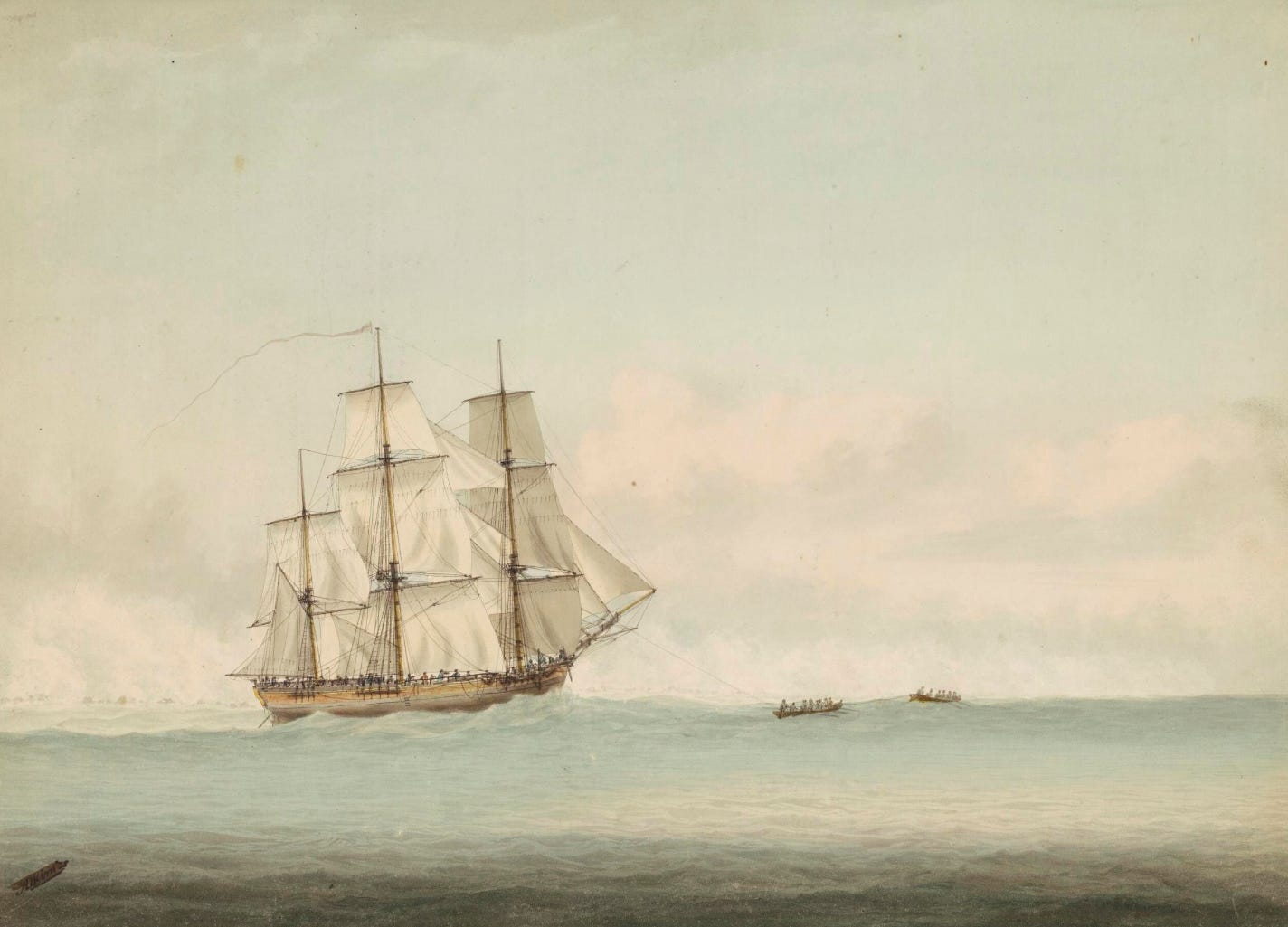
April 29, 1770: The HMS Endeavour, commanded by Royal Navy Captain James Cook, makes landfall at what is now eastern Australia’s Botany Bay. Cook’s expedition had set out on August 26, 1768, in part tasked with searching for the hitherto only rumored Terra Australis Incognita (‘unknown southern land’). Cook claimed the eastern portion of what was then called “New Holland” for Britain, giving it the name “New South Wales.” But Royal Society geographers insisted that there must be a larger southern landmass that Cook had missed, so he made a second voyage (1772-1775) that included the first European crossing of the Antarctic Circle and proved that no such landmass existed in temperate waters. A Russian vessel is believed to have been the first to sight the ice sheet around the actual southern landmass, Antarctica, in 1820.
April 29, 1916: A British army besieged at Kut, in Iraq, surrenders to the Ottomans in what was the worst military disaster in British history to that point.
MIDDLE EAST
LEBANON
The Lebanese Health Ministry reported on Wednesday that the Israeli military (IDF) killed “three emergency workers” (out of at least nine killed in total) in an apparent double-tap strike on the town of Madjal Zoun. Lebanese media is additionally reporting at least five killed in another IDF attack on the town of Jebchit, and the Lebanese army says that a strike on the town of Bint Jbeil killed one of its soldiers along with his brother.
The Lebanese Ministry of Agriculture issued a joint statement with the United Nations Food and Agriculture Organization and the World Food Program on Wednesday warning of a food crisis affecting some 1.24 million Lebanese people. The statement anticipates that they will face “crisis levels or worse” of food insecurity between now and August as a result of the war and associated displacement.
ISRAEL-PALESTINE
IDF strikes on Gaza killed at least five people on Tuesday, including a nine year old. The child had apparently strayed too close to the “yellow line” in the Khan Younis area. On Wednesday the IDF killed one paramedic in Gaza and one person, apparently a suspect in an earlier knife attack on Israeli personnel, in a raid on a West Bank town near the city of Ramallah. It later killed a 16 year old in a raid in the West Bank city of Hebron.
Reuters reported on Wednesday that “new maps” that the IDF issued to aid groups (but did not make public) last month show it claiming control of an additional 11 percent of Gaza on top of the 53 percent it controls under the terms of the current “ceasefire.” This leaves thousands of Palestinians in a sort of limbo area between the original “yellow line” and this new “orange line.” The Israelis claim that the “orange line” is only meant to be used as a reference for aid distribution and reflects areas where NGOs need to coordinate their operations with the IDF. Supposedly it has no bearing on civilians. It’s pretty well established at this point that the IDF has been moving the “yellow line” anyway, so the distinction between these two lines may be meaningless.
UNITED ARAB EMIRATES
The UAE government announced on Tuesday that it is withdrawing from the Organization of the Petroleum Exporting Countries (OPEC), effective May 1. It is not the first country to quit the cartel but is by far the most significant—the UAE was OPEC’s third largest oil exporter after Saudi Arabia and Iraq last year. It is the fifth largest member in terms of proven oil reserves. The Emiratis are also apparently leaving the OPEC+ framework, which includes large non-OPEC oil producers like Russia, Brazil, Kazakhstan, and Mexico. Its presence outside those structures will meaningfully reduce their capacity to regulate global oil supply and prices (a capacity that had already taken a hit given the US emergence as the world’s largest oil producer several years ago). Oil supply and price are currently severely constrained by the Iran war so it will take some time to see what effect this UAE decision will have.
This move came without warning but is not entirely out of the blue, given the rising tensions between the UAE and de facto OPEC leader Saudi Arabia over the past couple of years. The most obvious reason for the exit is that, as The Conversation’s Kristian Coates Ulrichsen writes, Emirati leaders want to pump and sell more oil than they’re currently allowed to do under OPEC+ production limits. They’ve invested in increasing their production capacity and have previously expressed frustration over limits that are meant to prop up oil prices artificially (and that have been largely championed by the Saudis).
But there are other geopolitical factors at play, including the Saudi-Emirati rivalry but now also including an Emirati sense that they’ve suffered a disproportionate share of Iran’s retaliation during the war without getting the support they expected from their fellow Gulf states. Emirati officials say they’re “reviewing” the country’s other international relationships over that grievance but they don’t expect to withdraw from any other organizations (like the Gulf Cooperation Council). This grievance has pushed the UAE—at least in the short-term—in closer alignment to a US government that would prefer lower oil prices for political reasons (its asinine decision to start a war in the Persian Gulf notwithstanding) and may not be all that choked up about disarray within OPEC. And with the Emiratis potentially seeking economic relief from the US it’s not a huge leap to speculate that leaving OPEC is a topic that’s come up in recent discussions between UAE and US officials.
IRAN
Donald Trump gave an interview to his friends at Axios on Wednesday in which he said that he intends to maintain the US naval blockade on Iran until Tehran agrees to meet his demands (whatever those are at this point) on its nuclear program. This interview came after a bit of media speculation about next steps in the Iran war the previous day. The Wall Street Journal reported, in keeping with what Trump later told Axios, that he’d already begun telling aides that he prefers maintaining the blockade to either resuming the shooting war or declaring victory and getting out. Reuters reported that US intelligence agencies have been tasked with assessing how Iran might respond in a scenario where Trump declares victory and gets out, which means that is or at least was on the table. I suppose Trump has now clarified his position, though given how often he changes his mind (I use the term loosely) no interview is going to be entirely clarifying.
Trump’s bet is that economic pressure will force the Iranians to fold before the US does. His rejection of the Iranian offer to reopen the Strait of Hormuz in return for ending the war and the blockade has sent oil prices back into the $120 per barrel range so that theory is going to be put to the test quickly. The Iranian economy is undoubtedly worsening—the rial, already basically worthless, fell to a whopping 1.81 million per US dollar on Wednesday and is, as far as I know, still dropping. Authorities have taken several steps to increase commerce via the country’s land borders but infrastructure has been battered, people are out of work, food costs are reportedly rising, and wartime restrictions (especially the internet throttling that began during the protests back in January) are making it difficult to do business.
The question is not whether the blockade can impose economic pain on Iran, it’s whether the Iranian government can withstand that pain long enough to force the US to reconsider its approach. The closure of the Persian Gulf continues to pay havoc with the global economy and maintaining this level of naval pressure is not cheap or logistically easy. The Pentagon is telling Congress that the war has cost $25 billion so far, a figure that manages to be both huge (Spencer Ackerman notes that it’s comparable to what the US military was spending during the height of the Afghanistan “surge”) and suspiciously low given that outside estimates were pegging the cost at $25 billion a month ago. It is unclear how long the US can maintain its current approach.
(It may be worth noting here that The Washington Post reported on Wednesday afternoon that the Pentagon is preparing to rotate the USS Gerald R. Ford and its carrier group back to the US. Although the Ford has been stationed in the Mediterranean and is not participating directly in the blockade, its many reported maintenance issues are a prime example of the stress that builds up when these units remain deployed for months on end—ten in this case—which seems fairly relevant in the context of a major and now open-ended maritime operation.)
If the economic pressure is enough to cause either side to blink the question becomes whether “blinking” means giving up or going back to the shooting war. The Axios piece above mentions that the US military’s Central Command “has prepared a plan for a ‘short and powerful’ wave of strikes on Iran in hopes of breaking the negotiating deadlock.” That would not break the deadlock but it would restart the war. It is in fact the same imbecilic logic that started the war in the first place, with Trump (at Benjamin Netanyahu’s insistence) figuring that a solid weekend of bombing and political assassinations would bring the Iranians to their knees. If at first you don’t succeed, etc. Meanwhile, anonymous Iranian officials are threatening unspecified retaliation if the US blockade isn’t lifted soon. So there are threats coming from both parties even if neither seems quite ready to start fighting again.
ASIA
THAILAND
The AP has published a photo essay on the environmental damage that rare earth mining is causing in Southeast Asia:
Thailand is bearing the brunt as toxic runoff from rare earth mines in upstream Myanmar and Laos seep into the Mekong Basin, threatening millions who rely on its waters for farms and fisheries.
These heavy metal toxins imperil Southeast Asia’s globally important, multi-billion-dollar produce industry, backbone of its developing economies.
“The Mekong and Kok Rivers are both a source of food and income, which gives life to the people,” said Sayan Khamnueng of the Living Rivers Association. “The river contaminants are the biggest transboundary issue we’ve ever faced.”
Thailand’s response to the spreading problem has been limited to monitoring levels of heavy metals and educating communities about health risks. That raises concerns for Cambodia and Vietnam, downstream.
CHINA
The United States currently owes more than $4.5 billion to the United Nations in the form of unpaid dues and unfulfilled support for UN peacekeeping operations. Rather than simply pay that money as owed, the Trump administration is apparently circulating a list of demands that it wants the UN to meet first. Mostly these demands involve general austerity measures to shrink the UN and reduce its already meager capabilities, but one of the demands is directed at China, or more specifically at the “tens of millions of dollars” that Beijing deposits each year in “a discretionary fund housed in the office of the U.N. secretary-general.” Apparently this is supposed to reduce Chinese influence within the UN. If the US is really worried about losing UN influence relative to China I would think that paying its bills would be a logical step to take, but what do I know?
AFRICA
SUDAN
In Sudan-related news:
A drone strike killed at least 11 people in the city of Rabak, in southeastern Sudan’s White Nile state, on Tuesday. The strike targeted the “Joint Forces,” an alliance of militant groups that are supporting the Sudanese military (SAF), so the Rapid Support Forces group was presumably responsible.
Also on Tuesday, the SAF said that its forces had repelled a new RSF attack on the Sali area in neighboring Blue Nile state. The RSF has attacked that locale at least twice in the past week.
Elsewhere in Blue Nile, the Sudan Doctors Network issued a new warning on Wednesday that the presence of over 100,000 displaced persons in the state capital, Ad-Damazin, is stretching that city to the breaking point. The longer the displacement continues without significant intervention the closer this situation is going to get to a major catastrophe.
The UN has blacklisted Algoney Hamdan Dagalo, the brother of RSF leader Muhammad Hamdan Dagalo, along with three Colombian mercenaries accused of procuring additional mercenaries on the RSF’s behalf.
MALI
The Malian military reportedly chased Islamic State fighters out of the town of Ménaka on Wednesday. Although they did not participate in the weekend offensive involving Tuareg rebels and Jamaʿat Nusrat al-Islam wa’l-Muslimin fighters, IS appears to have tried to take advantage of the chaos of that operation to seize the town, which is located near the Nigerien border. Elsewhere across northern Mali, civilians and security forces alike appear to be preparing themselves for a new round of militant attacks.
NIGERIA
The Nigerian military claimed on Wednesday that its forces have killed at least 18 militants in multiple operations in the country’s northeastern Borno state. Followup airstrikes were still reportedly being conducted so those operations aren’t entirely over as yet.
SOUTH SUDAN
A new report from the UN Food and Agriculture Organization, the World Food Program, and UNICEF released on Tuesday warns that some 7.8 million people in South Sudan (56 percent of the country’s population) are at risk of severe food insecurity due to “conflict and displacement.” It further estimates that some 2.2 million South Sudanese children aged six months to five years are facing “acute malnutrition” and some 700,000 are at “grave risk” of death. Worsening clashes between the South Sudanese military and various militant groups have made humanitarian intervention much more difficult in a country where living conditions were already poor.
EUROPE
UKRAINE
There are several items of note:
Russian attacks killed at least three people and wounded another 17 across Ukraine on Wednesday. Heavy fighting in Ukraine’s Donetsk oblast reportedly forced the displacement of at least 867 people from areas near the front line, according to Russia’s Interfax news service.
Donald Trump spoke with Russian President Vladimir Putin by phone on Wednesday and according to Trump they discussed a potential ceasefire. Or as he put it to reporters, “I suggested a little bit of a cease-fire and I think he might do that.” I hope nobody is holding their breath on this, but after their brief (and disputed) Easter ceasefire earlier this month it is conceivable that the parties could agree to do it again for the “Victory Day” commemoration on May 9.
The Ukrainian Foreign Ministry summoned Israel’s ambassador on Tuesday after a second Russian cargo ship allegedly carrying stolen Ukrainian grain docked at Haifa. The previous incident earlier this month prompted a request from the Ukrainians for the Israelis to detain that Russian vessel, which apparently fell on deaf ears. Once could be an oversight but twice is a pattern and the tenor of Ukrainian comments has turned more critical of the Israeli government, which has responded by insisting that Ukrainian officials haven’t offered any evidence that the grain was stolen and criticizing their decision to make this issue public.
Acting US ambassador to Ukraine Julie Davis, who also serves as US ambassador to Cyprus, announced on Tuesday that she’s stepping down in June and The Financial Times reported that she is leaving because of frustrations with the Trump administration’s Ukraine policy. Davis has been serving as US chargé d’affaires in Kyiv since May, after previous ambassador Bridget Brink resigned for similar reasons. Aside from disagreements over Ukraine, Davis was reportedly “blindsided” when Trump nominated Republican mega-donor John Breslow to replace her in Cyprus back in October.
KOSOVO
The Kosovan parliament missed its final deadline to elect a new national president on Tuesday, ensuring that the country will hold its third parliamentary election in roughly 18 months sometime later this year. Having already failed to elect a president last month the writing was on the wall, but Kosovan Prime Minister Albin Kurti gave it one last try before the legal deadline expired at midnight. As before, opposition parties boycotted the session and thus denied Kurti the two-thirds quorum necessary for a legitimate election. Parliament speaker Albulena Haxhiu, who is also acting president at the moment, should announce the date of the election soon.
AMERICAS
COLOMBIA
The ex-Revolutionary Armed Forces of Colombia (FARC) Central General Staff faction has claimed responsibility for a bombing on a highway in Colombia’s Cauca department that killed at least 21 people and wounded dozens more on Saturday. It issued a somewhat apologetic statement attributing the bombing to a “tactical error” made amid clashes with Colombian security forces.
PANAMA
The United States and the governments of five Latin American and Caribbean nations—Bolivia, Costa Rica, Guyana, Paraguay, and Trinidad and Tobago—issued a joint statement on Wednesday criticizing China for imposing what they called “targeted economic pressure” on Panama after an unfavorable court ruling. Back in January, the Panamanian Supreme Court annulled the contracts under which the Hong Kong firm CK Hutchison was administering the Balboa and Cristóbal terminals at the Pacific and Atlantic ends (respectively) of the Panama Canal. Beijing has since detained dozens of Panamanian-flagged ships, including 70 in March alone. The court’s decision to invalidate those contracts came in the context of previous threats by Donald Trump to seize the canal and US companies frequently use Panamanian-flagged container vessels for moving cargo so there are clearly bigger geopolitical issues at work here.
MEXICO
The US Justice Department announced on Wednesday that it is charging several officials in Mexico’s Sinaloa state, including governor Rubén Rocha, of colluding with the Sinaloa Cartel. This is certainly an escalation in the Trump administration’s assault on Mexican institutions and in particular on Mexican President Claudia Sheinbaum, given that Rocha is also from her Morena Party. Rocha issued a statement via social media saying that the charges “lack any truth or foundation whatsoever.”
HAITI
The last detachment of Kenyan police left Haiti on Monday, their failed anti-gang mission giving way to the UN-backed “Gang Suppression Force” that’s supposed to feature manpower contributions from Chad and several other still unnamed countries. The Kenyan-led mission never approached either its funding or manpower goals and was generally ineffectual. The new GSF operation appears to be off to a better start on both fronts and it is hoped that it will reach its full manpower extent (around 5500 personnel) by October.
UNITED STATES
Finally, while we’re tallying up the costs of the Iran war, The Intercept reports on a new Brown University estimate of the money that the Trump administration has spent on its American military adventures:
The Pentagon won’t disclose the price tag of its wars in the Western Hemisphere, but a new analysis by Brown University’s Costs of War Project, provided exclusively to The Intercept, offers the first window onto the ballooning costs.
By the most cautious estimate, the U.S. military’s intervention in Venezuela and attacks on boats in the Caribbean and the Eastern Pacific — Operation Absolute Resolve and Operation Southern Spear, respectively — have already cost taxpayers at least $4.7 billion.
The Costs of War analysis is the most comprehensive accounting of the U.S. air, naval, and Special Operations expenses — including some troop deployments and munitions — used in the two campaigns between August 1, 2025, and March 31, 2026. The need for such an estimate stems from the refusal of the Department of War to provide a tally of costs to lawmakers or The Intercept.
The researchers behind the Costs of War estimate say it’s almost assuredly an undercount.