

You’re reading the web version of Foreign Exchanges. If you’d like to get it delivered straight to your inbox, sign up today:
TODAY IN HISTORY
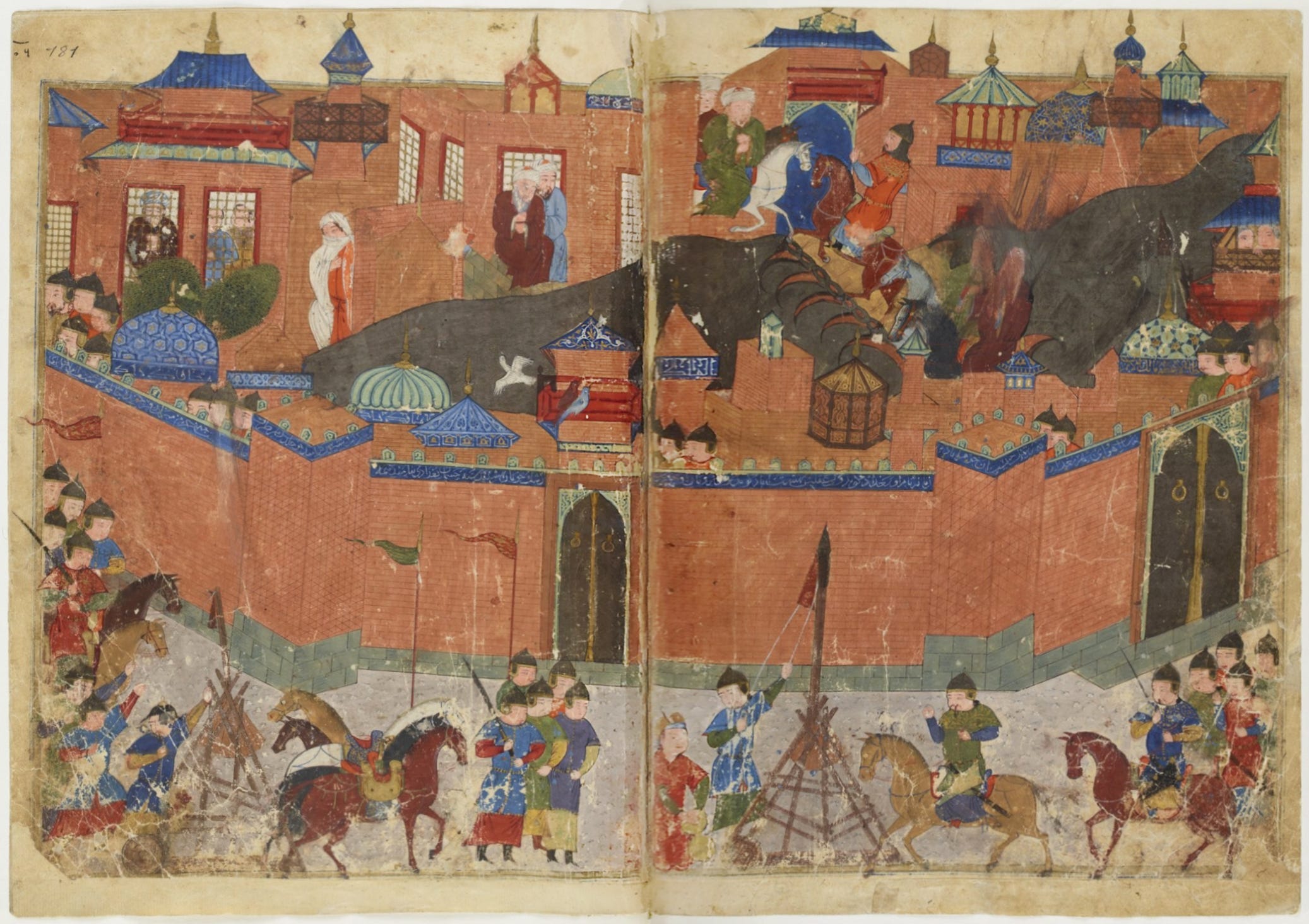
February 10, 1258: The Mongols sack Baghdad and topple the Abbasid Caliphate. In the aftermath of the siege Mongol warriors massacred tens and perhaps hundreds of thousands of Baghdad residents and destroyed much of the city including the fabled House of Wisdom, a repository of scholarly manuscripts whose loss was probably incalculable. Although Baghdad regained some of its importance under the Mongols it never returned to the heights it had enjoyed prior to this event, and the effective end of the caliphate marked a huge shift for the Islamic world writ large.
February 10, 1763: Representatives from France, Great Britain, Portugal, and Spain sign the Treaty of Paris, one of several diplomatic agreements ending the 1756-1763 Seven Years’ War. Reflecting the overall victory of the British-Prussian alliance, the treaty saw France cede considerable territory to Britain in North America (where the conflict was known as the French and Indian War). This included Canada and the eastern part of the Louisiana Territory (everything east of the Mississippi River). Ironically the treaty itself damaged Britain’s relationship with Prussia, as Prussian ruler Frederick II (“the Great”) was forced to make a separate peace deal in the Treaty of Hubertusburg and was angered by Britain’s decision to go it alone at Paris.
INTERNATIONAL
This may seem incongruous to anybody who’s been dealing with the extreme cold spell that has hit much of the US lately, but both the US National Oceanic and Atmospheric Administration and the Australian Bureau of Meteorology are pointing to indications of a potential El Niño forming in the southern Pacific later this year. Given how high global average temperatures have been in the absence of an El Niño since the last one ended in early 2024, the recurrence of that phenomenon is likely to send temperatures skyrocketing in 2027. The El Niño indications at this point are very preliminary and should be taken with a grain of salt.
MIDDLE EAST
SYRIA
AFP reports that the Iraqi government has so far received 2225 Islamic State prisoners transferred by the US military from their former detention sites in Syria to Baghdad’s jurisdiction. US forces began moving those detainees last month amid the conflict between the Syrian government and the Syrian Democratic Forces group. With the Trump administration reportedly considering a full withdrawal from Syria, the Pentagon may want to have these prisoners (upwards of 7000 in total) secured in Iraq before it starts pulling forces out.
LEBANON
The Israeli military (IDF) killed at least four people in two incidents in southern Lebanon on Monday. As ever Israeli officials say they were targeting Hezbollah operatives, which presumably includes the three year old they killed in one of those attacks. In another incident, Israeli forces entered southern Lebanon and abducted a senior figure in the Islamic Group, Lebanon’s Muslim Brotherhood branch. Islamic Group is aligned with Hamas and its fighters allegedly fired rockets into northern Israel during the 2023-2024 Israel-Hezbollah conflict.
ISRAEL-PALESTINE
There are a few items of note:
The Israeli “security cabinet” has reportedly approved new rules for the West Bank that intensify the de facto annexation of that territory. Among other elements, the new measures put Palestinians more directly under the oversight of Israeli law enforcement, even in parts of the territory that under the Oslo Accords are supposed to be administered by the Palestinian Authority. They also make it easier for Israeli settlers to buy land from Palestinians, something that is technically prohibited under a Jordanian law and is subject to a complicated permitting process under current Israeli law. Israeli Energy Minister Eli Cohen called this the establishment of “de facto sovereignty” over the West Bank, and with Donald Trump stressing his (rhetorical) opposition to the territory’s “annexation” I assume “sovereignty” is the Israeli euphemism of choice at least for the time being.
The IDF killed at least four alleged “militants” in southern Gaza on Monday after they allegedly emerged from a tunnel and allegedly began firing on Israeli soldiers. A retaliatory Israeli airstrike subsequently killed at least four people in northern Gaza. Israeli forces killed at least two people in separate incidents in Gaza on Sunday. Al Jazeera is reporting that Israeli forces killed at least seven people in multiple attacks across Gaza on Tuesday.
Hamas issued a statement on Saturday calling on “all parties to exert serious pressure” on the Israeli government to allow the “technocratic” committee that is supposed to be administering Gaza to actually enter the territory. The “National Committee for the Administration of Gaza” has hitherto been forced to work from Egypt because Israeli authorities won’t allow its members into Gaza. They haven’t explained why although they have complained about its logo, which is very similar to the one used by the PA. The Israeli government rejects any role for the PA in Gaza because that might advance the cause of Palestinian statehood.
The Indonesian government said on Tuesday that it is prepared to contribute as many as 8000 soldiers to the “international stabilization force” in Gaza, whose total size it estimates could be around 20,000 personnel. However, the details regarding where the force will operate and what it will be expected to do have yet to be spelled out, and if this force is really going to be expected to disarm Hamas I would imagine there will be some pushback by potential participants.
A recent analysis at War on the Rocks by former US Marine Colonel Andy Milburn lambastes Israeli conduct in its Gaza campaign, which he argues “has produced civilian death on a scale that cannot be explained by inevitability alone.” I am not going to go into detail because space is limited and I don’t think any of Milburn’s arguments will be unfamiliar to readers of this newsletter (though he does include his own reporting based on interviews with IDF personnel and his experiences in Iraq), but I think it’s worth noting that this is a piece written by a US military veteran in a venue that is one of the quintessential publications of the “NatSec” community. If Israel is taking flak even here that seems meaningful.
An investigation by Al Jazeera finds that the IDF used thermal and thermobaric weapons in Gaza that burn hot enough (3500 degrees Celsius) to fully obliterate a human body. Civil defense officials in Gaza say that they have documented 2842 people who were killed by these weapons whose remains will never be recovered. The Israelis acquired these munitions from, of course, the United States.
IRAN
The head of Iran’s Atomic Energy Organization, Mohammad Eslami, suggested to reporters on Monday that Tehran is prepared to dilute its stockpile of 60 percent enriched uranium in return for sanctions relief. This is the first indication of a specific concession on the Iranian part since the momentum for new nuclear talks began growing over the past couple of weeks, but it’s also the lowest hanging fruit the Iranians have to offer and is unlikely to get much traction with US negotiators. It does reveal, I think, that the Iranians still have access to that uranium and that means it wasn’t buried for all time during the “12 Day War.” That in itself should be a lesson for the US about the efficacy of its airstrikes, though I’m sure the lesson will be lost on the Trump administration.
Israeli Prime Minister Benjamin Netanyahu is visiting the White House this week to discuss his demands for any US-Iran agreement. In particular he’s expected to insist on the imposition of strict limits on Iran’s ballistic missile program. What Netanyahu wants is the freedom to attack Iran with impunity, which could be achieved by capping the range of Iranian missiles so that they are unable to reach Israel. The Iranian government would be exceedingly unlikely to agree to such a demand for obvious reasons, which would presumably cause the negotiations to collapse if Trump insists on that condition. This outcome would be fine with Netanyahu.
In other items, in an interview on Tuesday Donald Trump threatened to send a second aircraft carrier to the region should the negotiations fail and he decides to move forward with a military conflict. And the US Maritime Administration is warning ships to steer clear of Iranian waters in the Strait of Hormuz. The Islamic Revolutionary Guard Corps attempted to impound a US-flagged vessel there last week, prior to Friday’s nuclear talks.
ASIA
THAILAND
In something of a surprise outcome, Thai Prime Minister Anutin Charnvirakul’s Bhumjaithai Party won Sunday’s snap election fairly handily, taking 193 seats in the 500 seat House of Representatives at last count. I say “something of a surprise” because most polling ahead of the election had the progressive People’s Party out in front, but it finished a distant second with 118 seats. Anutin leaned heavily into nationalism during and after Thailand’s border conflict with Cambodia and that appears to have done the trick. He’ll still need to find a coalition partner or partners to give him a legislative majority. Voters also overwhelmingly approved a referendum calling for a rewrite to Thailand’s 2014 constitution, which gives the military an effective veto over civilian leadership via its appointed Senate.
CHINA
US Undersecretary of State for Arms Control and International Security Thomas DiNanno accused China of carrying out secret “nuclear explosive tests” back in 2020 during a United Nations conference on Friday. The allegations appear to be part of a new push from the Trump administration to bring China into negotiations with the US and Russia on a new arms control treaty (more on this later). Regardless, the executive secretary of the Preparatory Commission for the Comprehensive Nuclear-Test-Ban Treaty Organization, Australian diplomat Robert Floyd, issued a statement saying that the organization “did not detect any event consistent with the characteristics of a nuclear weapon test explosion” during the time DiNanno is alleging those tests took place.
JAPAN
In another major vote on Sunday, Japanese Prime Minister Takaichi Sanae’s decision to hold a snap election paid off perhaps beyond even her expectations. Her Liberal Democratic Party won a whopping 315 of 465 seats in the House of Representatives, going from a bare single seat majority in coalition with the conservative Ishin Party to a sole two-thirds supermajority (collectively the two parties now hold more than 350 seats). This outcome gives her a pretty free hand legislatively, which she’s expected to use to increase Japanese military spending and pass a stimulus-heavy 2026 budget.
OCEANIA
PALAU
The US State Department is barring the president of the Palauan Senate, Hokkons Baules, from entering the United States (along with his family), accusing him of “accepting bribes in exchange for providing advocacy and support for government, business, and criminal interests from China.” According to Reuters, Baules is known as an advocate for China within Palauan politics and there’s a link between a family business and alleged “Chinese criminal activity.”
AFRICA
SUDAN
A Rapid Support Forces drone strike hit a vehicle carrying displaced persons in Sudan’s North Kordofan state on Saturday, killing at least 24 people according to the Sudan Doctors Network. The RSF hasn’t commented on the incident but its drones have been on a killing spree in the Kordofan region in recent days. Elsewhere, the Sudanese military says that its forces repelled an RSF attack on the town of Al Selik, located near the South Sudanese border in southeastern Sudan’s Blue Nile state. The RSF and the Sudan People’s Liberation Army-North launched a new offensive in Blue Nile late last month. And Sudan has apparently rejoined the Horn of Africa’s regional bloc, the Intergovernmental Authority on Development. Sudan’s military government suspended its membership in the bloc in January 2024 after RSF leader Mohamed Hamdan Dagalo participated in an IGAD summit.
A Reuters “visual investigation” found on Tuesday that the Ethiopian military “is hosting a secret camp to train thousands of fighters for the Rapid Support Forces paramilitary group” in Ethiopia’s Benishangul-Gumuz region. According to “eight sources, including a senior Ethiopian government official,” the camp was financed by the United Arab Emirates, which also provided the trainers and unspecified “logistical support” for the facility. Emirati officials denied involvement. Most of the recruits are Ethiopian though there are Sudanese and South Sudanese nationals in the facility as well. The camp is positioned near the border with Sudan’s Blue Nile region, where the Sudanese military has accused Ethiopia of facilitating the RSF’s offensive. This appears to be the first solid evidence to support that claim.
UPDATE: The Ethiopian Media Authority subsequently stripped accreditation from three Reuters reporters in retaliation for this piece. It also removed the outlet’s credentials for covering the February 14-15 African Union summit in Addis Ababa.
LIBYA
Thousands of people apparently turned out for the funeral of Saif al-Islam Gaddafi, the son of former Libyan leader Muammar Gaddafi who was recently gunned down in his home, in the town of Bani Walid on Friday. I don’t want to make too much of this except to note the outpouring of public support in case his murder becomes a rallying cry for Libyans who are justifiably fed up with their current ruling class. Just something to keep in mind.
NIGERIA
The Pentagon is reportedly sending some 200 US soldiers to Nigeria to train Nigerian security forces. Military officials acknowledged last week that there are already US personnel in that country, though the size of the deployment and the nature of their activities are unclear. The Trump administration ordered airstrikes on alleged jihadist targets in northwestern Nigeria back in December after Donald Trump made unfounded allegations of a “genocide” against Nigerian Christians.
ETHIOPIA
Ethiopian Foreign Minister Gedion Timothewos sent a letter on Saturday to his Eritrean counterpart, Osman Saleh Mohammed, asserting that Eritrean military forces are occupying Ethiopian territory and demanding their withdrawal. The Eritrean military operated in northern Ethiopia’s Tigray region while it was aiding the Ethiopian military in its 2020-2022 war against the Tigray People’s Liberation Front, and there have been allegations ever since that its forces never entirely returned home. Ethiopian officials have accused the Eritreans of allying with the remnants of the TPLF to stoke a new conflict, a charge Eritrean officials deny. On Monday the Eritrean Information Ministry called the letter “patently false and fabricated.”
DEMOCRATIC REPUBLIC OF THE CONGO
Allied Democratic Forces jihadists attacked a village in the eastern DRC’s North Kivu province on Saturday, killing at least 20 people. The attack also displaced a large number of people and many are still missing, so that death toll may rise.
Elsewhere, Reuters reported on Tuesday that mercenary entrepreneur and Friend of Trump Erik Prince is working with the Congolese government in its conflict with Rwanda-backed M23 militants. According to its account Prince “deployed a private security force to operate drones” to help Congolese forces retake the city of Uvira in South Kivu province after the militants—under US pressure—withdrew from it in December. It’s unclear whether Prince is in the DRC at the US government’s behest or is coordinating with the Trump administration, but Congolese officials believe that the presence of US mercs among their soldiers will have a deterrent effect on M23 as its Rwandan patrons will likely not want to risk killing or wounding US nationals and potentially running afoul of Washington. Prince is also working with a group of “Israeli advisers” who have reportedly been training Congolese soldiers.
EUROPE
NATO
NATO may be just days away from launching operation “Arctic Sentry,” a project to bolster the alliance’s surveillance of and military presence in the Arctic region in order to satisfy Donald Trump so that he doesn’t invade Greenland deter Russia and China from their nefarious plans for world domination. The full scope of the operation is not yet clear.
RUSSIA
Foreign Policy’s Decker Eveleth argues that the biggest reason for concern about the expiration of New START is less the possibility of a new nuclear arms race than an increased risk of conflict. The monitoring and verification processes that came along with strategic arms control treaties—of which New START was the last active one—gave both the US and Russian (and before that Soviet) governments some assurance that they were aware of the general disposition of one another’s nuclear arsenals. The absence of that kind of transparency, and the uncertainty it generates, could be a source of tension. It will in all likelihood make negotiating a successor treaty harder, especially if the US insists on including China and thereby further complicating that process. The more time that passes with no arms control treaty in place, the greater the level of distrust that could build up between the parties.
UKRAINE
Ukrainian President Volodymyr Zelensky told reporters late last week that the Trump administration wants Ukraine and Russia to end their war by June and intends to “pressure” both parties accordingly. That’s slightly less ambitious than the March timetable Reuters had previously reported, though realistically to reach a final peace deal by June some sort of framework agreement would probably have to be in place by late March and even that would be cutting it close. Zelensky suggested that the administration is anxious to focus on the upcoming midterm elections in the US, which is probably true but not the sort of thing that US officials would say openly.
In the meantime, The New York Times reports that the Russian military is closing in on three of its biggest targets—the town of Huliaipole in Ukraine’s Zaporizhzhia oblast and the cities of Pokrovsk and Myrnohrad in Donetsk. The pace of the Russian advance remains very slow, but seizing any or all of these sites would position them to make further advances and that, at least, would give Russian negotiators a stronger hand to push for Ukrainian territorial concessions in peace talks.
PORTUGAL
As expected, Socialist candidate António José Seguro won Portugal’s presidential runoff on Sunday by a comfortable margin over Chega party candidate André Ventura. Seguro took two-thirds of the vote according to official results released on Monday. The Portuguese presidency is not an especially powerful office under normal circumstances, but Ventura’s second place finish in last month’s first round was a significant milestone for the far right and his loss in the runoff doesn’t necessarily diminish its importance in terms of the trajectory of Portuguese politics.
AMERICAS
COLOMBIA
Colombian President Gustavo Petro claimed on Tuesday that he had survived an attempt on his life the previous day. According to his account, the helicopter on which he was traveling to Colombia’s disaster-stricken Córdoba department had to divert from its scheduled landing site due to information that it could be fired upon. I haven’t seen any information regarding the would-be perpetrators.
HAITI
Haiti’s transitional presidential council dissolved on Saturday as its mandate expired, leaving Prime Minister Alix Didier Fils-Aimé as the lone holder of executive authority amid a political transition that appears to be in limbo. This is particularly noteworthy given that the council’s last few days were occupied in part by a plan to oust Fils-Aimé from his post, only for the Trump administration to put its proverbial foot down and force council members to back off. The council took office last year with one primary aim, organizing elections, that it failed to achieve. There are tentative plans to hold elections later this year, but with criminal gangs still in control of Port-au-Prince and expanding their footprint to other parts of the country it seems unlikely that a vote can be organized on that timetable.
CUBA
The Cuban government on Monday imposed a number of “emergency measures” intended to conserve a fuel supply that is depleting with no new shipments on the horizon, now that the Trump administration has cut off Havana’s Venezuelan and Mexican oil sources. Among other measures, Cuban officials told international airlines that they are no longer able to refuel their aircraft and they’ve begun closing down lightly occupied hotels and moving their guests elsewhere.
In general, as The Wall Street Journal reports, life on the island appears to be shutting down. Cuba is at best weeks away from completely running out of fuel and seeing the entire island plunged into a full blackout. The only possible way to avoid that would appear to be some sort of accord between the Cuban government and the Trump administration, a possibility that Donald Trump has said is definitely on the table. On that front, however, Drop Site reported on Monday that, according to “a senior Trump official,” US Secretary of State Marco Rubio is lying to his boss when he says that US-Cuban negotiations are already under way. Rubio in this account is planning to string Trump along for a few weeks and then claim that the “negotiations” broke down because of the Cuban side. Regime change is supposed to follow. The US State Department denied Drop Site’s reporting but has been unable to offer details—dates, locations, personnel involved, etc.—of any alleged US-Cuban talks.
CANADA
Donald Trump is now threatening to block the opening of the Gordie Howe International Bridge, which is supposed to go into service later this year and link the Canadian city of Windsor to the US city of Detroit across the Detroit River. He took to social media on Monday to say that he “will not allow this bridge to open until the United States is fully compensated for everything we have given them, and also, importantly, Canada treats the United States with the Fairness and Respect that we deserve.” One assumes he’s still mad about Canadian Prime Minister Mark Carney’s Davos speech but also he’s apparently angry that the Canadian government, which paid for the bridge, is somehow reaping too much of its economic benefit. Carney and Trump spoke about the bridge on Tuesday and planned further discussions.
UNITED STATES
Finally, in US news:
The US military destroyed another dreaded speedboat in the eastern Pacific Ocean on Monday, killing at least two people and leaving one other person stranded in the wreckage. The Pentagon’s killing spree has now claimed at least 130 lives since it began in early September.
The US impounded another “Venezuela-linked” oil tanker on Monday. This seizure is particularly noteworthy in that it took place in the Indian Ocean, which map enthusiasts may note is nowhere near Venezuela. The vessel, the Panamanian-flagged Aquila II, allegedly “ran” from the Caribbean after “operating in defiance of President Trump’s established quarantine of sanctioned vessels.” Or in other words it proceeded according to its planned itinerary until the US military pirated it.
Barak Ravid reported at Axios last week that the Trump administration is planning to hold the first meeting of the “Board of Peace” at the “Donald J. Trump Institute of Peace” in Washington on February 19. It only just started sending out invitations on Friday so things are still somewhat up in the air, but the plan apparently is to couple the board meeting with a fundraiser for Jared Kushner’s Gaza reconstruction/ethnic cleansing/graft plan. Sounds like it will be a real rocking time.