

You’re reading the web version of Foreign Exchanges. If you’d like to get it delivered straight to your inbox, sign up today:
TODAY IN HISTORY
January 31, 314: Sylvester I takes up the position of Bishop of Rome, aka Pope. He was officially the 33rd person to take that office, ignoring a handful of “antipopes” along the way. There are major gaps in the historical record around Sylvester’s actual pontificate, but later Catholic teaching imbued it with significant meaning in terms of the nature of the papal office. With Emperor Constantine I shifting the center of Roman power to the east, Sylvester is supposed to have been the recipient of the “Donation of Constantine,” an ~8th century forgery in which the emperor (grateful after Sylvester supposedly cured him of leprosy) is made to declare that the papacy held supreme authority over both the Church and all worldly rulers, as well as direct authority over the western portions of the empire. Needless to say this never really happened, but subsequent popes loved to pretend that it did and that makes Sylvester’s reign historically significant.
January 31, 1865: The US Congress passes the 13th amendment to the Constitution, abolishing slavery. President Abraham Lincoln signed it the following day, and the amendment was then submitted to the states for ratification, reaching the required three-fourths threshold in December. Several states took longer to ratify the amendment, including Mississippi, whose leaders finally decided that slavery ought to be illegal in, ah, 1995. I guess they just really needed some time to think about it.
February 1, 1713: Ottoman forces capture Swedish King Charles XII—who’d been taking refuge within the empire for nearly four years at this point—in what is known as the Skirmish at Bendery. Charles, who at the time was at war with a coalition led by Russia (the “Great Northern War”) was forced to return to Sweden, finally making his arrival in November 1714.
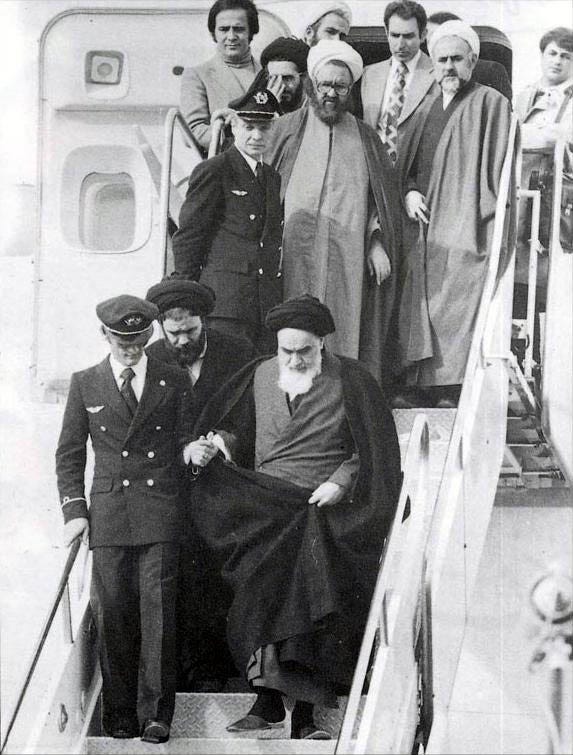
February 1, 1979: Ayatollah Ruhollah Khomeini returns to Iran after several years in exile, just in time to seize power.
MIDDLE EAST
LEBANON
Israeli military (IDF) airstrikes killed at least one person in southern Lebanon on Saturday and another on Sunday. As always Israeli officials claimed that the strikes targeted Hezbollah personnel and individuals, though Lebanese media reported that the person killed on Saturday was “carrying out repair work on the roof of a house” and Sunday’s lethal strike wounded two children because the target was apparently in a car with his family. The IDF also dropped leaflets on the border town of Bint Jbeil threatening to attack a local hospital over alleged Hezbollah activity.
ISRAEL-PALESTINE
A barrage of IDF strikes killed at least 32 people across Gaza on Saturday, according to civil defense officials, making it one of the deadliest days in the territory since the ostensible ceasefire went into effect in October. Israeli officials said that they were responding to an incident on Friday in which they observed eight alleged “terrorists” emerging from a tunnel in southern Gaza’s Rafah area. Israeli forces killed three of them on Friday. It’s unclear whether any of the other five were among Saturday’s dead.
Looking ahead, +972 Magazine’s Muhammad Shehada reports that the Israeli government has yet to allow Gaza’s newly appointed technocratic governing committee to enter the territory, amid signs that it’s trying to engineer the failure of the ceasefire:
Even though Benjamin Netanyahu agreed to join the Board of Peace at [Donald] Trump’s invitation, the Israeli prime minister publicly rebuked the president and criticized the Gaza Executive Board as running “contrary to Israeli policy.” Shortly after, Israeli Finance Minister Bezalel Smotrich declared “Gaza is ours” and called the Trump plan “bad for Israel.” Smotrich demanded that the plan be shelved in place of resuming “a full-force assault on Gaza” and rebuilding “permanent Israeli settlements” in the enclave.
The Israeli newspaper Maariv even reported that Israel is currently “preparing for the collapse of the Trump plan” and has already made preparations for resuming its assault on Gaza “without restrictions,” seeking this time to directly occupy the entire Strip. Israel’s Channel 14 further highlighted that the army’s chief of staff has approved plans for a large-scale attack on the enclave, including the invasion of areas that Israeli forces didn’t enter during two years of fighting.
In other words, Israel has made no secret of its intention to keep Gaza deadlocked indefinitely. The Israeli government is proactively taking steps to ensure that phase two of Trump’s plan will not proceed as planned — and at most, as Netanyahu remarked dismissively, remain a “symbolic” spectacle — in order to convince the Americans that Gaza is ungovernable, and thus prove the need for sustained Israeli military rule.
In other items:
Israeli authorities began the process of reopening the Rafah checkpoint on Sunday, though it was not expected to start handling a substantial number of entries and exits until Monday. The crossing will be opened only to individuals and not to aid, but that will at least allow people in Gaza who require medical care to leave the decimated territory to obtain it. Palestinians who have already left Gaza and wish to return will also be allowed to do so via Rafah though Israeli officials have said that they want to manage that process to maintain a net outflow of people through the checkpoint.
The Israeli government will proscribe the NGO Doctors Without Borders, after the organization reversed course and opted not to provide authorities with personal information about its Palestinian staff. This action will bar the charity from operating in Gaza effective March 1.
According to The New Arab, the Trump administration will announce the formation of Gaza’s “international stabilization force” in a matter of days. Supposedly the governments of Albania, Italy, Kazakhstan, and Kosovo have all agreed to send personnel to participate in the force, though Bloomberg has previously reported that the administration asked Italian officials to participate but had yet to receive a positive response. After a lot of handwringing about what exactly the force would be tasked with doing it really does sound like the expectation is that it will disarm Hamas on Israel’s behalf. That’s a tall and potentially dangerous order and it remains to be seen whether even these four governments will be comfortable with it.
IRAQ
The Iraqi Shiʿa Coalition Framework issued a statement on Saturday reaffirming its backing for former Prime Minister Nouri al-Maliki to resume that post, despite Donald Trump’s threats to cut off US support for Iraq if he does. It would appear that Trump’s attempt at intervening in Iraqi politics is having the opposite of its intended effect. Maliki’s likely elevation has had at least one tangible impact on US-Iraqi relations already, as Trump’s would-be Iraq envoy Mark Savaya is reportedly no longer handling that job. He was supposed to make his first official visit to Iraq in that capacity last Friday but “abruptly canceled,” and it sounds like he’s being blamed for “mishandling” Maliki’s nomination among other issues. According to Reuters, the US State Department’s Iraq file is now under the purview of Turkish ambassador/Syria-and-also-sort-of-Lebanon envoy Tom Barrack.
IRAN
At time of writing on Sunday the prospects of a new US attack on Iran seemed somewhat less imminent than they had on Friday. Donald Trump on Saturday claimed to reporters that Iranian and US officials had been “seriously talking,” a few hours after Iranian Supreme National Security Council Secretary Ali Larijani had said via social media that “the formation of a framework for negotiations is progressing.” To be sure, Larijani packed several superfluous words into that brief statement that diluted the message and Trump actually was negotiating with the Iranians last year and decided to bomb them anyway, so an attack certainly isn’t off the table yet. But even the fact that the US hasn’t started bombing, when earlier reporting suggested that an operation might commence as soon as Sunday, could be construed as evidence that diplomacy is taking place.
It’s also worth noting that the Islamic Revolutionary Guard Corps may have quietly canceled plans to hold live-fire naval exercises in the Strait of Hormuz on Sunday and Monday. Iranian media had reported that the IRGC was planning such an exercise, which could prepare Iranian forces to “close” the strait as Tehran has threatened to do in case of war with the US, but “an Iranian official” claimed on Sunday that those media reports “were wrong.” Whether they were really wrong or the IRGC decided to cancel the exercise to avoid inflaming the situation is anybody’s guess.
Or maybe the Trump administration is just buying time to move more air defense assets into place ahead of the expected Iranian retaliation. There’s a sense that the US military is still not ready for the sort of extended campaign that Trump’s apparent desire for regime change would demand. Iranian Supreme Leader Ali Khamenei has threatened a “regional war” if the US does attack. Internally, the Iranian government has reportedly been organizing celebrations of the upcoming anniversary of the 1979 Iranian Revolution that may double as shows of force, featuring military parades that could be meant to send a message both to the US and to anyone who might be considering a revival of last month’s street protests.
Barak Ravid is reporting that the governments of Egypt, Qatar, and Turkey are trying to arrange a meeting in Ankara between US envoy Steve Witkoff and “senior Iranian officials” sometime in the coming week. So that could delay a US attack for at least a few days, if not beyond.
ASIA
PAKISTAN
A two day battle between Pakistani security forces and Baluch separatists left upwards of 200 people dead by Sunday evening. The fighting began with a series of attacks by Baluchistan Liberation Army fighters across Baluchistan province on Saturday. Provincial officials have said that those attacks killed at least 17 security personnel and at least 31 civilians. The BLA is claiming that its forces killed at least 84 security personnel. Pakistani security forces retaliated heavily, carrying out multiple operations from Saturday into Sunday in which officials claim that they killed some 145 militants.
CAMBODIA
The Wall Street Journal attributes the recent “exodus” of scam center workers from compounds in Cambodia to a couple of recent “high-profile arrests”:
The arrests of two alleged ringleaders of transnational scam networks in Cambodia have led to thousands of workers—many of them trafficked—being let go from compounds across the country, one of the biggest shake-ups to date of the so-called pig-butchering industry.
But the government’s actions fall short of what experts say is needed to eradicate an illicit industry that has become deeply rooted in Cambodia and has stolen billions of dollars from Americans in recent years. The criminal activity has been dubbed pig-butchering because the perpetrators slowly build relationships with victims before stealing their money.
On Jan. 6, Cambodian authorities arrested Chen Zhi, the chairman of Cambodian conglomerate Prince Group, whom the U.S. sanctioned and indicted in October for allegedly running one of Asia’s largest transnational pig-butchering networks. The 38-year-old Chen was extradited to his native China the following day at Beijing’s request.
Just over a week later, Cambodian authorities took into custody Ly Kuong, 49, a Cambodian casino and real-estate tycoon, and charged him with fraud, money laundering and exploitation of illegally recruited workers.
JAPAN
A new poll from the Japanese newspaper Asahi suggests that Prime Minister Takaichi Sanae’s decision to dissolve parliament and hold a snap election could pay off in a big way. The survey has Takaichi’s Liberal Democratic Party and its coalition partner Ishin taking somewhere in the neighborhood of 300 seats in the House of Representatives, a huge boost from their current collective total of 233. The LDP alone may be in line to expand from just 198 seats to over 233, giving it back the sole majority it lost in 2024. The coalition will still hold a collective minority in the upper House of Councillors, but depending on the size of its lower house majority it will be able to override at least some unfavorable upper house votes.
AFRICA
SUDAN
The Sudan Tribune is reporting that the Sudanese military may be about to break the Rapid Support Forces/Sudan People’s Liberation Army-North siege of Kadugli, the capital of South Kordofan state. Those groups have been besieging that city for almost the entirety of the military-RSF war, which began in April 2023. The military broke through the RSF siege of the South Kordofan town of Dalang nearly a week ago, and on Sunday its forces captured the Al-Dashol area along the highway from Dalang to Kadugli. It’s been making heavy use of drones to soften up the RSF/SPLA-N forces ahead of its ground advances.
ALGERIA
The Algerian military is claiming that its forces killed four “terrorists” during an operation in the northwestern part of the country on Sunday. Algerian authorities typically apply that term to alleged jihadists though there’s no indication in this case as to who these four people were or their group affiliation (if any).
NIGERIA
The Nigerian military is claiming that its forces killed a senior Boko Haram figure and ten more of the group’s fighters in an overnight operation in Borno state. The senior figure was allegedly responsible for “coordinating operations and logistics” in Borno’s Sambisa Forest area, which is one of Boko Haram’s traditional strongholds.
ETHIOPIA
Drone strikes killed at least one person in northern Ethiopia’s Tigray region on Saturday. A regional official attributed the strikes to the Ethiopian military but that doesn’t appear to be confirmed. There have been reports of clashes between national and regional armed forces in western Tigray for the past few days that have been serious enough to cause the cancellation of regional air travel, though further details have been hard to come by.
EUROPE
RUSSIA
Elon Musk claimed via social media on Sunday that his SpaceX firm has stopped “the unauthorized use of Starlink by Russia” in Ukraine. Wreckage from long-range Russian drones has found components indicating that they are using Ukrainian Starlink service in their guidance systems. On Thursday, Ukrainian Defense Minister Mykhailo Fedorov said that Kyiv was working with SpaceX to address the issue.
UKRAINE
Ukrainian President Volodymyr Zelensky announced on Sunday that a second round of three-way US-Russia-Ukraine negotiations will take place in Abu Dhabi on Wednesday and Thursday. Shortly after that a Russian drone strike killed at least 12 mineworkers in the city of Dnipro, and that was after another drone strike wounded at least six people in a maternity hospital in the city of Zaporizhzhia. The first round of Abu Dhabi talks last month ended inconclusively but the parties all suggested that it had been a productive discussion (whatever that means in this context). US envoy Steve Witkoff met with Russian envoy Kirill Dmitriev in Florida on Saturday in advance of this second round of talks and, according to Witkoff, those discussions were similarly “productive and constructive.”
AMERICAS
VENEZUELA
The US State Department dispatched its new chargé d’affaires for Venezuela, Laura Dogu, to Caracas on Saturday to advance the process of reopening the US embassy there. Dogu is technically working out of the US embassy in Colombia for the time being, but her appointment puts her in line to become ambassador if/when the US and Venezuela restore full relations and the Caracas embassy is operating again.
CUBA
Donald Trump claimed to reporters on Saturday night that US officials are “starting to talk to Cuba.” He offered no further detail. Since removing then-Venezuelan President Nicolás Maduro from Caracas last month, Trump has been turning the proverbial screws on Havana and on Thursday he signed an executive order absurdly declaring the island’s Communist government to be an “unusual and extraordinary threat” to US national security. Between cutting off Venezuelan oil, which he now controls, and apparently pressuring the Mexican government to stop its oil shipments to Cuba, Trump seems prepared to put the island and its people into a perpetual blackout to achieve his aim of ousting the Cuban government by the end of this year. He’s offered negotiations with Havana toward some unspecified “deal” so as to avert the impending humanitarian catastrophe.
UNITED STATES
Finally, World Politics Review’s Paul Poast sees in Canadian Prime Minister Mark Carney’s Davos speech a sign that Western perceptions of US hegemony (and the potential threat that it poses) might be changing:
But perhaps the most prominent and influential alteration to the notion of balancing came from Stephen Walt in the mid-1980s, who extended the notion of balancing from “balance of power” to “balance of threat.” According to Walt, it’s not power alone that is threatening, but power coupled with “aggressive intentions.” For a long time, so the argument went, much of the world—especially in the West—was willing to tolerate U.S. hegemony, not balance against it, because it did not perceive the United States as having aggressive intentions.
That perception may not have been shared in Russia and China during the Cold War, nor in countries across the Global South where the U.S. militarily intervened. Indeed, Russia and China did find ways to balance against the U.S., both economically and militarily, and with only relatively brief exceptions they have continued to do so since the end of the Cold War. But the Western nations seemed content to regard U.S. hegemony benignly.
But as captured by Carney’s comments, the lack of balancing behavior in the West against the United States could now change. Canada is recalibrating its perception of America’s intentions due to Trump repeatedly calling Canada the 51st U.S. state, showing AI-generated maps that include Canada as part of the U.S., and demanding territorial concessions from NATO ally Denmark. Even if many of these comments are noncredible as threats and only meant as bluster, it would be irresponsible for Carney not to “update” his beliefs about U.S. intentions in light of them. Is the U.S. still as benign an actor as was previously believed? If not, then it might be time for Canada to consider balancing behavior—or hedging, as Carney called it.
(Foreign Exchanges readers can sign up for WPR’s free newsletter here and try out an all-access subscription free for 30 days, then $35 off—$77/year—after that.)