

You’re reading the web version of Foreign Exchanges. If you’d like to get it delivered straight to your inbox, sign up today:
PROGRAMMING NOTE: Given the major winter storm that appears set to blow through this area (among many others) in the next couple of days there is a nontrivial chance that the newsletter is going to have to go on an impromptu hiatus. We are somewhat prone to losing power here even during fairly routine weather events and this one looks exceptional. All of this is to say that if we miss a forthcoming newsletter or two that’s the reason why.
TODAY IN HISTORY
January 22, 1517: The Ottomans defeat the remnants of the Mamluk army at the Battle of Ridaniyah, one of the more consequential anticlimaxes in history. The Ottomans had all but ensured their conquest of the Mamluk Sultanate at the Battle of Marj Dabiq the previous August, but Ridaniyah technically marks the end of the sultanate and the point at which Egypt (along with Syria and the Hejaz) became an Ottoman possession.
January 22, 1905: The Russian Imperial Guard’s massacre of dozens of protesters (demanding better treatment for workers) in St. Petersburg, also known as “Bloody Sunday,” marks the start of the 1905 Russian Revolution. As reports of the massacre reached other cities, mass strikes began that sparked more violent reprisals from authorities, and the situation spiraled. The revolution ended in June 1907 with the institution of limited constitutional reforms and the creation of a parliament (the Duma). It also reshaped popular feelings about the Russian monarchy and served as a sort of prelude to the 1917 Russian Revolution.
January 22, 1946: The Republic of Mahabad is born.
MIDDLE EAST
SYRIA
The latest ceasefire between the Syrian government and the Syrian Democratic Forces group appears to have survived Wednesday’s mutual accusations of multiple violations. US envoy Tom Barrack, who has made it clear this week that the Trump administration is no longer interested in supporting the SDF, met with the group’s leader Mazloum Abdi on Thursday and called via social media for “the full upholding of the current ceasefire, as we collectively identify and implement confidence-building measures on all sides to foster trust and lasting stability.” The assumption is that there is a current ceasefire to uphold. Barrack and Abdi were apparently on cordial terms in this meeting after having reportedly fallen out earlier in the week over the perceived US abandonment of the SDF as a proxy force.
Well, maybe “perceived” isn’t the right word. According to The Wall Street Journal the Trump administration is considering the withdrawal of the roughly 1000 (that we know of) US military personnel in Syria. The first Trump administration very nearly pulled out of Syria entirely as well before its “Adults In The Room” talked Donald Trump into a reduction in forces rather than a complete withdrawal. Nevertheless the writing has been on the wall at least since the collapse of the Assad government left Syria in the hands of a government with which the US felt comfortable doing business (its jihadist roots notwithstanding).
These forces never had a legitimate justification for being in Syria and now if the administration is prepared to cut the SDF loose there really isn’t even an illegitimate reason for keeping them there. The last one of those, ensuring the continued detention of thousands of Islamic State fighters being held by the SDF, is no longer applicable since those fighters are being transferred to Iraq. Apparently this is being done at the Iraqi government’s request, as Baghdad decided that it would rather take responsibility for those fighters itself than risk them escaping amid the Syrian chaos.
ISRAEL-PALESTINE
Donald Trump officially unveiled his “Board of Peace” (AKA “we have the UN at home”) at the World Economic Forum in Davos, Switzerland, on Thursday with a somewhat hard to fathom focus on plans for rebuilding Gaza. I say “hard to fathom” because over the past week or so we’ve learned, among other things, that the board’s charter doesn’t even mention Gaza despite that ceasefire being its ostensible reason for being. So it’s a little jarring to suddenly see it discussed in the Gaza context again. Very little about the board itself seems to be settled—its role, its scope, its membership, its structure, and other seemingly pretty basic details are still up in the air and the most concrete thing I’ve seen about it so far is the $1 billion fee that Trump is charging for permanent membership in what at this point looks not unlike an international Mar-a-Lago. Hopefully the buffet is good at least.
That lack of clarity allowed Trump’s unveiling ceremony to be taken over by Jared Kushner’s vision of a reconstructed Gaza as a glittering paradise of modern cities, resort destinations, and above all investment opportunities built on Palestinian land with the Palestinians themselves rendered at best an afterthought. There was nothing in his presentation that even broached the topic of Palestinian statehood and the bargain he’s offering seems to be the same one the first Trump administration offered the Palestinians in the context of the “Abraham Accords”—give up your aspirations for freedom and self-determination and in return we’ll make sure you have jobs and food. Those Palestinians who remain in Gaza (and I’m sure any who want to leave won’t find Kushner or anyone else involved in this scheme standing in their way) will as far as we know get to live in well-supplied new housing camps under intense Israeli military surveillance with limited freedom of movement. But at least they might get to work in the resorts!
ASIA
BANGLADESH
Bangladesh’s February 12 election will be the country’s first since the ouster of former Prime Minister Sheikh Hasina by protesters in August 2024. Polling has hinted at a close race between the Bangladesh Nationalist Party and the Islamist Jamaat-e-Islami party, and according to The Washington Post the US government seems to be making peace with the possibility of an Islamist victory:
As the political landscape changes in Bangladesh, American diplomats there have signaled they are open to working with the resurgent Islamist movement. In a Dec. 1 closed-door meeting with female Bangladeshi journalists, a U.S. diplomat based in Dhaka said the country has “shifted Islamic” and predicted Jamaat-e-Islami would “do better than it’s ever done before” in the Feb. 12 election, according to the audio recordings.
“We want them to be our friends,” the diplomat said, asking if the reporters in the room would be willing to bring members of the party’s influential student wing on their programs: “Can you talk to them?” he asked. “Will they go on your show?”
The diplomat, whom The Post is not naming for security reasons, downplayed worries that Jamaat-e-Islami would try to force its interpretation of Islamic law on Bangladesh, saying Washington had leverage it was prepared to use. “I simply do not believe that Jamaat can impose sharia,” the diplomat said, noting that if party leaders made concerning moves, the United States “would have 100 percent tariffs put on them the next day.”
CHINA
The Trump administration is apparently telling reporters that it will allow China to purchase Venezuelan oil, albeit only at “fair market prices.” Under the new mercantilist relationship between the US and Venezuela, the latter’s oil will be managed by American firms. There had been some question as to whether the administration would permit China and other countries deemed unfriendly to purchase it. This clarifies that position. Venezuela, like Iran and Russia, had been selling oil at a discount to countries willing to purchase it despite US sanctions. Beijing had been its largest buyer, though that will presumably not be the case moving forward.
AFRICA
SUDAN
Reuters reports an escalation in Rapid Support Forces drone strikes on the Sudanese city of El-Obeid:
After the paramilitary Rapid Support Forces (RSF) tightened their grip on the westernmost Darfur region in late October, they shifted their focus to Kordofan and drones have struck weekly in and around al-Obeid, residents say.
At around the same time, the paramilitary’s ground forces began taking over towns and villages across the Kordofan region, while also besieging cities in South Kordofan state, according to residents.
The force has not yet approached al-Obeid, where daily life has continued despite the looming threat and an exodus late last year as the war intensified.
The army and allied forces have positioned themselves on the outskirts of the city.
NIGERIA
The United Nations World Food Program is warning that it will have to end food assistance to over 1 million people in northeastern Nigeria next month due to funding cuts, cutting its reach down from some 1.3 million people to just 72,000. The WFP estimates that some 35 million Nigerians in total will face food insecurity this year. Intensifying conflict has complicated the WFP’s operations but the main culprit here is, unsurprisingly, the Trump administration’s foreign aid cuts.
EUROPE
RUSSIA
The German government expelled a Russian diplomatic staffer on Thursday over alleged spying. The expulsion follows the arrest of a woman accused of acting as a Russian agent earlier this week—the diplomat was allegedly her handler.
Al Jazeera reports on one of the partisan groups that have been trying to sabotage the Russian military from within Russia:
While Russia strengthens its grip over occupied territory in Ukraine, its forces are facing resistance not only on the front lines but from the back as well. Among the so-called partisan groups, Atesh – whose name means “fire” in Crimean Tatar – has emerged as the most prolific, claiming responsibility for more than half of the sabotage attacks on Russian-controlled territory last year.
“We are currently in a war of attrition, and the role of internal resistance is becoming decisive,” the organisation’s coordinator told Al Jazeera over Telegram.
“The occupiers cannot guard every truck or every metre of rail in their rear.”
Atesh was founded in September 2022, seven months after the Russian military mounted a full-scale invasion of its western neighbour. While its core consists of Crimean Tatars, an ethnic minority with long-held grievances against Moscow’s rule, members also include Ukrainians and even a handful of Russians and Belarusians, according to the representative.
UKRAINE
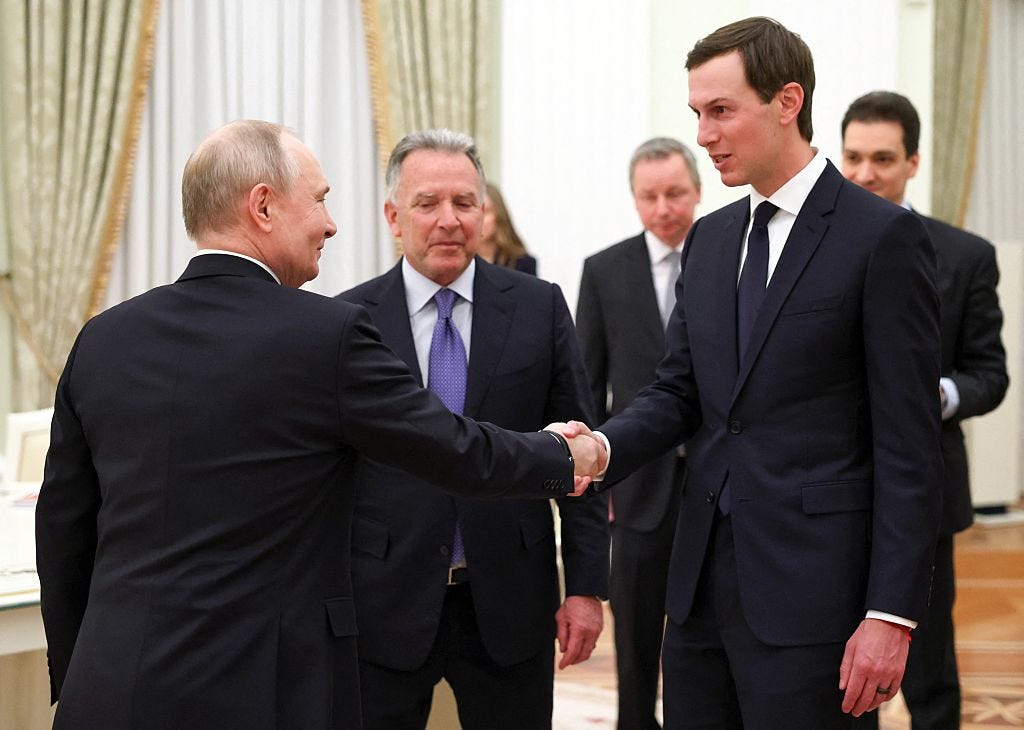
US envoys Jared Kushner and Steve Witkoff hopped over to Moscow from Davos on Thursday to meet with Russian President Vladimir Putin. They arrived just before midnight and I hadn’t seen any indication at time of writing as to how their chat had gone. Maybe they’ll discuss Putin’s offer to put up $1 billion in Russian assets currently frozen in the US as the fee for permanent membership on the Board of Peace. Witkoff has taken to telling reporters that there’s only one remaining issue standing in the way of a Russia-Ukraine peace deal but it’s unclear what that issue is or how far apart the parties are on it. A reasonable guess would be Russia’s demand that Ukraine cede the rest of the Donbas in a settlement, though there are many other possibilities.
AMERICAS
PERU
Current Peruvian interim President José Jerí has only been on the job since October but he may already be on his way out, amid a congressional investigation into alleged secret dealings with Chinese businessmen. There are apparently videos that have surfaced of Jerí meeting with these figures at a restaurant in Lima. He’s offered a legal explanation for those meetings, but the secretive manner in which they were conducted has raised suspicions. He’s apologized for the secrecy and accused his political opponents of trying to topple him ahead of April’s general election. It remains to be seen whether Jerí will face impeachment proceedings but he’s relatively popular for a Peruvian politician these days so ousting him may be a tall order for opposition legislators.
VENEZUELA
The Trump administration has named former ambassador Laura Dogu as its new chargé d’affaires for Venezuela. Since the US and Venezuela have not yet restored full diplomatic relations Venezuelan affairs are currently run out of the US embassy in Colombia and there is no ambassador. Dogu would presumably be in line for that post if/when the two countries restore full relations.
HAITI
The UN envoy for Haiti, Carlos Ruiz, claimed on Thursday that there’s an influx of personnel on the way to bolster the hitherto-undermanned Kenyan-led anti-gang mission in that country. According to Reuters that means the mission, which began in mid-2024, will finally reach its full size of 5500 police “by the summer, or autumn at latest.” I think a “wait and see” attitude would be appropriate here. In the meantime, Haiti’s current interim government is going to see its mandate expire on February 7 and since it hasn’t fulfilled its primary responsibility—organizing elections—there’s no indication what sort of government Haiti will have, if any, starting February 8. The interim executive, the Transitional Presidential Council, is reportedly moving to oust Prime Minister Alix Didier Fils-Aimé before its term expires, though the Trump administration is warning that it would take a dim view of such a move.
CANADA
I’m sorry to report that Canada isn’t going to be on the Board of Peace.
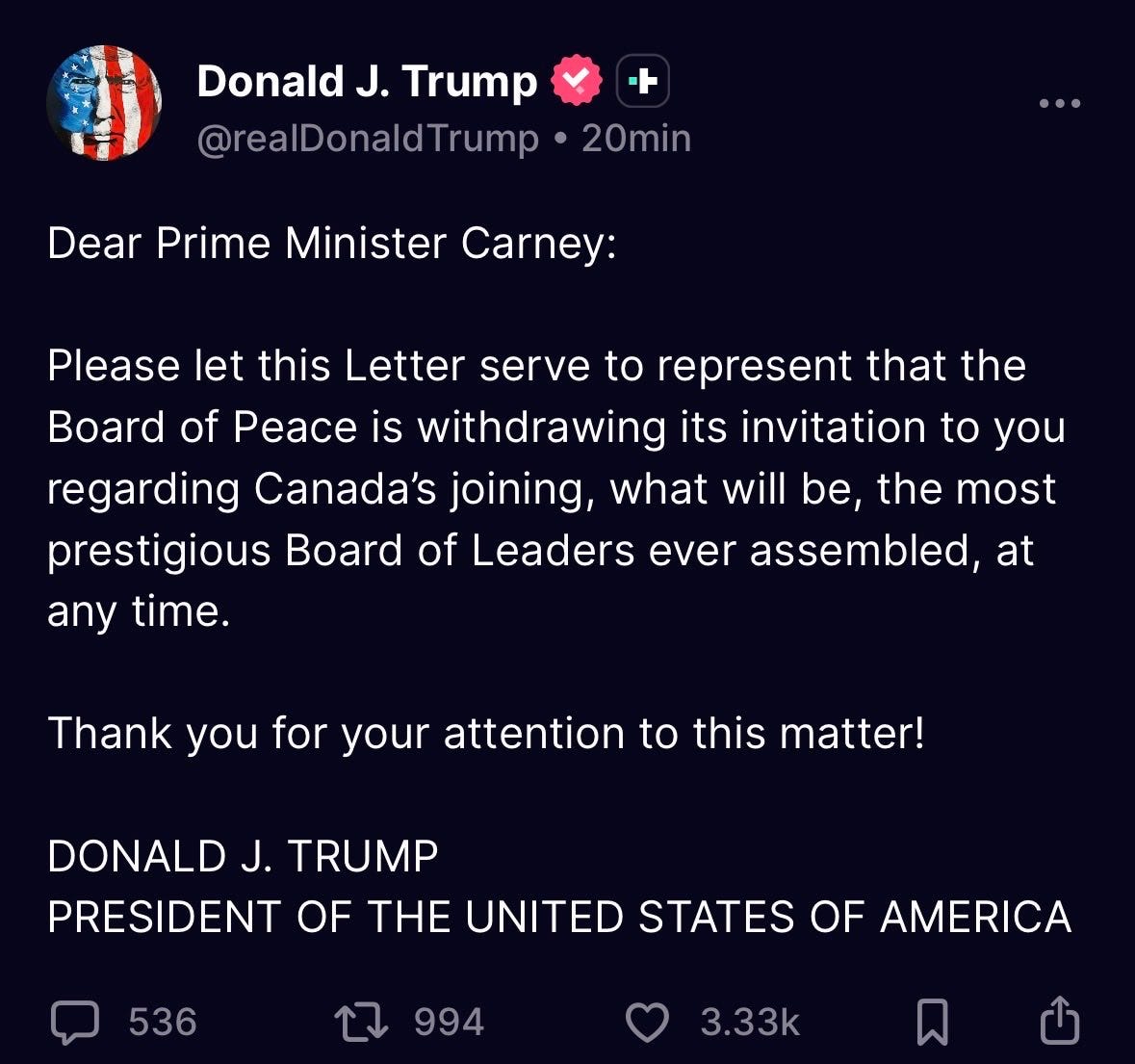
Foreign Exchanges offers its sincerest condolences to all of our Canadian readers in this difficult time.
UNITED STATES
Finally, Wired reports on a likely futile suggestion that could, if implemented, stop AI data centers from frying the planet:
As the world keeps warming and electricity bills take center stage in national politics, the data center boom will drive up US carbon emissions and electricity costs. But a few simple policies could help bring both emissions and prices back down.
That’s the message of a new analysis from the Union of Concerned Scientists released Wednesday, which models a variety of scenarios for how to fuel the coming AI boom. The US is poised to see a 60 to 80 percent increase in electricity demand through 2050, with data centers alone making up more than half of the increase by the end of this decade, the analysis finds. If policies stay the same as they currently are—with attacks on renewable energy being embedded into regulatory regimes and few significant national policies restricting carbon emissions from power plants—we could see between a 19 and 29 percent increase in CO2 emissions from US power plants tied just to the energy needs of data centers over the next 10 years.
There are answers, though: Bringing back tax credits for wind and solar, which were political targets in last year’s One Big Beautiful Bill, would cut CO2 emissions by more than 30 percent over the next decade, even if data centers eat up a significant chunk of new demand for electricity. They could also make wholesale electricity costs go down by about 4 percent by 2050, after a slight rise over the next decade.
Power plants are the second-largest source of greenhouse gas emissions in the US, making up about a quarter of the country’s overall emissions. Last year, emissions from the US power sector rose slightly, marking the first increase since 2023; commercial buildings like data centers, a separate analysis released last week from the Rhodium Group found, were the main drivers of that demand.
It’s likely futile because as soon as wind and solar power enter the picture the Trump administration is no longer interested. Nevertheless it’s good to know that we might have been able to avoid what is probably coming over the next couple of decades.