

You’re reading the web version of Foreign Exchanges. If you’d like to get it delivered straight to your inbox, sign up today:
TODAY IN HISTORY
February 5, 1810: A French army begins the two and a half year Siege of Cádiz, which had by this point in the Peninsular War become the capital of the rump government resisting Napoleon’s occupation of Spain. The defenders managed to hold out until the Duke of Wellington led a British-Portuguese-Spanish army to victory at the Battle of Salamanca in July 1812. Suddenly facing the possibility that his besieging army could be cut off and surrounded, French general Jean-de-Dieu Soult lifted the siege and retreated. The Peninsular War continued until Wellington and the armies of the Sixth Coalition defeated and ousted Napoleon in 1814.
February 5, 1862: Alexandru Ioan Cuza, prince of both Moldavia and Wallachia, becomes Domnitor (Principe Domnitor, “prince regnant”) of the new united nation of Romania. Cuza had de facto joined the two principalities three years earlier, when he came to rule both of them in personal union, but this marks the point at which the name “Romania” was applied to both lands in concert. Both Moldavia and Wallachia were still nominally part of the Ottoman Empire at this time and Romania would not emerge as an independent kingdom until the 1877-1878 Russo-Ottoman War. Cuza was long gone by then, having been ousted in a coup in 1866 and replaced with Carol I of the Hohenzollern-Sigmaringen dynasty.
MIDDLE EAST
LEBANON
The Norwegian Refugee Council says that the Israeli military (IDF) carried out at least 50 manned airstrikes in Lebanon in January, its highest monthly total since its ostensible ceasefire with Hezbollah in November 2024 and twice as many as it conducted the previous month. To be clear that’s manned airstrikes—the far more common IDF drone strikes are not included in that figure. NRC Lebanon director Maureen Philippon argued on Thursday that these strikes, along with “the many ground incursions that continue to happen away from the cameras,” render the ceasefire “little more than ink on paper.”
ISRAEL-PALESTINE
A new investigative report finds that the Trump administration is covertly deporting Palestinians to the West Bank:
The United States is quietly deporting Palestinians arrested by Immigration and Customs Enforcement (ICE) to the occupied West Bank by private jet, with two such flights taking place in coordination with the Israeli authorities since the beginning of this year — part of a secretive and politically sensitive operation revealed through a joint investigation by +972 Magazine and The Guardian.
Eight Palestinian men — shackled for the entire journey by their wrists and ankles — were flown from an ICE deportation hub in Phoenix, Arizona on Jan. 20 and arrived in Tel Aviv the following morning after refueling stops in New Jersey, Ireland, and Bulgaria. After arriving at Ben Gurion Airport, the men were put in a vehicle with an armed Israeli police officer and released at a military checkpoint outside the Palestinian town of Ni’lin in the West Bank.
The same private jet, which belongs to an Israeli-American property tycoon who is a friend and long-time business associate of President Donald Trump, conducted an almost identical journey on Monday this week, but the number of passengers onboard and most of their identities remain unclear.
Deporting someone to an occupied territory where they’re at clear risk of violence either from Israeli security forces or state-backed settler mobs is a violation of the principle of refoulement, under which asylum seekers are not to be sent back if they have credible reason to fear for their safety. Obviously the Trump administration has no use for legal niceties but that doesn’t mean the rest of us should ignore it when they break international law.
In Gaza, Reuters reports that the UAE has drawn up plans for “a compound to house thousands of displaced Palestinians” in the IDF-controlled Rafah region. The “Temporary Emirates Housing Complex” is part of a larger effort to move Gaza’s remaining civilian population into housing facilities on the Israeli side of the “yellow line” to isolate and weaken Hamas. Those facilities could also contain the populace while work theoretically gets underway on Jared Kushner’s proposal to transform the territory into a wholly sanitized techno-resort—or herd civilians out of the way if the Israelis decide to resume military activity against Hamas. There’s little reason to think that the Palestinians living in these camps would have anything approaching freedom of movement under intense IDF supervision, though anyone who wants to leave Gaza would presumably have no trouble getting the Israelis to facilitate that.
YEMEN
Now that it’s effectively undermined the UAE’s position in southern Yemen, the Saudi government is reportedly stepping in with its checkbook open to try to increase its own control over the region. Riyadh has allocated some $3 billion to pay public sector salaries in southern Yemen this year, one-third of it devoted to paying the remnants of the Southern Transitional Council whose fighters used to be on the Emirati payroll. The aim is to bring those fighters firmly under the control of Yemen’s internationally recognized government (a Saudi subsidiary) and then to build up the southern military so as to force the Houthis in northern Yemen to resume peace talks to avoid conflict.
Saudi officials are also offering to let the separatists hold a referendum on southern Yemeni independence, but under their auspices and only if/when the Houthi conflict is settled. They’re aiming to achieve that by the end of this year, which seems wildly ambitious but what do I know?
IRAN
At time of writing, US and Iranian delegations, led respectively by envoys Jared Kushner and Steve Witkoff and Foreign Minister Abbas Araghchi, were either on their way to Oman or had already arrived ahead of Friday’s planned negotiations. It would appear, at least for now, that the Trump administration has been swayed by Arab lobbying to agree to meet Iranian demands regarding the location (Oman rather than Turkey) and scope (nuclear only vs. wide-ranging) of these talks, but how long that flexibility is going to last likely depends on whether the parties make any meaningful progress on Friday and how intent Donald Trump really is on attacking Iran. There’s some speculation that he’s more reluctant to start a conflict than his recent public posturing might suggest, but we’ll see.
ASIA
PAKISTAN
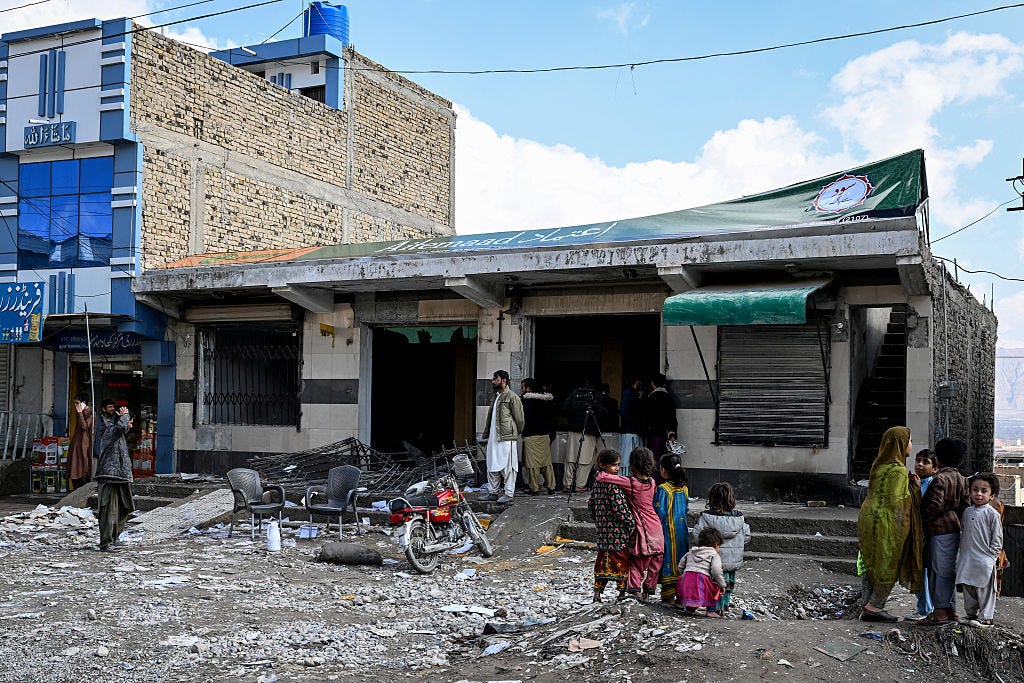
The Pakistani military said on Thursday that the counterterrorism operation it began over the weekend, following a series of militant attacks across Baluchistan province, is finally over. The Baluchistan Liberation Army, on the other hand, says its operations are ongoing. Pakistani military authorities claim that their security forces have killed at least 216 BLA fighters since Saturday, while the deaths of 22 security personnel and 36 civilians in the conflict take the overall toll past 250. The Pakistani Interior Ministry has tallied the deaths of 45 security personnel and 40 civilians. BLA officials claim their fighters killed more than 310 Pakistani soldiers. Pakistani officials, as they are wont to do in these sorts of situations, are alleging that the Indian government was involved in the BLA offensive, a charge that Indian officials have rejecte.
MYANMAR
Myanmar’s Union Election Commission has declared the military cutout Union Solidarity and Development Party (USDP) the official winner of the country’s recently concluded general election, and needless to say it wasn’t close. Of the 1025 national and provincial legislative seats that were up for grabs in this contest, the USDP won a very simple and believable 739 of them. With the National League for Democracy barred from participating the rest of the parties amounted to also-rans. United Nations rapporteur Tom Andrews called the election a “theatrical performance.”
The composition of Myanmar’s new/old government is in a bit of flux after the ruling junta created a new body earlier this week called the “Union Consultative Council,” whose remit is to “oversee” the country’s civilian government and military. Junta leader Min Aung Hlaing will presumably chair that council, which could give him paramount authority over both institutions. He’s also expected to make himself president when the USDP-controlled parliament opens its new session next month, though he may not need to assume that office if the council chair will supersede it.
AFRICA
SUDAN
In Sudan-related news:
Rapid Support Forces militants attacked another hospital in Sudan’s South Kordofan state on Thursday, killing at least 22 people. The hospital is located in al-Kiwek, situated a bit north of the city of Kadugli. The Sudanese military relieved that formerly besieged city earlier this week and has been on the offensive in the Kordofan region over the past couple of weeks.
The Integrated Food Security Phase Classification issued an alert regarding famine conditions in the Um Baru and Kernoi areas of Sudan’s North Darfur state on Thursday. This is not an official declaration of famine conditions but does mean that the latest data that the IPC has collected from those areas indicates that malnutrition has crossed the famine threshold.
The Sudan Tribune reports that the RSF and Sudan People’s Liberation Army-North are massing forces near the town of Kurmuk in southeastern Sudan’s Blue Nile state. They captured the nearby Deim Mansour area earlier this week and if they take Kurmuk they may be able to move against the provincial capital, Ad-Damazin.
MALI
World Politics Review’s Elliot Waldman notes that the Trump administration is “quietly” softening the US position toward the military junta in Mali and the neighboring Sahel states:
Last Friday evening, the State Department quietly announced in a social media post that its senior diplomat for Africa, Nick Checker, was traveling to Bamako “to convey the United States’ respect for Mali’s sovereignty and desire to chart a new course in the bilateral relationship and move past policy missteps.” The statement added that Washington looks forward to engaging with other governments in the region, specifically Burkina Faso and Niger, “on shared security and economic interests.”
In one sense, the department is formally declaring a stark change in policy. After a succession of coups overthrew civilian governments in Mali, Burkina Faso and Niger between 2020 and 2023, the U.S. under President Joe Biden suspended high-level diplomatic engagements with the new juntas and put on hold most economic and security assistance to those countries.
But in reality, the announcement just said the quiet part out loud. President Donald Trump’s administration has for months been resetting ties with West Africa’s military regimes, based on what analysts say is a quid pro quo by which the U.S. offers help in fighting violent jihadist groups in the region in exchange for access to minerals deposits in the three countries, including gold, lithium and uranium.
(Foreign Exchanges readers can sign up for WPR’s free newsletter here and try out an all-access subscription free for 30 days, then $35 off—$77/year—after that.)
ETHIOPIA
According to AFP the sprawling rivalry between Saudi Arabia and the UAE is spreading to Ethiopia, where Prime Minister Abiy Ahmed has made himself an Emirati client after accepting a $3 billion UAE loan in 2018 and an $800 million currency swap in 2023. The Sudanese military’s recent accusations about Ethiopian support for the RSF are presumably rooted in that UAE connection, since the Emiratis are the RSF’s biggest backer. Meanwhile, with Ethiopia’s relationships with Egypt and Eritrea under considerable strain both of those governments have sought to improve both their bilateral ties and their relationships with the Saudis.
EUROPE
RUSSIA
New START, the last surviving nuclear arms treaty between the US and Russia, expired on Thursday as expected. However, there may be some new hope for a successor. Barak Ravid at Axios reported that US and Russian negotiators had agreed or were close to agreeing on a “draft plan” to continue observing New START’s terms despite its expiration while the two countries negotiate a successor treaty. This would not be a formal extension but more of a “good faith” endeavor. It hasn’t been approved by either Donald Trump or Vladimir Putin yet.
Those US and Russian negotiators also agreed to resume military-to-military contact between the two countries. The Biden administration had ceased that dialogue shortly before the 2022 Russian invasion of Ukraine
UKRAINE
These US-Russian breakthroughs, or potential breakthroughs, were reached on the sidelines of the second round of trilateral talks in Abu Dhabi on ending the Ukraine war. As it happens those negotiations did not end with any sort of breakthrough regarding their intended purpose. The parties did agree to a prisoner swap involving 157 people on each side, which is not nothing but they’ve exchanged prisoners before and the war continues. Responsible Statecraft’s Connor Echols suggests that a better US-Russia relationship might help unlock progress in these negotiations but that very much remains to be seen.
AMERICAS
CUBA
UN Secretary-General Antonio Guterres warned on Wednesday of an impending humanitarian “collapse” if the US maintains its blockade on oil shipments to the island. Fuel shortages are starting to mount, which translates into longer and more frequent blackouts. Cuban President Miguel Díaz-Canel told state media on Thursday that he is “willing to engage in dialogue with the United States,” but said that it must be “without pressure or preconditions” and “from a position of equals, with respect for our sovereignty, our independence and our self-determination.” There is no reason to think that Donald Trump would be satisfied with those conditions.
UNITED STATES
Finally, TomDispatch’s William Astore ponders Donald Trump’s dream of a $1.5 trillion US military budget:
Of course, U.S. warmongering is anything but new, as is a belief in global dominance through high military spending. Way back in 1983, as a college student, I worked on a project that critiqued President Ronald Reagan’s “defense” buildup and his embrace of pie-in-the-sky concepts like the Strategic Defense Initiative (SDI), better known as “Star Wars.” Never did I imagine that, more than 40 years later, another Republican president would again come to embrace SDI (freshly rebranded as “Golden Dome”) and ever-more massive military spending, especially since the Soviet Union, America’s superpower rival in Reagan’s time, ceased to exist 35 years ago. Amazingly, Trump even wants to bring back naval battleships, as Reagan briefly did (though he didn’t have the temerity to call for a new class of ships to be named after himself). It’ll be a “golden fleet,” says Trump. What gives?
For much of my life, I’ve tried to answer that very question. Soon after retiring from the U.S. Air Force, I started writing for TomDispatch, penning my first article there in 2007, asking Americans to save the military from itself and especially from its “surge” illusions in the Iraq War. Tom Engelhardt and I, as well as Andrew Bacevich, Michael Klare, and Bill Hartung, among others, have spilled much ink (symbolically speaking in this online era) at TomDispatch urging that America’s military-industrial complex be reined in and reformed. Trump’s recent advocacy of a “dream military” with a proposed budget of $1.5 trillion in 2027 (half a trillion dollars larger than the present Pentagon budget) was backed by places like the editorial board of the Washington Post, which just shows how frustratingly ineffectual our efforts have been. How discouraging, and again, what gives?
Sometimes (probably too often), I seek sanctuary from the hell we’re living through in glib phrases that mask my despair. So, I’ll write something like: America isn’t a shining city on a hill, it’s a bristling fortress in a valley of death; or, At the Pentagon, nothing succeeds like failure, a reference to eight failed audits in a row (part of a 30-year pattern of financial finagling) that accompanied disastrous wars in Vietnam, Afghanistan, Iraq, and elsewhere. Such phrases, no matter how clever I thought they were, made absolutely no impression when it came to slowing the growth of militarism in America. In essence, I’ve been bringing the online equivalent of a fountain pen to a gun fight, which has proved to be anything but a recipe for success.
In America, nothing — and I mean nothing! — seems capable of reversing massive military spending and incessant warfare. President Ronald Reagan, readers of a certain (advanced) age may recall, was nicknamed the “Teflon president” because scandals just didn’t seem to stick to him (at least until the Iran-Contra affair proved tough to shed). Yet history’s best candidate for Teflon “no-stick” status was never Reagan or any other president. It was and remains the U.S. warfare state, headquartered on the Potomac River in Washington, D.C. And give the sclerotic bureaucracy of that warfare state full credit. Even as the Pentagon has moved from failure to failure in warfighting, its war budgets have continued to soar and then soar some more.
Forgive the repetition, but what gives? When is our long, national nightmare of embracing war and (wildly overpriced) weaponry going to end? Obviously, not anytime soon. Even the Democrats, supposedly the “resistance” to President Trump, boast openly of their support for what passes for military lethality (or at least overpriced weaponry), while Democratic members of Congress line up for their share of war-driven pork. To cite a cri de coeur from the 1950s, have they no sense of decency?