

You’re reading the web version of Foreign Exchanges. If you’d like to get it delivered straight to your inbox, sign up today:
TODAY IN HISTORY
February 2, 1982: The Syrian army under Rifaat al-Assad, brother of Syrian leader Hafez al-Assad, begins a month-long siege of the city of Hama intended to suppress a Muslim Brotherhood-led uprising there. By the time the siege ended on February 28, Rifaat’s forces had killed perhaps as many as 40,000 people in what is now known as the “Hama Massacre.”
February 2, 1943: The remnants of the German Sixth Army surrender to the Soviets, ending the Battle of Stalingrad a bit over five months after it started. The combined Axis army that attacked Stalingrad suffered upwards of 1 million casualties as well as the loss of thousands of vehicles, the initiative on World War II’s Eastern Front, and the sense of inevitability that previous Axis victories had created. The battle served as a turning point, after which it would be the Red Army, not the Axis, that was on the offensive.
February 3, 1509: A Portuguese fleet wins a decisive victory over a combined Mamluk/Gujarati armada at the Battle of Diu. After they’d struggled to gain an Indian foothold following the arrival of Vasco da Gama to the subcontinent in 1498, Diu confirmed that the Portuguese weren’t going anywhere and was a definite blow to the Mamluk-Venetian control of the Red Sea spice trade.
February 3, 1966: The unmanned Soviet spacecraft Luna 9 becomes the first man-made object to make a soft, recoverable landing on the moon. The craft then sent back a series of photographs of the lunar surface before losing contact on February 6.
MIDDLE EAST
SYRIA
The Syrian government-Syrian Democratic Forces integration process has advanced significantly over the past couple of days, as SDF fighters escorted Syrian Interior Ministry security forces into the cities of Hasakah on Monday and Qamishli on Tuesday. These deployments are “limited,” according to SDF leader Mazloum Abdi, and do not include any Syrian military forces in keeping with the agreement the two sides announced on Friday. Hasakah and Qamishli are two of the largest cities within the SDF’s previously autonomous administration so this is a major step toward bringing that region under Damascus’s control. Syrian security forces have also deployed around the city of Kobani but it’s unclear whether they will be entering it. Oil fields, border checkpoints, and other facilities across northeastern Syria are to be turned over to Damascus within the next ten days.
LEBANON
The Israeli military (IDF) killed at least one person across multiple airstrikes in Lebanon on Monday. It wounded at least eight people in two of those attacks. The previous day its aircraft sprayed an “unknown chemical substance” over areas along the “Blue Line” that serves as the de facto Lebanese-Israeli border, according to the United Nations, after ordering UN peacekeepers to withdraw from their positions. Israeli officials claimed that the substance was nontoxic but UN and Lebanese personnel collected samples for testing. UN officials say that this is not the first time the IDF has done something like this.
ISRAEL-PALESTINE
It seems fair to say that Monday’s reopening of the Rafah checkpoint did not go as many people expected, though in once sense it was probably predictable. Amid hope that reopening Rafah would allow Gaza residents in need of medical care to leave the territory in order to obtain it, just five medical evacuations took place on Monday due to what Al Jazeera called “tight security restrictions and a complex bureaucratic process.” Maybe that can be chalked up to first-day snafus, but there are an estimated 20,000 people awaiting medical evacuation from the territory so the pace needs to pick up substantially to meet the demand. Israeli authorities allowed one bus to enter Gaza carrying 12 returning Palestinians on Tuesday, so even their effort to engineer a higher number of departures than entrances isn’t going according to plan so far.
At Drop Site, Jonathan Whittall has published several photographs that he took while on a UN fact-finding mission to Gaza in early 2024. That’s the mission whose findings were written up in a US Agency for International Development memo that senior Biden administration officials then suppressed because of its legal and political implications. Whittall describes what the team saw as “an endless horizon of destruction” and you can get a glimpse of that from his photos. Additionally, The Nation turned its entire site over to stories from and about Gaza on Tuesday and I would urge you to head there to read those accounts.
IRAN
Iranian President Masoud Pezeshkian confirmed on Tuesday that he has given the green light to reopening negotiations with the Trump administration, provided that they remain “free of threats” as AFP put it. Then followed a flurry of activity that once again raised fears of a conflict. In the most serious incident, a US F-35 reportedly shot down an Iranian Shahed-139 drone that, according to the Pentagon, was “aggressively” approaching the USS Abraham Lincoln aircraft carrier in the Arabian Sea. Prior to that, Islamic Revolutionary Guard Corps naval forces reportedly tried to interdict a US-flagged oil tanker in the Strait of Hormuz. The tanker refused the order and gained a US naval escort shortly after. Neither of these incidents appears to have derailed plans for the talks but either easily could have, and I would argue that there is a possibility that personnel within the IRGC were/are trying to scuttle the talks.
Of potentially greater significance there are reports that the details around the negotiations are still in a great deal of flux. Barak Ravid claimed that Iranian officials are “walking back” previously agreed “understandings” regarding the location of the talks—the Iranians want to shift them from Turkey to Oman—and the format—they want bilateral negotiations rather than including regional “observer” delegations. They also want to limit the negotiations to nuclear-related issues rather than bringing in US demands around Iran’s missile program and its regional activities. Ravid may have sensationalized things, and a “senior Iranian official” later denied his report in a comment to the International Crisis Group’s Ali Vaez. A report from Al-Monitor’s Ezgi Akin more or less aligns with Ravid’s reporting on the substance, but I think what the Iranians are disputing is that any of these details had in fact been “previously agreed.”
This hemming and hawing about the nature of the talks may also reflect discord within the Iranian government, with those in the security establishment or within Supreme Leader Ali Khamenei’s orbit demanding some perceived concession from the US ahead of time. I haven’t seen any reaction from the Trump administration as yet and there is a possibility that the eventual response will come in the form of airstrikes. If the administration is really interested in negotiations the most effective response may be nothing at all—just continue to plan for multilateral talks in Istanbul later this week. But the issue of scope could be very serious. Trying to negotiate every grievance all at once could be an impossible task. Iranian officials understandably view their proxy networks and (especially now) their missiles as the only things standing between them and constant attacks from Israel, so getting them to give up either is a tall order to say the least. The logic behind the 2015 nuclear deal was to start with that issue and then with time and greater trust other grievances could be tackled in turn. That might have worked, had Donald Trump not wrecked the nuclear deal during his first term.
ASIA
PAKISTAN
As of Monday Pakistani authorities were claiming that their security forces had killed at least 177 Baluch militants over a 48 hour crackdown following Saturday’s coordinated Baluchistan Liberation Army attacks. Pakistani police and military forces conducted raids across Baluchistan province in the wake of those attacks and killed at least 22 more alleged militants overnight to reach that lofty total.
INDIA
The US and Indian governments announced a new trade deal on Monday under which, according to Donald Trump, the current 50 percent US tariffs on Indian products will be reduced to 18 percent while New Delhi has agreed to stop purchasing Russian oil (replacing it with US and/or Venezuelan oil) and eliminate tariffs on US products. Apparently all it took was a phone call between Trump and Indian Prime Minister Narendra Modi to secure the agreement. Trump had heavily punished India during his tariff spree last year, citing its status as a major Russian oil and weapons client. The dispute helped to thaw the hitherto frosty Indian-Chinese relationship, as Modi cast around for new trade partners.
Full, confirmed details of the agreement beyond what Trump is claiming are still unavailable as far as I know, which means there’s still some question as to what Modi actually conceded. In fact it could be argued that he hasn’t conceded anything yet, since nothing is official until there’s a signed deal in place. Nevertheless Modi already appears to be taking domestic criticism both for swapping out discounted Russian oil for more expensive US energy exports and for possibly agreeing to open India’s agricultural sector up to genetically modified US products.
CHINA
Sticking with the theme of sanctioned oil, The Diplomat’s Nik Foster argues that the Chinese government’s penchant for buying it is starting to look like a risky gambit:
The toppling of [Venezuelan President Nicolás] Maduro shows that these arrangements of purchasing discount oil from pariah states are inherently risky. For China’s broader oil market, the impacts of the Trump administration’s removal of Maduro will likely be negligible in the short term. Venezuela accounted for only around 4 percent of oil imported by China in 2025. There is also a glut of crude in storage and weak global demand, which will soften the near-term blow of the Venezuelan oil moving away from the Chinese market.
Yet in China, there is a small, albeit important sector of the economy that could become the first victim of the ongoing regime change in Venezuela. Most of Venezuela’s heavy crude fed so-called “teapot” refineries – independent, non-state-owned refiners, mostly located in Shandong Province. These smaller refineries, known as teapots, purchase crude oil at discount prices as they are purchasing sanctioned goods. Teapot refineries typically operate on thin margins, lack long-term supply contracts, depend on spot cargoes, and provide fuel fare. That leaves them the most exposed to sanctioned-barrel volatility because their economics often depend on access to discounted oil.
Teapots are critical to China’s downstream economy, refining diesel for trucking firms, logistics companies, farmers, and construction, jet fuel for the domestic aviation market, petrochemical feedstock for fertilizers, textiles, plastics, and lubricants, and fuel oil for infrastructure, shipping, and heavy industry end users.
If the teapot refinery sector starts to falter, he argues, the knock-on effects in terms of higher costs and unemployment could be outsized compared with that relatively small amount of Venezuelan oil that Beijing has been importing. And if something similar were to happen in terms of Iranian and/or Russian oil exports that could really be painful for the Chinese economy.
JAPAN
A Japanese research vessel has scraped sediment from the ocean floor at a depth of some 6000 meters around the Pacific island of Minamitorishima, in a first-of-its-kind test of the potential for sea mining rare earth minerals. The sample will be analyzed for rare earth content. Sea floor mining has been viewed, particularly by Western or West-adjacent nations, as a way to unlock vast (theoretically) mineral deposits outside the current Chinese-dominated supply chain. Its economic viability, geopolitical implications, and environmental impacts have yet to be determined.
AFRICA
SUDAN
The Sudanese Armed Forces announced on Sunday that it has opened a road into the city of Kadugli, capital of South Kordofan state, breaking through an over two-year siege by the Rapid Support Forces group and the Sudan People’s Liberation Army-North. This is the SAF’s second major advance in South Kordofan in as many weeks, following its entry into the similarly besieged town of Dalang. Assuming the RSF isn’t able to reverse these gains and the SAF can build on them to strengthen its overall position in Kordofan, this may wind up being another turning point in Sudan’s civil war. An RSF drone strike on Kadugli killed at least eight people later on Tuesday.
Elsewhere, the RSF and SPLA-N have reportedly seized the town of Deim Mansour in southeastern Sudan’s Blue Nile state. The allied militant groups launched a new offensive in that province late last month and to my knowledge this is their most significant advance so far. The RSF may now move on the nearby town of Kurmuk. Sudanese military officials are accusing the Ethiopian government of facilitating this offensive, though if they’ve offered evidence of that I’m unaware of it. The Sudan Tribune is also reporting that a “high-ranking” RSF officer and the leader of an allied local tribe were both killed, along with at least three other people, in some sort of clash in East Darfur state that took place on Sunday. Details are sketchy but it seems the tribal leader arrested several RSF fighters and accused them of collaborating with the SAF, sparking the violence.
All of this fighting comes as US envoy Massad Boulos told the audience at a Sudan Humanitarian Fund event in Washington on Tuesday that both the SAF and the RSF have agreed “in principle” to adopt a UN “mechanism” under which combatant forces would withdraw from several Sudanese cities in order to allow civilians to return to their homes. Among those cities would be the North Darfur capital, Al-Fashir, which the RSF seized in November and where it appears to have carried out a massacre whose full extent remains unknown. Boulos is hoping they will have an agreement on paper by the start of the Muslim holy month of Ramadan on February 17. He also said that the “Quad” (the US, Egypt, Saudi Arabia, and the UAE) have agreed on a “comprehensive peace plan,” though of course that means nothing without the combatant parties agreeing to it.
LIBYA
Three “Libyan National Army” fighters were killed in a clash with what LNA officials called “mercenary groups and outlawed terrorist gangs” near the Nigerien border on Saturday. They may have been jihadists though there’s no real information apart from what the LNA has claimed and that’s somewhat vague. According to AFP there is some “unverified” video footage circulating online in which the mystery militants claim to be “fighters and revolutionaries from the south.”
In a surprising development Saif al-Islam Gaddafi, son and one-time heir apparent of former Libyan leader Muammar Gaddafi, has been killed. His political advisers are claiming that “four masked men” gunned him down in his home in the Libyan city of Zintan. There’s not much more information beyond that.
ETHIOPIA
The International Crisis Group’s Magnus Taylor discusses the recent violence in northern Ethiopia’s Tigray region:
Northern Ethiopia’s Tigray region has seen renewed fighting, sparking concerns that a return to war could be on the cards. On 26 January, the Tigray Defence Forces (TDF), the armed wing of Tigray’s ruling party (the Tigray People’s Liberation Front or TPLF), moved into the disputed territory of Tselemti in north-western Tigray, clashing with federal troops and militias from the neighbouring Amhara region. Then, on 29 January, the TDF entered Korem and Alamata in southern Tigray’s Raya district, another contested area, without apparent federal resistance.
The government responded by cancelling all flights to Tigray. On 31 January, it reportedly carried out drone strikes on two vehicles in the central part of the region. The next day, Tigray’s leader, Tadesse Werede complained that Addis Ababa had started “something resembling an all-out war”, and announced that the TDF would withdraw from Tselemti to de-escalate.
Even if it does so, however, the sudden flare-up spiked fears that Tigray is sliding back toward conflict, after having been the centre of a devastating civil war from 2020-2022.
DEMOCRATIC REPUBLIC OF THE CONGO
M23 militants carried out a drone strike over the weekend on the airport in the city of Kisangani, capital of the eastern DRC’s Tshopo province. Corneille Nangaa, leader of M23’s political parent group the Congo River Alliance, claimed responsibility for the strike on Tuesday and said that it proved that the Congolese military no longer has air superiority. There are no reports of either casualties or serious damage. The Qatari government, which has been mediating peace talks between M23 and the Congolese government, claimed on Monday that the UN is sending a ceasefire monitoring group to the Congolese city of Uvira though we’ll see if this drone strike affects those plans.
EUROPE
RUSSIA
Barring some last-minute reprieve New START, the 2010 accord that is currently the only treaty governing the US and Russian nuclear stockpiles, will lapse on Thursday. Russian President Vladimir Putin proposed a one year extension back in September and Donald Trump at the time said it “sounds like a good idea,” but that’s apparently as far as the discourse went. In January Trump talked about negotiating “a better deal” to replace New START but there’s nothing on the table and no negotiations are planned, so at this point a new arms race seems more likely.
UKRAINE
Whatever agreement Trump and Putin made to pause Russian attacks on Ukrainian cities and infrastructure is clearly over, after an overnight Russian bombardment targeted Kyiv and other cities and especially targeted the Ukrainian electrical grid. Russian officials had said that the one week reprieve the two leaders discussed ended on Sunday. On Monday the Russian military claimed the capture of another village in Ukraine’s Zaporizhzhia oblast.
AMERICAS
VENEZUELA
Interim Venezuelan President Delcy Rodríguez met with US chargé d’affaires Laura Dogu in Caracas on Monday. It doesn’t sound like they broke any major new diplomatic ground but the meeting itself is noteworthy. Dogu should be in line to become ambassador if/when the two countries fully normalize relations.
COLOMBIA
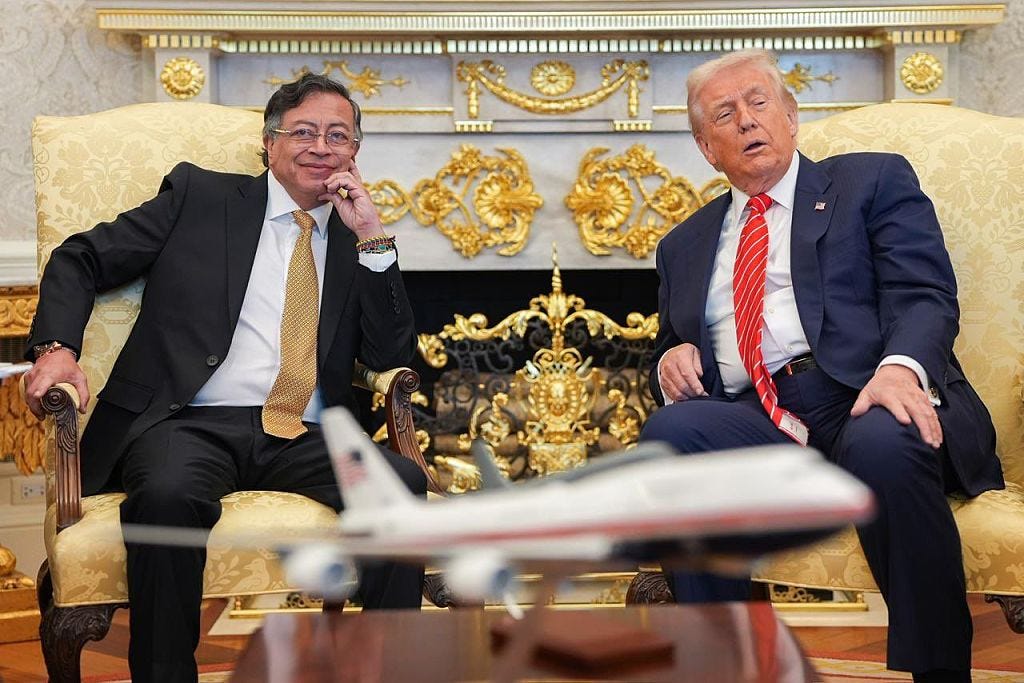
Donald Trump hosted Colombian President Gustavo Petro at the White House on Tuesday, which likewise doesn’t seem to have resulted in any major developments but is noteworthy on its own given that just about a month ago Trump was threatening to do to Petro what he did to Nicolás Maduro. After their meeting Trump called Petro “terrific” and apparently they agreed to collaborate on interdicting drug trafficking and containing any violence stemming from the chaos around Maduro’s ouster in neighboring Venezuela. Petro seemed similarly pleased with how the encounter went.
COSTA RICA
Right-wing populist Laura Fernández won Costa Rica’s presidential election on Sunday, taking around 48 percent of the vote to finish well ahead of runner up Álvaro Ramos at around 33 percent. Since she took more than 40 percent of the vote Fernández won outright in the first round without the need for a runoff. Her Sovereign People’s Party (PPSO) looks to have won an outright majority in the Legislative Assembly election but fell short of the supermajority that it was seeking.
CUBA
Mexican President Claudia Sheinbaum promised on Sunday to send humanitarian aid to Cuba this week, though she stopped short of committing to send any oil to the island. Donald Trump’s tariff threats appear to have intimidated the Mexican government into halting oil shipments to Cuba, leaving it completely without suppliers now that Venezuela is also not an option. Sheinbaum said only that she’s aiming to “diplomatically solve everything related to the oil shipments (to Cuba) for humanitarian reasons.”
UNITED STATES
Finally, the US dollar declined sharply in value last week, and while it’s recovered a bit since then it is still down considerably from where it was one year ago. While a weaker dollar is something Donald Trump has sought, it may not be great news economically given that it likely means higher prices and interest rates for Americans. Trump’s argument is that a weaker dollar will make US products cheaper overseas and thus boost exports, but Foreign Policy’s Keith Johnson suggests that the effect might not be all that significant:
There are a lot of non-currency barriers to greater U.S. exports. Consumer preferences are famously one: Oversized SUVs and light trucks are not prized in Europe or Japan. Regulatory restrictions are another, as with many limits on agricultural exports, whether to Europe or Asia. And then there are geopolitical barriers, such as the trade war that Trump intensified with China not once but twice, which resulted in the loss of the main export outlet for the huge U.S. agricultural sector. U.S. agricultural exports to China fell from $36 billion in 2022 to $16 billion in 2025, and they are still falling.
The other problem with hoping that a cheap dollar will drive increased exports is that it takes things to make things, and one-third of the things that it takes (inputs for manufacturing) are themselves imported. Since those inputs are getting more expensive, due both to a weaker dollar and the self-imposed import duties on nearly every country in the world, there is less benefit than meets the eye, especially for industries such as pharmaceuticals, aerospace, cars and trucks, and petroleum products.
And then there is the stubborn math of the U.S. trade balance, which registers $1 trillion more imports than exports every year. With a weaker dollar, all those imports will be more expensive. And while the Trump administration would be happy to see them disappear, many imports are necessary (the U.S. oil patch genuinely needs imported tubes and pipes; European pharmaceuticals simply do not have U.S. equivalents yet) and cannot be jettisoned.