

You’re reading the web version of Foreign Exchanges. If you’d like to get it delivered straight to your inbox, sign up today:
TODAY IN HISTORY
March 5, 363: The Roman Emperor Julian, later dubbed “Julian the Apostate” since he converted from Christianity to paganism and has the distinction of being the last non-Christian Roman ruler, leads his army east to invade the Sasanian (Persian) Empire. Later Roman invasions of Persia generally turned out to be mistakes, and although Julian showed some military aptitude he proved to be a poor strategist and so this campaign was no exception to that rule. After some initial successes, Julian gave up his plan to besiege Ctesiphon and instead he led his army on an aimless march through Mesopotamia, harassed the whole way by Persian forces. He died of wounds suffered in the Battle of Samarra in June. The army chose his successor, a general named Jovian who ordered a prompt retreat back to Roman territory and surrendered Mesopotamia to the Persians.
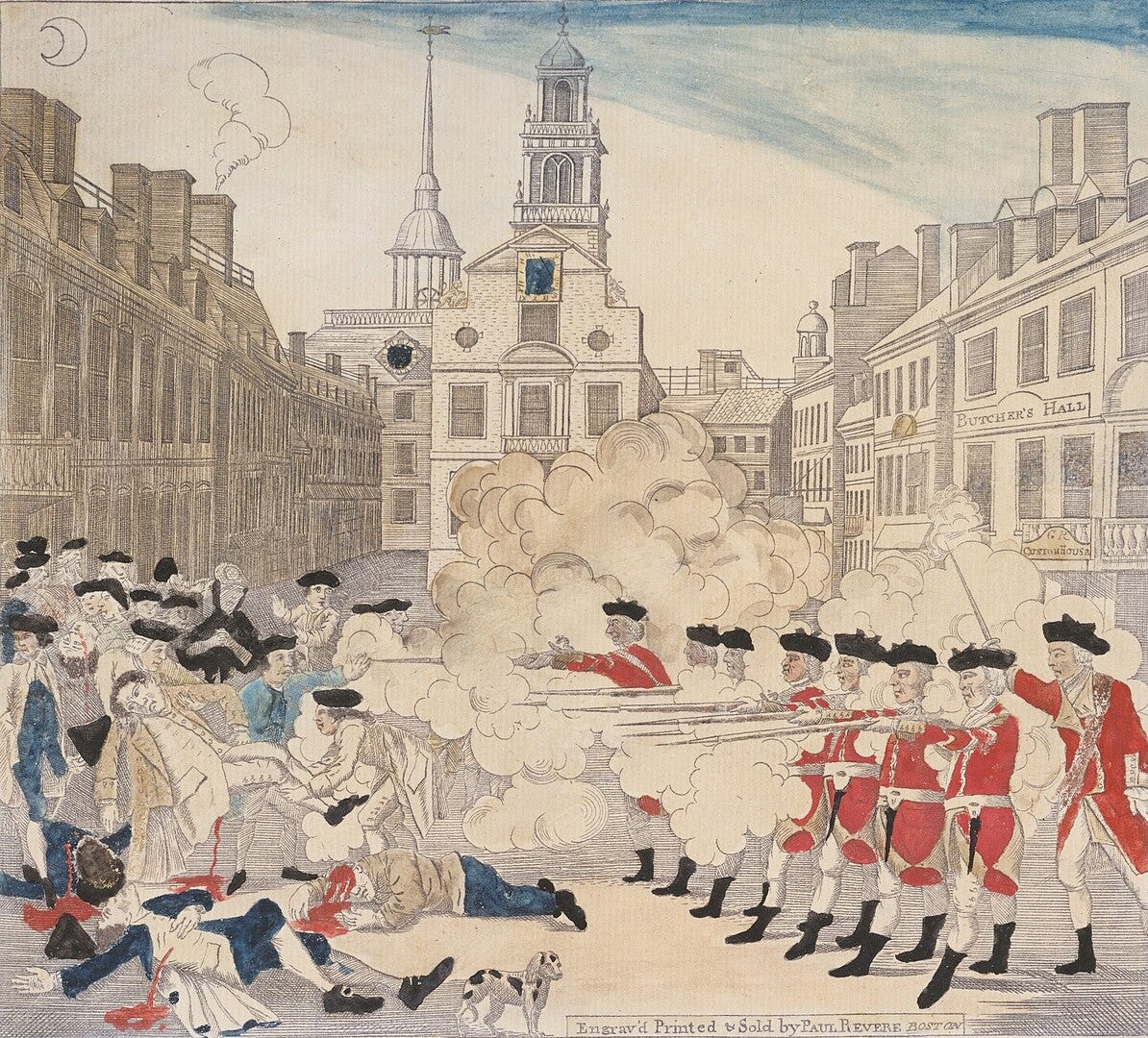
March 5, 1770: British soldiers, confronted by an angry mob in the city of Boston, open fire on the crowd, killing five people and wounding another six in an incident that became known as the “Boston Massacre.” Although it took place five years before the start of the American Revolution, popular imagination has closely linked the massacre to the war. Crispus Attucks, said to have been the first person killed when the shooting began, became immortalized as the first person killed in the Revolution.
MIDDLE EAST
LEBANON
The Israeli military (IDF) killed at least ten people across Lebanon on Thursday after issuing evacuation orders for southern Beirut and its suburbs. This is in addition to the evacuations it ordered for much of southern Lebanon the previous day. The civilian toll here is rising quickly, with the Lebanese Public Health Ministry reporting that the IDF has killed at least 102 people and wounded 632 more since Monday while displacing some 83,000. Around 38,000 are believed to have crossed into Syria, though most of those were likely Syrian nationals. With the IDF likely planning to increase its ground presence in southern Lebanon Reuters is reporting that Hezbollah has deployed its Radwan “special forces” fighters to that region. The group had pulled those personnel out of southern Lebanon under its 2024 ceasefire with Israel.
Israeli officials are now claiming that “several dozen” officers in Iran’s Islamic Revolutionary Guard Corps, primarily advisers to Hezbollah, are fleeing Lebanon in fear of being targeted by IDF strikes. The Israeli government issued a warning to Iranian officials in Lebanon earlier this week and on Thursday Lebanese Prime Minister Nawaf Salam issued an order on Thursday to prevent IRGC action and potentially deport any IRGC personnel in the country.
ISRAEL-PALESTINE
Israeli treatment of the Palestinians has quickly become an afterthought because of the Iran war, but The New Arab helpfully recaps what Israeli authorities have been doing “to wreak havoc in both Palestinian territories.” They’ve continued daily killings in Gaza, including at least two people on Wednesday, while settler violence in the West Bank seems to be escalating with Israeli state acquiescence and under cover of the war. Additionally the Israeli government has restricted access to al-Aqsa mosque for “security reasons.” That’s particularly punitive right now, when the site would typically be very active during Ramadan.
IRAN
The Intercept’s Nick Turse offers an update on the Trump administration’s war “planning” that manages to be both unsurprising and yet still very disturbing:
The Trump administration’s war on Iran is reckless and ill-planned, four government officials briefed on the attacks told The Intercept.
Even in classified briefings, Trump administration officials laid out no clear vision for the U.S. war on Iran or its aftermath, the sources said.
“The administration doesn’t have a clue. They do not have an actual, real rationale, endgame, or plan for the aftermath of this,” one of the officials, who spoke on the condition of anonymity to discuss classified matters, told The Intercept.
“There is no thought process into what any of this means long term,” said another. “It’s not coordinated regime change. It’s just ‘bomb them until they’re less of a threat.’”
Asked about the administration’s plan for Iran after the war, that official responded: “Whatever.”
In other items:
Donald Trump exclusively told both Reuters and Axios on Thursday (which means it wasn’t “exclusive,” but I digress) that he is expecting to help select the next leader of Iran. This seems somewhat presumptuous under the circumstances. Trump is clearly unhappy with reports that Ali Khamenei’s son, Mojtaba, is the favorite to succeed his father as supreme leader. He also still appears to be clinging to the notion that he can deal with Iran in the same way he dealt with Venezuela a couple of months ago, despite what is now six days of evidence to the contrary. He actually said as much in the Axios interview, telling them that “I have to be involved in the appointment, like with Delcy in Venezuela.” That would be compliant Trump proxy Delcy Rodríguez, Venezuela’s interim president.
Al Jazeera’s casualty tracker now has the death toll in Iran up to 1230. That daily death rate is not far off from the intense early months of the Israeli genocide in Gaza. In fairness it may be too early to draw any conclusions from that, and as far as I know there’s been no attempt to determine how many of those killed were civilians.
Trump also expressed to Reuters his excitement at the prospect of a US-backed Kurdish invasion of northwestern Iran, which is expected to begin in a matter of days. Iranian officials are also anticipating it, which is why they’ve started attacking Iranian Kurdish militant groups over the border in Iraq. Nechirvan Barzani, president of Iraq’s Kurdistan Regional Government, distanced himself and the KRG from a potential Iranian operation on Thursday but it’s clear he’s at least not going to prevent one from being launched from KRG territory. There’s still no indication of either US or Israeli ground forces deploying to Iran, though Al Jazeera did speculate that the Kurds could be used “to create a ground buffer for Israeli forces, possibly streaming in from Iraq.” That seems unlikely but I guess not totally outside the realm of possibility.
In his Axios interview Trump reiterated his demand that Israeli President Isaac Herzog pardon Benjamin Netanyahu, in case you’d forgotten one of the motives for this war and for Israel’s overall campaign to lay waste to the Middle East.
Two apparently Iranian drones struck the airport and a school in Azerbaijan’s Nakhchivan region on Thursday, wounding at least four people. Azerbaijani President Ilham Aliyev has ordered his military “to prepare and implement retaliatory measures,” though he’s also said that Azerbaijan will not participate in “operations against Iran” so I don’t know what form this retaliation would take. Iranian officials are insisting that they did not intentionally attack Azerbaijan, so if that’s true it’s unclear what might explain this incident.
Iranian officials are also denying that they fired the missile that was intercepted seemingly en route to Turkish airspace on Wednesday. Short of some sort of “false flag”-type attempt to draw Turkey into the conflict it’s also hard to know what to make of this. Iranian military units are operating somewhat autonomously now so maybe these incidents have been judgmental errors by midlevel officers or the like, but I’m just speculating there. NATO, by the way, is boosting its “ballistic missile defense posture” in the wake of that incident.
The IRIS Bushehr, an Iranian naval support vessel, made an emergency stop in Sri Lanka on Thursday and disembarked its crew, hoping to avoid being sunk by a US submarine as happened to the IRIS Dena the previous day. Speaking of the Dena, we now know that it was returning from the MILAN-2026 naval exercise in India and thus may very well have been unarmed as vessels participating in that event are supposed to be. It’s unlikely that the US Navy would not have known that. Sinking an enemy naval vessel in wartime is of course not an unusual or illegal act although it may be worth pointing out that the United States has not declared war on Iran so it’s not really “wartime” in that sense.
The US and Qatar have reportedly approached Ukraine for assistance in countering Iranian drones. Since Russia has been operating the same Shahed one-way drones that Iran manufactures the Ukrainians have been developing countermeasures including drone interceptors that could be of use to Qatar and other Gulf states for stopping these drones by means that are more affordable and replaceable than US-made Patriot missiles. The Ukrainians need to be careful not to deplete their own stockpile of interceptors but they seem open to swapping some of the devices for more air defense munitions (like Patriots) that can be used to defend against Russian missiles.
Reuters reported on Thursday evening that US military investigators have concluded that it was a US strike that hit a girls elementary school in the Iranian city of Minab on Saturday in what remains the single highest civilian casualty event in this war. Iranian officials have said that the strike killed some 150 students along with several adult staff. A New York Times analysis reached basically the same conclusion, though the authors and whoever wrote the headline bent over backwards (and mangled the English language) to try to obfuscate what they were actually saying.
The US Treasury Department issued a 30 day waiver on Thursday allowing India to purchase Russian oil without risking sanctions. Regular readers may recall that India’s purchasing of Russian oil was seen as an offense so heinous it justified punishing New Delhi with a 50 percent tariff. Now, with the war causing global oil prices to spike, the Trump administration is more concerned with getting Russian oil to market than with punishing Russian customers.
Asked by Time on Thursday whether Americans should worry about the possibility of an Iranian retaliation on US soil, Trump replied “I guess.” If nothing else, it’s comforting to see that he’s really thought this war through.
ASIA
AFGHANISTAN
Hundreds of Afghan civilians turned out on Thursday in the capital of Paktia province, Gardez, to protest against continued Pakistani military strikes in that province and other border regions of Afghanistan. Drop Site reports on the costs this war is inflicting on Afghan civilians:
“The situation is very bad. Many civilians have been hit directly and the resources to help them are very limited or simply don’t exist,” Mohammad Zaman, a local journalist from Khost, told Drop Site.
Further north, in the provincial capital of Asadabad in Kunar province, locals said that several strikes and clashes in recent days caused 13 civilian casualties and widespread destruction. “Many civilians were killed and many others lost their homes,” Sher Agha, a resident and local activist, told Drop Site. Other districts were reportedly hit as well.
The UN now reports at least 146 civilian casualties, including 42 deaths, occurred in Afghanistan between February 26 and March 2. The Taliban has reported 110 civilian casualties, including 65 women and children, and that 8,400 people have become internally displaced.
For the growing number of internally displaced families fleeing the violence, the prospect of a secure future appears increasingly distant. Families in some villages have begun moving out of fear that further strikes could hit populated areas. In Kabul, reports circulated over the weekend that Pakistani aircraft had also targeted the Bagram area north of the capital, where America’s largest abandoned military base in Afghanistan lies.
NEPAL
Nepal’s parliamentary election came off seemingly without major incident on Thursday. Election officials are estimating turnout at around 60 percent, which is roughly consistent with Nepal’s 2022 election. Full results probably won’t be available for another week but partial results could start coming in by Friday. The Rastriya Swatantra Party is still considered the frontrunner.
AFRICA
SUDAN
According to The Sudan Tribune, the Sudanese military captured the town of Barah in Sudan’s North Kordofan state on Thursday. Rapid Support Forces militants had controlled Barah consistently since October and have effectively held it going back to shortly after its war with the Sudanese military began in April 2023. If the military can hold on to Barah and follow up its success it could reopen the road from El-Obeid, the capital of North Kordofan, to Omdurman. That would be crucial to staging any large-scale operation against the RSF in the Kordofan region and, potentially, beyond that into Darfur.
Speaking of Darfur, The Sudan Tribune also reported on Thursday that Musa Hilal, the founder of Sudan’s notorious Janjaweed militia and a major Arab tribal grandee in Darfur, turned up in Khartoum on Thursday after surviving the RSF’s attempt to kill him a few days ago. Despite the RSF’s roots in the Janjaweed movement Hilal has supported the Sudanese military in this conflict, and on Thursday he said that “the battle with the Rapid Support Forces has begun now.” He may be an asset to the military in Darfur but that remains to be seen.
NIGERIA
Islamic State West Africa Province fighters are believed to have been responsible for attacks on two military bases in northeastern Nigeria’s Borno state on Tuesday night that left at least 14 soldiers dead. In one of those attacks they were able to seize arms and abduct “an unknown number of women.”
SOMALIA
The Somali parliament voted on Wednesday to amend the country’s constitution to delay elections that should take place later this year. The postponement would effectively extend President Hassan Sheikh Mohamud’s term by at least another year, though to avoid international scrutiny he’s not playing up that aspect of it.
EUROPE
UKRAINE
Ukrainian President Volodymyr Zelensky revealed on Thursday, to I assume no great surprise, that this week’s planned round of Ukraine-Russia-US peace talks has been postponed. If for no other reason than its scheduled location, Abu Dhabi, current circumstances would have make holding negotiations next to impossible. The Russian and Ukrainian governments did release 200 POWs on either side on Thursday as part of a prisoner exchange they arranged at the previous session last month in Geneva. Each country should release another 300 prisoners on Friday to complete that exchange.
Elsewhere, the International Atomic Energy Agency’s board of governors voted on Thursday to condemn Russian attacks on Ukraine’s power grid, which is a risk to the safety mechanisms at nuclear sites like the Zaporizhzhia power plant. Notably the US voted against the measure, which is the first time it has done so in multiple IAEA votes on this same issue.
KOSOVO
Somewhat incredibly, Kosovo may be heading for another snap election after parliament failed to elect a president on Thursday. Even though Vetëvendosje party leader Albin Kurti was able to secure his own reelection as prime minister last month he was not able to muster a quorum for the session to elect his presidential candidate, rendering any vote meaningless. Kosovo’s inconclusive parliamentary election last February was followed by a snap election in December, so this would be the country’s third election in a bit over one year if that’s the outcome.
FRANCE
World Politics Review’s Ulrike Franke argues that Emmanuel Macron’s proposal to change French nuclear policy could be a big deal:
With the regional war sparked by the U.S. and Israel’s attacks on Iran dominating the news cycle, one of the most groundbreaking developments in the history of European nuclear deterrence has gone almost unnoticed. The fact that the development came in the form of a speech by French President Emmanuel Macron, known more for making big announcements than for following through on them, may also have led observers to discount the news as insignificant.
That would be a mistake. The changes to France’s nuclear doctrine and posture that Macron announced two days ago in his speech at Ile Longue, where France’s nuclear-armed submarines are based, represent a momentous shift that could reshape nuclear deterrence on the European continent for years to come. Macron said France would increase the size of its nuclear arsenal and expand cooperation with European allies to deter attacks. Importantly, the speech by France’s “think-tanker in chief” was immediately followed by a joint declaration from him and German Chancellor Friedrich Merz, confirming that Macron’s proposals will be followed by action.
AMERICAS
VENEZUELA
The US and Venezuelan governments agreed on Thursday to restore diplomatic relations, at the end of a visit to Caracas by US Secretary of the Interior Doug Burgum. This has been in the cards since the US abduction of former Venezuelan President Nicolás Maduro back in January, so much so that the State Department has already appointed an ambassador-in-waiting in the person of envoy Laura Dogu, and seemingly indicates that the Trump administration is satisfied with Delcy Rodríguez’s performance as its Venezuelan viceroy.
CUBA
Donald Trump is already looking ahead to his next regime change project, telling reporters that Cuba is next on his list after Iran. Personally I would try to take these things one at a time, but that’s while I’m not president I guess. Trump is already choking the Cuban economy by depriving it of fuel, and he further isolated Havana diplomatically this week by convincing his loyal Ecuadorian vassal Daniel Noboa to declare the members of Cuba’s diplomatic mission personas non grata and boot them all out of the country. Ecuador’s foreign ministry didn’t offer an explanation but in this case none is needed.
UNITED STATES
It’s truly the end of an era in Washington as Donald Trump fired Homeland Security Secretary Kristi Noem on Thursday and replaced her with Oklahoma Senator Franksteve Gorch Markwayne Mullin. Trump said that Noem will be transitioning to a new job called “Envoy for The Shield of the Americas,” whatever that means, but it’s pretty clear that she was moved out for being an embarrassment even by the standards of this administration—a remarkable achievement on her part, frankly.
Finally, Foreign Policy’s Esfandyar Batmanghelidj considers the impact that the Trump-Netanyahu war could have on the global economy:
Over the past few days, Iranian drones and ballistic missiles have hit oil platforms, refineries, airports, seaports, hotels, and commercial vessels. In selecting these targets, Iran has made a bold gamble. It has used its asymmetric capabilities—cheap drones and abundant ballistic missiles—to attack the countries that had been the most effective boosters of diplomacy since U.S. President Donald Trump took office. Gulf leaders repeatedly tried to use their unique influence in the Oval Office to steer the United States away from a war of choice against Iran and toward a new nuclear deal.
Gulf leaders have condemned Iran’s attacks. Anwar Gargash, a key architect of UAE foreign policy, warned that the targeting of Gulf states has confirmed “the narrative of those who see Iran as the primary source of danger in the region and its missile program as a constant driver of instability.” He urged Iran to return to its “senses” before the region was thrust into a deeper crisis.
Iran’s attacks could push the Gulf states to enter the conflict, opening their airspace to U.S. forces and even joining operations against targets in Iran. For now, reports suggest that Gulf leaders, unable to tolerate the mounting economic disruptions, are pushing the Trump administration to pursue a cease-fire.
Over the past quarter century, the Gulf states have emerged as the economic powerhouses of the Middle East and significant players in the global economy. They were able to do so in large part because of the stability and security promised by their rulers and underwritten by the United States, which maintains military bases in every Gulf state apart from Oman. But when the first Iranian drones penetrated Gulf air defenses, they shattered the facade of the region’s security. The United States had instigated a war that undermined the security of all its partners in the region and remains seemingly unable to protect the Gulf states from the blowback.