

You’re reading the web version of Foreign Exchanges. If you’d like to get it delivered straight to your inbox, sign up today:
Eid Mubarak to those who are celebrating!
TODAY IN HISTORY
March 19, 1220 (or thereabouts): Genghis Khan’s Mongolian army sacks the city of Samarkand.
March 19, 1279: A heavily outnumbered Mongol (Yuan) fleet defeats a Song Dynasty fleet at the Battle of Yamen, today in China’s Guangdong province. Despite the disparity in numbers, the Yuan were able to blockade the Song fleet in Yamen’s harbor until it ran out of food and water, and then once the Song were desperate enough to attack the Mongols engaged in a ruse to draw them into a trap. In the wake of the defeat, the young Song Emperor Zhao Bing committed suicide, bringing the Song Dynasty to an end and leaving China entirely in Mongolian hands. The Mongol conquest reunified China after some 300 years of north-south division.
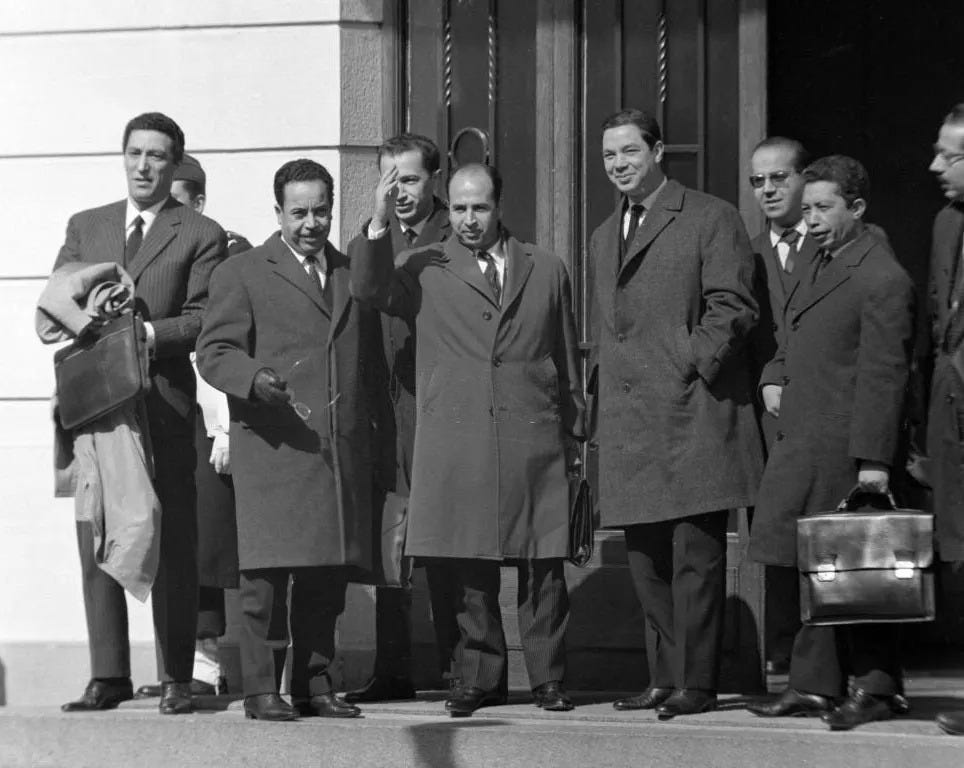
March 19, 1962: French and Algerian forces begin a ceasefire under the newly agreed Évian Accords that would mark the end of the fighting in the Algerian War of Independence. The Accords laid out the terms of Algerian independence while preserving some French commercial and military interests, and were put to an April referendum in France and a July referendum in Algeria, winning approval in both countries.
MIDDLE EAST
LEBANON
The Israeli military (IDF) has killed at least 45 people and wounded some 100 more across Lebanon over the past two days. Several of its airstrikes have targeted Beirut, but most of the violence has focused on southern Lebanon as the Israeli ground operation ramps up. The Lebanese Health Ministry is now reporting that the IDF has killed at least 1001 people and wounded over 2584 since resuming its conflict with Hezbollah on March 2. It has displaced than 1 million people.
ISRAEL-PALESTINE
IDF airstrikes killed at least four people in Gaza city on Thursday, according to the territory’s civil defense officials. Israeli officials are also claiming to have killed a Hamas intelligence officer in Khan Younis. Meanwhile, amid drastic overall cuts to the amount of humanitarian aid entering Gaza, Israeli authorities say they’ve suspended all UNICEF aid shipments due to the discovery of “undeclared items” among their medical supplies. The items in question were apparently “bottles containing nicotine”—surely a legitimate reason to suspend medical aid.
On a somewhat more positive note the Israeli government did reopen the Rafah checkpoint on Thursday. This should mean that at least a few of the thousands of people in Gaza who require medical evacuation will be able to exit the territory.
IRAQ
Airstrikes in northern Iraq’s Nineveh and Saladin provinces killed at least two Popular Mobilization militia fighters on Thursday. It’s unclear whether these were US or Israeli strikes.
IRAN
Israel’s decision to attack Iran’s South Pars gas field on Wednesday sparked a mini-crisis within the maxi-crisis that is the Iran war that reverberated well into Thursday. Primarily this manifested through intense Iranian attacks on energy sites around the Gulf, the most impactful of which was a strike on Qatar’s Ras Laffan natural gas processing facility late Wednesday that QatarEnergy CEO Saad al-Kaabi later claimed would reduce Qatari liquefied natural gas exports by as much as 17 percent over the next three to five years. That’s billions of dollars in lost revenue, to put it in strictly bottom line terms. Iranian missiles also struck Israeli oil facilities in Haifa, though the damage was apparently not severe. What was severe was the associated spike in oil and gas prices, which did level off somewhat by Thursday afternoon.
Israeli Prime Minister Benjamin Netanyahu said in a Thursday evening press conference that he was halting IDF attacks on Iranian energy sites at Donald Trump’s request. That capped off a day in which Trump tried, very unconvincingly, to claim that the US had no knowledge of the South Pars attack. He pushed that message initially in a social media post late Wednesday night, shortly after the strike, in which he asserted that “the United States knew nothing about this particular attack” while decrying the Iranian retaliation against Qatar and threatening more attacks on Iranian energy facilities. US and Israeli sources contradicted Trump and it beggars belief that the IDF would have undertaken such an attack without at least a cursory notification to the Pentagon. Trump actually appeared to contradict himself at one point on Thursday though I honestly can’t tell if he meant that he’d told Netanyahu not to do Wednesday’s attack or not to do any more attacks like it in the future. Iranian officials are threatening a more intense retaliation if their energy facilities are attacked again.
In other items:
A US F-35 was forced to make an emergency landing at an unspecified Middle Eastern airbase on Thursday after apparently taking damage from Iranian air defenses. If that is what happened this would be the first time an F-35 has been hit by enemy fire.
The IDF says that it has destroyed Iran’s Caspian Sea “naval capabilities.” A quick map check would presumably show that there’s no obvious reason why the Israeli military should care about Iran’s Caspian Sea naval capabilities apart from provoking generalized state collapse. Unless there’s some sort of plan for attacking Iran from the north that has yet to manifest.
Having already lifted sanctions on Russian oil and oil products that been stranded at sea, the Trump administration is reportedly of a mind to do the same thing with Iranian oil. This would be another desperate attempt to tamp down oil prices. There are “about 140 million barrels” of Iranian oil at sea, according to US Treasury Secretary Scott Bessent, which shouldn’t be enough to meaningfully shift the global oil market.
According to The Financial Times, if the US Navy ever does start escorting cargo ships through the Strait of Hormuz the Trump administration might force the operators of those ships to purchase insurance from the US government. It might appear unseemly for the US government to try to profit off of a maritime crisis it created, but consider that…well, no, that is pretty unseemly now that I think about it. Never mind.
ASIA
PAKISTAN
The Pakistani Taliban (TTP) announced a three day Eid ceasefire on Thursday, coinciding with the five day ceasefire that the Afghan and Pakistani governments reached the previous day and that went into effect on Thursday morning. The TTP ceasefire will go into effect on Friday, the first full day of the festival.
THAILAND
To I assume nobody’s surprise, the Thai parliament reelected Prime Minister Anutin Charnvirakul to a full term in that office on Thursday. Anutin’s Bhumjaithai Party won last month’s snap election and established a parliamentary majority via an alliance with the Pheu Thai party, so his prospects were not in doubt.
CHINA
The office of the US Director of National Intelligence released the 2026 “Annual Threat Assessment of the US Intelligence Community” on Wednesday, and the highlight seems to be its conclusion that Beijing will likely not attempt a forcible unification with Taiwan in 2027. The intelligence community has previously estimated that Beijing would be capable of an attack on Taiwan by 2027, but capability does not imply intent and the sense is that Xi Jinping is still hoping to secure the island “without using force.”
JAPAN
Japanese Prime Minister Takaichi Sanae visited the White House on Thursday and apparently won over Donald Trump with some unspecified and probably vague promise of assistance with respect to the Iran war. Trump has included Japan in his list of countries that should bail the US out by forcibly reopening the Strait of Hormuz but he seemed satisfied with whatever Takaichi said to him on Thursday though I doubt she agreed to put Japanese naval vessels in the line of fire.
The other highlight of Takaichi’s visit was…well, I’ll let you read about it:
But at a news conference in the Oval Office on Thursday, a reporter pressed Trump about why he did not tell US allies like Japan in advance about his administration’s plans to attack Iran.
Trump responded with a quip about the Japanese sneak attack on the US naval base at Pearl Harbor during World War II.
“We wanted surprise. Who knows better about surprise than Japan, OK? Why didn’t you tell me about Pearl Harbor?” Trump asked Takaichi, who appeared uncomfortable.
“You believe in surprise, I think, much more so than us,” Trump added.
Takaichi appeared somewhat nonplussed by Trump’s comment but it didn’t appear to affect the rest of their session.
AFRICA
CHAD
The Chadian government said on Thursday that a drone strike from neighboring Sudan killed 17 people in a Chadian border town the previous day. This appears to be a distinct incident from the fighting that killed at least 17 people on the Sudanese side of the border on Tuesday. It’s not clear whether the Rapid Support Forces or the Sudanese military (or one of its allied militias) was responsible for the strike. The Chadian military has now reportedly undertaken a major operation to clear out weapons and other materiel from the border region.
DEMOCRATIC REPUBLIC OF THE CONGO
Delegations from the Congolese and Rwandan governments met earlier this week in Washington and according to the AP they “agreed on coordinated steps to de-escalate tensions in eastern Congo.” There’s no indication as to what those steps are, exactly, but they apparently correspond to the bilateral deal that presidents Félix Tshisekedi and Paul Kagame signed alongside Donald Trump back in December. That agreement included a Rwandan commitment to help resolve the M23 uprising in the eastern DRC and a Congolese commitment to crack down on the Democratic Forces for the Liberation of Rwanda militant group.
MADAGASCAR
Madagascar junta leader Michael Randrianirina appointed Mamitiana Rajaonarison as his new prime minister on Sunday, just under a week after he’d sacked former PM Herintsalama Rajaonarivelo and the rest of the cabinet. It is still unclear why he decided to make the switch.
EUROPE
BELARUS
The Belarusian government released 250 prisoners on Thursday, deporting 15 of them to Lithuania while the rest remained in the country. This was part of a quid pro quo arrangement with US envoy John Coale, under which the Trump administration agreed to lift US sanctions targeting Belarusian financial institutions and several potash companies.
UKRAINE
Foreign Policy’s Sam Skove and Rishi Iyengar offer several reasons why the Ukrainian government’s attempt to “cash in” on its expertise in countering Iranian-made Shahed drones may not pan out:
For one, the counterdrone interceptors that Ukraine uses need trainers for their operators, said Verkhovodov of D3. That’s particularly challenging to export, as those trainers are busy at home teaching Ukrainian forces how to defend against constant Russian attacks.
Even if they clear that hurdle, it’s also a question of time. “They say they can create a pilot in three weeks that can go out to the field and do this, but that’s still three weeks,” Grieco said. “It doesn’t mean it’s going to happen tomorrow.”
Drone detection is another challenge, added Kateryna Bondar, a fellow at the Center for Strategic and International Studies, a Washington think tank. Ukraine uses a web of drone detection capabilities, including audio sensors capable of detecting Shaheds that are flying low to avoid radar. Setting up such a system outside Ukraine “will take time,” Verkhovodov said.
Politically, it’s also not clear how quickly Ukraine’s government will offer counterdrone technology—or how high the demand in the Gulf might really be.
AMERICAS
MEXICO
The Mexican Navy announced on Thursday that its forces had captured Omar Oswaldo Torres, leader of the Sinaloa Cartel’s “Los Mayos” faction. The operation took place near the capital of Sinaloa state, Culiacán, and left at least 11 people dead. The Navy’s statement also mentioned the seizure of “high-powered weapons and tactical equipment,” and on that subject The New York Times reported earlier this week that even as it pressures the Mexican government to crack down on cartels, the Trump administration is presiding over an escalation in the flow of weapons into Mexico from the US:
As the Trump administration pushes the Mexican government to do more against drug cartels, an unintended beneficiary has emerged from the U.S. pressure campaign: the weapons smugglers who supply guns to the Sinaloa Cartel, the criminal powerhouse behind much of the fentanyl flooding American streets.
Mexican and U.S. authorities have poured billions of dollars into stemming the flow of drugs, particularly fentanyl going north. Yet gun traffickers have quietly moved what they say is an unprecedented amount of weapons south, arming the very criminal group the U.S.-Mexico effort was meant to weaken.
Over the past year and a half, the demand for weapons has exploded as the Sinaloa Cartel wages a three-front war: confronting an intensified offensive by the Mexican government, battling rival factions within its own ranks and stocking up for the prospect of U.S. military intervention.
UNITED STATES
Finally, at The Conversation Amy McAuliffe argues that growing uncertainty about the reliability of US commitments is prompting Washington’s allies to reconsider their stances on nuclear weapons:
Canadians are openly discussing the merits and risks of pursuing a nuclear weapon. Europeans are similarly considering a nuclear deterrent for the bloc. In South Korea, public support for a nuclear weapon is at its highest level on record, and even in Japan some politicians are talking about the once-taboo subject.
Until just a few years ago, few experts would have predicted that these nations – all allies of Washington – might one day join the nuclear club. Since 2006, that club has consisted of just nine countries: the United States, Russia, the United Kingdom, France, China, India, Pakistan, North Korea and Israel, with its undeclared program.
The hope of nonproliferation advocates was that nine would be the maximum. But over the past few years, more and more nations are seriously exploring “going nuclear.”
As an expert on weapons technology and former assistant director of the CIA for weapons and counterproliferation, I have watched these developments with alarm.
Perceived national security threats still shape U.S. allies’ views of developing nuclear weapons – with North Korea a key driver for South Korea, China paramount for Japan, and Iran key for Saudi Arabia.
But what has changed demonstrably for many U.S. allies is a newfound skepticism over the credibility of the so-called U.S. nuclear umbrella, which for decades has offered allies an easy way of declining to pursue nuclear weapons. Concerned about the Trump administration’s foreign policy, some nations are considering developing domestic nuclear weapons programs or seeking new deterrence assurances.
Add in the main lesson of the Iran war, which is that governments that find themselves on the US shit list should do whatever they can to acquire nukes rather than simply toying with the idea, and we may be entering an exciting new age of nuclear proliferation. Eh, I’m sure it will be fine.