

You’re reading the web version of Foreign Exchanges. If you’d like to get it delivered straight to your inbox, sign up today:
PROGRAMMING NOTE: So the good news is we didn’t lose power, so here is tonight’s double-packed news roundup. The bad news, at least for some of you, is that I am not feeling all that hot this evening so with apologies I am going to forego our usual Tuesday voiceover. Thanks for reading!
TODAY IN HISTORY
March 16, 1527: Though outnumbered, a Mughal army under the dynasty’s founder, Babur, defeats a conglomeration of forces under Rajput leader Rana Sanga at the Battle of Khanwa in northeastern India. Babur made effective use of field artillery and wagon fortifications, as well as the defection of a large portion of Rana Sanga’s army, to win the battle. In defeat, Rana Sanga’s alliance fell apart and Mughal control of northern India was secured—at least until they were (temporarily) ousted from power in 1540.
March 16, 1968: American soldiers massacre hundreds of people in the South Vietnamese village of Sơn Mỹ, an incident that became known as the “My Lai Massacre.” According to the Vietnamese government US forces slaughtered 504 people, concentrated primarily in the hamlets of Mỹ Lai (whence the incident takes its name) and Mỹ Khê. They raped several women and children and mutilated their bodies after executing them. The US military initially covered up the atrocity by claiming that the deaths had occurred during a battle against Viet Cong forces, but the efforts of military veteran Ronald Ridenhour and journalist Seymour Hersh eventually uncovered the truth. Despite the extent of the brutality only one US soldier was convicted in connection with the massacre—Lieutenant William Calley. US President Richard Nixon commuted his life sentence and Calley wound up serving three and a half years in house arrest.
March 16, 1988: The Iraqi military massacres between 3200 and 5000 Kurds in the city of Halabja using mustard gas and an undetermined nerve agent. The attack was the gruesome centerpiece of Saddam Hussein’s Anfal Genocide, which targeted Iraqi Kurds who resisted Hussein’s government with Iranian assistance, under a broader plan to “Arabize” northern Iraq.
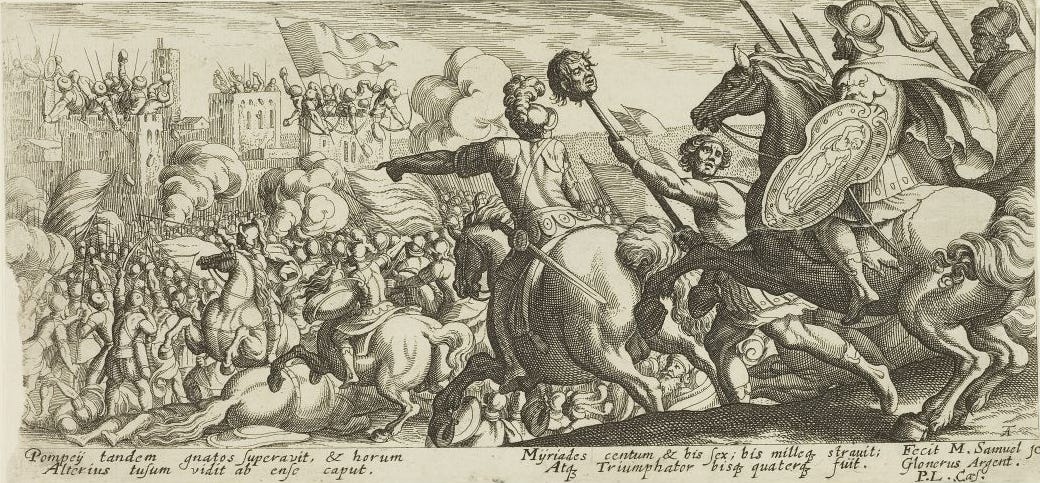
March 17, 45 BCE: Julius Caesar and his army defeat the remaining leaders of the rival Optimate faction in the Battle of Munda, located somewhere in what is now southern Spain. After Caesar had defeated the Optimates in Greece and North Africa his attention shifted to the west, where an army had seized the province of Hispania Ulterior and declared its allegiance to Gnaeus Pompeius (son of Ceasar’s former rival Pompey the Great). Munda is usually considered the last major battle of Caesar’s civil war. Several Optimate leaders were killed and while Gnaeus fled he was quickly tracked down and likewise put to death. Another son of Pompey, Sextus, survived and established himself on Sicily, where he held out into the Second Triumvirate period.
March 17, 1401: This is the generally established date for the sack of the city of Damascus by the “Turco-Mongolian” warlord Timur (“Tamerlane”). Despite resistance from the region’s Mamluk rulers, Timur’s army had by this point sacked multiple cities in what is now Syria and Lebanon before laying siege to Damascus in December 1400. After a three month holdout the city fell, at which point Timur’s forces slaughtered most of the inhabitants—artisans and others considered useful were enslaved and sent to Timur’s capital, Samarkand—and carried off anything movable of value. Timur’s conquest of Syria eventually brought him into conflict with the emerging Ottoman principality in Anatolia, leading to an encounter that suffice to say did not go well for the Ottomans. The siege is notable for a meeting between Timur and pioneering historian/social scientist Ibn Khaldun, who was sent as a Mamluk emissary and subsequently wrote about their interaction.
March 17, 1861: The first Italian parliament proclaims King Victor Emmanuel II of Sardinia as king of a newly unified Italy. This was the culmination of a unification process (the Risorgimento) that began amid the Revolutions of 1848, though that process wasn’t completed until the Italians took Venice from Austria in 1866 and Rome from the Papacy in 1870.
MIDDLE EAST
LEBANON
The Israeli military (IDF) began what it called “limited and targeted ground operations” in southern Lebanon on Monday. Several border towns suffered airstrikes and ground raids as the IDF worked to establish “forward defense” in advance of what is expected to be a much larger invasion and occupation. Israeli Defense Minister Israel Katz said that displaced residents of southern Lebanon will not be permitted to return home “until the security of the residents of the North [of Israel] is guaranteed.” At this point Lebanese authorities have registered over 1 million displaced persons in the two weeks since the IDF resumed intensive Lebanese operations.
As for proposed peace talks between the Lebanese and Israeli governments, those are apparently off for now as the Israelis have withdrawn, according to Haaretz. They are still interested in talks, in this narrative, feeling that they can extract heavy concessions from Beirut right now because of the war and because public sentiment in Lebanon appears to be turning against Hezbollah. But they’re more interested in further ramping up the pressure via this ground invasion and are waiting for the Trump administration to get more involved in Lebanon talks. Right now the French government is taking the lead.
As far as the Trump administration is concerned negotiations don’t appear to be a priority. In fact, Reuters reported on Tuesday that the administration is trying to pressure the Syrian government into invading Lebanon “to help disarm Hezbollah.” It’s gotten a cool reception in Damascus so far, with Syrian officials wary of getting sucked into the war and aggravating sectarian tensions domestically. Still, it doesn’t sound like they’re completely ruling out a Lebanese operation. For whatever it’s worth, US envoy Tom Barrack has denied Reuters’ reporting via social media.
ISRAEL-PALESTINE
An IDF airstrike killed at least three people, one of them a child, in southern Gaza’s Khan Younis area on Tuesday. There’s been no comment from Israeli officials. In the West Bank, Israeli forces killed one person and wounded another near the city of Salfit. They were allegedly throwing rocks at IDF personnel.
Reuters reported on Monday that Hamas representatives met over the weekend with “envoys” from Donald Trump’s “Board of Peace” about advancing Gaza’s ostensible ceasefire. It’s unclear exactly what they discussed, but afterward the Israeli government announced that it will reopen the Rafah checkpoint to allow movement between Gaza and Egypt. The Hamas delegation apparently indicated that the group could withdraw from the ceasefire if the restrictions that Israeli officials have imposed on Gaza since the start of the war remain in place. “Further meetings” are expected to take place over the course of this week.
YEMEN
An artillery attack killed at least ten people, including six children, in northern Yemen’s Hajjah province on Sunday. Details seem quite murky. The strike targeted people who were gathered for a Ramadan iftar (evening) meal in a province that is mostly (though apparently not entirely) under Houthi control. The nominal Yemeni government accused the Houthis of carrying out the attack but that doesn’t seem to have been confirmed.
IRAQ
On Monday, a US or Israeli airstrike killed Abu Ali al-Askari, the chief spokesperson and security commander for Iraq’s Kataʾib Hezbollah militia. As Joel Wing notes this strike came three days after an airstrike killed Askari’s father and KH Secretary-General Abu Hussein al-Hamidawi. The US and Israel appear to be employing the same decapitation logic that they’ve employed in connection with Iran and Hezbollah to Iran-aligned Iraqi militias. That’s in addition to more general attacks on militia facilities—one strike also on Monday killed at least six militia fighters near the Syrian border.
IRAN
Israeli airstrikes have apparently (this now seems to be confirmed) killed two more senior Iranian officials: Basij paramilitary commander Gholamreza Soleimani and Supreme National Security Council Secretary Ali Larijani. The latter is probably more significant, as the Islamic Revolutionary Guard Corps can promote a new officer to head the Basij but Larijani was one of a small and shrinking cadre of civilian officials who could be said to have real authority in Tehran at present. I don’t think there’s much question that the IRGC is running Iran right now but Larijani was probably the senior figure interfacing between it and the country’s political apparatus. He also likely would have been heavily involved in any attempt at ceasefire talks, which may be part of the reason why the Israelis targeted him. If one kills all the potential negotiators, it makes organizing negotiations more difficult. It’s not exactly clear when they were (allegedly) killed but Larijani apparently hadn’t made any public appearances since Friday.
In other items:
Speaking of ceasefire talks, the past couple of days have seen wildly diverging reporting on the question of diplomatic contacts between the US and Iranian governments. Drop Site’s Jeremy Scahill reported on Monday that, Donald Trump’s claims that Iranian officials “want to negotiate badly” notwithstanding, after US envoy Steve Witkoff “personally sent messages to officials in Tehran, including Foreign Minister Abbas Araghchi, last week exploring possibilities for resuming negotiations” the Iranians ignored him. Somebody in the Trump administration then told Barak Ravid and Marc Caputo at Axios that in fact it was Araghchi who’s reached out to Witkoff, and they were in contact with one another. Araghchi then hopped onto social media to deny that report and the back and forth devolved into anonymous US and Iranian officials calling each other liars. Each version of this story is self-serving to the side pushing it, but I will say that if Witkoff and Araghchi really are in regular contact with one another it should be fairly easy for the White House to provide evidence of that. It has not done so as yet, opting instead to accuse Drop Site of exhibiting “America Last behavior.”
Reuters, meanwhile, reported on Tuesday that new Iranian Supreme Leader Mojtaba Khamenei is rejecting “de-escalation proposals conveyed to Tehran by intermediaries.” Assuming that’s true it would probably put the kibosh on Araghchi or any other Iranian officials communicating with Witkoff. Or at the very least it would limit what they could be talking about.
Trump’s request/demand/plea for other countries to reopen the Strait of Hormuz for him has unsurprisingly fallen on deaf ears. Weirdly it seems other world leaders don’t want to put their naval forces or commercial ships and crews at risk for their lives on behalf of the US president, particularly not one who’s spent the past 14 months constantly demeaning them. It’s OK though, because after hopping on to social media on Tuesday to once again demean those leaders and their countries Trump insisted that “WE DO NOT NEED THE HELP OF ANYONE!” I shudder to think what this might mean he’s about to do.
National Counterterrorism Center Director Joseph Kent resigned on Tuesday, saying that he “cannot in good conscience support the ongoing war in Iran.” Kent, who from what I can tell is a MAGA diehard, blamed the war on “pressure from Israel and its powerful American lobby” while denying that “Iran posed an imminent threat to the United States.” I’m not here to evaluate his claims with respect to Israeli influence but I will note that Trump and Secretary of State Marco Rubio have said similar things over the past couple of weeks though they haven’t framed it as a criticism. Kent is the senior-most administration official to resign over the war to date. Trump dismissed the resignation’s significance by telling reporters that Kent was “very weak on security.” One wonders, then, why Trump hired him as National Counterterrorism Director in the first place.
According to The Guardian, UK national security adviser Jonathan Powell attended the final round of US-Iran nuclear talks before the war started and found the Iranian delegation’s proposal at that session “surprising.” While not a “complete deal,” Powell and his team concluded that “it was progress and was unlikely to be the Iranians’ final offer” and thus came away assuming that there would be at least one more round of talks. Obviously there was not, in part (supposedly) because US negotiators Witkoff and Jared Kushner reported to Trump that the Iranians were being intransigent. It may be worth noting here that Powell and his team have actual experience in international diplomacy and nuclear-related issues, while Steve Witkoff is a property developer and Jared Kushner’s family has a lot of money. In other words it’s possible that they, unlike Powell, didn’t understand what the Iranians were offering. Or maybe there was something more nefarious happening: a “diplomat with knowledge of the talks” told The Guardian that “we regarded Witkoff and Kushner as Israeli assets that dragged a president into a war he wants to get out of.”
The Washington Post reported on Tuesday that while Israeli officials keep publicly calling on Iranians to rise up and overthrow the Islamic Republic (and killing Basij members to encourage an uprising), privately they’ve concluded that any who do so will “get slaughtered.” I thought I’d mention this in case anyone out there is still harboring some belief that this is all about liberating the Iranian people. The most charitable reading of this discrepancy is that the Israelis want to see more chaos in Iran and don’t really care how many people get killed to manifest that. The cynical reading is that they welcome more protester deaths because they think that it will bolster their case for continuing the war.
ASIA
KAZAKHSTAN
To I assume no great surprise, Kazakh voters opted on Sunday to approve the new constitution that President Kassym-Jomart Tokayev has been championing. With a healthy 73 percent turnout, some 87 percent voted to adopt the new charter. There’s no indication that the vote counting was rigged though the leadup was not exactly “free and fair” in the sense that the “no” side wasn’t really able to mount a campaign while “yes” had full state backing.
AFGHANISTAN
In what would easily be the largest single casualty incident in the Pakistan-Afghanistan war so far if it’s true, Afghan officials are accusing the Pakistani military of striking a drug treatment hospital in Kabul on Monday evening, killing at least 400 people and wounding at least 250 more. Pakistani officials are denying the claim and insist that their Monday airstrikes targeted military facilities in Kabul as well as eastern Afghanistan’s Nangarhar province. The hospital is a 2000 bed facility so if it took the brunt of an airstrike those casualty figures would be reasonable, and the BBC says that it has already been able to confirm at least 100 deaths. These airstrikes came a few hours after cross-border fighting killed at least four people in Afghanistan. There is still little indication of any meaningful peace process. Chinese mediation appears to be failing and the Gulf Arab states, who have gotten involved in previous rounds of Afghan-Pakistani conflict, are preoccupied at the moment.
MYANMAR
Myanmar’s new parliament opened for business on Monday. I mention this only in passing, since the sham election that produced this body simply gave the country’s existing military government a thin civilian veneer. The Union Solidarity and Development Party, a military cutout, was the overwhelming winner of that election and unsurprisingly installed one of its own officials as speaker in the opening session. The main question now seems to be whether junta leader Min Aung Hlaing will have himself elected president or maintain his position as head of the Myanmar military. Or maybe he’ll do both. He’s also presumably going to chair a new body called the “Union Consultative Council” that will oversee both military and civilian affairs and may wind up being the ultimate governing authority in the state.
CHINA
Donald Trump is postponing his planned visit to China, which was tentatively supposed to happen around the end of this month but will instead be pushed back by “five or six weeks.” While hosting Irish Taoiseach Micheál Martin at the White House on Tuesday, Trump told reporters that he’s “look[ing] forward to seeing President Xi [Jinping]. He looks forward to seeing me, I think.” I’m going to need a fact check on that second part. Trump suggested over the weekend that he might postpone his trip if Xi refused to bail him out on the whole Strait of Hormuz thing, but the message on Tuesday was simply that he can’t be away from Washington in the middle of a war. The visit was aimed at negotiating a more durable trade accord than the “ceasefire” under which the US and China are currently operating.
AFRICA
SUDAN
The Sudan Tribune is reporting that Rapid Support Forces militants have recaptured the town of Barah in Sudan’s North Kordofan state, some ten days after the military took it from them. Barah is strategically significant because it’s situated along the main road from Omdurman to the capital of North Kordofan, El-Obeid. The military would need to control it in order to mount a new offensive from its positions in the capital area into the Kordofan region. RSF forces reportedly also seized the town of Karnoi, which lies on the border between Chad and Sudan’s North Darfur state.
NIGERIA
Three apparent suicide bombings, presumably coordinated, killed at least 23 people in the northeastern Nigerian city of Maiduguri on Monday evening. The blasts occurred just minutes apart in different areas of the city, hence the presumably coordination. There’s been no claim of responsibility as yet. On Tuesday, gunmen attacked two villages in northern Nigeria’s Katsina state, killing at least 15 people in total. This was apparently retaliation after security forces killed three people in a firefight a short time prior to the attacks. These were probably criminal bandits.
SOMALIA
The government of Somalia’s South West state announced on Tuesday that it is “suspending” ties with the federal government in Mogadishu. It accused federal officials of supporting local militias with the aim of overthrowing state President Abdiaziz Laftagareen. There’s been no comment from federal officials, but tensions between the federal and state governments have been running even higher than usual since the former amended the country’s constitution earlier this month to delay elections and keep federal President Hassan Sheikh Mohamud in office for at least another year. Mogadishu’s relations with several other states are already strained—Puntland and Jubaland have largely suspended ties and Somaliland of course declared independence back in 1991.
REPUBLIC OF THE CONGO
To what I again assume is no great surprise, Congolese President Denis Sassou Nguesso won Sunday’s presidential election with a very simple and believable 94.82 percent of the vote on a likewise believable 84.65 percent turnout. Statistics aside he was running against a group of basically no name candidates so the outcome was a foregone conclusion.
EUROPE
EUROPEAN UNION
EU foreign policy coordinator Kaja Kallas gave an interview to Reuters on Tuesday in which she rejected the notion that European states would participate in any military action to reopen the Strait of Hormuz and called for an end to the Iran war. What’s interesting about the latter is that she put the onus on the US and Israel, as well as Iran, to wrap things up. Europe has been at best an afterthought in this conflict and European leaders have mostly responded to it by finding ways to blame Iran for a war it didn’t start. Kallas’s comments may suggest a shift in European rhetoric and a greater willingness to acknowledge that this was a US-Israeli war of choice that the US and Israel will also have to choose to end. It could be a noteworthy development.
RUSSIA
Kenyan Foreign Minister Musalia Mudavadi visited Russia on Monday for a meeting with his Russian counterpart Sergey Lavrov. The main outcome of that session seems to have been an agreement whereby the Russian military will stop enlisting Kenyan nationals to fight in Ukraine. The Ukrainian government estimates that there are some 1700 Africans fighting in the Russian army, and a “Kenyan intelligence report” estimates that some 1000 of them are Kenyan, a number that appears to have shocked Kenyan officials. Moscow insists, as Lavrov did again on Monday, that these Kenyans are voluntarily signing up to join the Russian military but there have been accusations that at least some of them are being trafficked.
UKRAINE
The head of the Russian military’s general staff, Valery Gerasimov, claimed on Monday that his forces have captured 12 Ukrainian villages since the start of the month and are making headway toward at least two targets, the cities of Sloviansk and Kostiantynivka in Ukraine’s Donetsk oblast. There’s no verification of this. Gerasimov also claimed new advances in Ukraine’s Zaporizhzhia oblast, which directly contradicts recent assertions from Volodymyr Zelensky and Ukrainian military commander Oleksandr Syrskyi.
AMERICAS
COLOMBIA
Colombian President Gustavo Petro accused the Ecuadorian military of carrying out airstrikes on Colombia’s side of their shared border in a cabinet meeting on Monday. Then, in a Tuesday social media post, he revealed the discovering of “27 charred bodies” along the border. Ecuadorian President Daniel Noboa called Petro’s claim “false” in his own social media post. There is at least one armed group calling itself the “Border Commandos” that operates in both Colombia and Ecuador so it’s not inconceivable that the Ecuadorians may have been attacking targets in the vicinity of the border. There’s also another possibility, now that the US military is also apparently conducting airstrikes in Ecuador. It’s unclear whether the Pentagon would feel any particular need to respect the Colombian border in this situation.
CUBA
The Cuban power grid totally collapsed on Monday, the first time the island has experienced a full blackout since the United States established its fuel blockade. Coincidentally, or not, Donald Trump told reporters in the White House that same day that he will “have the honor of taking Cuba,” adding that “I can do anything I want with it.” Cuban authorities had restored power to some 55 percent of the island by Tuesday afternoon. It’s unclear how directly the fuel shortage contributed to the grid collapse, as Cuba does produce enough oil to keep at least part of the grid functioning under normal circumstances.
Trump has already made Cuba his next target after Iran, though it remains to be seen whether he’s going to aim for full regime change or a Venezuela-type scenario wherein the US removes one element of the government and leaves the rest in place to implement Washington’s bidding. The New York Times reported on Monday that the administration is insisting that Cuban President Miguel Díaz-Canel and maybe a few other Communist Party stalwarts will have to go under any sort of negotiated settlement, which suggests it’s aiming for the Venezuela option. It’s never been clear how much real authority Díaz-Canel has, but he’d make a useful symbol for the Trump administration to say that it’s purged Cuba of communists and made the island safe for exploitation by predatory US companies free market capitalism. Raúl Guillermo Rodríguez Castro, grandson of Raúl Castro, could serve as the Delcy Rodríguez analogue in this scenario, albeit probably from behind the scenes.
UNITED STATES
Finally, TomDispatch’s Alfred McCoy sees in the Iran war echoes of another empire’s ill-fated Middle Eastern adventure:
Among the “antique legends” most helpful in understanding the likely outcome of the current U.S. intervention in Iran is the Suez Crisis of 1956, which I describe in my new book Cold War on Five Continents. After Egyptian leader Gamal Abdel Nasser nationalized the Suez Canal in July 1956, a joint British-French armada of six aircraft carriers destroyed Egypt’s air force, while Israeli troops smashed Egyptian tanks in the sands of the Sinai Peninsula. Within less than a week of war, Nasser had lost his strategic forces and Egypt seemed helpless before the overwhelming might of that massive imperial juggernaut.
But by the time Anglo-French forces came storming ashore at the north end of the Suez Canal, Nasser had executed a geopolitical masterstroke by sinking dozens of rusting ships filled with rocks at the canal’s northern entrance. In doing so, he automatically cut off Europe’s lifeline to its oil fields in the Persian Gulf. By the time British forces retreated in defeat from Suez, Britain had been sanctioned at the U.N., its currency was at the brink of collapse, its aura of imperial power had evaporated, and its global empire was heading for extinction.
Historians now refer to the phenomenon of a dying empire launching a desperate military intervention to recover its fading imperial glory as “micro-militarism.” And coming in the wake of imperial Washington’s receding influence over the broad Eurasian land mass, the recent U.S. military assault on Iran is starting to look like an American version of just such micro-militarism.
Even if history never truly repeats itself, right now it seems all too appropriate to wonder whether the current U.S. intervention in Iran might indeed be America’s version of the Suez Crisis. And should Washington’s attempt at regime change in Tehran somehow “succeed,” don’t for a second think that the result will be a successfully stable new government that will be able to serve its people well.