

You’re reading the web version of Foreign Exchanges. If you’d like to get it delivered straight to your inbox, sign up today:
TODAY IN HISTORY
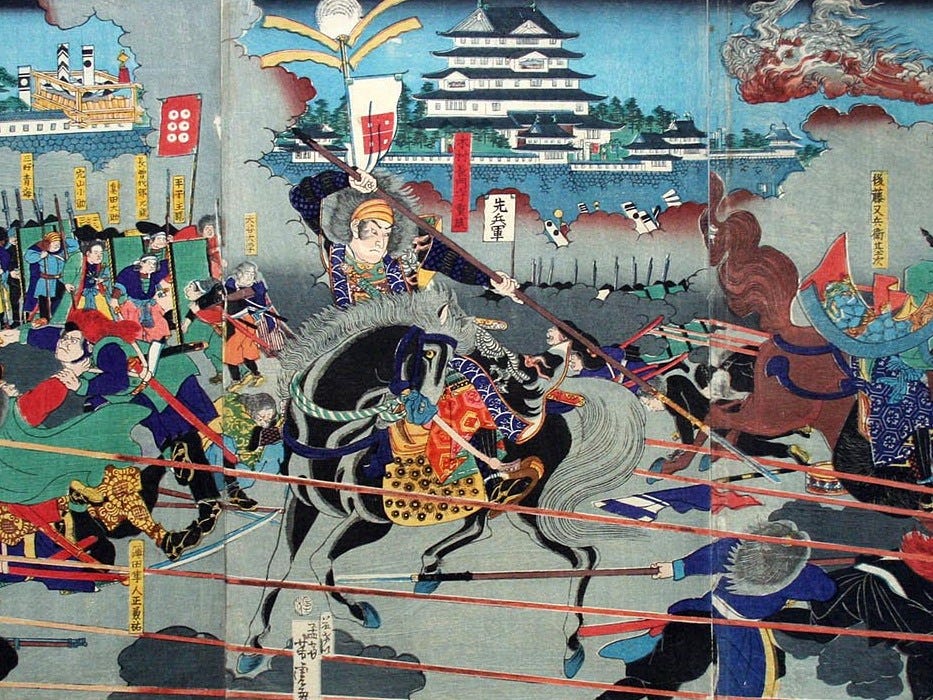
June 4, 1615: The army of the Tokugawa Shogunate captures Osaka, ending a siege that had begun the previous month. This was the second Tokugawa siege of Osaka in less than a year—the initial siege, which lasted from November 1614 to January 1615, had ended with a peace agreement that quickly collapsed. With its capture of Osaka, the Tokugawa clan was able to force the disbanding of the Toyotomi clan, the last serious obstacle to full Tokugawa control over Japan.
June 4, 1989: Chinese soldiers charged with enforcing a declaration of martial law enter Beijing’s Tiananmen Square overnight, beginning a violent dispersal of protesters that left many people dead. The square had been the site of large student-led protests since mid-April, motivated by a wide array of issues but chiefly concerned with economic challenges, demands for political reform, and calls for a government anti-corruption campaign. The military action and ensuing bloodshed broke up the demonstrations. Official figures put the June 3-4 death toll at 241, 218 of them civilians, while various unofficial claims have put it at 300-1000 and above.
MIDDLE EAST
LEBANON
Al Jazeera reports on the terms of Wednesday’s Israel-Lebanon ceasefire and explains why it’s unlikely to hold:
According to the Trump administration, Israel and Lebanon have agreed to implement a ceasefire contingent on a “complete cessation” of Hezbollah fire and the evacuation of its fighters from the area south of the Litani River.
The agreement also calls for the creation of “pilot zones” where Lebanese Armed Forces would take exclusive control “to the exclusion of all non-state actors”. The stated aim is to move towards a wider political and security agreement, including the dismantling of non-state armed groups and preventing their re-emergence.
But Hezbollah was not party to the talks and has already rejected the agreement. Lebanon was represented by government diplomats, even though the Lebanese army is not a party to this conflict.
Hezbollah leader Naim Qassem rejected the deal on Thursday, but that was only after Israeli Defense Minister Israel Katz said that the Israeli military (IDF) would continue its Lebanese operations regardless of the ceasefire. Indeed the agreement doesn’t seem to oblige the IDF to do anything, least of all to withdraw from southern Lebanon. That alone makes the rest of the framework untenable. To stress the point, IDF airstrikes killed at least eight people and wounded another eight in eastern and southern Lebanon on Thursday.
There’s a potentially significant development buried in the joint statement that US, Israeli, and Lebanese officials released on Wednesday to announce the ceasefire. That statement references a June 2 comment by US Secretary of State Marco Rubio declaring that Hezbollah “is an enemy of Lebanon.” In issuing the statement the Lebanese delegates implicitly endorsed that remark, which potentially advances the real US-Israeli interest in these talks which is fomenting another civil war in Lebanon.
ISRAEL-PALESTINE
The IDF killed at least ten people in Gaza on Thursday. Nine of them were killed in airstrikes that targeted four apartment buildings near Gaza city—the IDF hasn’t commented on this attack on civilian residences. Israeli attacks have now killed at least 930 people since the start of the Gaza “ceasefire.”
OMAN
The Omani government is so far resisting the Trump administration’s demand that it sever ties with Iran and officials insist that any arrangement they reach with the Iranian government over management of the Strait of Hormuz will comport with international law. US officials have threatened to sanction and/or bomb Oman should it join Iran in any toll/fee/etc. system in the strait, an idea that Iranian officials are now characterizing as a charge to cover environmental remediation in the waterway. The New Arab’s Giorgio Cafiero explains the politics behind the threats:
Understanding the forces shaping this shift requires looking at political pressures from within the US capital. Muscat’s role as the “unsung hero” of the Joint Comprehensive Plan of Action (JCPOA), which included its hosting of secret negotiations in Oman between Obama administration officials and Iranian representatives, led to certain neoconservative and pro-Israel circles in Washington taking issue with the Sultanate.
To many within those networks, Oman’s position as a diplomatic bridge between the United States and the Islamic Republic has been suspicious. Over time, a range of think tank analysts, lobbyists, and political pundits sought to encourage both Trump administrations to see Muscat not as a trusted partner, but as a problematic regional actor.
For years, pro-Israel and Likud-aligned organisations have promoted narratives critical of Oman within Washington policy circles. These campaigns have frequently relied on exaggerated, misleading, or outright false claims regarding Muscat’s ties to Iran and members of the so-called “Axis of Resistance,” portraying such relationships as justification for a more punitive American approach toward the Sultanate.
KUWAIT
+972 Magazine’s Mira Al Hussein identifies one country where Donald Trump’s drive to expand the “Abraham Accords” might actually succeed:
Most of the states Trump is calling to join the accords — in fact, insisting that this “should be mandatory” — have reasons to resist. Kuwait, however, is undergoing huge transformations that are steadily eroding its institutional capacity to do so.
With its Arab nationalist tradition and historically robust pro-Palestine politics, Kuwait has always been an outlier as a member of the Gulf Cooperation Council (GCC) on the issue of normalization. But since the Emir Mishal Al-Ahmad Al-Sabah took office at the end of 2023, Kuwait has drifted steadily closer to Abu Dhabi, and the domestic consequences have quickly followed.
Kuwait’s parliament — a rare democratic institution in the Gulf — was suspended indefinitely in 2024. A sweeping campaign of mass denaturalization has since affected an estimated 300,000 individuals, including citizens of Palestinian descent. The fabric of political participation that once gave Kuwait its distinctive Gulf character is being deliberately shredded in tandem with closer military and intelligence cooperation with the UAE.
IRAN
The maritime data firm Kpler is reporting that four Iranian-flagged oil tankers carrying a combined 7 million barrels of oil passed through the Strait of Hormuz on Monday. They are the first Iranian tankers known to have transited the strait and tested the US blockade since April 15.
ASIA
ARMENIA
As Al-Monitor’s Amberin Zaman reports, next week’s Armenian parliamentary election is drawing a substantial amount of foreign interest:
In normal times, Mehmandar, Armenia’s largest wholesale market for fruits and vegetables in the Ararat valley near the Turkish border, is a beehive of activity. But these are not normal times. Russia, citing spurious hygiene concerns, had just slapped a ban on Armenian fruits and vegetables. Business is dead. Some 90% of Armenian produce was sold to Russia. “My tomatoes fetched 2,000 drams [$5.50] per kilo a week ago; now they are worth 900 [$2.45] at most,” said Karen Arakelian, a stony-faced farmer. “It’s because of the elections.”
Arakelian is right. On June 7, Armenia will hold nationwide parliamentary polls. They are being touted as a historical referendum on the future course of this Christian nation of 3 million in the southern Caucasus that was part of the Soviet empire. A startling burst of global interest has seen Russia and a Western bloc led by the United States, the European Union and Turkey backing rival candidates amid a dizzying disinformation campaign waged by both sides.
Neighboring Iran and Azerbaijan have their own stakes in the emerging geopolitical order. If all goes to plan, Armenia would sit at the crossroads of the Middle Corridor, a trade route linking Europe to China that would bypass Russia’s northern corridor and Iran. “This is the first geopolitical election in Armenia’s history, and foreign actors each have their favorites,” Tigran Grigoryan, head of the Regional Center for Democracy and Security, a Yerevan-based think tank, told Al-Monitor.
Donald Trump is lavishing praise on incumbent Prime Minister Nikol Pashinyan, who also has Turkish support as the two countries pursue normalization. The Russian government is backing the opposition and steps like its recent bans on Armenian imports and the recall of its ambassador from Yerevan are intended to hurt Pashinyan’s chances of victory. But that effort may be backfiring, as recent polls show a “surge” in public support for Pashinyan’s Civil Contract party.
PHILIPPINES
The “new structure” that the Philippine government says it intends to investigate in the South China Sea’s Scarborough Shoal may turn out to be nothing. According to Reuters, satellite imagery showed that there was some sort of object in the shoal last week but later imagery suggests that it’s no longer there. It may have been some sort of buoy or even a barrier positioned at the entrance to the shoal, presumably by the Chinese military, or it may have been something that just passed through. Either way if it’s gone there’s not going to be much to investigate.
NORTH KOREA
North Korean leader Kim Jong-un pledged on Thursday “to beef up our state’s nuclear forces at an exponential rate” according to state media. He toured a new facility for the production of weapons-grade nuclear material and claimed that North Korea’s production capacity has doubled over the past five years. As ever he’s intent on demonstrating that North Korea is immutably a nuclear-armed state and any US or South Korean hopes of “denuclearization” are futile.
AFRICA
SUDAN
The Sudanese military (SAF) claimed on Wednesday that its forces had fended off “a large-scale attack” by the Rapid Support Forces and the Sudan People’s Liberation Movement-North on the town of Al-Barka in Sudan’s Blue Nile state. Which is interesting, because the RSF reportedly released video footage that seemed to show its fighters occupying an SAF base in the town. If that footage is accurate then either the SAF is lying or it initially lost the town but was able to recover it. The SAF seized Al-Barka from the RSF and company late last month.
SOMALIA
Mogadishu has seen two days of violence after security forces intervened in an effort to quash planned protests against Somali President Hassan Sheikh Mohamud. Protest organizers, including former Somali Prime Minister Hassan Ali Khaire, are pushing back against the postponement of what was supposed to have been this year’s elections, which carried with it the extension of Mohamud’s term for at least another year. There have been no specific reports of casualties but AFP spoke to a “security analyst” who did say there have been casualties, and according to Khaire the fighting has involved “heavy weaponry” that has damaged “civilian infrastructure.”
EUROPE
EUROPEAN UNION
The Wall Street Journal reports on the EU’s attempt to wean itself off of dependence on foreign tech firms:
The European Union is putting forward a stack of measures aimed at bolstering its technological capabilities in the latest push from the bloc to reduce its dependence on tech giants from countries like the U.S.
The European Commission, the EU’s executive arm, outlined a so-called tech sovereignty package, with policies targeting a broad range of tech infrastructure, from semiconductors to cloud services, data centers and artificial intelligence.
The proposals—which need to be negotiated by the European Parliament and the Council of the European Union to be approved—come as EU officials voiced concerns over the bloc’s reliance on non-EU companies for increasingly important technologies that store sensitive data and power devices and vital infrastructure.
President Trump’s second term has seen a flareup in tensions with the EU over tariffs and geopolitics, injecting a fresh sense of urgency into the bloc to become more independent.
UKRAINE
Russian bombardments killed at least 12 people and wounded “dozens” across Ukraine overnight and into Thursday. At least five were killed in Ukrainian-held parts of Donetsk oblast. Ukrainian airstrikes, meanwhile, killed at least three people in the Crimean city of Simferopol and at least one person on a “commuter train” in the eastern part of the peninsula.
Meanwhile, Volodymyr Zelensky sent/released an open letter to Vladimir Putin on Thursday proposing face-to-face negotiations in a neutral country along with a ceasefire. Putin held a press conference in St. Petersburg, apparently before he’d been briefed on the letter, and did not seem particularly open to either consideration even as he insisted that he’s “certainly prepared and willing to reach an agreement with Ukraine.” Putin is back to questioning Zelensky’s legitimacy (based on Ukraine’s 2024 presidential election, postponed/canceled under martial law) and is still demanding the entire Donbas, which means he’ll keep the war going unless Zelensky agrees to surrender the portion that Ukraine still controls.
AMERICAS
BOLIVIA
Bolivian President Rodrigo Paz appointed Ernesto Justiniano as his new defense minister on Wednesday, replacing Marcelo Salinas after he and Education Minister Beatriz Garcia resigned the previous day. Justiniano promised to “restore normalcy” after weeks of anti-austerity protests and road blockades have isolated La Paz and created shortages of food and other essential goods in the capital. The Bolivian Congress voted last week to authorize the deployment of military forces to quell internal unrest so Justiniano may be preparing to go that route.
CUBA
The Trump administration blacklisted Cuban President Miguel Díaz-Canel as well as several members of his family and the Castro family on Thursday. It also designated the Cuban Ministry of the Revolutionary Armed Forces and a number of other entities.
UNITED STATES
The US military bombed another alleged drug boat on Wednesday, killing at least two people. US Southern Command said that the vessel “was engaged in narco-trafficking operations,” offering no evidence of that as usual.
Finally, TomDispatch’s Alfred McCoy considers US imperial decline from the standpoint of energy:
Probe deeper still for the causes of the ongoing all-American imperial decline and you’ll come to the most fundamental but generally least noted factor in the rise and fall of every world empire for the past 500 years: energy innovation.
In the sixteenth century, Spain and Portugal maximized the caloric output of the human body by developing the slave plantation, whose phenomenal profitability allowed a uniquely cruel form of commercial agriculture to spread from West Africa along the coast of Brazil to the Caribbean and then, of course, to the American South. A century later, the Dutch mastered wind power, using windmills to saw uniform planks to build efficient sailing ships that won them a commercial empire stretching from the Spice Islands of Indonesia to the island of Manhattan. In the nineteenth century, Britain’s industrial revolution developed coal-fired steam engines for factories, trains, and ships that facilitated its conquest of colonies covering a quarter of the globe. After 1945, America’s ascent to global hegemony would be synonymous with the rise of petroleum, quickly supplanting coal as the world’s primary form of energy and leading to repeated U.S. interventions in the Middle East for the past 70 years.
In recent years, however, Beijing has launched a revolution in green energy from the sun and wind whose accelerating pace, driven by its sheer economic efficiency, has the potential to transform much of the global economy, while simultaneously making China the world’s preeminent economic power. With surprising speed, solar-powered electrical generation has become 41% less expensive (and wind 53% cheaper) than the least expensive form of fossil fuel. In addition, engineering innovations in battery design for both driving and electrical storage are likely to make the cost of carbon-fueled power prohibitively expensive within a decade or less.
China was already outpacing the US before Donald Trump returned to office and with the US out of the green energy business completely until at least January 2029 any competition may be well and truly over by that point.