

You’re reading the web version of Foreign Exchanges. If you’d like to get it delivered straight to your inbox, sign up today:
TODAY IN HISTORY
January 27, 1944: The Soviet Red Army finally ends the 872 day Siege of Leningrad by driving off the last German forces still remaining in the vicinity of the city. Whether you go by the highest estimates, which put the death toll north of 5 million; the lowest, which put it around 1.2 million; or somewhere in between, Leningrad was one of the longest and deadliest military encounters in recorded history.
January 27, 1945: Exactly one year later, the Red Army liberates the Nazi concentration/extermination camp complex at Auschwitz, in occupied Poland. The Nazis executed some 1.1 million people at Auschwitz between 1940 and 1945, most of them Jews. In 2005, the United Nations General Assembly designated January 27 as “International Holocaust Remembrance Day.”
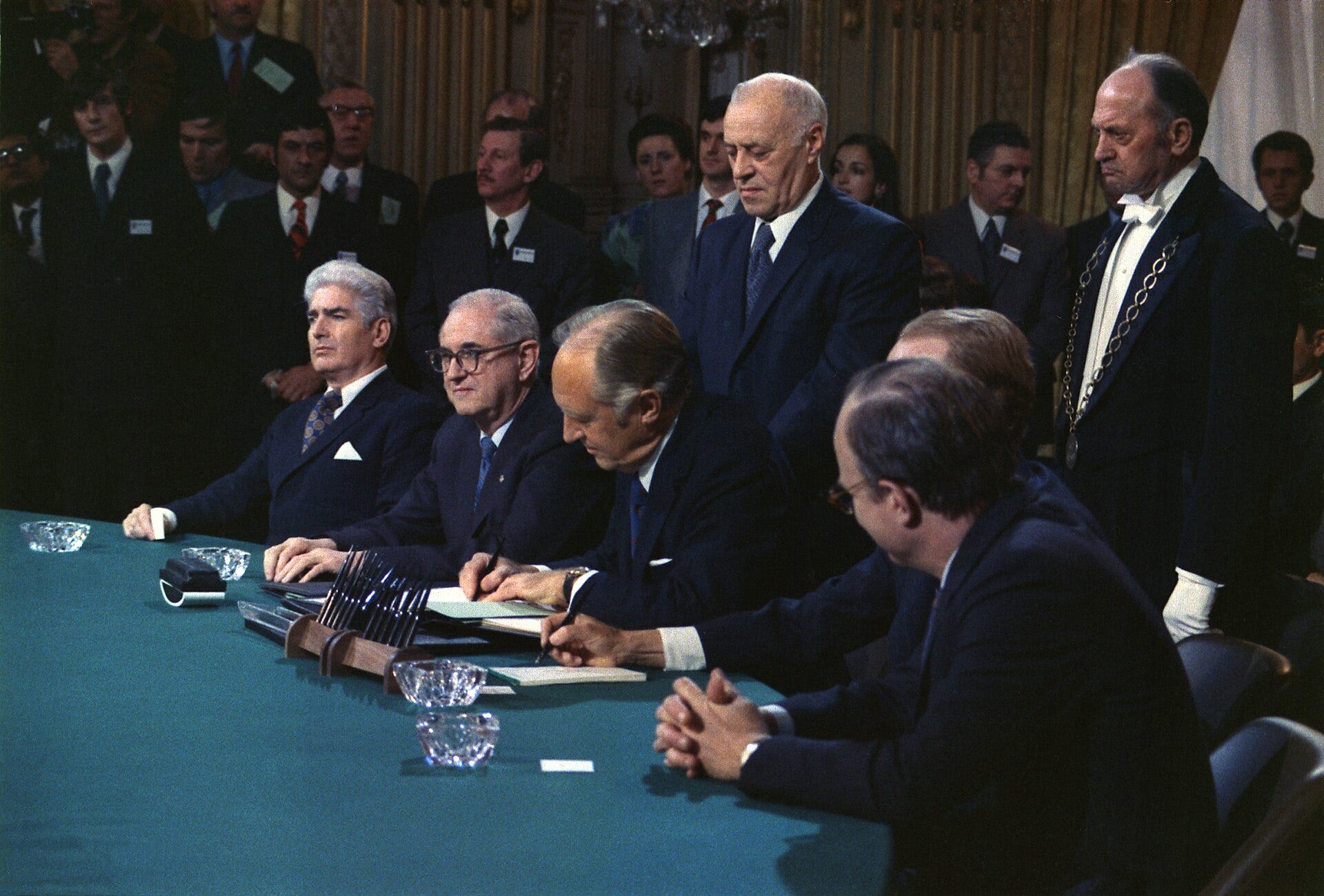
January 27, 1973: The United States, North Vietnam, South Vietnam, and the South Vietnamese Provisional Revolutionary Government all sign the Paris Peace Accords, marking the end of the Vietnam War. The deal called for the withdrawal of US forces from Vietnam and the imposition of a ceasefire, plus the withdrawal of all foreign forces from Laos and Cambodia. The ceasefire failed almost immediately, but the US was in no position to stop the eventual fall of South Vietnam in 1975.
INTERNATIONAL
The Bulletin of the Atomic Scientists moved its “Doomsday Clock” to 85 seconds to midnight on Tuesday, which is four seconds closer than they’d set it last year and the closest they’ve yet come to the clock striking 12. Bulletin CEO Alexandra Bell pointed to the “increasingly aggressive and nationalistic” behavior exhibited by “major countries” and the threat that poses to international cooperation as one reason for moving the clock forward.
MIDDLE EAST
SYRIA
At time of writing the Syrian government was reportedly “hoping” to hold new talks with Syrian Democratic Forces officials about integrating the SDF into the state politically and militarily, even as soon as Tuesday. I haven’t seen any indication that those talks happened or that they’ve been scheduled, and as far as I know there hasn’t been any comment on the prospect from anyone within the SDF.
On a somewhat related note, the Russian military has reportedly pulled or is pulling its forces out of northeastern Syria amid the risk of continued conflict between Damascus and the SDF. The Russians have maintained a relatively small presence in the region, particularly at Qamishli airport, though most of their military forces in Syria have been deployed to the two Russian bases in the northwest, at Hmeimim and Latakia. The future of those facilities remains in question as Moscow is still ironing out its relationship with the post-Bashar al-Assad Syrian government.
LEBANON
An Israeli military (IDF) airstrike killed a program host from the Hezbollah-affiliated al-Manar television station in the southern Lebanese city of Tyre on Monday. He is at least the seventh Lebanese journalist killed by the IDF since 2023.
The leader of the Lebanese Free Patriotic Movement, Gebran Bassil, declared via social media on Tuesday that his party’s political accord with Hezbollah has “collapsed,” citing a failure to “integrate” Hezbollah’s “choices and weapons” into the Lebanese state. Hezbollah and the FPM formed an alliance of sorts back in 2006, when the latter left the “March 14 Alliance” and joined the “March 8 Alliance” that includes Hezbollah. Former FPM leader Michel Aoun relied on Hezbollah’s support to make himself president in 2016. Bassil now apparently sees the political winds turning against Hezbollah, which has been weakened after its conflict with Israel and concurrent loss of senior leadership and is under pressure both internally and from Israel to disarm. The FPM remains one of Lebanon’s most prominent Christian parties so this break is a blow to Hezbollah’s political standing.
ISRAEL-PALESTINE
Retired IDF general Amir Avivi told Reuters on Tuesday that the Israeli government is clearing land in southern Gaza’s Rafah area in order to build “a camp for Palestinians potentially equipped with surveillance and facial recognition technology at its entrance.” This is not breaking news but hearing it from someone like Avivi, who still works as an adviser to the IDF, is significant. The camp would be used to house potentially “hundreds of thousands” of Palestinians—concentrating them, if you will, into this one heavily secured site. People living in the camp would be given the option of leaving Gaza altogether, though that would be done in such a way as to maintain the image of a “voluntary” relocation.
This relocation is meant to facilitate rebuilding Gaza as a dystopian techno-resort that, as Al Jazeera reports, will necessitate the almost complete erasure of anything that was in Gaza previously. Certainly that’s been facilitated by the IDF’s destruction of just about everything in Gaza over the past two-plus years but it is disturbing to see that destruction essentially embraced in the name of creating big real estate opportunities for Donald Trump’s friends and family (one assumes). There’s been no Palestinian input into this rebuilding plan nor is there any clarity about the actual role Palestinians will play in the “new Gaza.” The techno-resort will need cheap labor, to be sure, but beyond that it’s conceivable that Gaza’s Palestinian residents won’t even be allowed out of their Israeli-controlled camps—unless they want to leave the territory.
Elsewhere, according to Reuters Hamas wants to “incorporate” its police force into the new administration in Gaza. I cannot conceive of a scenario in which the Israeli government would be comfortable with this so let’s say that it is very unlikely to happen and revisit if I’m wrong. The group also wants to see its civilian personnel carried over into the new administration, which may be an easier sell particularly in areas where some level of expertise might be important. Mass firings could create economic hardship and potentially chaos that the Israeli government and the “Board of Peace” might rather avoid. And The Financial Times is reporting that the Israeli government is preparing to negotiate a new ten year security agreement with the US. The current one expires in 2028. Israel gets $3.8 billion per year in military aid under that deal and there’s some possibility that number could decline in the next one given Benjamin Netanyahu’s stated desire to “taper off” direct US support.
IRAQ
The Iraqi parliament’s plan to elect a new federal president had to be put on hold on Tuesday when, as suspected, the country’s two largest Kurdish parties failed to agree on a consensus candidate. The Kurdistan Democratic Party is still demanding that its candidate be given preference over the candidate of the Patriotic Union of Kurdistan, which has traditionally held the office. It’s unclear when the vote might take place.
Whoever becomes president is expected to nominate Nouri al-Maliki as prime minister, after the Shiʿa Coordination Framework coalition named him as its candidate on Saturday. But his prospects may have taken a serious blow on Tuesday, when Donald Trump took to social media to say that Maliki’s prospective election would be “a very bad choice.” Trump went on to say that he will cut off US aid to Iraq if Maliki becomes PM. It’s unclear whether Maliki has the votes now to be elected PM though under normal circumstances the Framework-backed candidate would be the prohibitive favorite. But Trump’s threat could cause some members of the Framework to rethink his candidacy.
ASIA
INDIA
The European Union and the Indian government reached agreement on a massive “free trade” agreement on Tuesday that Indian Prime Minister Narendra Modi called “a mother of all deals” while asserting that it “represents about 25 percent of global GDP, and one-third of global trade.” I’m not going to try to check his math but he’s probably close, given that at its maximum extent this accord affects some 2 billion people and involves a combined market of around $27 trillion. New Delhi is even opening up its automotive market to EU imports, which is a step that Indian officials had previously been unwilling to take. The agreement needs to be approved by both governments and given that both of them are on somewhat shaky ground with Donald Trump there’s some trepidation about his potential reaction.
LAOS
Wired has just published an extensive look inside one of the many online scam operations that have established themselves across Southeast Asia:
The bizarre reality of daily life in a Southeast Asian scam compound—the tactics, the tone, the mix of cruelty and upbeat corporate prattle—is revealed at an unprecedented level of resolution in a leak of documents to WIRED from a whistleblower inside one such sprawling fraud operation. The facility, known as the Boshang compound [in northern Laos], is one of dozens of scam operations across Southeast Asia that have enslaved hundreds of thousands of people. Often lured from the poorest regions of Asia and Africa with fake job offers, these conscripts have become engines of the most lucrative form of cybercrime in the world, coerced into stealing tens of billions of dollars.
Last June, one of those forced laborers, an Indian man named Mohammad Muzahir, contacted WIRED while he was still captive inside the scam compound that had trapped him. Over the following weeks, Muzahir, who initially identified himself only as “Red Bull,” shared with WIRED a trove of information about the scam operation. His leaks included internal documents, scam scripts, training guides, operational flowcharts, and photographs and videos from inside the compound.
Of all Muzahir’s leaks, the most revealing is a collection of screen recordings in which he scrolled through three months’ worth of the compound’s internal WhatsApp group chats. Those videos, which WIRED converted into 4,200 pages of screenshots, capture hour-by-hour conversations between the compound’s workers and their bosses—and the nightmare workplace culture of a pig butchering organization.
“Pig butchering” is the euphemism used to describe these operations.
AFRICA
SUDAN
The Sudanese military claimed late Monday that its forces had broken through the Rapid Support Forces group’s two-year siege of Dalang (or Dilling) in Sudan’s South Kordofan state and had opened a road into the town. If true that could be a significant gain for the military as it attempts to strengthen its position in the Kordofan region. The capital of South Kordofan, Kadugli, is under RSF siege and lifting that may be the military’s next objective. It’s also potentially important from a humanitarian perspective. The Integrated Food Security Phase Classification has declared famine conditions in Kadugli and there’s good reason to believe that Dalang is also in a state of famine, though the IPC hasn’t been able to verify that.
NIGERIA
Jihadist militants attacked an army unit in northeastern Nigeria’s Borno state on Monday, killing at least seven soldiers and capturing 13 more. Boko Haram is believed to have been responsible for the attack.
DEMOCRATIC REPUBLIC OF THE CONGO
It’s been one year since M23 militants seized control of the eastern Congolese city of Goma, and the AP reports on current conditions there:
The scars from the fighting between the Congolese army and M23 in January 2025 remain visible, but life has gradually returned to normal: Markets are functioning and people are adapting, but there is no real economic recovery. Bank closings, followed by the shutdown of the international airport, have severely crippled economic activity, plunging thousands of households into poverty.
Rwanda-backed M23 is the most powerful of over 100 armed groups vying for a foothold in mineral-rich eastern Congo, near the border with Rwanda. The conflict has created one of the world’s most significant humanitarian crises, with more than 7 million people displaced, according to the U.N. agency for refugees.
Following a sharp escalation of fighting early last year, M23 rebels took over Goma, which remains in their hands today.
In downtown Goma, the banking district is one of the most striking symbols of the new reality, with once-bustling buildings now shuttered. ATMs are out of service, and the bank signs are off.
That leaves people almost completely dependent on mobile phone money transfer services. It is a way to survive — but an expensive one.
EUROPE
EUROPEAN UNION
NATO Secretary-General Mark Rutte’s skepticism notwithstanding, The Wall Street Journal reports that Europe’s defense industry is growing amid talk of reducing the continent’s dependence on US military protection:
President Trump’s overtures about acquiring Greenland are now reviving questions among the U.S.’s North Atlantic Treaty Organization allies over whether Europe can make enough of its own weapons to fight independently of America.
Defense analysts and lawmakers mainly conclude yes, but not just yet.
The continent’s once-sclerotic defense industry is churning out drones, tanks, ammunition and other weaponry at its fastest pace in decades as the region looks to rearm in the face of Russian aggression and divides with Washington. But there is still some way to go. The cost of replacing current U.S. military equipment and personnel in Europe would be around $1 trillion, according to the International Institute for Strategic Studies think tank. Some holes remain in the region’s manufacturing capability, including stealth fighters, long-range missiles and satellite intelligence.
While Europe has increased its defense production in recent years, its fragmented industry currently lacks the capacity of its U.S. peers, which are financed by the world’s largest military budget.
Still, sharp increases in military spending across Europe and renewed efforts in research and development are bringing operational independence closer—and in some cases it is happening surprisingly quickly.
UKRAINE
Russian drone and missile strikes killed at least 12 people across Ukraine overnight, including at least five on a passenger train in Kharkiv oblast. Despite recent peace talks the Russian military has continued bombarding Ukraine nightly and is still targeting the country’s civilian electrical and heating infrastructure. Speaking of those peace talks, Reuters reports that the Trump administration is telling Ukrainian leaders that they must agree to a peace deal with Russia before they can get any sort of security guarantee from the US. The Financial Times previously reported that the administration was specifically tying security guarantees to Ukraine’s willingness to cede territory in the Donbas to Russia, but a “source” cited by Reuters said that the quid pro quo isn’t quite that specific and the administration isn’t dictating terms to Ukraine so much as it’s insisting there must be a peace deal before any guarantees could be activated.
Meanwhile, a new study from the Center for Strategic and International Studies is claiming that some 1.8 million combatants have been killed in the Ukraine war to date, including almost 1.2 million Russian fighters and 600,000 Ukrainians. These figures are based in part on US and European estimates because neither Moscow nor Kyiv has been forthcoming about their own casualty figures. It is a stunning number if it’s even close to accurate, especially given how static the conflict has been territorially over the past couple of years.
AMERICAS
VENEZUELA
The US State Department notified members of Congress on Monday that it has begun sending diplomatic staff to Venezuela on a temporary basis, as a first step toward restoring full diplomatic relations and reopening the US embassy in Caracas. The US broke off relations with Venezuela in 2019, during Donald Trump’s first term, but there’s been a move to restore them following the abduction of Nicolás Maduro earlier this month. All may not be completely well in the relationship between the US and its newest would-be colonial possession, however, as the US intelligence community is reportedly skeptical about the prospects of interim Venezuelan President Delcy Rodríguez following orders from Washington in the long term. In particular the USIC seems uncertain about whether Rodríguez will really sever relations with China, Cuba, Iran, and Russia as the Trump administration is demanding.
UNITED STATES
Finally, Van Jackson argues that talk of the US military de-prioritizing China in its latest National Defense Strategy is very overblown:
Some will say—have said—the NDS abandons the fight against China, de-prioritizes it. If only! That inference comes from semiotics for stupid people; the document arranges the China-threat section after the homeland-threat section. But the salient question is not whether the NDS places magic words in a sequence that makes us feel good and sufficiently menaces China; it’s whether the words indicate the US military will continue to invest in a force capable of fighting China inside the “first island chain” (Taiwan) and the answer is obviously yes. American oligarchy would collapse if the national security state were forced to stop gooning to East Asian war fantasies.
Much has been made of spheres of influence as a guiding concept of Trump foreign policy. As it happens, I’ve been writing about spheres of influence for a decade, drawing mostly critical conclusions. There is no doubt the US is building a force meant to assert its sphere of influence over Latin America, but nothing in Trump administration foreign policy has extended a sphere of influence to China or anyone else. The NDS cedes nothing to China. The most you could say is that it swaps out Biden-era language about China as a “pacing threat” for language about needing to deny China dominance of Asia, which truly is a distinction without a difference. People who say otherwise don’t understand defense strategy. Both configurations of language translate into military primacy same as under any previous president. Did you think the hawks wouldn’t win under this regime?