

You’re reading the web version of Foreign Exchanges. If you’d like to get it delivered straight to your inbox, sign up today:
TODAY IN HISTORY
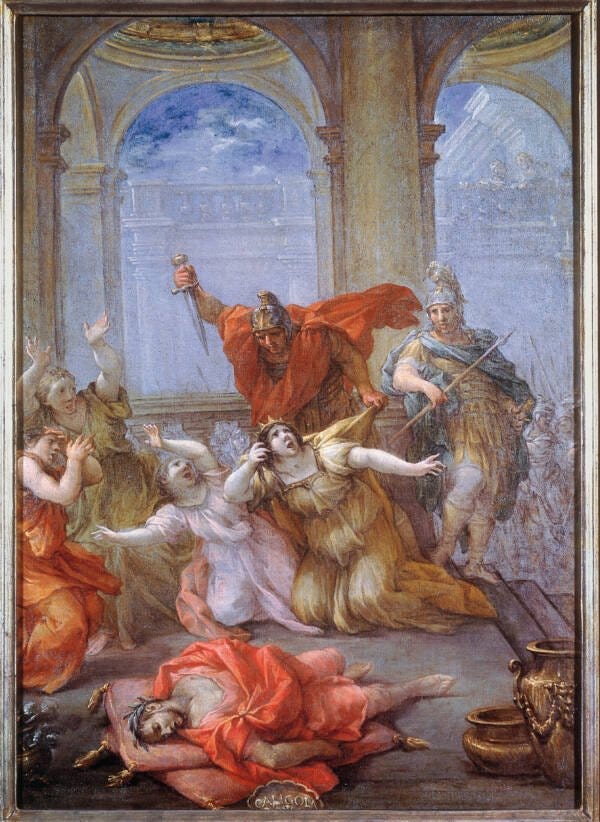
January 24, 41: The Roman Praetorian Guard assassinates the sitting emperor, Caligula, for…well, a bunch of reasons, including the regular ridicule he heaped upon the Guard’s commander, his (alleged) plans to move the imperial capital to Alexandria, and his, shall we say, grandiose sense of self. With no real plan in place for succession, another Guard faction smuggled Caligula’s uncle, Claudius, out of the city and he was subsequently proclaimed emperor. Claudius turned out to be a competent emperor, and modern historians tend to put him in the “good” (or sometimes even “very good”) tier when ranking Roman rulers. His reputation definitely benefits by comparison with both his predecessor and his successor (Nero).
January 24, 1984: Apple begins selling a new computer it calls the “Macintosh.” After some early struggles related to its relatively low performance combined with a relatively high price, and then a mid-life crisis related to essentially the same things, I would have to say the product turned out to be fairly successful. The Macintosh, or “Mac,” is credited with driving the move toward the graphical user interface.
January 25, 750: An outnumbered rebel army defeats the Umayyad caliphate in battle near the Great Zab River in modern Iraq. The victory proved to be the decisive engagement of the Abbasid Revolution that saw the Umayyads overthrown and the caliphate assumed by the new (and still mostly unknown at this point) Abbasid dynasty, who moved the imperial capital from Damascus to Kufa and then in 762 to the newly-built city of Baghdad.
January 25, 1971: A Ugandan military coup led by General Idi Amin overthrows the socialist regime of President Milton Obote. Amin would rule Uganda as a brutally authoritarian dictator until he was ousted during the Uganda-Tanzania War of 1979.
MIDDLE EAST
SYRIA
The four day ceasefire between the Syrian government and the Syrian Democratic Forces group lapsed on Saturday with no indication what was to follow…until the Syrian Defense Ministry announced a 15 day extension. This appears to have been a US-influenced decision made in part to facilitate the continued transfer of Islamic State prisoners from facilities in northeastern Syria to Iraq. Damascus is continuing to move additional forces into northeastern Syria which suggests that officials are planning for a resumption of conflict or at least want to demonstrate enough strength that they can intimidate SDF leadership in further negotiations. There are still reports of scattered violence in the region despite the ceasefire, but on a more positive note the Syrian government agreed to open a corridor to bring humanitarian aid into the city of Kobani. A large number of people displaced by this conflict have wound up there and conditions have reportedly been difficult to say the least.
ISRAEL-PALESTINE
There are a few items of note:
Israeli military (IDF) gunfire killed at least three people in Gaza on Sunday, two in one incident in Gaza City and another in the Khan Younis region. There’s been no comment on these killings from Israeli officials yet as far as I know. An Israeli drone strike killed two children in northern Gaza the previous day, and health officials announced the death of another Palestinian infant due to exposure. According to Al Jazeera the drone strike targeted a group of “civilians gathering firewood.”
The Israeli government said on Sunday that it has begun a “large scale operation” in northern Gaza with the aim of locating the remains of the last October 7 captive, Ran Gvili. This is apparently based on “new intelligence” (maybe provided by Hamas though Israeli officials deny it) that links his body to “a cemetery in [Gaza City’s] Tuffah neighborhood.” Coincidentally, or not, Sunday’s shooting incident in Gaza City took place in Tuffah. The repatriation of Gvili’s body is one of several elements of phase one of the Gaza ceasefire that have yet to be fulfilled even though the overarching framework has been advanced to phase two at mostly US insistence. Israeli officials are still conditioning the reopening of the Rafah checkpoint, another unfulfilled “phase one” term, on Gvili’s repatriation.
US envoys Jared Kushner and Steve Witkoff were in Israel on Sunday, where they held “constructive” discussions with Israeli Prime Minister Benjamin Netanyahu. There’s no indication what they actually talked about other than that it involved phase two of the ceasefire and “broader regional issues,” which seems mostly to be a euphemism for if/when they’re planning to bomb Iran though it may also include Israel’s bombing campaign in Lebanon and Israeli-Syrian relations.
Another Forensic Architecture piece at Drop Site claims that the IDF is turning the “yellow line” into a physical border. That mainly seems to involve the creation of earth berms to make a more permanent division of the territory than the yellow-painted blocks the Israelis had previously been using. Many of these berms are being erected dozens or in some cases hundreds of meters beyond where the actual “yellow line” is delineated on maps.
The Wall Street Journal reports on the “extensive” support that the IDF is providing to anti-Hamas militias in Gaza, which includes “air support” and medical care as well as “intelligence, weapons, cigarettes and food” along with the ability to operate from the safety of Israeli-controlled territory. In return the militias are killing Hamas officials in parts of Gaza that the ceasefire technically makes off-limits to IDF personnel. What they are not doing is establishing themselves as viable political alternatives to Hamas among the territory’s population—their collaboration with the IDF and sometimes checkered records of criminal activity make that a hard sell.
SAUDI ARABIA
I’m sad to report that, according to The Financial Times, the dream that was Neom is over. The grand symbol of the New Saudi Arabia “is set to be significantly downscaled and redesigned as a review of the massive development nears completion after years of delays and budget overruns.” That includes “The Line,” its planned “linear city,” which is going to be “radically scaled back” under the new project parameters. Plans to host the 2029 Asian Winter Games at the complex’s planned “Trojena” ski resort are now off as well, though the Saudis are still aiming to host the football (soccer) World Cup in 2034. The rest of the project is being reimagined as a data center “hub.” Neom’s skyrocketing costs and technical challenges proved too much to overcome, particularly with oil prices well below the Saudi government’s “breakeven” point of $90 and up per barrel.
Though this means that Saudi Crown Prince Mohammed bin Salman is throwing in the towel on his biggest pet project, I think it’s important not to lose site of the many, many people he may have killed to get to this point. This is a difficult figure to pin down, but it has been reported that Saudi security forces were given clearance to use “lethal force” to evict members of the Huwaytat tribe from the land that was to be used for Neom. They killed at least one person connected with that tribe and several other members were arrested and sentenced to death for resisting. Those casualties are likely dwarfed by the number of migrant laborers who have died on the job in Neom. A 2024 ITV documentary put that figure at 21,000 for the entirety of MBS’s “Vision 2030” program, of which Neom was the most prominent element, and claimed that some 100,000 additional workers were believed to be missing.
IRAQ
The Coordination Framework, the alliance (more or less) of Iraqi Shiʿa political parties, made former Prime Minister Nouri al-Maliki its candidate for that office on Saturday. This all but ensures that Maliki will get the job and comes after incumbent PM Mohammed Shiaʿ al-Sudani gave up his bid to remain in office earlier this month. It also may be very unpopular among Arab Sunnis and Kurds, communities that Maliki alienated during his previous two-term stint as PM from 2006-2014, though with the proper distribution of patronage gigs and other spoils Maliki can surely win at least some parties within those blocs over to him.
Maliki could be elected PM in a matter of days, but that depends on the resolution to another thorny political issue involving the Iraqi presidency, which must be held by a Kurd. Parliament is scheduled to convene on Tuesday to elect a president but the country’s two largest Kurdish parties—the Kurdistan Democratic Party and the Patriotic Union of Kurdistan—have not agreed on which of them will hold that office. Traditionally the PUK holds the federal presidency and the KDP holds the presidency of the Kurdistan Regional Government. But the KDP has increasingly come to dominate Kurdish politics over the PUK and has been agitating for control of both presidencies since Iraq’s last federal election back in 2021. Legally Maliki can become PM only once there’s a president in office to nominate him, so if Tuesday’s session goes sideways his re-coronation may be delayed.
IRAN
TIME is reporting that, according to “two senior officials” in the Iranian Health Ministry, the death toll from this month’s anti-government protests and the ensuing crackdown may have been as high as 30,000 or more. That’s far beyond even the highest current figures being cited by human rights organizations and should be taken with a liberal amount of salt, though it seems more credible than some of the other very high casualty claims I’ve seen floating around on social media that seem to be based on nothing. Another “count gathered by physicians and first responders” also relayed by TIME puts the death toll at 30,304 and that’s apparently only a partial tally. If these figures are even close to accurate, and to be clear that remains a big “if,” they would rival some of the worst incidents of state violence around the world in recent memory.
ASIA
PAKISTAN
The Washington Post reports on the economic impact that the Pakistani government’s closure of its border with Afghanistan is having in northern Pakistan:
In the sprawling fruit market in this northwestern Pakistani city [Peshawar], Imran has spent the past several months waiting for shipments that aren’t arriving.
The crates of Afghan walnuts, apricots and pomegranates he once hauled through the stalls have disappeared, casualties of Pakistan’s decision to close its border with neighboring Afghanistan.
Pakistan shut all major crossings along its roughly 1,600-mile border with Afghanistan in mid-October amid clashes with the Taliban-run government in Kabul. The sides eventually agreed to a ceasefire, but crossings remain closed to trade. It amounts to the longest border shutdown in living memory, locals say.
Imran, a 40-year-old loader who has worked at the market for more than two decades, said he cannot recall a more desperate stretch.
“It’s not enough to feed my family,” said Imran, who does not have a surname. He keeps coming to the empty market every day because he can’t bear the thought of staying home and explaining to his children why he’s not at work.
MYANMAR
Myanmar held the third phase of its pantomime of an election on Sunday with the outcome not in much doubt. The military’s cutout, the Union Solidarity and Development Party, already secured a parliamentary majority as of the second phase earlier this month, so the only question coming out of Sunday’s vote is how big a majority it will get (or bestow upon itself as the case may be). In a development I’m sure nobody could have seen coming, junta leader Min Aung Hlaing is reportedly planning to name a successor as military commander so that the incoming parliament can elect him president at its earliest convenience. Internationally it remains to be seen whether the election will be treated as the sham that it certainly seems to be or if it will nevertheless bestow electoral legitimacy on a continuation of the country’s military government.
AFRICA
CENTRAL AFRICAN REPUBLIC
World Politics Review’s Tangi Bihan writes that President Faustin-Archange Touadéra’s landslide reelection last month was based on tangible security improvements:
The security context surrounding the Dec. 28 elections was markedly improved from years past, with voting taking place in peace across most of the country. Authorities even opted to hold a historic quadruple ballot, with presidential, legislative, regional and municipal elections all taking place on the same day. That the government was able to organize the elections under such relatively safe conditions marks a real accomplishment for Touadera given the country’s long history of civil conflict.
The question now is whether this stability is sustainable—or merely cosmetic.
Since coming to power in 2016, in the aftermath of a period of severe instability, Touadera has achieved several tangible results. First, by bringing in Russian mercenaries from the Kremlin-linked Wagner Group in 2018 and allowing them to fight on the front lines, he succeeded in pushing back and weakening the main armed groups—though it should be noted this came at the cost of serious human rights violations, particularly against civilians from the Fulani ethnic group, who are often conflated with militia members.
This reconquest of national territory took place mainly from early 2021 onward, in response to a major rebel offensive that took place around the 2020 elections. At the time, fighters from the Coalition of Patriots for Change, or CPC, were closing in on the capital, Bangui. The coalition—comprising armed factions born out of the country’s civil war in 2013-2014—had just been formed by former President Francois Bozize with the explicit aim of preventing the vote. But government security forces managed to push them back thanks to decisive support from the Wagner Group as well as Rwandan troops, some of whom were deployed as U.N. peacekeepers. That set the stage for the dramatic improvement in security conditions that culminated in last month’s elections.
“Today, no province is exclusively under the control of armed groups,” says Fulbert Ngodji, an analyst at the International Crisis Group. “The state has restored its presence throughout the country.”
(Foreign Exchanges readers can sign up for WPR’s free newsletter here and try out an all-access subscription free for 30 days, then $35 off—$77/year—after that.)
The piece goes on to note that Touadéra’s government cut deals with a couple of the CPC’s biggest rebel factions, the Return, Reclamation and Rehabilitation group and the Union for Peace in the Central African Republic, that offered inducements in return for their agreement not to interfere in the election. There’s some question as to whether that arrangement, which also clearly improved the security situation, can or will survive now that the election is over.
DEMOCRATIC REPUBLIC OF THE CONGO
Allied Democratic Forces jihadists attacked parts of the northeastern DRC’s Ituri province early Sunday morning, killing at least 25 people. Casualty figures often rise after ADF attacks as officials locate the bodies of people who attempted to flee or were otherwise missing in the immediate wake of the incident, so that number may rise as recovery work continues.
EUROPE
UKRAINE
Three-way talks between US, Russian, and Ukrainian delegations wrapped up in Abu Dhabi on Saturday with apparently no major breakthroughs on the issues that are still outstanding. However, the parties (including the UAE officials who participated) are describing the negotiating session in fairly positive terms and nobody to my knowledge has said anything that would discourage another round, and for a first attempt at this framework that’s probably the best outcome that could realistically have been expected.
ALBANIA
Protesters demanding the resignation of Prime Minister Edi Rama clashed violently with police in Tirana on Saturday evening. Thousands of people turned out for the demonstration, organized by opposition parties, and eventually tried to break through a police cordon to storm the parliament building. Some of them apparently threw rocks and, more seriously, Molotov cocktails at police, some ten of whom were injured. Rama has been implicated in a corruption scandal centering on Deputy Prime Minister Belinda Balluku, particularly after a court suspended her from duty back in November over Rama’s objections.
AMERICAS
BOLIVIA
According to Reuters, the Trump administration wants the Bolivian government “to kick suspected Iranian spies out of the South American country and designate Tehran's elite Islamic Revolutionary Guards Corps as a terrorist group,” along with Hezbollah and Hamas. With new Bolivian President Rodrigo Paz eager to improve relations with the US and having already restored relations with Israel this list of demands seems like a no-brainer, but we’ll see. Hezbollah has a presence among the Lebanese diaspora in Latin America though the size of that presence has probably been overhyped by US officials. The IRGC’s activities in the region are harder to measure and equally susceptible to US exaggeration.
CANADA
Still apparently miffed over Canadian Prime Minister Mark Carney’s big World Economic Forum speech, Donald Trump threatened on Saturday to impose a 100 percent tariff on all Canadian products should Carney conclude a trade deal with China. He can’t legally do this, since most Canadian exports to the US are protected from punitive tariffs by the US-Mexico-Canada Agreement, but it’s anybody’s guess whether that sort of thing even matters anymore.
At his newsletter, Luke Savage offers his thoughts on Carney’s speech:
In what was certainly the most striking (and, in my own circles, the most talked about) part of the speech, [Carney] also saw fit to include a critique of what the now-defunct liberal consensus actually meant in practice:
We knew the story of the international rules-based order was partially false. That the strongest would exempt themselves when convenient. That trade rules were enforced asymmetrically. And we knew that international law applied with varying rigour depending on the identity of the accused or the victim. This fiction was useful. And American hegemony, in particular, helped provide public goods: open sea lanes, a stable financial system, collective security and support for frameworks for resolving disputes. So, we placed the sign in the window. We participated in the rituals. And we largely avoided calling out the gaps between rhetoric and reality.
These are, to say the least, not the sentiments one generally hears uttered from a lectern in Davos. And, when it comes to the speech’s reception, there is clearly something of an “only Nixon could go to China” logic at work. That the messenger here is Mark Carney — an ur figure of liberal globalism and finance capital speaking at the WEF — has, I think, lent the words quoted above an added gravity they might not have had if delivered by someone else.
Effectively, Carney conceded the essence of what many left wing critics of US-led globalization have been saying for decades: that the so-called “rules-based international order” has mostly been a mirage; a shimmering artifice of norms and institutions designed to give a sheen of legitimacy to the self-interest of powerful states without actually binding their conduct. As Grace Blakeley here observes, this system did more to influence “the framing and interpretation of states’ behaviour” than guide or constrain the behaviour itself. It allowed moral travesties like the invasion of Iraq and the more recent destruction of Gaza, but demanded Western powers and their allies at least make vague appeals to certain rules and universal principles.
UNITED STATES
Finally, the Pentagon released its 2026 National Defense Strategy on Friday. To the delight of everyone in the Americas, I’m sure, the document demotes China to second-place on the list of US military priorities while dominating the Western Hemisphere has been elevated to the top spot:
The Defense Department said in an influential strategy document published Friday that the U.S. military’s top focus is no longer on China but instead the homeland and Western Hemisphere.
The priorities laid out in the 2026 National Defense Strategy, a quadrennial report last published in 2022, diverge significantly from those of the Biden administration, with efforts geared more inward such as securing the border and countering narcotics.
The document says the country is not pursuing an isolationist agenda, but lays out why the U.S. wants allies to do more while the military focuses more on the homeland.
The main focus on the homeland includes a section about the U.S. no longer ceding key terrain in the Western Hemisphere and how the Pentagon will provide President Donald Trump with “credible options to guarantee U.S. military and commercial access to key terrain from the Arctic to South America, especially Greenland, the Gulf of America, and the Panama Canal.”
“We will ensure that the Monroe Doctrine is upheld in our time,” it adds, referring to the 19th-century foreign policy doctrine that asserts the U.S. sphere of influence extends throughout the Western Hemisphere.
In both the Asia-Pacific and European regions the NDS suggests that traditional US allies are on their own or at least that they will be expected to take a more proactive role in their own defense. But anyone living in North or South America will learn to love the US yoke or else, seems to be the message.
I want to note especially that last paragraph in the excerpt above, because it represents a flagrant misunderstanding of the Monroe Doctrine by both the Pentagon and NBC News. There is nothing in the “Monroe Doctrine” as it was articulated by James Monroe that necessarily asserts hemispheric US domination in the way the Trump administration is interpreting it. That several past administrations have interpreted it in similar ways doesn’t make it so, and in fact this has been a contested point throughout US history. There’s obviously no reason to expect this administration or this Pentagon to acknowledge that, but you would hope that NBC and company would do a better job on these sorts of issues.
Last but certainly not least, I don’t know what to say about recent events in Minneapolis and it’s somewhat outside of my purview to try to comment on them, which is my way of saying that you can find richer analysis and/or commentary elsewhere. I will simply express my solidarity with the people there who are struggling against the state-sanctioned killing of their neighbors and leave it at that.