

You’re reading the web version of Foreign Exchanges. If you’d like to get it delivered straight to your inbox, sign up today:
TODAY IN HISTORY
February 19, 197: The Roman army under Emperor Septimius Severus faces off against forces loyal to Roman usurper Clodius Albinus in the Battle of Lugdunum (AKA the modern French city of Lyon). After a two day fight Severus and his army were victorious, and Albinus either committed suicide or was murdered. Exact casualty figures are obviously impossible to tabulate, but there were a large number of Roman soldiers involved (a total of between 100,000 and 150,000, split more or less evenly between the two principals) and later reports suggest high casualties on both sides. Consequently, many historians hold that Lugdunum produced the greatest number of Roman military casualties of any single battle in the history of the empire.
February 19, 1942: US President Franklin Delano Roosevelt signs “Executive Order 9066,” which in so many words permitted the forced relocation of Japanese nationals and Japanese-Americans to internment camps. Roosevelt finally suspended the order in December 1944 and the camps were shut down by 1946. If December 7, 1941, was “a date which will live in infamy” because of the Japanese attack on Pearl Harbor, this date lives in a different kind of infamy. In an act of pure xenophobia for which the US government eventually apologized and made reparations payments—when I say “eventually” I mean survivors received reparations in the 1990s—the Roosevelt administration incarcerated tens of thousands of people without charge and in the process destroyed their lives and livelihoods.
MIDDLE EAST
SYRIA
Islamic State has claimed responsibility for an attack that killed one security officer and wounded another in eastern Syria’s Deir Ezzor province on Wednesday. According to Reuters this is the fourth attack targeting state forces that has been claimed by IS since the ouster of the previous Bashar al-Assad led government.
ISRAEL-PALESTINE
Donald Trump’s “Board of Peace” held its first meeting in Washington on Thursday, and as expected most of the proceedings focused on Gaza. Specifically, Trump announced that nine countries—Azerbaijan, Bahrain, Kazakhstan, Kuwait, Morocco, Qatar, Saudi Arabia, the United Arab Emirates, and Uzbekistan—have contributed a collective $7 billion toward the reconstruction of the territory. Don’t get me wrong, $7 billion is a lot of money, but it’s around 10 percent of what the full reconstruction of Gaza is expected to cost and that’s under ideal circumstances so we can assume that the real cost will be higher. It’s also unclear if these countries are on board with their money being spent on the Jared Kushner quasi-ethnic cleansing reconstruction plan.
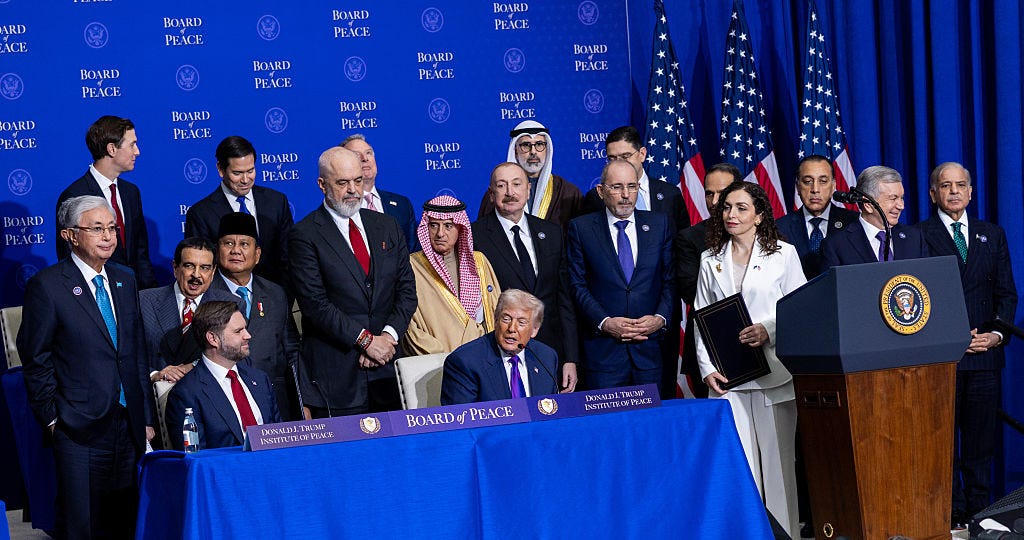
Likewise, Trump also announced that five countries—Albania, Indonesia, Kazakhstan, Kosovo, and Morocco—have agreed to participate in Gaza’s “international stabilization force,” while Egypt and Jordan have agreed to support the training of a Palestinian police force for the territory in conjunction with the stabilization force’s efforts. To my knowledge only Indonesia has committed to send a specific number of personnel—8000—and it remains unclear whether any of these countries will be comfortable with their soldiers attempting to disarm Hamas, as still seems to be the expectation.
IRAN
As he was inaugurating his “Board of Peace,” Donald Trump told reporters on Thursday that he intends to decide whether or not to start a war with Iran within ten days. He later extended that to “10-15 days, pretty much maximum.” That timeframe, especially at the maximum end, roughly corresponds with the expectation that Iranian negotiators will be producing a new set of proposals within two weeks after Tuesday’s meeting in Geneva. But it also allows a bit more time for the US military to finish amassing what is now its largest deployment in and around the Middle East since the 2003 invasion of Iraq. So I don’t think we can read anything into Trump’s intentions. There’s also the possibility that he’s lying—he was making similar statements last year right up to the threshold of the “12 Day War,” so there’s no reason to give him the benefit of the doubt.
The Wall Street Journal added a new wrinkle to this story on Thursday afternoon when it reported that Trump “is weighing an initial limited military strike on Iran to force it to meet his demands for a nuclear deal.” If he opts to go that route then the 10-15 day timeframe may go out the window, as he might want to conduct this “limited” attack soon in order to influence the negotiations. The notion that the Iranian government would continue to negotiate in that scenario strikes me as fanciful, but I suppose anything is possible. If the Iranians walked away from negotiations or simply refused to cave to Trump’s pressure the result would be the war that Trump seems to want anyway, so he may see it as a no-lose proposition.
Airlines are reportedly canceling flights into Iran and some have begun steering clear of Iranian airspace, which are costly steps to take if there’s only a suspicion of conflict so make of that what you will. There is apparently a move within the US House of Representatives led by Ro Khanna (D-CA) and Thomas Massie (R-KY) to force a vote on a war powers resolution that could constrain Trump if it passes. The chances of it passing are probably minimal and if it were to pass Trump could simply ignore it and see what happens.
ASIA
SOUTH KOREA
The Seoul Central District Court convicted former South Korean President Yoon Suk-yeol of insurrection on Thursday, sentencing him to life in prison. The case of course stems from Yoon’s attempted self-coup back in December 2024, a charge his defense attempted to refute by arguing that everything he did was within presidential authority and did not rise to the level of attempting to overthrow the government. He may appeal. Prosecutors had sought the death penalty.
JAPAN
The Japanese House of Representatives formally reelected Takaichi Sanae as the country’s prime minister on Thursday, following her coalition’s landslide victory in this month’s snap election. With her new legislative supermajority Takaichi is expected to pursue closer relations with the US, higher military spending, and a right-wing social agenda.
AFRICA
SUDAN
A new United Nations report levels the charge of genocide at Sudan’s Rapid Support Forces militant group:
A “campaign of destruction” in October by Sudanese paramilitary forces against non-Arab communities in and near a city in the country’s western region of Darfur shows “hallmarks of genocide,” UN-backed human rights experts reported Thursday, a dramatic finding in the country’s devastating war.
The paramilitary Rapid Support Forces – which are at war with the Sudanese military – carried out mass killings and other atrocities in the city of El-Fasher after an 18-month siege during which they imposed conditions “calculated to bring about the physical destruction” of non-Arab communities, in particular the Zaghawa and the Fur communities, the independent fact-finding mission on Sudan reported.
The Trump administration blacklisted three RSF commanders on Thursday over atrocities committed during the Al-Fashir campaign.
An RSF drone strike killed at least one civilian in the town of Kurmuk on Wednesday evening. The RSF and the Sudan People’s Liberation Army-North are advancing on Kurmuk amid their new offensive in southeastern Sudan’s Blue Nile state. The town is strategically positioned near the Ethiopian border.
NIGERIA
Militants stormed through at least eight villages in northwestern Nigeria’s Kebbi state on Tuesday, killing at least 34 people in total. Authorities believe that the attackers were members of the Lakurawa, a jihadist group that is thought to have ties to Islamic State but whose cohesion and allegiances are still not well understood. The US military’s Christmas airstrikes in Nigeria targeted alleged Lakurawa camps.
SOMALIA
According to AFP, the Somali government’s project of supporting local fighters against al-Shabab has not necessarily benefited the residents of “liberated” areas:
In 2022, the government started arming clan militias to fight off Al-Shabaab, the local Al-Qaeda affiliate that has waged war against the state for two decades.
The offensive saw major successes against the insurgents, but locals like Hersi say the militias that replaced them proved to be even worse.
“We can’t even breathe because of the fear of the militias,” said Hersi, who regularly drives goods lorries from Bosaso port in the far north of Somalia to Hiiraan province where he lives.
“At every checkpoint, we are forced to stop at gunpoint, we are extorted, and we risk losing our lives even when we pay,” he told AFP.
“These were the same ones we supported, but now we fear them more than anything.”
While al-Shabab is extortionate and often brutal it does operate within some semblance of order. The clans do not, which means that residents can find themselves randomly being shaken down by armed, drunk men (an example from that piece) who don’t seem to be operating under any sort of rules at all.
EUROPE
GREECE
The Greek government has struck a deal with US energy firm Chevron and a “consortium” of other firms to explore the waters south of Greece for potential energy deposits. The agreement has sparked outcry from the governments of Turkey and Libya (the western Libyan version), who made their own deal in 2019 to divide the eastern Mediterranean that is not recognized by Athens in large part because it basically ignores Greek maritime claims around the island of Crete.
It’s been a while since overlapping claims in the eastern Mediterranean were regularly generating headlines, but World Politics Review’s Jonathan Gorvett reports that tensions in the region are starting to escalate again:
Turkish President Recep Tayyip Erdogan and Greek Prime Minister Kyriakos Mitsotakis struck an optimistic tone at a meeting Wednesday in Ankara, with Erdogan noting the disputes between the two countries are “complex” but “not insurmountable.” Mitsotakis agreed, suggesting that “it is time now to lift every threat, formal and substantive, in our relations.”
Yet despite the warm smiles and handshakes, a range of disputes continues to cast a shadow over regional relations in the Eastern Mediterranean.
One of the sources of unease for Turkey is the recent flurry of defense agreements that Greece has signed with Israel and the Republic of Cyprus, each of which have their own frictions with Ankara. The deals raise questions over how far they may go—and at which country they might be aimed.
Nothing has gotten terribly heated so far, but Gorvett suggests that May’s parliamentary election in Cyprus may be a flashpoint, particularly if the right-wing and anti-Turkish National People’s Front emerges as a major legislative bloc.
(Foreign Exchanges readers can sign up for WPR’s free newsletter here and try out an all-access subscription free for 30 days, then $35 off—$77/year—after that.)
UNITED KINGDOM
Donald Trump hopped on social media on Wednesday to once again lambaste the UK government for “giving away” the island of Diego Garcia, home to one of the US military’s largest overseas facilities. It’s been about a month since he last brought this up and he’s still wrong—the UK’s agreement to cede the Chagos Islands to Mauritius includes a 99 year lease (i.e., effectively indefinite) that will preserve its control over Diego Garcia. The US State Department had literally signaled US support for that agreement on Tuesday, one day before Trump’s rant. It was initially unclear what set him off, but The Guardian is reporting that he’s angry because the UK government told the Pentagon that it could not use Diego Garcia for an unprovoked attack on Iran. The Diego Garcia facility is operated by the US but the base itself belongs to the UK, giving it a veto over the facility’s use. Trump’s tantrum may wind up quashing the UK-Mauritius deal, which again had actually secured the continued US use of Diego Garcia.
Elsewhere, UK authorities arrested Andrew Mountbatten-Windsor—the former Prince Andrew before he was stripped of that title last year—over his ties to Jeffrey Epstein. Specifically he’s been charged with misconduct in public office over allegations that he passed confidential information to Epstein back in 2010. Between this and the Peter Mandelson story, the Epstein case seems to be hitting the UK establishment particularly hard in recent weeks.
AMERICAS
ARGENTINA
AFP reports on another general strike in Argentina:
Shops and supermarkets closed, flights were canceled and garbage piled up Thursday as Argentine workers staged their fourth general strike of President Javier Milei’s term, some clashing with police.
The few buses running in Buenos Aires were nowhere near full, although car traffic was unusually heavy as many workers observed the 24-hour strike against a contentious labor reform.
Dozens of flights were canceled and train stations were left deserted with only a handful of buses running, AFP observed.
On roads leading into the capital, small groups of protesters blocked traffic.
Later in the day, several thousand demonstrators gathered outside parliament, where a few dozen participants engaged in running battles with police, throwing bottles and stones.
Officers replied with tear gas, water cannons and rubber bullets to clear the area.
PERU
The Peruvian Congress elected Free Peru politician José María Balcázar as the country’s new interim president on Thursday, replacing the recently ousted José Jerí. Balcázar is the eighth president Peru has had since July 2016. He will soon give way to the ninth, as Peruvian voters will choose a new officeholder in April’s general election. Well, maybe I’m being optimistic. Balcázar is already under fire for past statements that seem to extol the virtues of child marriage and underage sexual activity. He says those statements have been taken out of context but it’s not exactly an ideal first headline for kicking off his presidential term. There are also corruption charges swirling around him, which is what saw Jerí drummed out of office after just four months. So it remains to be seen whether his presidency can survive until April.
CUBA
Axios’s Mark Caputo reported on Wednesday that US Secretary of State Marco Rubio “has been holding secret talks with” Raúl Guillermo Rodríguez Castro, “the grandson and caretaker” of Cuban grandee (or in Caputo’s words “aging de facto dictator”) Raúl Castro. In this reporting Rubio believes the younger Castro is “business-minded” and disdainful of communism, and would be interested in “rapprochement” with the US. He’s prominent enough that he could emerge as a new Cuban leader if someone were to arrange some sort of governmental upheaval in Havana—hypothetically, of course.
Drop Site reported earlier this month that Rubio has been lying to Donald Trump when he says there are ongoing negotiations between Cuban and US officials and Caputo’s reporting muddies that picture a bit, though there’s no indication that these contacts with the younger Castro are in any sense official government-to-government negotiations. Instead it sounds like Rubio is looking for someone whom the US could place in power in Havana who would have enough credibility to run the country while also being a compliant US proxy. This is similar to the administration’s approach in Venezuela, though here there’s not really a singular Nicolás Maduro-esque figure to kidnap. Castro would be the Cuban Delcy Rodríguez.
UNITED STATES
Finally, there were a few other highlights/lowlights from Thursday’s “Board of Piece” meeting to mention. Notably one of them involved the UN—despite having established the board as an obvious UN rival, Donald Trump said during the conference that the US will “help them money-wise, and we’re going to make sure the United Nations is viable.” Later in the day the UN revealed that it received $160 million from the US last week. The US owes $4 billion in past UN dues, or I guess $3.84 billion now, just to put that in perspective.
By way of additional perspective, Trump says he’s going to sock $10 billion in US funding into the board to help it get going. That’s substantially more than the US is obliged to spend on regular UN dues per decade. And Responsible Statecraft’s Thomas Cavanna argues that it may wind up being a massive waste of money:
Although the Board was initially conceived to address the Gaza crisis, its newly released Charter criticizes “institutions that have too often failed” and “seeks to promote stability, restore lawful governance, and secure enduring peace in areas affected or threatened by conflict.”
Thus, as President Trump suggested, the Board of Peace targets the U.N., which Washington regards as a bloated bureaucracy rife with ideological bias.
Yet those wide-ranging ambitions could prove a foreign policy distraction for Washington, honing in on issues that have no real bearing on vital U.S. interests. For example, Trump has already expressed his desire to resolve the Egypt-Ethiopia conflict over the Grand Renaissance Dam, implied that the Board might assume some of the responsibilities of the 66 international organizations that Washington left in early 2026, and claimed that it could “do pretty much whatever [its members] want to do.”
The risk of overstretch is compounded by the Board’s questionable ability to deliver. The informal and exclusive nature of minilateral organizations has consistently led to suboptimal efficiency and insufficient legitimacy.
But the Board of Peace’s characteristics may exacerbate this problem. Although its charter promised “more nimble and effective” approaches, it lacks enforcement, dispute-resolution, and accountability mechanisms, as well as a structure that enables good governance.
Needless to say, the centralization of decision making authority in a single person (Trump, who visibly fell asleep during the conference) also does not augur well for the board’s success.