

You’re reading the web version of Foreign Exchanges. If you’d like to get it delivered straight to your inbox, sign up today and get 40% off on your first year:
LIVESTREAMING NOTE : Don’t forget to join Elizabeth Urban of Islamic History for the Curious and me next Tuesday (8/25) at 8 PM eastern for the second in our new monthly livestream series. This month I’ll be asking Elizabeth about pre-Islamic Arabia and we will take your questions. Find us in the Substack app or bookmark the link so you won’t miss it!
TODAY IN HISTORY
August 22, 1153: A Crusader army captures the city of Ascalon (modern Ashkelon) from the Fatimid Caliphate, ending a nearly seven month siege. Ascalon had been a priority for the Crusaders since the First Crusade, and its importance had only grown since then as it served as a Fatimid beachhead into Crusader territory and was the main point of origin for Fatimid raiding parties. With brief interruptions the city remained in Crusader hands until the Egyptian Mamluk Sultanate destroyed it in 1270 as part of its wider and ultimately successful campaign to eliminate the Crusader kingdoms altogether.
August 22, 1864: An international convention held in Geneva produces a treaty outlining humane “rules” of war, including provisions for the treatment of sick and wounded soldiers. That treaty would subsequently be amended and expanded four times and is the basis of the First Geneva Convention, which was adopted along with the other three Geneva Conventions in 1949.
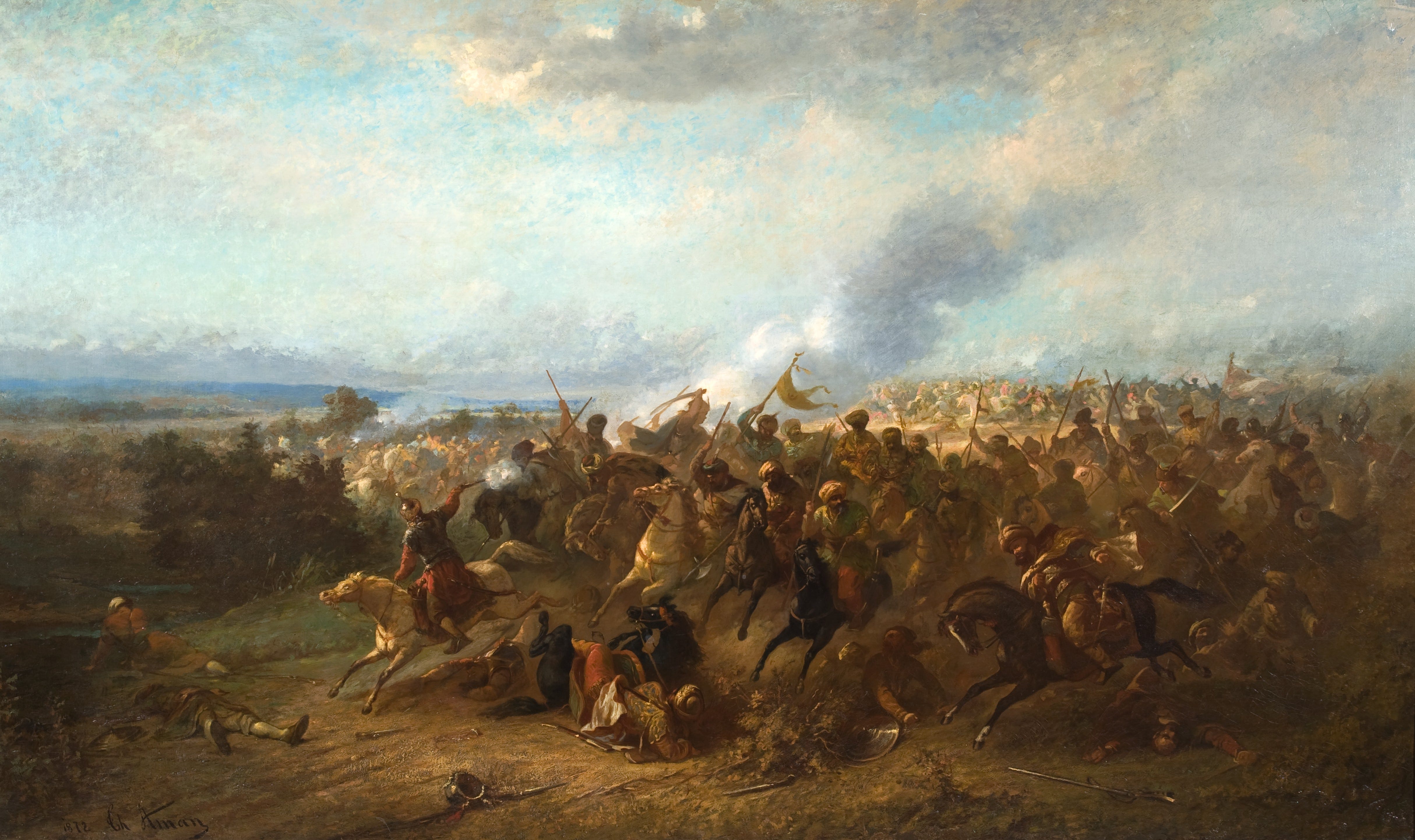
August 23, 1514: The Ottoman Empire decisively defeats a would-be rival, the nascent Safavid kingdom in Iran, at the Battle of Chaldiran. The engagement’s lopsided outcome ended any notion of a Safavid threat to the Ottomans and reportedly sent Safavid ruler Ismail I into a personal crisis from which he never entirely recovered.
August 23, 1595: An outnumbered Wallachian army under Prince Michael “the Brave” defeats an Ottoman army under Grand Vizier Koca Sinan Pasha at the Battle of Călugăreni, today located in southern Romania. Michael had to retreat afterward due to the Ottomans’ decisive advantage in numbers, but the victory became an important symbolic event in Romanian national history. This battle was part of the 1593-1606 Long War between the Ottomans and Habsburgs, which ended inconclusively but did stabilize the Ottoman-Habsburg frontier for several decades.
August 23, 1939: The Nazi German and Soviet governments sign the Molotov–Ribbentrop Pact, a nonaggression treaty that included an agreement to divvy up parts of Eastern Europe. The accord grew out of negotiations on an economic cooperation agreement and Soviet concerns about a potential war with Germany (and the reliability of France and the UK as possible allies). The pact paved the way for the Nazi invasion of Poland on September 1, which sparked World War II, but relations between the two countries broke down over the next several months and the Nazis terminated it when they invaded the USSR in June 1941.
MIDDLE EAST
SYRIA
The Israeli military (IDF) bombed a “civilian car” south of Damascus on Saturday, wounding at least one person. It later claimed to have been attacking a “terrorist” of unknown description who was somehow threatening Israeli soldiers. That incident notwithstanding, Axios reported on Sunday that Syrian Foreign Minister Asaad al-Shaibani and Mossad director Roman Gofman “met Sunday in an effort to lower the temperature between the countries” in the wake of the IDF’s attack on Abu Duhur airbase on Tuesday. It’s unclear whether they made any headway.
You can probably put this in the “who cares” file, but US ambassador to Turkey/Syria envoy Tom Barrack put himself in a bit of hot water on Friday when he said in a podcast interview that the Israelis “still occupy the Golan against the UN resolutions, against all of the international order, which has said the Golan is Syria’s.” As far as the Israeli government is concerned it has annexed the Golan, and Donald Trump adopted that position as official US policy during his first term. So while Barrack was technically right he was also out of step with his boss (or bosses, depending on your perspective). He reversed himself on Sunday in comments to the AP but there is some chance that he may face additional consequences.
ISRAEL-PALESTINE
The IDF killed at least two people in Gaza from Friday to Saturday and three more on Sunday, one of them a four year old child. In the West Bank, soldiers and settler militants wounded at least 19 people in multiple attacks across the territory on Saturday. For those who are interested, Jasper Nathaniel has published an interview with Loui Ridi, one of the Palestinian homeowners currently being besieged by militants and IDF soldiers in the West Bank village of Qusra.
NOTUS’s Akbar Shahid Ahmed reports that there is little reason to expect the Trump administration to oppose the Israeli government’s E1 settlement and its broader effort to cleave off East Jerusalem from the West Bank:
A new Israeli government effort to build settlements near Jerusalem could lead to another uptick in Israeli-Palestinian tensions, and there’s little indication the Trump administration will use its influence to limit rising instability.
Israel’s housing ministry opened bidding this week for companies to build more than 1,200 housing units in the West Bank’s E1 zone, part of occupied Palestinian territory where Israeli settlements are illegal under international law. Constructing Israeli homes in the region would block a key route between the north and south sections of the territory and separate it from East Jerusalem, where more than 300,000 Palestinians live and where diplomats have long envisioned a capital for a Palestinian state alongside Israel.
U.S. allies quickly condemned the move and suggested action to stop the land grab. Insiders expect a far more muted American response.
When NOTUS asked a U.S. official who works on Middle East policy about the chances of the Trump administration blocking the E1 move, the official responded: “Zero.”
The U.S. embassy in Jerusalem is “in lockstep” with Israeli Prime Minister Benjamin Netanyahu’s government, said the official, who was not authorized to speak on the record.
The indifference likely extends to any Israeli attempt to change the status quo in Jerusalem, for example by seizing control of the Haram al-Sharif/Temple Mount complex from the Jordanian-run waqf that administers it now.
IRAN
Pakistani military boss Asim Munir is reportedly heading to Iran on Monday to try to revive negotiations toward ending the ongoing Iran-US standoff. It’s unclear whether he’ll be bringing a new proposal with him though it’s hard to imagine Munir making an in-person visit to Tehran just to touch base with Iranian leaders. Still, I wouldn’t expect any breakthroughs.
At present we’re still waiting to see what (if anything) the Trump administration has planned as part of “Maximum Pressure 2.0” and how Iranian leaders intend to respond to it. Iranian Supreme National Security Council Secretary Mohsen Rezaee threatened “seismic” repercussions for any country that participates in MP2 on Saturday, including a promise to block all oil from leaving the Persian Gulf region via any route should Gulf Arab states join the effort. That would have to be done militarily. On a related note Tehran reportedly allowed a number of Iraqi oil tankers to transit the Strait of Hormuz recently at the request of the Iraqi government. The concession emerged from Iranian parliament speaker Mohammad Bagher Ghalibaf’s multi-day visit to Iraq over the past week.
In news that would be fairly hilarious if true, Lebanon’s Al Mayadeen outlet (which is generally considered close to Hezbollah) is apparently reporting that the governments of Pakistan, Saudi Arabia, and Turkey have invited Iran to join their “Mecca Agreement” mutual defense alliance. I would assume that this is not true, or at least that if it is true the offer was made contingent on the Iranian government settling its conflict with the US and making a number of other adjustments to its foreign/security policy, like ending its support for Iraqi militias and Yemen’s Ansarullah group. It’s hard to imagine the Iranians trusting the other members of the alliance enough to take those kinds of steps. But even if the offer were made with major prerequisites attached it would still represent a massive upheaval in regional dynamics that would not bode terribly well for the US.
ASIA
THAILAND
No fewer than 51 “coordinated arson and incendiary attacks” across southern Thailand left at least three people wounded on Saturday evening, according to the Thai military. Most of the attacks and all three of the casualties took place in Narathiwat province but additional incidents were reported in Pattani and Yala provinces. Several of the attacks targeted local government offices. This was presumably the work of ethnic Malay rebels, though there’s been no claim of responsibility made as yet.
CHINA
The China Manned Space Agency announced on Sunday that it is postponing the Chang’e-7 mission, which was supposed to take off soon and, among other things, search for ice (specifically frozen water as opposed to, say, dry ice or methane ice) at the moon’s southern pole. It did not give a reason for the postponement except to say that the decision was taken after a “comprehensive assessment” determined that the mission did not meet launch conditions, whatever those might be.
AFRICA
SUDAN
The Chadian military accused its Sudanese counterpart of carrying out a drone strike on a “convoy of vehicles” inside Chad on Saturday. I have not seen any indication of casualties. The Sudanese military (SAF) has carried out attacks along the Chadian-Sudanese border, sometimes straying into Chadian territory, in the past. It has accused Chad’s government of funneling supplies to the Rapid Support Forces militant group in Darfur.
Elsewhere, fighting between a faction of the Sudan People’s Liberation Movement-North and the Otoro community has continued in Sudan’s South Kordofan state despite a RSF-brokered ceasefire that was declared on Friday. Otoro leaders accused the SPLM-N on Saturday of shelling the town of Kauda, which the two parties have been disputing violently going back to at least May.
SOMALIA
According to UNICEF, the number of Somali children admitted to medical facilities for malnutrition-related reasons rose by 32 percent in the first half of this year. It’s warning that aid cuts have taken a severe toll on health and nutrition programs and may force the closure of up to 618 Somali health facilities by the end of 2026. Doctors Without Borders claimed earlier this month that funding for alleviating malnutrition in Somalia has dropped by over 80 percent.
DEMOCRATIC REPUBLIC OF THE CONGO
The Congolese government and the M23 militant group issued a statement on Saturday announcing that they’ve “agreed on a roadmap for peace talks.” This apparently includes mechanisms for reporting ceasefire violations and for resolving any challenges in implementing the “framework” deal that they reached back in November. The parties hashed out this roadmap in Switzerland earlier this month along with representatives from the African Union Commission, Qatar, Switzerland, Togo, and the United States. The ceasefire still seems to be aspirational and there are reports of ongoing fighting in the eastern DRC, though a monitoring team is supposed to arrive in the region on Monday.
Meanwhile, the death toll from the eastern DRC’s ongoing Ebola outbreak has passed 2500 according to the United Nations, and health authorities are beginning a clinical trial of the Ervebo vaccine. Ervebo was developed to counter the Zaire strain of Ebolavirus and it’s unknown whether it will have any effect on the Bundibugyo strain that is responsible for this outbreak. World Politics Review’s Mohamed Keita and L.A. Mustafa attribute the scope of this outbreak to the DRC’s “governance crisis”:
Even before the outbreak Congo’s health system was contending with 14.9 million people in need of humanitarian assistance, a projected 9 million displaced, and drastic cuts in international aid from the U.S. and other donors. But the [Félix] Tshisekedi administration’s spending priorities must also be accounted for. Since he took office in 2019, public expenditures on health have steadily hovered between 3.5 percent and 4 percent of GDP, while military spending has more than doubled in the same period. This reflects Kinshasa’s unfortunate habit of prescribing a militarized response to what is at its core a multidimensional governance crisis.
Ituri is a live demonstration of this failed approach. Since 2017, the province has seen a surge in communal violence among militias aligned with rival ethnic communities, as a constellation of other armed groups prey on civilians and battle the Congolese military. In 2021, Tshisekedi declared an emergency “state of siege” that was supposed to last for 30 days, but the measure has been continually renewed since then, effectively placing the province under martial law. This state of affairs has continued despite a 2022 U.N. experts’ finding that security and humanitarian conditions had deteriorated under military rule, not to mention repeated calls by elected representatives from Ituri to lift the emergency measure.
In the weeks leading up to the official detection of the epidemic, concerns surfaced about Ituri authorities’ inability to stem escalating massacres of civilians by armed groups like the Islamic State-aligned Allied Democratic Forces (ADF) and the CODECO militia. After the outbreak’s declaration, the general who has governed Ituri since 2021, Johnny Luboya, called the epidemic a second war front and asserted that the principles of military operation “are almost the same as those applied in medicine.” However, neither he, nor anyone under his command, took responsibility for months of unexplained deaths, and nobody inside the reporting chain had to answer for it.
Luboya’s rule has been characterized by opacity surrounding the use of public funds, reports of extortion and abuses by soldiers, and the illegal deployment of troops and police to protect mining sites at the expense of civilian protection. In June, Tshisekedi replaced Luboya with another general, Gaby Kasongo Mulumba. The change appeared to respond not to local grievances but to pressure from neighboring Uganda, whose army chief Gen. Muhoozi Kainerugaba had been publicly demanding Luboya’s removal, accusing him of obstructing Ugandan troops operating in the area against the ADF.
As Keita and Mustafa go on to point out, the abuses of militarized governance may be part of the reason why residents in the affected area haven’t been terribly eager to collaborate with health authorities. They also compare the government’s mishandling of this outbreak with the far more efficient manner in which it has pursued extending Tshisekedi’s time in office, which is supposed to end in 2028. That doesn’t paint the Congolese government in a terribly good light.
EUROPE
RUSSIA
The Russian government may be quietly downgrading its diplomatic relations with the United Kingdom. It turns out that Moscow withdrew its ambassador, Andrey Kelin, from London last month and has not yet replaced him. The online list of staff in Russia’s UK embassy does not currently include anyone beyond the chargé d’affaires level. It could be that the Russian government just hasn’t gotten around to naming a new ambassador, but the lack of clarity is noteworthy inasmuch as UK-Russian relations are not in a terribly good place at the moment amid reports that the UK has been supplying long-range attack drones to Ukraine.
UKRAINE
Russian strikes killed at least seven people in Ukraine on Saturday, one day after the “double-tap” drone strike on a shopping center in Kryvyi Rih that killed at least 16 people. Ukrainian strikes killed at least ten people across Russia. On Sunday a Russian bombardment killed at least three people in Ukraine’s Kharkiv oblast.
AMERICAS
BOLIVIA
Several days ago Bolivian authorities arrested a major figure in the resurgence of the far-right across Latin America:
The businessman and political consultant Fernando Cerimedo, 42, had been working as an adviser to the Bolivian president, Rodrigo Paz Pereira, and was one of the main strategists behind Javier Milei’s campaign in Argentina’s 2023 presidential election.
He has previously been described as Maga’s man in Latin America – a reference to Donald Trump’s Make America Great Again movement – and is credited with helping secure the US president’s endorsement of the rightwing Nasry “Tito” Asfura, who won Honduras’s presidential election in December.
On Tuesday morning, Cerimedo landed in Santa Cruz de la Sierra, in Bolivia, and was arrested before boarding another flight reportedly bound for Buenos Aires, Argentina. According to police, he was detained on suspicion of ordering a gun attack on Nadia Beller, a Bolivian lawyer who local media reported had been in a relationship with Cerimedo – who is married – since last year.
It’s safe to say that Paz would have preferred not having to arrest Cerimedo, which was part of a difficult week for him in which he also had to sack Economy Minister José Gabriel Espinoza after the Bolivian Congress voted to remove him amid a corruption scandal.
CANADA
US-Canadian trade talks collapsed without a deal on Friday night, leaving the US on the verge of imposing 50 percent tariffs on some $20 billion-plus in Canadian products and Canadian Prime Minister Mark Carney pledging to retaliate on a “dollar for dollar” basis starting on September 8. Carney attributed the collapse to “last-minute terms” demanded by the US side, as well as a sense that the US signature on any agreement would be “written in pencil” (i.e., unreliable), and suggested that the two countries are now “at war.”
The Trump administration has been insisting that it’s simply responding to years of discriminatory trade policies by the Canadian government, but if Carney’s description of US demands—including an effective veto over Canada’s trade deals with other countries and unspecified measures that would “restrict our protections of our language, our culture, and in effect, our sovereignty”—are accurate then they go well beyond simply redressing some basic commercial disagreements. There are no further negotiations planned so it sounds like the tariffs are inevitable at this point. Longer term the prospects for successfully renegotiating the US-Mexico-Canada free trade agreement seem pretty dismal.
UNITED STATES
Finally, The New York Times reports on the Trump administration’s latest human trafficking atrocity:
At least five people who were deported by the United States to Liberia but resisted getting off the plane were flown to Equatorial Guinea on Thursday, according to a U.S. official and lawyers familiar with their cases.
It is the first reported case in the administration’s so-called third-country deportation campaign of migrants refusing to get off a deportation flight in a country to which they had no ties and being flown to another such country.
The rapid switch shows how widely the U.S. government has cultivated countries to serve as destinations for deportation through a secretive deal-making campaign.
The deportees who resisted were part of a deal struck by the government of Liberia with the Trump administration to take up to 1,200 deportees from the United States in the next year.
Among the migrants sent to Equatorial Guinea, in Central Africa, from Liberia, in West Africa, were four Cuban men, a Brazilian person and a Cameroonian woman, said Alexandra Smolyar, a lawyer at Asian Americans Advancing Justice Atlanta, a legal group that represents migrants deported to Equatorial Guinea as part of a separate deportation deal.
Three of the Cuban men spoke to the NYT and described US Immigration and Customs Enforcement officers roughing them up in Liberia before putting them back on the plane and telling them that they would return to the US. They were then flown to Equatorial Guinea instead, and they were then taken in handcuffs to a hotel in the city of Malabo where people trafficked from the US are apparently being held under armed guard.