

You’re reading the web version of Foreign Exchanges. If you’d like to get it delivered straight to your inbox, sign up today:
TODAY IN HISTORY
April 30, 1803: US representatives Robert Livingston and James Monroe and French representative François Barbé-Marbois sign the Louisiana Purchase Treaty in Paris. The treaty ceded France’s vast Louisiana Territory in North America to the United States, roughly doubling the young nation’s size, in return for $15 million. Livingston and Monroe intended to negotiate the purchase of the port city of New Orleans and were prepared to pay up to $10 million just for the one city. But Napoleon decided to sell the entire territory because he needed the money and because the Haitian Revolution had thrown his colonial plans for the Americas into disarray. Most of the Louisiana Territory wasn’t really Napoleon’s to sell, as it still belonged to Indigenous tribes, but in purchasing it the US bought the “right” to acquire that land by whatever means it chose.
April 30, 1975: The North Vietnamese army and the Viet Cong capture Saigon, bringing the Vietnam War to a close. The North Vietnamese had begun their assault on the city the day before, when the remaining US personnel in Saigon began an evacuation known as “Operation Frequent Wind” that cleared out the US embassy and moved some 7000 US and Vietnamese nationals out of the country in the largest helicopter evacuation in history. The North Vietnamese government, which wasn’t really the “North” Vietnamese government anymore, renamed Saigon Hồ Chí Minh City, and this date is commemorated annually in Vietnam as Reunification Day.
INTERNATIONAL
Reporters Without Borders released its annual World Press Freedom Index on Thursday and it doesn’t paint a very pretty picture:
For the first time since RSF started producing the index in 2002, more than half of the world’s countries fall into the “difficult” or “very serious” categories for press freedom – “a clear sign that journalism is increasingly criminalised worldwide”.
Only seven mostly Nordic countries are ranked with “good” press freedom, with Norway, the Netherlands and Estonia in the top three. France ranks 25th with a “satisfactory” score, while the United States ranks 64th with a “problematic” score, falling seven places since President Donald Trump took office.
RSF reports that Trump “has turned his repeated attacks on the press and journalists into a systematic policy”, citing the detention of Salvadoran journalist Mario Guevara, who was later deported, while he was documenting a protest against immigration raids, as well as the suspension of several notable public media institutions.
In Latin America, RSF highlighted the dramatic fall of Javier Milei’s Argentina (98th, -11) and of El Salvador (143rd), which has dropped 105 places since 2014 following the launch of a war against the Maras criminal gangs.
The press freedom NGO said that “Eastern Europe and the Middle East are the two most dangerous regions for journalists in the world, as they have been for 25 years”, notably putting Russia (172nd) and Iran (177th) in the bottom 10.
It added that wars and restrictions on access to information are some of the driving factors for the decline in press freedom. It cited Israel’s attacks on journalists in Gaza, the occupied West Bank and Lebanon as an example of this, ranking Israel 116th.
MIDDLE EAST
TURKEY
Kurdistan Workers’ Party (PKK) cofounder Murat Karayılan accused the Turkish government of having “frozen” its peace process with the militant group in an interview published on Thursday. Essentially it seems Ankara has pocketed the PKK’s concessions with respect to its disarmament and eventual dissolution, and now that the onus is on Turkish officials to make concessions to the PKK they’ve decided they’re not interested. This was apparent months ago, but to have a major PKK figure like Karayılan say it openly is a significant development. Turkish President Recep Tayyip Erdoğan insisted earlier this week that “the process is proceeding as it should,” which doesn’t seem to be how the PKK sees it.
LEBANON
The Israeli military (IDF) killed at least 28 people across southern Lebanon on Thursday, marking the highest single day casualty figure yet under the ostensible ceasefire. Lebanese President Joseph Aoun and parliament speaker Nabih Berri both condemned the continued Israel assault, though their condemnation remains strictly rhetorical. That said, according to Reuters there is a “rift” emerging between Aoun and Berri, who by virtue of their positions represent the country’s Maronite and Shiʿa blocs, respectively, over continuing Lebanese-Israeli “peace” talks. Aoun is reportedly prepared to normalize relations with Israel in return for a full peace deal while Berri wants a modest nonaggression agreement. Their lack of cohesion is reportedly making it difficult for Saudi Arabia, which has involved itself in the peace process on Lebanon’s behalf, to establish diplomatic parameters. Notably the Saudis appear to be concerned that Aoun is moving too quickly to appease the Israelis.
Meanwhile, Haaretz reports that Israeli soldiers are increasingly pressed by Hezbollah drone attacks and are starting to criticize a mission that seems less about battling militants and more about permanently depopulating southern Lebanon:
Soldiers in the field told Haaretz that much of what they do now isn’t directly fighting Hezbollah, but systematically destroying buildings in villages in southern Lebanon.
“The only mission is to continue the destruction,” one officer said. “There is no other mission.” The IDF believes this systematic destruction of Shi’ite villages will prevent villagers from returning home.
Another commander said that, contrary to the IDF’s claim that the soldiers are destroying “terrorist infrastructure” in these villages, the destruction goes well beyond that. “It isn’t terrorist infrastructure; we’re destroying everything,” he said. The IDF terms this plan for demolishing Shi’ite villages in southern Lebanon “Operation Silver Plow.”
As part of this plan, a polygon is marked out for each of the units in the area showing the section they are responsible for razing. At the end of every day, there’s an assessment of what was accomplished, and every commander is required to report how many homes he destroyed. Each unit is assigned a number of bulldozers operated by civilian contractors that it is required to protect.
ISRAEL-PALESTINE
The IDF killed at least four people in Gaza on Thursday, according to the territory’s health officials. To my knowledge there’s been no comment from Israeli personnel about those deaths.
Reuters reports on the rats that are now infesting Gaza’s displaced persons camps:
Doctors Without Borders released a new report this week accusing the Israeli government of using water as a “weapon of war” in Gaza. The territory is still suffering from severe water shortages more than six months after the start of the “ceasefire” that was supposed to alleviate its humanitarian crisis. Israeli officials insist that they’re letting more than enough water into the territory, but with Gaza’s water infrastructure mostly obliterated people are forced to rely on expensive and logistically challenging water deliveries. The infrastructure can’t be repaired because the Israelis won’t allow the necessary materials to enter the territory.
Elsewhere, the IDF intercepted a new Gaza aid shipment by the Global Sumud Flotilla in waters off the coast of Crete on Thursday. This was much further from Gaza than the IDF usually interdicts these fleets, putting it out in international waters and making the interception at least arguably an act of piracy. Israeli personnel abducted several people from the flotilla and said that it was planning to release them in Greece later in the day.
IRAQ
Donald Trump has apparently given his assent to Ali al-Zaidi, the presumptive incoming Iraqi prime minister. The Coordination Framework political coalition nominated Zaidi on Monday after a lengthy dispute between factions backing former PM Nouri al-Maliki (the bloc’s original choice) and incumbent Mohammed Shiaʿ al-Sudani. Trump’s opposition sunk Maliki’s candidacy so his approval was seen as necessary to ensure that Zaidi would get the job.
IRAN
There are a few items of note:
US Central Command boss Brad Cooper was scheduled to brief Donald Trump on Thursday about new military options with respect to Iran. As you may recall, Trump is now once again thinking about striking Iran, but only briefly and purely with the intention of advancing the negotiating process. This is the same logic that caused him to go to war with Iran in the first place, but hey, maybe it will work this time. It’s also possible that he’s trying to convince the Iranians that he might attack again, but for that threat to work the Iranians would actually have to fear the war’s resumption and I’m not sure that’s really the case. They may even view it as preferable to an indefinite US blockade.
The US State Department reportedly wants its diplomats to push their host governments to support another coalition to reopen the Strait of Hormuz. This one, the “Maritime Freedom Construct,” aims to “share information, coordinate diplomatically and enforce sanctions.” It would not be sailing ships through the strait so I question the efficacy of this approach. Trump keeps demanding that US allies simply “take” the strait, though nobody has taken him up on that dare yet.
Iranian Supreme Leader Mojtaba Khamenei issued another written statement on Thursday. The upshot is that he’s not prepared to open Hormuz and doesn’t think much of making any concessions to the US. I don’t think it’s worth dwelling too much on this sort of performance.
Friday will mark 60 days since Trump went to war with Iran, which should under the 1973 War Powers Resolution mean that the US Congress must vote on whether or not to allow him to continue the conflict. But don’t worry! There’s not going to be a vote, because House Speaker Mike Johnson has decided that the US and Iran aren’t at war anymore. Sure, technically a blockade is an act of war and the shooting could resume at any time, but…I’m sorry, I’ve lost my train of thought. The most important thing is that Congress won’t have to do its job. What a relief!
The Pakistani government is allowing countries (excluding India) to use its territory to ship goods overland to Iran, bypassing the US blockade. This will ease the blockade’s economic blow to some extent but not completely, given the inefficiency of overland shipping compared to its maritime variant. But it will also help establish Pakistan as more of a regional trade hub and boost its direct trade contacts with Iran, bypassing Afghanistan.
ASIA
PAKISTAN
Reuters reports on the plight of hundreds of thousands of Afghan nationals who are being expelled from Pakistan even as the war between those two countries makes it much more difficult for them to get to the border and cross into Afghanistan. The expulsions themselves are already painful, particularly for those whose families fled to Pakistan decades ago and who in many cases have never set foot in Afghanistan. But the closure of the border has left them stranded in long lines of traffic in Pakistan.
MYANMAR
The AP reports that Myanmar’s military may be reasserting itself:
A little more than a year ago, the government’s military was on the back foot in Myanmar ‘s bloody civil war, pushed out of great swaths of the country’s north by an alliance of seasoned militias, and forced into defensive action around the rest of the country by other established groups and new pro-democracy guerrillas.
Today the picture has changed.
With its ranks swollen by tens of thousands of new conscripts, the military, known as the Tatmadaw, has reversed some of its losses and appears poised to resume the offensive, while some opposition groups have left the fight and infighting and supply issues have weakened others.
The junta—that’s what it is, its recent pantomime of an election notwithstanding—has offered to engage in peace talks with those opposition groups. But despite a general level of exhaustion after more than five years of war, it’s not clear that any of them are prepared to take up that offer.
AFRICA
SUDAN
The New Humanitarian reports on the local solidarity that’s helping residents of the embattled city of El-Obeid survive Sudan’s ongoing civil war:
Home to a key army base, the city’s residents have endured drone attacks and a long-running siege imposed by the paramilitary-turned-rebel [Rapid Support Forces], while taking in more than a million displaced people who are living in camps and with host families.
Yet far from giving in, the population has revived long-standing traditions of communal solidarity while reinventing other aspects of everyday life to survive the onslaught.
Across the city, host families have welcomed in the displaced, religious networks and volunteer groups have set up community kitchens, and small clinics and community-run health points have stood in for a struggling health system.
New local food production – largely led by women – has taken root to ease shortages, while truck drivers have risked their lives to bring in supplies, using back roads that pass through remote villages and forests to avoid armed checkpoints.
“We carry the lives of families, not just goods,” said 48-year-old Mohammed al-Hassan, one of many transporters who use cars, tuk-tuks, donkey carts, and sometimes their own backs to bring in goods. He said he views the work as a “duty rather than business”.
The efforts of El Obeid’s residents – described to The New Humanitarian in interviews conducted over the phone – reflect a much wider story of local solidarity seen across all of Sudan’s states and cities for the last three years.
MALI
Following up on its shock offensive fighting alongside Azawad Liberation Front (FLA) rebels over the weekend, the jihadist group Jamaʿat Nusrat al-Islam wa’l-Muslimin (JNIM) now says it is imposing a blockade on the Malian capital city of Bamako. The group has been blocking fuel shipments from reaching the city since September, but cut a deal with the Malian junta last month to lift that restriction in return for a prisoner release. Now it sounds like they’re going to attempt a full blockade, with a spokesperson saying that “the only concession is being made for those already in Bamako to allow them to leave.”
NIGERIA
A new report from Amnesty International accuses the Nigerian government of setting up a deadly concentration camp for ethnic Fulani:
The Nigerian authorities must conduct a prompt, thorough, independent, impartial, transparent and effective investigation into the reported deaths of least 150 members of the Fulani community, most of them children, who have been arbitrarily detained by the Nigerian military in the north-central state of Kwara, Amnesty International said today.
An investigation by the human rights organization found that the victims were among 1,500 Fulani pastoralists who have been detained at the National Youth Service Corps (NYSC) Orientation Camp in Yikpata for the past three months. They were transported to the camp after being forced to leave their homes amid escalating attacks by armed groups in Kwara. Instead of finding safety, they face overcrowded and unsanitary conditions, restrictions on their movements, acute malnutrition and disease. At least 100 pregnant women at the camp are at risk of life-threatening complications due to a lack of adequate maternal care.
“Members of the Fulani community face persecution on two fronts – from armed groups and the military. Instead of receiving protection, they are being denied their rights to personal liberty, livelihood, movement, education and healthcare. We met people who described losing parents, siblings, spouses, children and grandchildren at the camp. Such tragedies only add to their suffering,” said Isa Sanusi, Director of Amnesty International Nigeria.
SOMALIA
The Somali government said on Wednesday that its forces had killed at least 22 al-Shabab fighters in an operation in the Lower Shabelle region.
DEMOCRATIC REPUBLIC OF THE CONGO
The Trump administration blacklisted former DRC President Joseph Kabila on Thursday. Kabila is allegedly working with the M23 rebel group and its Rwandan patrons, and suffice to say that his reemergence last year (after several years abroad) in the M23-controlled city of Goma didn’t do much to dispel that allegation. A Congolese military court subsequently sentenced him to execution in absentia. He’s still believed to be living in Goma and the US Treasury Department accused him of helping to finance M23’s operations.
EUROPE
RUSSIA
The governor of Russia’s Belgorod oblast, Vyacheslav Gladkov, said via social media on Friday morning that a Ukrainian drone strike had killed two teenagers in that province.
UKRAINE
What appeared to be an emerging diplomatic spat over a shipment of allegedly stolen Ukrainian grain heading for Israel was diffused on Thursday when its prospective importer refused to take delivery. The Israel Grain Importers Association announced that the Russian cargo vessel Panormitis will be required to find an alternative destination for its discharge, and maritime tracking data showed the vessel heading away from the Israeli port at Haifa. Ukrainian President Volodymyr Zelensky had accused the Israeli government of knowingly accepting Ukrainian grain as the Panormitis approached. It would have been the second Russian vessel to unload allegedly Ukrainian grain at Haifa this month. The Israeli Foreign Ministry rejected claims that it had backed down due to Ukrainian pressure and instead maintained its position that Kyiv had not offered any evidence to show that the grain was in fact taken from Russian-occupied parts of Ukraine.
Ukrainian military commander Oleksandr Syrskyi has instituted a maximum two-month deployment period for front line soldiers, amid a public scandal over the conditions they have been enduring. Relatives of soldiers in one Ukrainian brigade circulated pictures of their loved ones last week showing them in disturbingly emaciated condition. This forced the Ukrainian military to acknowledge that it has not been able to keep front line units supplied with food and water (to say nothing of ammunition and other materiel), a disruption it blamed on Russian drone strikes. The Ukrainians have experimented with using robotic devices (“ground drones”) to deliver supplies while minimizing the risk of casualties, but those devices are still frequently targeted by Russian strikes. The deployment limit could help—if the already overstretched Ukrainian military can actually implement it.
KOSOVO
Acting Kosovan President Albulena Haxhiu has scheduled the country’s next snap election for June 7. The contest became inevitable when parliament failed again to elect an actual president earlier this week. This will be Kosovo’s third parliamentary election in about 16 months.
AMERICAS
VENEZUELA
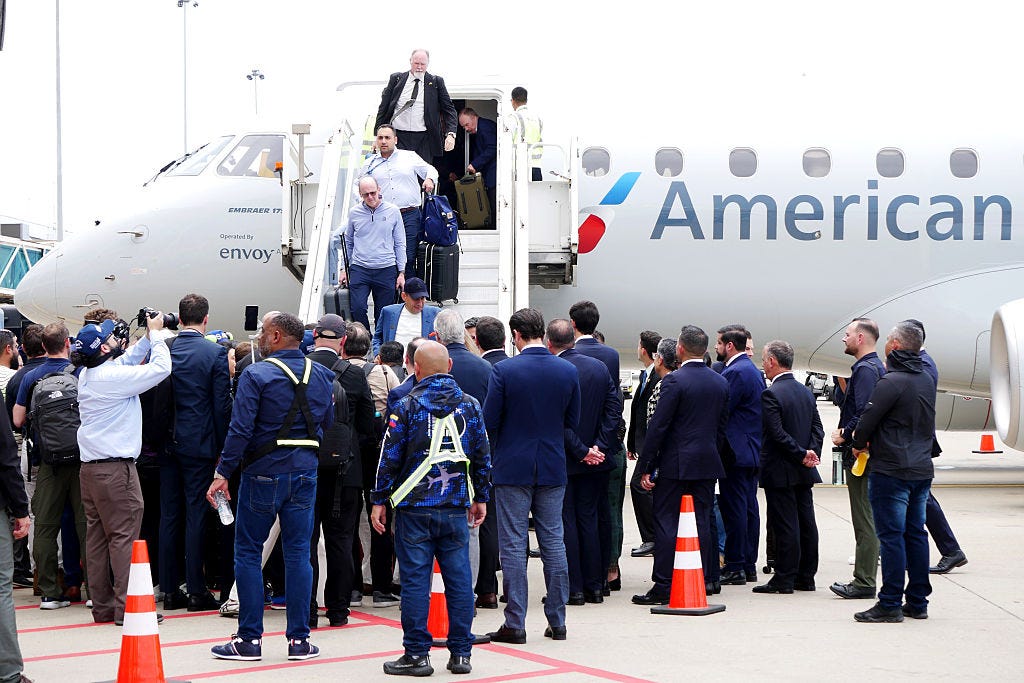
An American Airlines flight from Miami landed in Caracas on Thursday, which is noteworthy inasmuch as it was the first direct flight from the US to Venezuela since 2019. It marks another step toward fully normalizing bilateral commercial and diplomatic relations in this new post-Nicolás Maduro era.
CUBA
According to the AP the US fuel blockade is crippling Cuban agriculture:
Eduardo Obiols Sobredo struggles to feed Cubans young and old, a task even harder now because of a U.S. energy blockade that has caused sweeping water and power outages along with severe gas shortages.
“I feel like crying,” the 58-year-old farmer said. “It’s so sad to see crops grown with so much effort go to waste, especially when you know there are so many who need them.”
Farming equipment is falling silent across Cuba, with no fuel to power it. Farmers like Obiols Sobredo are turning to animal and manual labor, but not everyone can afford it, and resources are limited.
As a result, poverty is deepening and hunger is increasing across Cuba, a country of nearly 10 million people. The quality and quantity of fruit and vegetables is diminishing, and prices are surging even further beyond the means of many across the island nation.
While the Iran war pinches energy supplies around the world, Cuba is the rare place blaming the Trump administration’s targeted actions instead.
UNITED STATES
Finally, at The Ideas Letter Daniel Bessner offers his interpretation of our current geopolitical moment, with the US losing primacy and an unfamiliar kind of multipolarity emerging:
This new multipolar world order will be very different from the bipolar system that existed during the Cold War. In the latter conflict, the two superpowers, despite occasional diplomatic and economic engagement, largely operated independently and devoted significant resources to fighting each other in proxy wars on behalf of universalistic ideological projects. It will also be nothing like the unipolar moment, in which the United States exerted unprecedented economic, military, political, and cultural influence over global affairs. Finally, it will be unlike the Concert of Europe that lasted from the Congress of Vienna of 1814–1815 until the outbreak of World War I. Whereas in the latter period the world’s most powerful states operated within a shared diplomatic culture refined through centuries of interaction, nothing like that exists today.
Above all, we are entering an era in which ideology will matter less to geopolitical competition than it did in the nineteenth, twentieth, and early twenty-first centuries. In the last two hundred years, the world’s most important powers fought in favor of particular ideologies such as liberalism, fascism, and communism that they considered to be globally applicable. That period is over. Instead, what unites the world’s powers today is that they are not fighting in favor of universalist visions of the good society but are instead committed to the pursuit of material national interest. Ours is therefore the first era in two centuries in which raw power is the sole end of international politics.
To avoid the outbreak of a major war, we must confront this reality openly and honestly. And a good way to do so is to turn to the past, when President Franklin Delano Roosevelt envisioned a world similar to the one presently emerging.