

You’re reading the web version of Foreign Exchanges. If you’d like to get it delivered straight to your inbox, sign up today and get 40% off on your first year:
TODAY IN HISTORY
September 7, 1191: A Crusader army under English King Richard I (“the Lionheart”) defeats Saladin’s Ayyubid forces at the Battle of Arsuf, one of the major military engagements of the Third Crusade. Richard’s disciplined infantry withstood several waves of attacks by Saladin’s cavalry before a late and somewhat unplanned Crusader cavalry charge routed the Muslim army. Afterward the Crusaders were able to capture the port city of Jaffa (part of modern Tel Aviv) but Richard would eventually determine that he lacked the military strength to fulfill his main goal, retaking Jerusalem.
September 7, 1822: Brazilian Independence Day—Portuguese prince and Brazilian regent Dom Pedro (the future Pedro I of Brazil) declares Brazil’s independence from Portugal. The ensuing war, which had already begun at a low level in early 1822, ended in 1825 with a Brazilian victory.
September 7, 1901: The Boxer Rebellion ends with the defeat of the rebels and the signing of the Boxer Protocol. Under the treaty the Chinese government, which had joined the rebels in their anti-colonialist uprising, was obliged to pay an indemnity to the Allies—Austria-Hungary, France, Germany, Italy, Japan, Russia, the United Kingdom, and the United States—as well as Belgium, the Netherlands, Norway, Portugal, Spain, and Sweden, and to take steps to diminish its military capabilities.
September 8, 617: Rebels led by the Duke of Tang, Li Yuan, defeat an imperial Sui Dynasty army by luring it out of the city of Huoyi in northern China. The victory left Li Yuan preeminent among the many nobles who were in rebellion against the Sui, and the following June he had himself crowned Emperor Gaozu of the new Tang Dynasty. The Tang ruled China for almost 300 years, from 618 to 907, with a brief 690-705 interregnum. Nowadays the Tang period is generally regarded as a “golden age” in terms of the flourishing of Chinese civilization and the expansion of China’s political and cultural hegemony.
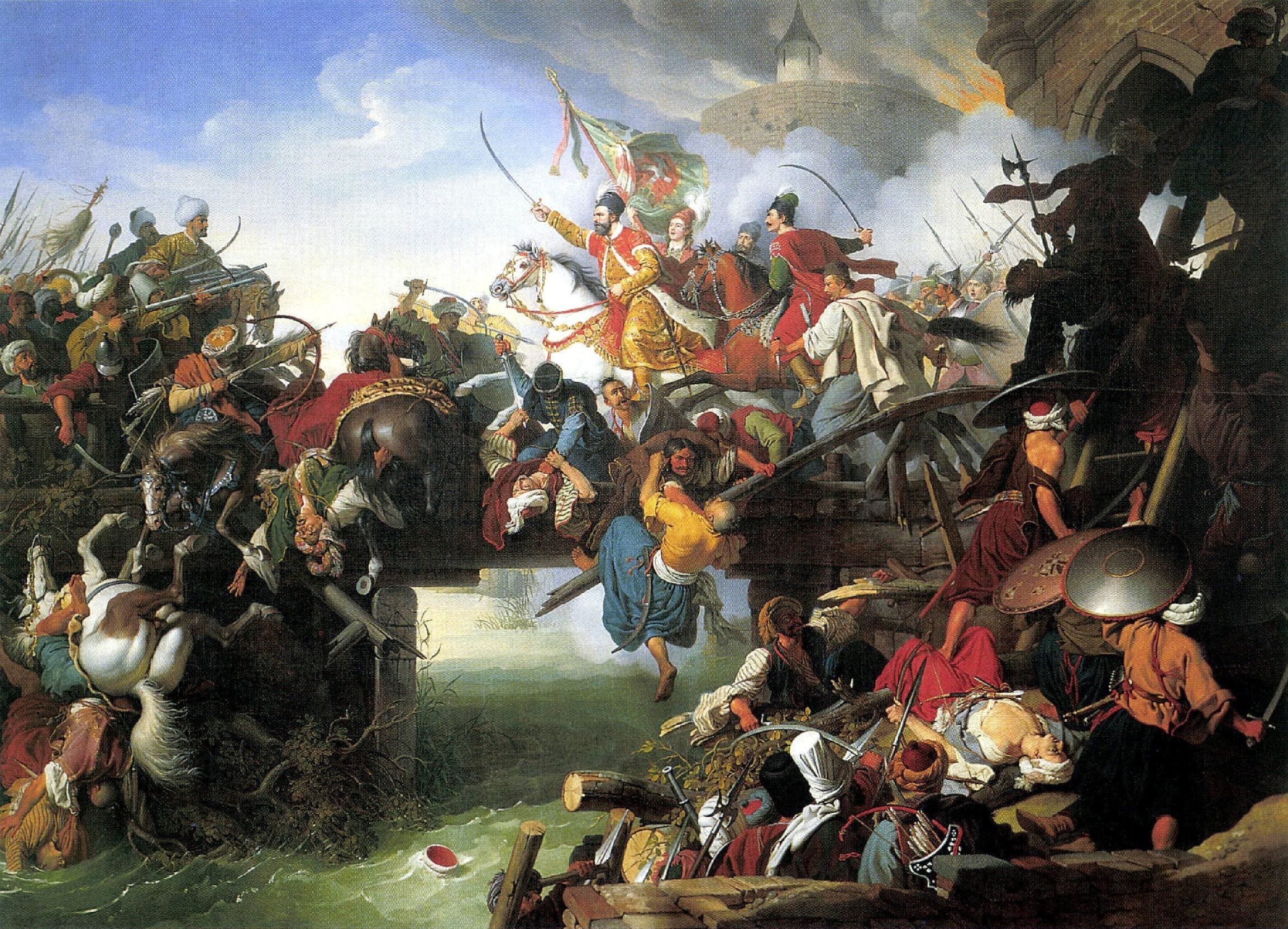
September 8, 1566: An Ottoman siege of the Hungarian city of Szigetvár ends with the Habsburg garrison, under the command of Croatian Ban Nikola IV Zrinski, defeated (and almost completely wiped out) and the Ottomans in control. Szigetvár is remembered today as a tactical victory for the Ottomans but a significant strategic setback, and is commemorated in both Hungarian and Croatian national histories (Zrinski’s death while leading a final charge out of the castle is particularly well-regarded). The Ottomans suffered significant losses during an unexpectedly lengthy siege, including Sultan Sulayman himself, who died in his tent at the age of 71 just two days before the siege ended. This forced them to abandon plans to march on Vienna, so there is a case to be made that the garrison’s robust defense—while ultimately unsuccessful—prevented further Ottoman expansion into central Europe.
MIDDLE EAST
SYRIA
The United Nations Commission of Inquiry on Syria submitted a new report to the UN Human Rights Council on Tuesday in which it argued that Israeli military actions in Syria could rise to the level of war crimes. The commission assessed that the Israeli military (IDF) has “increasingly sustained and entrenched” itself in southern Syria and particularly flagged its detention of Syrian civilians. Israeli diplomats criticized the report as “Israel-bashing” and insisted that the country has no “territorial aspirations” in Syria.
On Monday, International Atomic Energy Agency director Rafael Grossi claimed that the eastern Syrian nuclear reactor that the IDF bombed in 2007 could have been used “in the production of fissile material” for nuclear weapons. This doesn’t mean that it necessarily would have been used for that purpose but it is at the very least suggestive. Recent IAEA inspections of the reactor site, in Deir Ezzor province, have uncovered nuclear material as well as several other nuclear-related facilities.
LEBANON
The IDF killed at least 13 people across southern Lebanon on Monday, including at least 11 people (two children) in one strike on the town of Kfar Rumman. IDF attacks continued through Tuesday, and after a relative lull in Lebanese casualties Israeli forces have now killed at least 27 people since Sunday.
ISRAEL-PALESTINE
In Israel-Palestine news:
The IDF killed three more Palestinians in Gaza, including one child, over a 24 hour period from Sunday into Monday, in addition to the father and daughter it killed on Sunday.
In what mainly appears to be an act of political theater, a group of 12 countries including Canada, France, and the UK imposed a ban on goods produced on Israeli settlements in the West Bank on Tuesday. The ban comes in response not to the illegality of the settlements themselves but to the wave of settler terrorism that has been drawing international attention of late. This “coalition of the willing” appears to be a stand-in for a proposed European Union ban on such products, which has been stymied by German opposition. While I don’t want to dismiss the importance of this entirely, it is the lowest possible hanging fruit for these governments to pick and Bloomberg reported on Monday that UK officials “have privately told the US that the sanctions are largely symbolic and will have no material impact on the UK's wider relationship with Israel on trade or security.” So, yeah, mostly theater. The Israeli government has already responded by closing the UK’s East Jerusalem consulate, which could also be viewed as an act of theater in that it doesn’t really do much to inconvenience the UK government, though it does punish any Palestinians who might be seeking British consular services.
Of potentially greater significance is a Haaretz report on Tuesday claiming that United Arab Emirates President Mohamed bin Zayed personally warned Israeli Prime Minister Benjamin Netanyahu about the possibility of a “major” forthcoming Hamas attack in late September 2023. MBZ’s information could be traced back to Hamas leader Yahya Sinwar himself, who apparently told an unnamed Fatah official to convey a warning to the Israeli government amid stalled negotiations on lifting its Gaza blockade. The Fatah official did that, and also passed the information along to a friend of his in Abu Dhabi. MBZ’s interaction with Netanyahu was meant to reinforce the seriousness of the threat. Netanyahu mostly blew it off, arguing that if an operation was coming it would happen in the West Bank, and never conveyed MBZ’s message to his senior security officials.
The same report also claims that on the evening of October 7, 2023, Qatari Prime Minister Sheikh Mohammed bin Abdulrahman Al Thani informed Mossad head David Barnea that Hamas (under threat of expulsion from Qatar) had agreed to release, without conditions, all of the Israeli civilians whom it and other armed factions had taken captive in their attacks. He offered to mediate negotiations between Hamas and the Israeli government to arrange their release, and Barnea refused. The Qataris kept pushing on this for a few more days but the Israeli government refused to engage.
These revelations are not exactly new but having them reported in such detail about seven weeks before Israel’s next parliamentary election feels significant, certainly as pertains to Netanyahu’s standing.
UN rapporteur Francesca Albanese warned on Monday that the Israeli government, or any other entity, that clears rubble in Gaza is likely helping to destroy evidence of war crimes and may be found liable for that. While certainly accurate, the prospect of holding anybody responsible for such an act presumes a functioning and enforceable system of international law and I think we’ve established pretty conclusively at this point that such a thing does not exist.
YEMEN
Building on its apparent gains in recent days, the Yemeni military launched a new counteroffensive against Ansarullah on Monday with officials talking about going all the way to Sanaa. As far as I can tell there’s no indication that they’ve made any additional progress as yet but casualties are mounting, with at least 728 people killed and wounded since August 26 and some 21,000 displaced just within Yemen’s Taiz province. Among the casualties were at least seven people killed in an airstrike that hit a prison in northern Yemen’s Jawf province on Monday. Ansarullah blamed Saudi Arabia for that attack.
UPDATE: As of Wednesday the death toll in that prison airstrike had risen to 23 and may rise still further.
On Tuesday morning the spokesperson for the Saudi-led coalition in Yemen, Turki al-Maliki, accused Ansarullah of wounding at least 73 civilians in attacks against “civilian and economic sites in the kingdom.” He apparently didn’t say when these attacks took place, but the Saudi Ministry of Energy did report several strikes targeting energy facilities in the kingdom on Tuesday morning so presumably Maliki was referring specifically to them. At time of writing Ansarullah was reporting that a Saudi retaliation was underway but the scope was still unclear. AFP added more casualty data, saying that it has tallied more than 500 people killed to date including 278 Ansarullah fighters, 216 government personnel, and 29 civilians.
IRAN
The US military claimed the destruction of five more Iranian oil tankers on Tuesday, in addition to the three it struck over the weekend. The precursor again seems to have been another round of attempted Iranian strikes on US warships. Iranian forces retaliated for the tanker attacks by firing on US military targets in Jordan. The Islamic Revolutionary Guard Corps is reportedly claiming to have successfully struck two US destroyers, though I’m not sure if these strikes are supposed to have happened before the tanker attacks or after. I would take any assertion like this with a grain of salt unless/until it’s confirmed by some other source.
Iranian Supreme National Security Council secretary Mohsen Rezaee claimed on Sunday that the Iranian government will soon be unveiling a new “exclusion zone” on either end of the Strait of Hormuz, potentially expanding its target package from vessels that are transiting the waterway to include vessels that appear like they might be planning to transit it or that have already transited it. As far as I know Tehran hasn’t yet made any official announcement about implementing this zone and it’s possible that ambiguity on the subject might suit Iranian aims better than specificity. Rezaee did say that the zone will begin where the US naval blockade sits, though it’s unclear exactly where the Iranians define that to be.
On Tuesday, the Trump administration blacklisted every Iranian airline (the 27 that weren’t already under US sanctions) as well as nine other aviation-related entities. The aim is to effectively blockade Iran by air as well as by sea under “Maximum Pressure 2.0,” at least to the extent that other governments are willing to abide by these airline designations. Speaking of economic pressure, the Iranian government announced on Tuesday that it is raising gasoline prices for those who purchase more than their 110 liter per month quota, doubling the cost above that threshold to 100,000 rials per liter. Despite its oil resources Iran runs a fuel deficit, and so the US pressure campaign is pinching the Iranian economy even in this sector.
ASIA
NEPAL
The Diplomat’s Biswas Baral argues that Nepal’s recent disastrous floods may have major repercussions for the country’s foreign policy:
Nepal’s recent floods, which have killed at least 1,280 people while over 5,600 are still missing as of this writing, rank among the country’s worst natural disasters. Preliminary estimates put economic losses at $2.56 billion. But the disaster’s consequences will extend far beyond the immediate human and economic toll.
It has also undermined the efforts of successive post-2015 governments to achieve more geopolitical balance, largely through the development of new transport, trade and transit facilities with China.
As a landlocked country wedged between India and China, Nepal has long sought to preserve its strategic autonomy by balancing the influence of its two neighbors.
Much of the infrastructure that the Nepali government has built at its Kerung border checkpoint was washed out in the flooding and will take considerable time and money to rebuild. Further complicating the situation, the Chinese government has closed a second checkpoint for fear of landslides. Coupled with the damage that Nepal suffered to its power grid the result is likely greater dependence on India.
NORTH KOREA
The Russian and North Korean governments opened the first road bridge connecting their countries across the Tumen River on Monday. According to Russian officials it will be able to handle “up to 300 vehicles” per day and will be immediately open to cargo traffic. Passenger traffic may come later. Those details aside, the bridge is probably more significant as a symbol of the developing relationship between the two countries amid the Ukraine war.
AFRICA
SUDAN
AFP is reporting that an apparent Rapid Support Forces drone strike killed at least 13 people and wounded another 22 in the city of Umm Ruwaba in Sudan’s North Kordofan state on Tuesday. Elsewhere, Sudan Tribune is reporting that “up to 20 people are dying each day from severe hunger and disease” in the Jebel Marra area in Sudan’s Darfur region. Officials in the Sudan Liberation Movement (al-Nur) faction, which controls that area (and which consequently has become a haven for displaced persons fleeing the RSF) are claiming that the area is in a state of famine and that millions of people could be at risk. Any official famine designation would require international assessment, but there’s no reason to doubt that conditions are dire.
NIGERIA
The New Humanitarian’s Obi Anyadike reported on Monday that the Nigerian government and Boko Haram have been in a ceasefire since June and are likely to extend it for at least another 40 days. The two sides came to this agreement during negotiations over the release of some 360 civilians whom the jihadist group kidnapped from a village near the Cameroonian border back in March. It also included a $3.7 million ransom payment to Boko Haram, though the Nigerian government has denied that—indeed it’s denied or refused to comment on the whole arrangement because it doesn’t want to be seen Negotiating With Terrorists. But apparently there is some feeling that this ceasefire could lead to more comprehensive negotiations on some sort of settlement, perhaps including joint operations against the Islamic State West Africa Province group. That very much remains to be seen.
EUROPE
UKRAINE
The Russian military killed at least five people and wounded another 30 in bombarding Kyiv overnight, coinciding with the expiration of its three day pause in attacks on the Ukrainian capital (and the departure of US envoys Jared Kushner and Steve Witkoff). Ukrainian strikes, meanwhile, killed at least two people in Russian-occupied Crimea and two more people in Russia proper.
SERBIA
Serbian President Aleksandar Vučić announced on Tuesday that he’s setting October 25 as the date for the country’s snap parliamentary election. He triggered this election when he announced his resignation earlier this year, possibly with an eye toward circumventing term limits by making himself prime minister (assuming that his Serbian Progressive Party wins the election).
Also on Tuesday, European Commission President Ursula von der Leyen and European Council President António Costa criticized the attendance of several Serbian officials at the funeral of convicted génocidaire Ratko Mladić on Monday. Mladić, who led ethnic Serb forces during the 1992-1995 Bosnian War and was convicted for his conduct by the International Criminal Tribunal for the former Yugoslavia in 2017, died last month in The Hague. The Serbian government initially planned to give him a state funeral before backing down under international criticism. There may be repercussions for Serbia’s European Union membership bid though it’s unclear what those might be.
HUNGARY
The Hungarian government expelled ten Russian diplomatic staffers on Tuesday, claiming that they had “engaged in activities in Hungary that are unacceptable for diplomats under the Vienna Convention.” Presumably that means some form of espionage or interference in domestic affairs but it’s unclear exactly what they were doing. The election of Prime Minister Péter Magyar and his Tisza party earlier this year brought a more Europe-friendly government to power in Budapest and that seems to be causing a recalibration of the country’s relationship with Moscow. The Russian government will presumably retaliate for this act.
GERMANY
The far-right Alternative for Germany (AfD) party won Sunday’s legislative election in Germany’s Saxony-Anhalt state with roughly 44 percent of the vote. That translates to 39 seats in the 83 seat state parliament, shy of a sole majority but close enough that the party may be able to bring in a handful of defectors or independents to cobble together a working coalition. I don’t normally devote time to state-level elections in this newsletter and I’m not going to spend much time on this one, but given the potential ramifications of AfD running Saxony-Anhalt both on German federal politics and on the European far-right in general it seemed worth noting.
ICELAND
The Icelandic Foreign Ministry summoned US ambassador Billy Long on Tuesday to express displeasure over one of Donald Trump’s recent social media posts. Said post included a map that showed the US flag emblazoned over all of North America—including Iceland, whose western portion technically does sit on the North American continental plate though I doubt that the map’s illustrator gave it that much thought. Needless to say the post was poorly received in other places as well.
AMERICAS
ECUADOR
The US military’s Southern Command sunk another Ecuadorian vessel in the eastern Pacific on Monday, the fifth such incident in the past two weeks. The Pentagon insists, without offering any evidence, that these vessels serve as refueling/logistical waystations for drug traffickers. It has been boarding them and detaining their crews before sinking them.
VENEZUELA
The Trump administration is apparently not done looting Venezuela, as Reuters reported on Tuesday that it is pursuing the country’s mineral resources as well as its oil according to “three sources familiar with the discussions.” The arrangement would presumably parallel the administration’s oil deal and could include gold as well as critical industrial minerals. Logistically there could be additional complications as unlike Venezuela’s oil resources, its mineral resources have been under-assessed.
GREENLAND
The EU inked a new agreement on Monday to invest €200 million in Greenland “aimed at improving local quality of life over the next two years,” as Al Jazeera put it. NATO and the EU have both demonstrated increased interest in Greenland in hopes of fending off Donald Trump’s desire to annex the island or at least to undermine his complaints that the blocs are ignoring Greenland’s economic and security needs. The EU is also planning to substantially increase aid to Greenland when it considers its next six year (2028-2034) budget.
CANADA
Finally, Canadian tariffs went into effect on Tuesday, imposing new duties on $20 billion (US) of US products in a dollar-for-dollar retaliation for the tariffs that the Trump administration imposed on Canada last month. Unable to let Canada have the last word (for now) in this exchange, Donald Trump announced in response that the US will ban several categories of Canadian goods from the US altogether. The new restrictions include Canadian alcohol and dairy products as well as “large motorcycles.” He’s also apparently planning to expand the tariffs to additional Canadian products next week. There is no war but the trade war, I guess.