

TODAY IN HISTORY
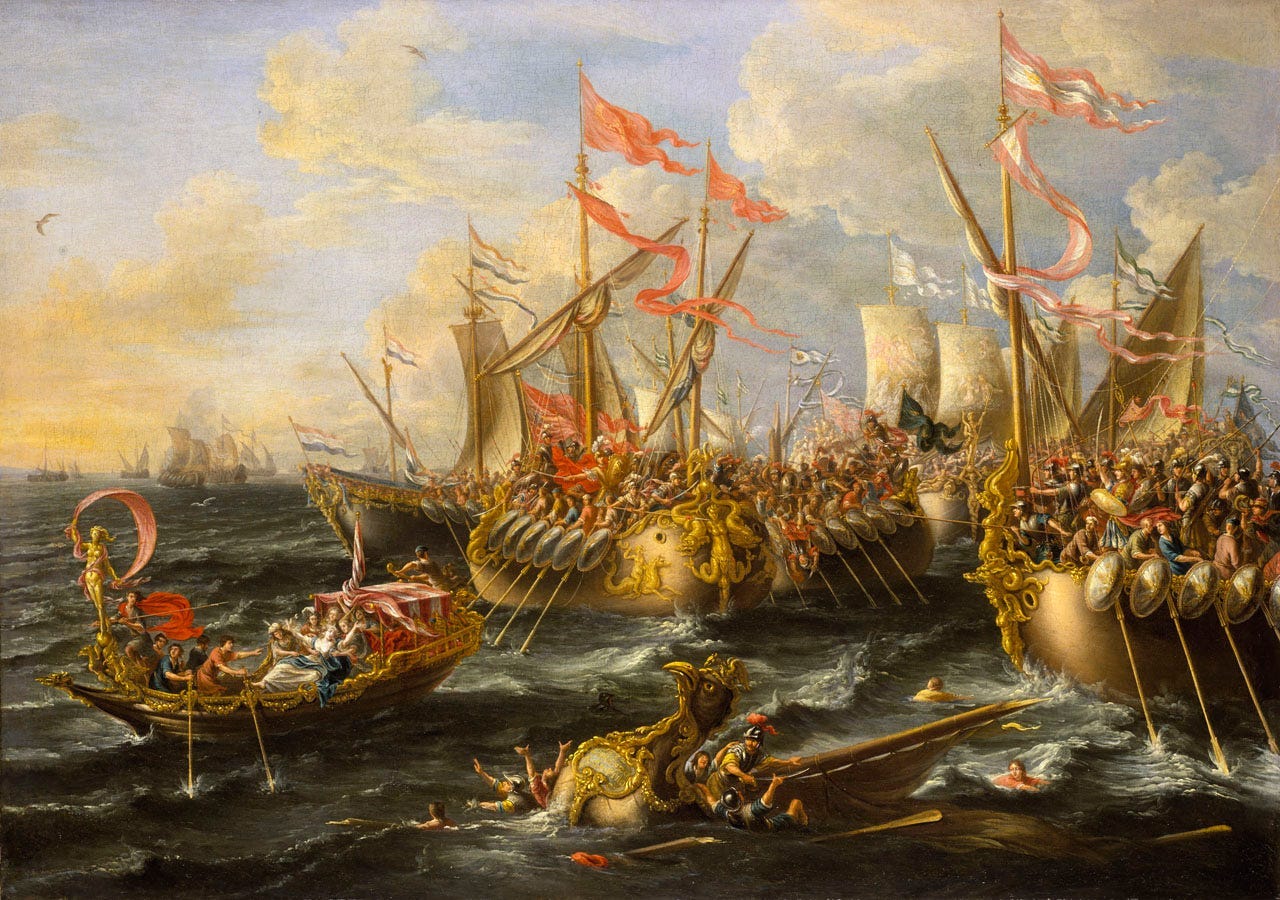
September 2, 31 BCE (or thereabouts): Octavian’s forces decisively defeat the navy of Mark Antony and Cleopatra at the Battle of Actium. Actium effectively marked the end of the war between Octavian and Antony, as both Antony and Cleopatra subsequently retreated to Alexandria and eventually committed suicide after Octavian besieged the city. His rival gone, Octavian became the first emperor of Rome, taking the title Augustus to mark his new status.
September 2, 1192: The Third Crusade effectively ends with the Treaty of Jaffa, under the terms of which Richard the Lionheart and Saladin agreed to a three year cessation in hostilities, during which time Saladin would allow Christian pilgrims to visit any holy sites in his territory, including Jerusalem. Richard agreed to surrender the city of Ascalon (modern Ashkelon) to Saladin, but only after destroying its fortifications. The treaty was the product of Richard’s realization that he lacked the manpower to besiege Jerusalem and that he needed to return home to defend his French territories.
September 2, 1870: The Prussian Third and Fourth armies thoroughly defeat the French Army of Châlons in the Franco-Prussian War’s Battle of Sedan, in northeastern France. In military terms the Prussian victory was of significant importance. The entire Army of Châlons, which had been trying to come to the Army of the Rhine’s aid during the Siege of Metz, was eradicated, suffering some 18,000 casualties and a whopping 104,000 soldiers captured. In political terms the impact was massive. It just so happens that French Emperor Napoleon III had accompanied the Army of Châlons to Metz, and he was among those taken prisoner. Two days later, an uprising in Paris saw whatever was left of the empire give way to the “Government of National Defense,” which attempted to salvage the war but ultimately surrendered in January 1871 and transitioned into the French Third Republic.
INTERNATIONAL
A United Nations report declared on Wednesday that humanity “has failed in its goal of limiting global warming to 1.5 degrees Celsius above preindustrial times.” That was the stretch goal of the 2015 Paris Climate Agreement, which mainly called for keeping warming below 2 degrees Celsius. Needless to say the prospects for that goal aren’t looking terribly good either. The UN is now suggesting that, in addition to limiting carbon emissions, it is also necessary to remove carbon from the atmosphere on what The New York Times characterized as “a colossal scale.” That would require either massive reforestation or a technological breakthrough to achieve and even at that the timeframe would be too long to avert serious near-term climate impacts.
MIDDLE EAST
SYRIA
The Washington Post’s Gerry Shih reports on the Syrian government’s attempt to present its country as an alternative to the now-volatile Strait of Hormuz:
Day and night, 5,000 hulking trucks carrying oil from the Persian Gulf rumble across this stretch of barren desert as if in a caravan snaking its way toward the Mediterranean Sea.
The trucks began shuttling between the refineries of southern Iraq and the Syrian port of Baniyas in April, initially as an experiment by Iraqi oil exporters seeking to circumvent the Strait of Hormuz after cargo traffic in the waterway was stopped by the U.S.-Israeli war with Iran.
Today, the daily bumper-to-bumper procession of tanker trucks is a showcase of how Syria and its new government aim to benefit as global energy flows are reshaped.
More than 18 months after the fall of Bashar al-Assad, who fled after 24 years in power, Syria is poised to capitalize on the lifting of international sanctions and the continuing war in the Persian Gulf.
Boasting access to Europe through its Mediterranean port at Baniyas, Syria — under its new president, Ahmed al-Sharaa — is pitching itself as a relatively stable, overland corridor for energy and goods, and an alternative to the Strait of Hormuz.
It is daft to imagine supplanting the strait’s prewar traffic with truck convoys, but there is a plan in the works to build a pipeline from southern Iraq to the Syrian coast that would be more effective though still not a full replacement. Construction is expected to take about two and a half years, though, so it’s not an immediate solution, and it will of course be vulnerable to attack. Even if all goes perfectly, rerouting Persian Gulf oil that is bound for Asia through the Mediterranean would add considerably to the logistical burden of getting it to market.
