

You’re reading the web version of Foreign Exchanges. If you’d like to get it delivered straight to your inbox, sign up today and get 40% off on your first year:
PROGRAMMING NOTE: As I mentioned a few days ago, this will be our last regular FX roundup for September as I will be spending the rest of the month getting my daughter moved in to college and spending a bit of time with her before school starts. I appreciate everybody’s patience as I manage this process and adjust to not having her around, which I have to confess is making me a little sad even as I’m excited for her taking her next major life step. I will be back hopefully to our regular schedule on October 1.
TODAY IN HISTORY
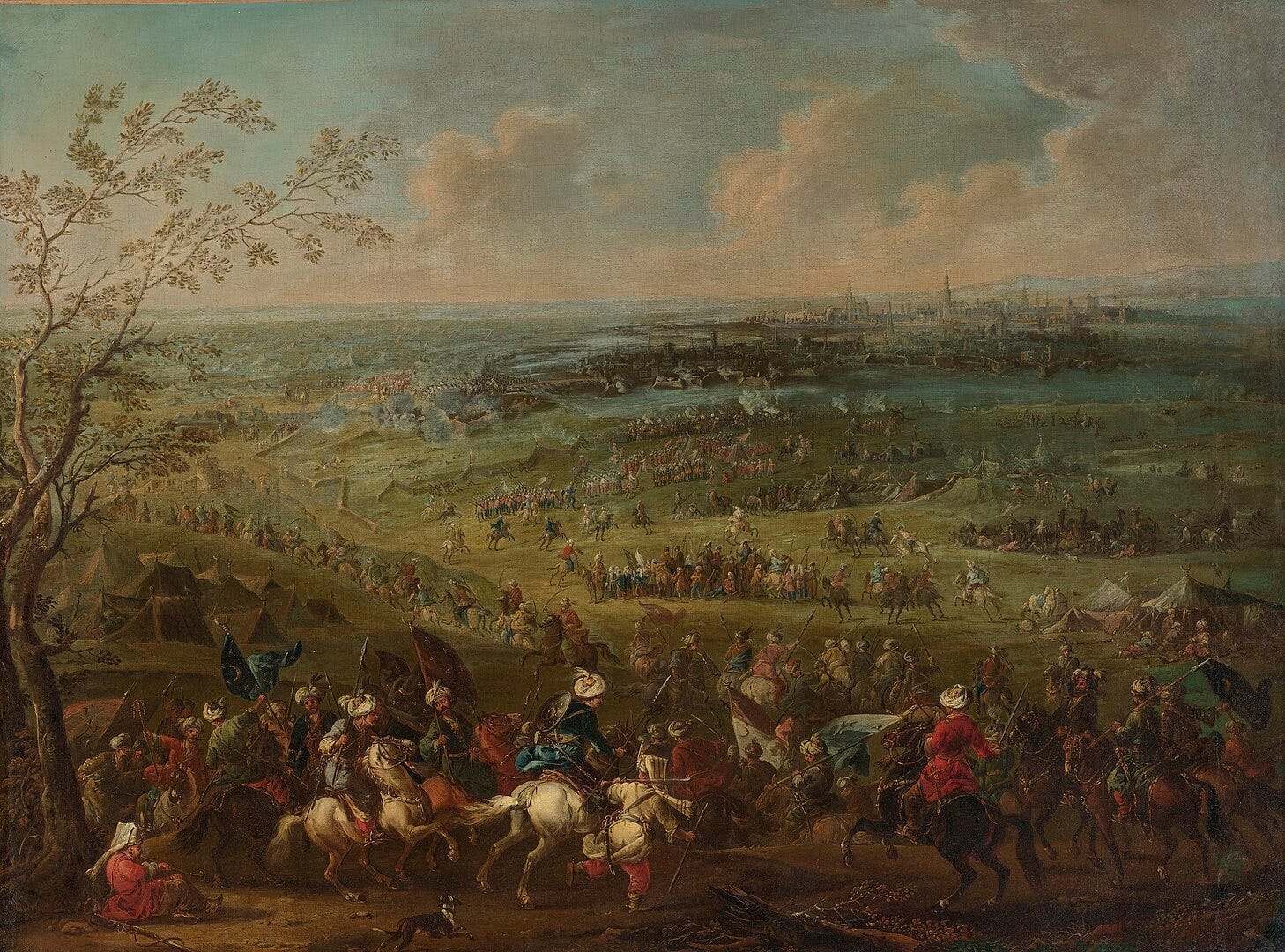
September 12, 1683: In the first major engagement of the 1683-1699 Great Turkish War, an army led by Polish King Jan III Sobieski defeats the Ottomans at the Battle of Vienna and thereby breaks up the in-progress siege of that city. The Ottomans retreated in disarray, allowing the Polish-Lithuanian Commonwealth and the Habsburgs to take advantage and grab chunks of formerly Ottoman territory. By 1687 the Ottomans had been driven out of Hungary and were well on their way to the first major military defeat the empire had suffered in centuries.
September 12, 1974: A committee of Ethiopian military officers, called the “Derg,” overthrows Emperor Haile Selassie in a coup amid mass unrest caused in part by a serious famine. The Derg, which refashioned itself as the “Provisional Military Government of Socialist Ethiopia,” ruled the country until 1987, when it further transformed itself into the People’s Democratic Republic of Ethiopia.
September 13, 533: A Byzantine army under Belisarius defeats the Vandals in the Battle of Ad Decimum, near Carthage. This was Belisarius’s first victory in his invasion of North Africa and kicked off his campaign to restore the western Mediterranean to Roman control.
September 13, 1993: Israeli Prime Minister Yitzhak Rabin and Palestine Liberation Organization chair Yasser Arafat sign the Oslo I Accord in Washington, DC. Oslo I established a Palestinian government of sorts, the Palestinian Authority, and included provisions for the eventual withdrawal of Israeli forces from the Occupied Territories and economic cooperation between the Israelis and Palestinians. It was supposed to be an interim agreement on the road to Palestinian statehood, though the parameters of the “state” that was on offer are debatable to say the least and at any rate the agreement collapsed in large part because it simply put off discussions of any of the really challenging issues (settlements, Jerusalem, Palestinian right of return, etc.) in the Israel-Palestine crisis.
MIDDLE EAST
LEBANON
Reuters reported on Sunday that the Israeli and Lebanese governments will hold their next round of US-brokered negotiations in Rome next month. There doesn’t appear to be any more specificity as to the date than that. There’s been some question as to whether this eighth session would actually go forward, given that the Israeli government has not really limited its military activity in southern Lebanon despite various agreements reached during previous sessions. The Lebanese and Israeli ambassadors to the US are scheduled to meet next week in Washington to make arrangements for the Rome meeting, so it sounds like they’re still on track.
ISRAEL-PALESTINE
Authorities in Gaza reported on Sunday that the Israeli military (IDF) had killed at least ten people in the territory since Thursday night. That includes a pregnant woman gunned down by Israeli soldiers in the Mawasi displacement camp in southern Gaza’s Khan Younis area. The IDF says that it is “looking into the incident.”
YEMEN
Fighting continued along Yemen’s Red Sea coast through the weekend, as forces aligned with the nominal Yemeni government indicated that they intend to try to recover the territory they’ve lost to Ansarullah over the past several days. Ansarullah also continued its drone strikes against targets in Saudi Arabia, while the Saudis have continued carrying out airstrikes against Ansarullah targets.
CNN recounted Ansarullah’s seizure of the coast on Saturday, attributing the collapse of government-aligned forces in Mokha and around the Bab al-Mandab strait to a lack of air support and to their own internal weakness. In terms of the latter, this report claims that when Ansarullah advanced into the port city of Mokha on Thursday it found that “the actual strength of the army [defending the city] was only about 20% of what it was on paper.” Apparently it was mostly “staffed” with “ghost soldiers,” fictional personnel invented by somebody who was scamming the government and its Saudi backers for their salaries.
The pro-government coalition has also undoubtedly been weakened by the tension between Saudi-backed factions and the UAE-backed Southern Transitional Council, which erupted into conflict late last year that ended with the STC largely sidelined. Although the STC has formally dissolved it still reportedly has thousands of fighters in the field, but they’re unwilling to volunteer themselves in defense of the government under the circumstances and it’s not clear that the Saudis would be willing to accept their assistance anyway.
IRAN
Somebody attacked an Iranian cargo vessel near Qeshm island in the Strait of Hormuz on Sunday morning, killing at least one person and wounding four others. To my knowledge the US military has not (yet) commented on this incident, which is unusual if this was in fact a US attack (the Pentagon isn’t usually shy about claiming responsibility for these sorts of things). When asked about the incident later in the day, Donald Trump replied “I don’t want to say,” which could be a coy way of claiming responsibility or could just mean he didn’t know anything about it.
On the subject of the strait, the Omani government was supposed to host a meeting on Monday involving representatives from Iran and several Gulf Arab states to discuss the Iranian-Omani arrangement for managing that waterway as well as regional tensions overall. But Omani Foreign Minister Badr Albusaidi announced on Sunday night that the meeting had been postponed “in the interests of consensus.” He didn’t offer any additional details.
In other items:
The New York Times’ Farnaz Fassihi has a new report alleging that “a fringe hard-line faction” inside Iran was responsible for a July attack on three commercial ships in the Strait of Hormuz that contributed significantly to derailing the US-Iranian “memorandum of understanding.” Supposedly this faction—led by Hossein Taeb, commander of the Islamic Revolutionary Guard Corps’ Basij paramilitary wing—acted even without the knowledge of IRGC commander Ahmad Vahidi but may have had the approval of Supreme Leader Mojtaba Khamenei. That’s hard to know for sure because, according to Fassihi, Khamenei is still only communicating through a small group of intermediaries (if in fact he’s communicating at all). Khamenei’s absence from normal government functions has, in this narrative, led to factional infighting within the Iranian elite, in particular between this “fringe hard-line” group and more moderate voices who wanted to maintain the MOU rather than return to conflict. The appointment of Mohsen Rezaee as secretary of Iran’s Supreme National Security Council in early August was supposed to tamp down that infighting because he’s apparently seen as someone who has credibility with all of the factions. I don’t know how much credence to give any of this but the report has gotten a fair amount of attention so I felt it was worth at least noting it.
AFP reported on Sunday that Iranian products (foodstuffs in particular) are still making their way to markets in Dubai even though the UAE ostensibly suspended all economic activity with Iran last month. While the suspension is having an effect and probably a significant one, the continued trade highlights the difficulty in completely severing those economic links.
The Iraqi government closed three checkpoints along the border between Iran and Iraq’s Maysan province on Saturday after determining that Friday’s drone strike on Saudi Arabia’s East-West Pipeline originated there. It began reopening the checkpoints on Sunday after Iraqi security forces apparently tracked down and seized the equipment used in the drone launch.
A clash between Iranian security forces and unspecified armed militants left at least three of the former and five of the latter dead in the city of Saravan on Saturday, according to Iranian state media. Saravan is located in the eastern part of southeastern Iran’s Sistan and Baluchistan province, which regularly sees activity by a host of non-state groups including Sunni jihadists, Baluch separatists, and criminal/smuggling gangs. It’s unclear who was involved in Saturday’s incident. A Basij commander was killed in the same province on Tuesday, though it’s also unclear whether the two incidents are connected.
ASIA
INDIA
Leaders of the BRICS member states met in New Delhi this weekend for a summit that was expected to be hindered by the Iran war, especially given that both Iran and the UAE are members. As far as I can tell it hasn’t resulted in any major developments but to some mild surprise The Gang did reach unanimity on a joint statement on Saturday that expressed “deep concern over the continued escalation of tensions” related to the war while calling for “maximum restraint.”
MYANMAR
Myanmar’s ruling junta said on Sunday that it is revoking the status of United Nations ambassador Kyaw Moe Tun over what it called “illegal activities.” Kyaw Moe Tun is a “holdover” from Myanmar’s previous civilian government, and I put “holdover” in quotes because the junta tried to fire him after the February 2021 coup that overthrew that government. But the UN Credentials Committee has refused to take up the case of Kyaw Moe Tun’s legitimacy or to consider accepting an ambassador from the junta, which is still regarded as illegitimate by most of the rest of the world. The committee may reconsider Kyaw Moe Tun’s status after the UN General Assembly later this month.
AFRICA
SUDAN
Sudan Tribune is reporting a major drone attack on the capital of Sudan’s Blue Nile state, Ad-Damazin, that began on Sunday evening. It reported on Friday that the Rapid Support Forces and Sudan People’s Liberation Movement-North (al-Nur) were advancing on that city so the drone strikes could be the first wave of a larger assault, or the militants may just be softening the city up.
MALI
CNN reported on Saturday on the extent of the Ukrainian military’s activities in Africa and particularly in Mali:
The conditions are grueling. Temperatures regularly soar above 110 degrees Fahrenheit during the day, then drop sharply overnight. Water is scarce and the dust and sand get everywhere. But at least they are working above ground. This elite group of Ukrainian drone operators has spent years hunting Russians from dugouts in Ukraine. They are still doing the same – but in the desert in northern Mali.
Some 15 Ukrainian specialists have been deployed to the junta-led country in Africa’s Sahel region to assist local rebel forces who are fighting Russian troops – part of Kyiv’s mission to weaken its enemy wherever it operates. And Kyiv has also branched out to other theaters of conflict, capitalizing on its hard-won expertise in drone warfare to forge new anti-Russian partnerships.
Speaking to Ukrainian soldiers and officers involved in operations in Mali and Libya, CNN can reveal for the first time the extent of these operations on other continents. A Ukrainian Defense Intelligence source with knowledge of the operations told CNN that several Ukrainian specialists were also stationed in Sudan and that troops from Chad, Niger and Burkina Faso had previously traveled to Mali to receive drone training from Ukrainian soldiers there.
Reporting on the Ukrainian presence in Mali goes back to 2024, when officials in Kyiv hinted at Ukrainian involvement in the Azawad Liberation Front’s (FLA) ambush (along with Jamaʿat Nusrat al-Islam wa’l-Muslimin jihadists) of a column of Malian soldiers and Russian mercenaries at Tinzaouaten, in Mali’s Kidal region. Ukrainian advisers also apparently played a role in the FLA/JNIM offensive in northern Mali earlier this year. According to CNN they are providing the FLA with “support, training and operational help.”
EUROPE
UKRAINE
Russian attacks killed at least nine people across Ukraine on Saturday and at least six people on Sunday, while Ukrainian strikes killed at least two people in Russia on Sunday. One Russian strike on Sunday may have targeted a train carrying several Western “advisers” to the Ukrainian government, including former UK Prime Minister Boris Johnson and former US Central Intelligence Agency director David Petraeus. The strike hit a different Ukrainian Railways train at a station near the Ukrainian-Polish border that the Johnson-Petraeus train had just left. Also on Sunday, Donald Trump called on the Ukrainian government to stop attacking Russian refineries because he’s worried about the political ramifications of the price of diesel fuel. Russia has suspended diesel exports due to those Ukrainian attacks, which coupled with the effects of the Iran war has driven domestic diesel prices in the US over $6 per gallon.
KOSOVO
The Kosovan parliament reelected Prime Minister Albin Kurti on Sunday but it may not matter because, somewhat inexplicably, it still failed to elect a president. While the two largest parties in the legislature—Kurti’s Vetëvendosje and the Democratic Party of Kosovo (LDK)—agreed a couple of weeks ago to back a joint candidate for president, several of the latter’s MPs have decided to revolt against that deal. Any Kosovan presidential vote requires a two-thirds quorum in parliament to be official and those LDK rebels are able to join with other MPs to prevent the legislature from reaching that threshold. Failure to elect a president will trigger a snap election, which would be Kosovo’s fourth in the last two years.
SWEDEN
Swedish voters headed to the polls on Sunday for a general election whose main plot-line was whether the far-right Sweden Democrats party would wind up as part of the country’s governing coalition. Prime Minister Ulf Kristersson had indicated that he was willing to incorporate the party into his government if it meant keeping his right-wing majority. He’d already tacked to the right on issues related to immigration in order to court the party’s support.
Full results won’t be known until Wednesday at the earliest but at this point it looks like Kristersson’s embrace of the far right may not be working out. Preliminary results give the center-left opposition, headlined by the Swedish Social Democratic Party, 176 seats, which is enough for a bare single seat majority in the 349 seat parliament. If that holds, and it’s much too early to say, it would probably mean that the Sweden Democrats would remain out of government. Kristersson has suggested that he will still try to form a centrist coalition that keeps him in place as PM, taking advantage of the fact that the opposition coalition is ideologically very tenuous. But he would presumably have to abandon the Sweden Democrats to make that work.
FRANCE
The French UN mission in Geneva has apologized for a social media post it made back in July that questioned the US government’s commitment to human rights and prompted US delegates to walk out of a subsequent UN Security Council session while French representatives were speaking. I can’t think of anything that is less important than this but as I did note the spat when it occurred I figured I should also note the apology.
IRELAND
Donald Trump visited Ireland over the weekend and decided to create a minor international incident by telling reporters that he thought it would be “fantastic” if Ireland and Northern Ireland were to unify. Needless to say that comment did not go over terrible well in London and even Irish Taoiseach (PM) Micheál Martin, who was sitting next to Trump when he said it, apparently seemed somewhat uncomfortable. The UK government has no intention of holding a Northern Ireland status referendum anytime soon, and polling suggests that if it did hold one most residents would vote to remain in the UK. Trump may have intended more to send a message to Irish-American voters than to announce any new geopolitical agenda.
AMERICAS
CANADA
The Wall Street Journal reports that Canadian Prime Minister Mark Carney is responding to his country’s trade war with the US by pursuing a closer relationship with the European Union:
Carney has instructed his special envoy to Europe to scope out the most ambitious possibilities short of full membership in the EU or its common market, according to people familiar with the matter. The details are still being sketched by technical working groups for what the prime minister has told his aides will be the reorienting of an economy and a society that for half a century has been dominated by the U.S.
To European leaders, Carney has even suggested Canada take on a new title: “Associate Member of the European Union.” The EU, not known for its flexible enforcement of membership rules, is open to the idea, officials from both sides say.
Alongside Carney’s established emissaries are informal advisers drawn from the worlds of finance and politics. Some are fellow members of a Book Club in Ottawa that he no longer has time to attend, who quip that they abide by the code of the movie “Fight Club”: “The first rule of Book Club,” several told the Journal, “is you do not talk about Book Club.”
The result of the monthslong talks: European and Canadian officials are eyeing ways in which Canada could informally lock into Europe’s $21 trillion single market in strategic supply chains such as energy, AI, the critical minerals needed for batteries or semiconductors and, most urgently, defense.
According to the WSJ “the idea has even come up to allow Canadians to live and work in Europe visa-free.” The domestic political considerations of such a major geopolitical shift may be too much to overcome, but the fact that they’re even discussing this is arguably the first real indication that Carney intends to back up his rhetoric about Canada-US relations with some action.
UNITED STATES
Finally, at Foreign Affairs Daniel Benjamin and Steven Simon take stock of the costs of the now-25 year old US “War on Terror”:
Typically, when policymakers and analysts speak of the global war on terror—the defining fact of international affairs for two decades—they discuss the damage done to terrorist groups, the plots that have been thwarted, the rise and fall of jihadi ideology, the many intelligence failures, and, perhaps above all, the two forever wars in Afghanistan and Iraq. These are the scorecards of contemporary counterterrorism. But left out of this framing are the profound effects of this vast war on terror on domestic politics and society.
The human statistics alone tell an appalling story: more than 7,000 U.S. troops were killed in action, 53,000 were wounded, and well over 30,000 took their own lives—a staggering number. According to Brown University’s Costs of War Project, these conflicts added $8 trillion to the U.S. national debt, with trillions more projected in the future for veterans’ health care, including for the half million GIs with traumatic brain injuries and posttraumatic stress disorder.
Yet even these numbers fail to show the myriad ways in which two decades of war transformed the United States. For years, the fixation on Islamist terror shaped a culture drenched in fear, as voices from politics, the media, civil society, and a swelling counterterrorism-industrial complex insisted that the country faced an existential threat. Amid this climate, the government was given broad new powers to root out and prosecute potential jihadi activity wherever it might be, and the widespread assumption that there might be another terrorist attack began to reshape American society itself. Rather than bringing the country together behind a shared—and narrowly defined—enemy, however, the result has been a dramatic decline in social cohesion. It has contributed to the demise of political bipartisanship, already weakened in previous decades. At the same time, the war on terror fueled an alarming rise in xenophobia and anti-immigrant sentiment and discredited the country’s political and foreign policy elites.
Above all has been the uncontrolled expansion of executive power. This impetus did not begin with the war on terror; generations of American leaders and scholars have sought to increase presidential power, drawing up mechanisms that could sideline civil liberties and intertwine military and police activities. But after 9/11, these contingencies were used to give the executive branch sweeping new authority in the name of domestic security. And today, an authoritarian president is using these powers to target his political enemies. The United States, then, is overdue for a reckoning with the political legacy of the war on terror.
Good luck with your daughter's move. When my son left for college I was shattered, but he returned home four years later and now lives nearby. My advice is, visit her often if you can, and look forward to the holiday visits home! The four years will pass sooner than you think.
Wow congratulations to your family, Derek! And good luck!