

You’re reading the web version of Foreign Exchanges. If you’d like to get it delivered straight to your inbox, sign up today and get 40% off on your first year:
TODAY IN HISTORY
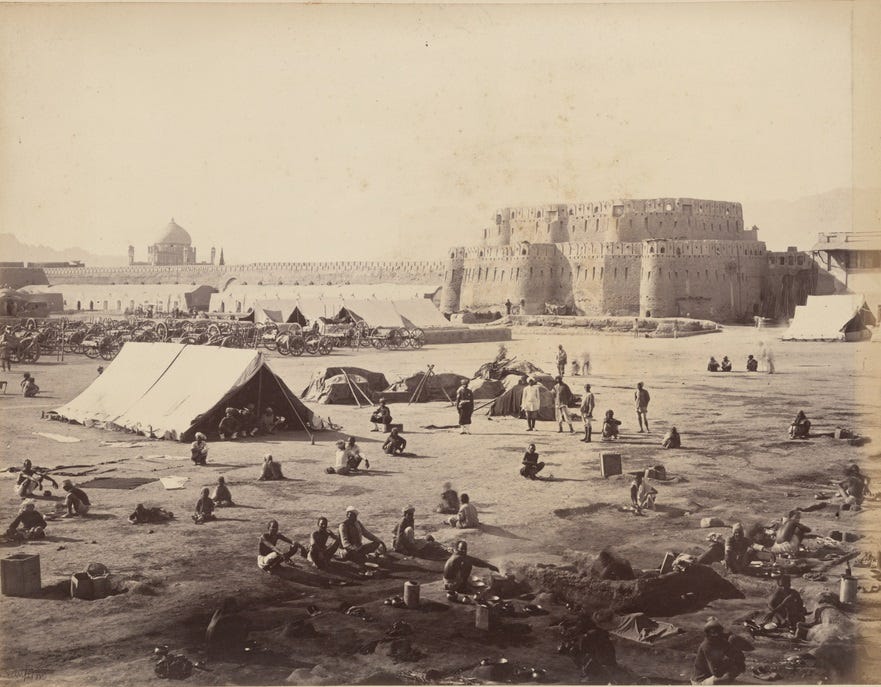
September 1, 1880: A decisive British victory at the Battle of Kandahar ends the Second Anglo-Afghan War. British authorities deposed Afghan Emir Ayub Khan Barakzai and replaced him with his more pliable cousin, Abdur Rahman Khan.
September 1, 1939: Nazi Germany invades Poland. The German offensive began a week after the signing of the Molotov–Ribbentrop Pact between Germany and the USSR and a day after the pact’s ratification by the Supreme Soviet. The initial German invasion overwhelmed the outgunned Polish military, and a subsequent invasion by the Red Army on September 17 sealed Poland’s fate and resulted in a partition of the country. The invasion is regarded as the start of World War II, as it triggered French and British declarations of war against Germany.
September 1, 1969: The Libyan Free Officers Movement, led by a young colonel named Muammar Gaddafi, overthrows King Idris of Libya in a coup d’état. Idris had been broadly unpopular, seen as siphoning off a disproportionate share of Libya’s newfound oil wealth and viewed as tyrannical by tribes that were accustomed to a great deal of autonomy. He was also in poor health, and when it became known that he planned to abdicate in favor of his nephew on September 2 the officers moved to preempt that. Gaddafi declared the founding of the “Libyan Arab Republic” and then set about implementing a political and economic program aligned with that of his idol, Egyptian leader Gamal Abdel Nasser, including its tenets of Arab socialism and pan-Arabism as well as its more authoritarian elements.
MIDDLE EAST
SYRIA
Clashes between the Druze “National Guard” militia and Syrian security forces left at least one of the former’s fighters dead and ten of the latter’s personnel wounded in southern Syria’s Suwayda province on Tuesday. This outbreak of violence apparently began on Thursday and left at least two civilians dead over the weekend. I haven’t seen any indication as to what caused the fighting.
The International Atomic Energy Agency has concluded that one of two sites its inspectors visited last month in eastern Syria’s Deir Ezzor province contained “cooling infrastructure … consistent with that of a nuclear reactor.” The site is the same one that the Israeli military (IDF) bombed in 2007 in “Operation Outside the Box.” The IAEA had previously assessed that it was “likely” a nuclear reactor but had not been able to confirm that assessment.
ISRAEL-PALESTINE
The IDF killed at least four people in Gaza on Tuesday during an operation in which it captured Moeen al-Arabeed, identified by Israeli officials as “the head of Hamas’s internal security force.” Arabeed’s wife was among the dead along with two children. The casualties apparently resulted from airstrikes that the IDF conducted after the “covert” team it sent into Gaza to effect the capture was discovered. This is yet another Israeli violation of the October “ceasefire,” which did not include a “but we really wanted to capture that guy” exception.
In the West Bank, the United Nations World Food Program said on Tuesday that it will halve its aid operations due to lack of funding (the product of aid cuts by the US and several European countries). In practical terms that means the number of people it’s supporting will decrease from 400,000 to 200,000, at a time when terrorist activity by Israeli settlers and security forces is, if anything, increasing the need for aid.
IRAN
The US and Iran exchanged fire again on Tuesday, with the former killing at least five people and wounding 68 others when one of its strikes hit a home in southern Iran during a wedding ceremony. There were presumably other casualties as well but that’s not clear as yet. The Iranians retaliated with a round of missile and drone strikes targeting military sites in Jordan as well as Gulf Arab states including Bahrain and Kuwait. This latest round of fighting came after apparent Iranian attacks on two oil tankers in the Strait of Hormuz overnight.
ASIA
CHINA
“Two senior Trump administration officials” have claimed to Reuters that cargo vessels belonging to China’s state-owned COSCO Shipping firm are using “concealed equipment on board … to spy on military communications near the coastlines of target nations.” The Chinese embassy in Washington rejected the claim. Last year the US Defense Department added COSCO to its list of Chinese companies accused of collaborating with the People’s Liberation Army. It is unclear whether the administration intends to take any action related to this allegation, but it seems unlikely given that any move to sanction the firm or ban its ships from US ports could risk reopening a trade war that Donald Trump seems intent on avoiding.
NORTH KOREA
South Korean MP Youn Kun-young told reporters on Tuesday that South Korea’s National Intelligence Service had made “an assessment that talks” between the US and North Korean governments “could be possible at anytime.” It’s unclear on what basis it made that assessment. The NIS has also assessed a “very low possibility” that North Korea will send additional military forces to support the Russian war in Ukraine, which seems to contradict Ukrainian President Volodymyr Zelensky’s warnings that upwards of 50,000 North Korean troops may be on the way.
AFRICA
SUDAN
An investigative report by The Sudan Tribune tracks the ways in which gold produced in the Darfur region is smuggled into the Central African Republic and Chad, and on from there:
Sudan Tribune interviewed drivers and logistics workers who transported gold shipments into the CAR and Chad in guarded convoys to mobile transit camps operated by unidentified Sudanese and foreign traders.
The investigation could not determine the exact coordinates of these sites, but drivers described them as highly mobile transit bases.
Equipped with modular shelters, water tankers, generators, solar panels, and Starlink satellite internet terminals, the encampments are designed to relocate swiftly along transit routes.
Flight tracking and source accounts indicate that once in the CAR, consignments of gold are flown to the United Arab Emirates, the primary trading and refining destination. Other parcels are routed directly through informal channels to Russia, generating hard-currency liquidity outside international sanctions regimes.
GUINEA-BISSAU
As expected, voters in Guinea-Bissau approved a new national constitution in Sunday’s referendum. Official results have the affirmative getting 70 percent of the vote with just under 60 percent turnout. Between the very clean 70-30 vote split and a turnout figure that contradicts observations of minimal participation at polling sites on election day I think it’s safe to say that these figures are very simple and, above all, believable. The new constitution significantly increases the powers of the presidency, which should be good news for junta leader/“transitional president” Horta Inta-A Na Man whenever he decides to make himself president for real.
SOMALIA
The New Arab reported on Tuesday that Somaliland President Abdirahman Mohamed Abdullahi is about to travel to the United States, where he’s hoping that Israel’s recognition of Somaliland’s independence, and the region’s strategic Red Sea location, will help him make a case for US recognition. US officials regularly interact with Abdullahi’s government but the Trump administration still insists that it supports Somalia’s territorial integrity.
EUROPE
RUSSIA
The Financial Times is reporting that “Russia has been secretly helping Iran develop advanced supersonic cruise missiles” under a “multiyear covert programme.” The project aims “to help Iran to develop a ramjet propulsion system,” and while the FT investigation found that the Iranians have built and tested such a system there’s no evidence that they’ve yet deployed it in combat. What is mainly of interest here is that the Russian government didn’t just supply Iran with ramjet-powered missiles, it has instead supported Iran’s own development of that technology. Arms transfers can be interrupted or halted if one party’s priorities change, but the effects of this sort of project can’t be undone. It shows a Russian intent to arm and support countries that are hostile toward the US/West on a long term basis, predating the current Iran war.
UKRAINE
Another major overnight Russian bombardment (for the sixth night in a row) left at least 12 people dead in and around Kyiv on Tuesday. At least 12 more people were wounded across the country. Elsewhere, Russian President Vladimir Putin is claiming that his country’s forces seized some 270 square kilometers of territory in eastern Ukraine’s Donetsk oblast last month and that they’ve surrounded “a large group of Ukrainian troops.” Neither claim can be verified.
GERMANY
The German government is accusing its Russian counterpart of attempting a drone attack on Leipzig/Halle Airport last month. On August 4 a drone carrying explosives was discovered at that facility, apparently in the vicinity of a Ukrainian aircraft, and security personnel disarmed it without further incident. German authorities are taking a number of retaliatory steps, most significantly the closure of the Russian consulate in Bonn later this month. The Russian embassy in Berlin rejected this accusation as “unsubstantiated, absurd and contrary to common sense” while promising retaliation for any diplomatic measures that Germany takes.
UNITED KINGDOM
Donald Trump told reporters on Tuesday that he may “review” US policy toward the Falkland islands. At present the US is neutral on the question of whether the islands should be part of the UK or Argentina but it recognizes UK administrative authority over them. The Trump administration has been threatening to recognize Argentine sovereignty over the islands in an effort to coerce the UK government into raising defense spending. That’s because the current UK government under Prime Minister Andy Burnham is reportedly preparing to walk back the previous government’s commitment to spend at least 3 percent of GDP on defense by 2030. Switching the Falklands policy could also be viewed as punishment for the UK’s failure to join in Trump’s glorious war on Iran.
AMERICAS
VENEZUELA
The New York Times gets into the mechanism by which the Trump administration is looting tens of billions of barrels of oil from Venezuela, which boils down to the Defense Department’s Office of Strategic Capital taking “up to a 35 percent” ownership stake in Venezuelan oil magnate Alejandro Betancourt’s North American Blue Energy Partners firm (though the legality of that is unclear). The deal would also entitle the US to “preferential” prices on oil sales. Betancourt, as Axios explains, seems like a very upstanding citizen who’s been sued in US court and investigated by US and Swiss prosecutors on corruption charges—though as a “US official” explained, the administration is “not nominating anyone for sainthood here.”
One thing that probably doesn’t bode terribly well for the success of this arrangement is that the US and Venezuelan interpretations of what it means seem to diverge quite a bit, as Responsible Statecraft’s Orlando Pérez writes:
[Venezuelan President Delcy] Rodriguez described her interpretation of the deal on Telegram and expanded on it Saturday night on state television. Hers is a 25-year, bilateral project across 17 strategic fields and eight greenfield blocks, targeting more than 1.5 million barrels a day, drawing $100 billion in investment and returning roughly $209 billion to the Venezuelan state at a benchmark price of $65 per barrel, which would give the government about $19 of revenue per barrel. She insisted it preserves Venezuelan sovereignty over natural resources.
Trump, for his part, claimed there will be majority American ownership of the reserves, which would be illegal under Article 12 of Venezuela’s constitution. A U.S. official told the Associated Press that Washington would control 55% of the output of a new private company called North American Blue Energy Partners (NABEP), the second largest oil producer in Venezuela, with an ownership stake and the right to buy crude at cost for the Strategic Petroleum Reserve and the military.
The White House fact sheet later broke that figure down: a 35% equity stake for the Pentagon’s Office of Strategic Capital, plus the State Department gets the right to buy 20% of output at cost.
This framing appears at odds with that of Rodriguez; it’s hard to imagine, after all, that Caracas will get $19 per barrel if the U.S. is buying large amounts of it at cost.
COLOMBIA
A car bomb killed at least one person and wounded another ten outside a police station in the Colombian city of Cúcuta on Tuesday. There’s no indication as to responsibility but authorities blamed a similar incident in the same city last month on National Liberation Army (ELN) rebels. Elsewhere, Colombian President Abelardo de la Espriella claimed on Monday that military forces had killed at least 20 members of the Central General Staff (Estado Mayor Central or EMC) militant group in airstrikes that morning in Guaviare province.
MEXICO
Mexican authorities say that a “spate of bomb attacks” has impacted multiple states across the country in recent weeks. One incident, a car bombing, left at least 11 people wounded in Zacatecas state on Monday. Cartels and other criminal networks increasingly appear to be turning to drones as well, mainly in attacks on police or military personnel.
UNITED STATES
Finally, The American Prospect’s Gillian Brockell describes the experience aboard one of the Trump administration’s human trafficking flights:
For the first few hours of the Immigration and Customs Enforcement flight over the Atlantic Ocean, Mohamed Barry continued to act like himself, which is to say, he expected to be visible to the people around him.
So as GEO Group flight security guards stood over him and the other shackled passengers, chatting casually with each other, he asked them what country he was going to be deported to. They didn’t answer.
When the guards started drinking from red and blue plastic cups and the smell of alcohol wafted over to his seat, he asked one of them point-blank, “Are you guys allowed to drink on the job?” No response.
Then a man from Eritrea or Somalia, Barry isn’t sure which, began to beg the guards to let him use the lavatory. Barry chimed in with an appeal to decency, telling the guards, “Please consider us as human beings.” But the guards were boisterous by that point, he said, and they didn’t appreciate the man’s increasingly loud and desperate pleas crashing their party.
Barry watched as a guard turned and looked at the man dead in the face and said, “You. Can pee on. You.” Another guard laughed.
“After seeing that, I just kept my head down,” Barry, 52, told me over the phone last week.
Among the things Barry witnessed was at least one outright crime. According to Brockell, he saw “an ICE agent tell a foreign official to return them to their countries of origin, despite all having protection orders barring this—a practice called chain refoulement that is illegal under U.S. and international law.”