

You’re reading the web version of Foreign Exchanges. If you’d like to get it delivered straight to your inbox, sign up today and get 40% off on your first year:
TODAY IN HISTORY
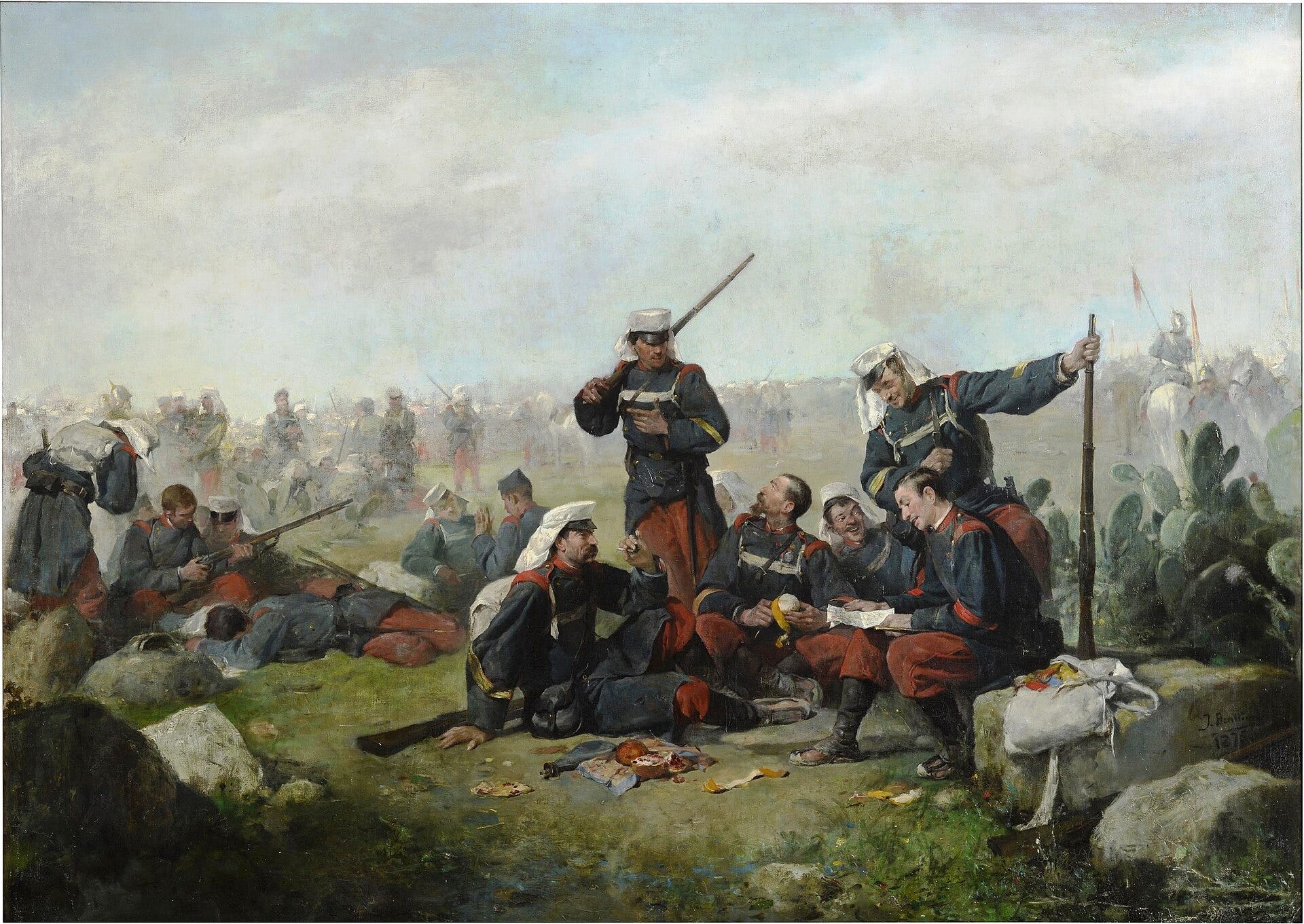
October 22, 1859: The Spanish government declares war on Morocco, sparking the six month Hispano-Moroccan War. Repeated attacks by Berber tribesmen from the Moroccan Rif region against the Spanish North African cities of Ceuta and Melilla prompted the declaration. In a relatively anti-climactic conflict the Spanish army occupied the northern Moroccan city of Tétouan and that effectively ended the fighting. The Treaty of Wad Ras, signed in late April 1860, obliged Morocco to pay a hefty war indemnity, expanded the territories of both Ceuta and Melilla, and gave the southern Moroccan coastal city of Sidi Ifni to Spain as well. The Spanish government returned Sidi Ifni to Morocco in 1969.
October 22, 1884: The International Meridian Conference, which was a real thing, designates the line of longitude running through the Royal Observatory at Greenwich as the international Prime Meridian. Previously most major seafaring countries, at least, designated their own separate prime meridians that often ran through their capital cities (Germany used the “Berlin Meridian,” for example, and France used the “Paris Meridian”). But such was the ubiquity of British map-making that the UK/Greenwich prime meridian had become the international standard by default even before this conference made it official. Nowadays the international Prime Meridian is the IERS Reference Meridian, which still runs through Greenwich but is around 100 meters east of the previous one.
INTERNATIONAL
A new assessment from the International Union for Conservation of Nature finds that 96 percent of shallow water coral reefs worldwide are “critically endangered” and could die off by 2075. A study published last year estimated that some 84 percent of the world’s reefs are bleaching as a result of rising water temperatures. Coral can recover from bleaching events if temperatures decline, but that doesn’t seem realistic without urgent human action.
The European Union has awarded its Sakharov human rights prize to the International Criminal Court. I don’t know that this warrants much commentary except to say that between this and the Nobel committee’s decision to award its peace prize to former ICC judge Navi Pillay earlier this month it seems pretty clear that there’s a message being sent in the face of the Trump administration’s drive to destroy the court.
MIDDLE EAST
SYRIA
Syrian Interior Ministry security forces raided a suspected Islamic State hideout near Damascus on Thursday, killing at least five alleged IS fighters. At least two government personnel were also killed in the clash. Elsewhere, the Israeli military (IDF) killed a “civilian with a disability” in southern Syria’s Daraa province on Thursday morning, according to the SANA news agency. The IDF has reportedly “expanded” its occupation of southern Syria of late, entering villages in Daraa and Quneitra provinces at will and, among other things, uprooting olive groves.
ISRAEL-PALESTINE
The IDF killed at least three people across Gaza on Thursday while a fourth person died of wounds suffered in a previous Israeli attack. The Euro-Med Human Rights Monitor became the latest NGO to warn that Israeli restrictions and worldwide funding cuts are pushing the territory toward another humanitarian crisis, with food prices rising and food supplies growing scarcer.
In the West Bank, Jasper Nathaniel has written another dispatch from the olive harvests, including the Israeli government’s response to the recent international attention garnered by settler terrorist attacks on Westerners and the brief arrest of US politician Brad Lander:
The IDF responded to outrage over Lander’s arrest by claiming that the delegation had failed to coordinate its visit to a private Palestinian olive field with the military, apparently oblivious to the absurdity of the requirement itself. But one line of the statement particularly stuck with me: “As in previous years, security forces are working to facilitate a safe and orderly olive harvest season.” Maybe someone over there has a sense of humor.
It seems clear that Israel’s response to the PR disaster triggered by the high-profile settler attacks has been to crack down on the activists and journalists documenting the violence, including one of the few people who captured the assault on Heidi. As for prosecuting the actual violent criminals, nine of the ten people arrested on suspicion of involvement in the Abu Falah and Taybeh attacks were quietly released days later, after Israel had heavily promoted the arrests on social media. The sole person still in custody is the settler who ran over a Palestinian while he prayed in December. Apparently, that crime alone wasn’t enough to keep him behind bars.
YEMEN
Pro-government forces appear to have launched a major operation to try to break Ansarullah’s siege of the city of Taiz, reporting hundreds of engagements and claiming that they killed or wounded some 285 Ansarullah fighters. These claims can’t be verified and should be taken with a grain of salt, but The New Arab reported on Wednesday, based on comments from a “senior military commander,” that a Taiz counteroffensive was on the horizon so that part at least rings true.
The threat of additional Ansarullah attacks reportedly prompted Aramco to order employees to evacuate its main headquarters in the Saudi city of Dhahran on Thursday. It’s unclear whether they were responding to a specific threat against that facility, which has already been attacked by Ansarullah, or reacting to the missile attack that killed two people (at last count) at King Fahd International Airport in the nearby city of Dammam late Wednesday.
IRAN
Iran’s Islamic Revolutionary Guard Corps claimed on Thursday that no fewer than seven vessels had either been attacked or struck sea mines in the Strait of Hormuz overnight. There’s no confirmation of that and no word as to any casualties. The recent intensification of attacks on shipping in the strait apparently hasn’t affected oil exports from the Persian Gulf, though it presumably has raised insurance premiums and other costs for vessels attempting to transit the waterway.
ASIA
AFGHANISTAN
The New York Times reports on Saturday’s exchange of hostilities between Afghanistan and Pakistan as well as the prospects for their border conflict to worsen:
In the latest round of fighting on Saturday, Pakistan’s military claims to have destroyed a military camp along the rugged, porous border and killed Afghan soldiers. A provincial spokesman for the Afghan military denied that there were any Afghan casualties and claimed instead that the Taliban had killed 13 Pakistani soldiers.
The conflict could become even more unpredictable, said Ibraheem Bahiss, an expert on Afghanistan at the International Crisis Group, as both sides embrace proxy groups: The Taliban in Afghanistan are accused of failing to restrain incursions by armed groups in the borderland that target Pakistan, while Pakistan is warming to the idea of supporting anti-Taliban armed opposition.
On Sept. 27, the Taliban said they had killed 28 militiamen and captured 32 others who had tried to enter Afghanistan from Pakistan. The Pakistani government called the accusations “baseless.”
“The proxy standoff is intensifying, and that’s a more dangerous escalation,” Mr. Bahiss said.
NORTH KOREA
The Diplomat’s Lee Sook-yeon warns that the North Korea government’s decision to resume its Demilitarized Zone loudspeaker broadcasts is a break with precedent and could lead to further tensions:
Previously, North Korea and South Korea stopped their loudspeaker broadcasts through bilateral agreement, after discussions. But South Korea ended its last round unilaterally. New President Lee Jae-myung ordered the broadcasts stopped on June 11, 2025; the North’s broadcasts ended the next day. In August 2025, the military began dismantling its fixed loudspeakers in what the defense ministry called “a practical measure aimed at helping ease tensions with the North.” Seoul said it had not consulted Pyongyang.
Pyongyang rejected any suggestion of reciprocity. After South Korea’s military reported that the North was removing some of its own speakers, Kim Yo Jong said: “We have never removed loudspeakers installed on the border area and are not willing to remove them.” About a week later, in fact, two new North Korean speakers went up opposite the South Korean border counties of Cheorwon and Hwacheon.
Now North Korea has declared that it will resume broadcasts. If so, the new round of loudspeaker use will be different from recent history. In 2015, 2016, and 2024, Seoul began broadcasting first; this time Pyongyang has declared its intention to do so, in response to alleged South Korean provocations. This is despite repeated efforts on the part of the Lee administration in Seoul to show its goodwill toward the North.
AFRICA
SUDAN
The Sudanese military (SAF) claimed the seizure of two parts of southeastern Sudan’s Blue Nile state on Thursday, including an important military base in the Bukuri region. That facility had been in the hands of the Rapid Support Forces militant group since late August, and is located close enough to the state capital, Ad-Damazin, to have been of concern to the SAF. Blue Nile has been a particularly active theater in recent days, with the RSF having made an advance there earlier this week.
An investigation by the BBC has found that the RSF “systematically destroyed” the medical infrastructure in the North Darfur capital of El Fasher before its fighters seized that city about a year ago:
Using sources who were on the ground in el-Fasher, the BBC has found details of at least 43 separate attacks on hospitals and healthcare sites from May 2024 to October 2025 - some hit multiple times.
Under international law it is illegal to attack health facilities or their staff during conflict.
The investigation also reveals the toll on medical workers in the western city. In the period from April 2023 to October 2025, the BBC’s data shows 120 were injured, 55 killed and 10 forcibly “disappeared” or abducted.
“The RSF [were] trying to evacuate the hospitals, to put them out of service because the health system is the cornerstone of any city or any state,” says Dr Muhamed Suliman, a surgeon who was based in el-Fasher during the siege and spoke to the BBC.
“The RSF started hitting these areas so citizens have no longer any way to stay there. It was intense. It was deliberate. It was planned.”
UGANDA
The confirmation of an Ebola case in Nigeria earlier this week raises questions about the situation in Uganda, where this patient (“the Ugandan-born wife of a Swiss diplomat based in Abuja,” according to Reuters) is believed to have contracted the illness. The Ugandan government reported 20 cases of Ebola earlier this year linked to the outbreak that began in the northeastern Democratic Republic of the Congo, but it’s been officially Ebola-free since August. “Officially” Ebola-free and “actually” Ebola-free could be two different things, however. Ugandan authorities are claiming that the Nigerian patient had traveled in the DRC before returning to Nigeria via Uganda, but both the World Health Organization and the Africa Centers for Disease Control and Prevention say that they can’t verify that claim, in which case the virus may still be present in Uganda.
EUROPE
UKRAINE
Russia’s overnight bombardment killed at least four people across Ukraine, while the Russian military reported downing 808 Ukrainian drones. So it would seem that whatever progress has been made on the subject of peace talks didn’t involve any commitment to reduce hostilities. The two sides did exchange bodies on Thursday, with the Russians repatriating 252 sets of Ukrainian remains and the Ukrainians returning 25 Russian bodies.
The Wall Street Journal reported on Thursday that Donald Trump had asked Elon Musk the previous day to lift the restrictions that he’d imposed on Ukraine’s Starlink satellite service. Ukrainian officials were saying that the system was working better on Thursday but had not been fully restored to normal.
SERBIA
With Serbian voters heading to the polls on Sunday, former President Aleksandar Vučić’s Serbian Progressive Party (SNS) has decided that praising war criminals is the best way to activate its base:
Hunting for ways to rally voters, the media machine of Serbia’s embattled strongman Aleksandar Vucic has been accusing his rivals of smearing a notorious Serb general, who was convicted of genocide and crimes against humanity.
Ratko Mladic, who died in custody in The Hague in August, was the general behind the 1995 Srebrenica massacre in Bosnia. Yet many Serbs remember him as a valiant warrior who defended his people and their identity from attack by Bosnian Muslims seeking their own state.
Denying his crimes has become a note in Mr. Vucic’s campaign pitch, seen by his camp as a surefire way to stoke nationalist sentiment and win votes before the high-stakes general election on Oct. 25.
Vučić is term limited, so he’s banking on SNS winning a parliamentary majority so he can shift jobs and make himself prime minister. Polling has a new bloc that emerged from the student-led anti-corruption protests that have been rocking Serbian politics since November 2024 running neck-and-neck with the SNS and its coalition partners.
AMERICAS
HAITI
El Salvador has reportedly sent 100 special forces personnel to Haiti to participate in efforts to rescue the four Salvadoran soldiers who were ambushed and abducted by gang militants near Port-au-Prince over the weekend. Salvadoran President Nayib Bukele had announced a rescue operation the previous day without going into detail about what it would entail. The AP is reporting that another 100 Salvadoran soldiers were going to be deployed to Haiti on Thursday evening. The whereabouts of the four missing soldiers remain unknown and Bukele has threatened a more intense response if they are not released alive.
CANADA
Canadian Prime Minister Mark Carney visited Turkey this week and signed a new “strategic partnership” agreement with President Recep Tayyip Erdoğan on Thursday. The wide ranging accord calls for closer relations on trade, defense, energy, and elsewhere and is a big shift in what had been a fairly arms-length relationship. This is part of Carney’s effort to widen Canada’s diplomatic reach to compensate for the country’s worsening relationship with the US.
UNITED STATES
Finally, Vanity Fair’s Matthew Cole reports on a hack of Jared Kushner’s cell phone that reveals that he spent much of Donald Trump’s first term conducting an independent foreign policy operation backed by a Persian Gulf “slush fund”:
Kushner, UAE ruler Mohamed bin Zayed (MBZ) and Mohammed bin Salman (MBS) of Saudi Arabia, converged at an auspicious moment. MBS wanted to be crown prince. MBZ wanted to blow up Obama’s Iran nuclear deal, and Kushner wanted both to help him force the Palestinians into a deal that Israel would accept. Despite the perception of his wealth, Kushner was not entirely financially independent of his parents, and the family business, Kushner Companies, faced a billion-dollar loan coming due on their trophy property, the Manhattan office building at 666 Fifth Avenue.
Early in the first Trump administration, MBZ and MBS offered to pay for a slush fund dedicated to helping the new administration with foreign policy goals. The idea was to help pay for Trump’s promised wall between Mexico and the US, for example, in an effort to secure a second term in the White House. The two Arab royals initially discussed with Kushner putting more than $10 billion into the effort. Within months, though, as MBZ pushed the Trump administration to help back MBS’s effort to become his country’s crown prince—and future king—the broader foreign policy slush fund idea fizzled. Instead, MBZ and MBS initially, and then MBZ alone, put at least $2 billion into at least two bank accounts for Kushner. It is unclear how the royals organized their $2 billion in combined payments, but they effectively split the cost.
The two accounts are designated Alpha and Beta, the former being housed in an Azerbaijani bank and used to advance Kushner’s (and the UAE’s) geopolitical aims and the latter deposited in the Israeli Central Bank and intended “for Kushner’s personal benefit.” Kushner, of course, didn’t disclose the existence of these accounts in what was a massive breach of federal government ethics rules. Nor did he ever represent himself as a foreign agent despite being bankrolled by two foreign powers.
Wasn't that long ago when the Nobel Committee gave Trump the green light to kidnap Nicolas Maduro and plunder Venezuela's oil wealth by awarding the prize to a right-wing traitor to their own country, even referring to the notorious Ms. Machado as a "a key, unifying figure in a political opposition that was once deeply divided."
I tend to think they should be offering an apology in lieu of yet another targeted message to Trump.