

You’re reading the web version of Foreign Exchanges. If you’d like to get it delivered straight to your inbox, sign up today and get 40% off on your first year:
TODAY IN HISTORY
October 20, 1448: The Second Battle of Kosovo ends with the Ottomans victorious over a Hungarian army under regent John Hunyadi. The Hungarians nearly won an unlikely victory but ultimately couldn’t overcome the Ottomans’ advantage in numbers and their field fortifications. The Ottoman victory shored up the empire’s position in the Balkans and allowed Sultan Murad II to turn his attention to the east and expand the Ottoman domains in Anatolia.
October 20, 1962: Chinese forces attack India in two disputed border regions—Ladakh in the west and the Tibet-Arunachal Pradesh region in the east—beginning the month-long Sino-Indian War. The conflict ended with a decisive Chinese victory that stabilized the still poorly defined Chinese-Indian border on Beijing’s terms.
October 20, 2011: With the tide of Libya’s civil war having turned decisively against him, thanks in no small measure to NATO’s intervention, a fleeing Muammar Gaddafi is captured by rebels west of the city of Sirte and summarily executed. Gaddafi’s death definitely marked the end of an era but it did not mark the end of Libya’s internal conflict, which in many respects remains ongoing.
MIDDLE EAST
ISRAEL-PALESTINE
The Israeli military (IDF) killed at least four people over multiple incidents in Gaza on Tuesday. Al Jazeera reported a “surge” of IDF attacks that began overnight and continued into the day, mainly focused on Gaza city though there were incidents reported elsewhere as well.
YEMEN
There are a number of items:
The death toll from Monday’s Ansarullah missile strike on a military camp in southern Yemen’s Shabwah province has now risen to 73. There are still 14 people missing so that figure may continue to increase.
UK Defense Secretary Wes Streeting announced on Tuesday that the Royal Air Force will “conduct defensive counter-air operations over Saudi Arabia, helping to protect Saudi cities, civilian populations and critical national infrastructure” from Ansarullah attacks. He was keen to stress the defensive nature of this operation, because domestically the UK government does not want to be seen jumping into the Yemen war. That is what it’s done, though, and it remains to be seen if the “defensive” distinction will hold.
United Nations human rights commissioner Volker Türk called on Tuesday for Ansarullah to allow humanitarian aid to enter the besieged city of Taiz. The siege has caused a spike in food and other commodity prices in the city and is also reportedly limiting access to clean water. Türk also called on the combatants to allow civilians who want to leave Taiz to do so “freely and safely.” The UN Refugee Agency, meanwhile, is reporting that over 250,000 people have been displaced by fighting in Yemen since July. Taiz has seen both the largest inflow and largest outflow of displaced persons in that time. The displacement surge is taxing already strained resources in southern Yemen.
IRAN
Pakistani military boss Asim Munir seems to have left Tehran empty-handed on Tuesday, after visiting the Iranian capital to discuss peace talks. Munir met with several Iranian officials, including President Masoud Pezeshkian and parliament speaker Mohammad Bagher Ghalibaf, and the common message appears to have been that Tehran doesn’t trust the United States to negotiate in good faith and won’t seriously reengage in diplomacy unless/until the US meets its preconditions — including ending its naval blockade and lifting sanctions. According to The New Arab, Munir was in Tehran to bring a new proposal from Pakistani and Qatari mediators that aims to find some middle ground on the issues of Iran’s nuclear program and its frozen assets. Supposedly this proposal has gotten “positive responses” from US and Iranian officials, but we haven’t heard anything from the former and there’s not much in the reporting around Munir’s visit to suggest that the latter are enthusiastic.
On another front, the Iranian ambassador in Baghdad claimed on Tuesday that the Iranian and Iraqi governments have reached an agreement for the expulsion of Iranian Kurdish militant groups from northern Iraq. I’m not sure how this is supposed to be implemented and the whole thing has a sort of “believe it when you see it” vibe so I wouldn’t put too much stock into these reports. The presence of those groups is a constant source of tension in the Iranian-Iraqi relationship so I’m sure the Iraqi government would like to be rid of them, but internal politics are a huge obstacle.
ASIA
AFGHANISTAN
The UN humanitarian agency (OCHA) has reiterated the World Food Program’s warning about Afghanistan’s emerging hunger crisis:
More than four million babies and children under six will need treatment for acute malnutrition next year, it warned.
Between September and October, 15.9 million people -- or nearly one in three Afghans -- were facing food insecurity at crisis levels or worse, including 3.4 million in emergency conditions, the agency said.
The outlook is set to deteriorate further during the winter lean season from November to April.
“The number facing acute food insecurity is projected to rise to 19.2 million, of which five million are expected to face emergency levels of hunger,” which is “one step away from famine”, said OCHA’s Afghanistan spokeswoman Olga Cherevko.
INDIA
Inter-communal violence left at least three people dead and four wounded in eastern India’s Manipur state on Monday. As we have noted previously, Manipur has been subject to violence involving the Meitei and Kuki communities on and off since at least 2023. In this case gunmen attacked a Meitei village. Community leaders are blaming Kuki “militants” though Kuki groups are denying involvement. Prior to Monday it had been months since the last incident.
NORTH KOREA
North Korean state media released photos of leader Kim Jong-un on Tuesday in response to the latest unsourced rumor that he’s Actually Dead. A few still photos with no verification of their date or provenance won’t put those rumors completely to bed but, as the BBC notes, if Kim really had died there would likely be visible indications that something serious was happening in North Korea (troop movements in North Korea or along the Chinese border, for example) and nothing like that has been observed.
AFRICA
SUDAN
The death toll from Monday’s drone strike in the disputed Abyei region along the Sudan-South Sudan border has risen to at least 153, according to the territory’s information minister. The strike hit a fuel depot near a crowded market, explaining the high casualties. Additionally, the death toll from two strikes in Sudan’s West Kordofan state on Sunday evening has risen to at least 150. The Sudanese military is likely responsible for all of these attacks.
LIBYA
The eastern Libyan House of Representatives legislature voted on Tuesday to ratify a 2019 maritime boundary agreement that its rival western Libyan-based government concluded with the government of Turkey. This is the outcome of a concerted effort by Turkish officials to cultivate ties with warlord Khalifa Haftar and his family, who control the eastern Libyan government, that also led earlier this year to a military cooperation agreement with Haftar’s “Libyan National Army.” The vote drew a rebuke from the Greek government, which has long regarded the 2019 deal as a violation of its maritime rights.
MALI
Islamic State Sahel Province fighters reportedly killed at least 48 people in an attack in eastern Mali’s Ménaka region that began late Sunday and continued overnight into Monday. According to a local Tuareg leader the group targeted civilians accused of providing intelligence to the Malian military in support of its drone operations. Malian authorities claimed on Monday to have struck a “major” militant base near the town of Ménaka, though they didn’t offer additional details as far as I know.
NIGERIA
Jihadist militants ambushed a security convoy in northeastern Nigeria’s Borno state on Saturday, killing at least 15 people. Boko Haram is believed to have been responsible.
Nigerian authorities reported a confirmed case of Ebola linked to the ongoing outbreak in the Democratic Republic of the Congo on Tuesday in the person of a woman who had traveled to the country from Uganda. The patient is in isolation and officials are tracing her contacts. The DRC outbreak has already spread to Kenya, where authorities have confirmed nine cases though so far no evidence of transmission outside of the immediate circle of the initial patient.
EUROPE
EUROPEAN UNION
The EU rolled out a new “strategy for the Arctic” on Tuesday that, according to AFP, appears to be aimed at bolstering the bloc’s independence from the US:
The United States is named only a handful of times in the 20-page paper, compared with almost two dozen mentions for Canada.
Some of the initiatives listed in the strategy seemingly aim to cut dependencies on Washington.
According to the draft, Brussels is planning a “sovereign and secure” submarine cable to connect Greenland with the EU’s mainland as part of a broader “Pan-Arctic” cable project – also linking Canada, Japan and South Korea.
The bloc is also working to provide satellite connectivity in the Arctic through satellite constellation project IRIS², which aims to rival Elon Musk‘s Starlink.
Unsurprisingly the document focuses quite a bit on Russia, with calls for defending against drone incursions and “hybrid attacks” as well as plans for increasing the EU’s fleet of icebreakers.
UKRAINE
Volodymyr Zelensky met with US envoy Steve Witkoff in Norway on Tuesday, after which he declared that US intelligence sharing with Ukraine had been restored. The US apparently stopped sharing intel on incoming Russian strikes with the Ukrainian military last week amid Zelensky’s latest public feud with Donald Trump. More recently Zelensky has accused the US of delaying deliveries of Patriot air defense missiles, though whether that’s because Trump is mad at him or because the US is running out of those munitions is unclear.
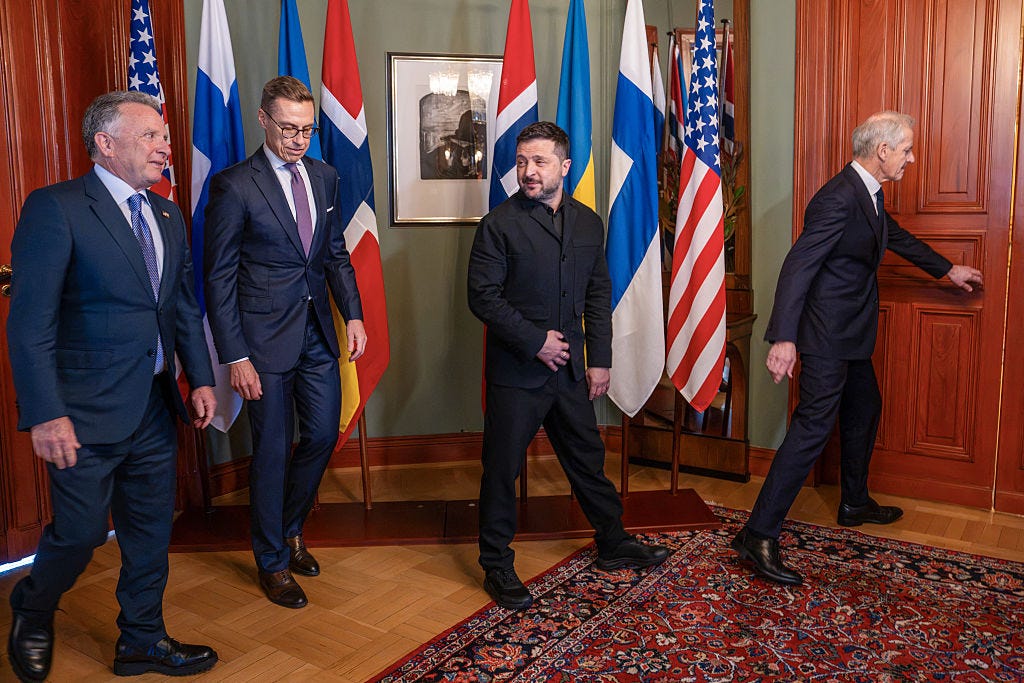
We’ll see whether Tuesday’s positive feelings actually last. Trump sounded on Tuesday at the White House like a guy who is still a) tired of this war and b) angry at Zelensky for not surrendering and ending it. He’s likely to continue looking for ways to punish Ukraine.
Speaking of which, The Wall Street Journal reported on Tuesday that it was SpaceX CEO Elon Musk who ordered the throttling of Ukraine’s military-grade Starlink service. Whether he spoke with Trump and/or other US officials before doing so remains a matter of contention (it still seems hard to believe that he would have done so completely on his own initiative) but he and Trump definitely discussed it after the throttling became public. Regardless of one’s position on this war I think the idea that the world’s richest man can pull the plug on an entire country’s military mid-conflict is probably something that warrants a broader societal conversation to say the least.
AMERICAS
COLOMBIA
Jacobin’s Carlos Cruz Mosquera discusses new President Abelardo de la Espriella’s drive to bring the US military to Colombia:
In the ten weeks since multimillionaire lawyer Abelardo de la Espriella was inaugurated as Colombia’s president, the country has undergone a significant political shift with respect to asserting its national sovereignty, with Colombia returning to — and potentially deepening — its subordinate position vis-à-vis the United States.
Less than a week after the change of government in Colombia, US Secretary of Defense Pete Hegseth announced a major shift in US-Colombian military cooperation, stating at a press conference that de la Espriella had approved an agreement for joint operations in Colombia. US Southern Command (SOUTHCOM) commander General Francis Donovan had met with Colombia’s highest-ranking military officials by the end of the month to begin planning those joint operations against armed groups. There have since been reports — some confirmed directly by the Colombian government and US Southern Command — of US military personnel and aircraft operating in Colombia.
The prospect of a renewed US military presence has provoked alarm among significant sections of Colombian society, particularly on the Left, which has a long tradition of opposition to US interventionism in the region. De la Espriella’s policy has therefore faced growing scrutiny and opposition. Opposition leader Iván Cepeda has submitted a formal complaint to the Colombian courts, arguing that the president’s actions concerning the joint military operations have violated the political rights of Colombians.
CANADA
Voters in the Canadian province of Alberta voted overwhelmingly against independence in Monday’s referendum. On the question of holding a second, “binding” independence referendum just 24 percent of voters said “yes.”
UNITED STATES
Finally, Responsible Statecraft’s Andrew Leonard discusses the logistical concerns around the US Congress’s effort to merge the US and Israeli militaries:
In title, the U.S.-Israel FUTURES Act sounds like one of many bilateral cooperative agreements between the U.S. military and a partner military force anywhere in the world. But in reality, as written, the provision would pressure existing security cooperation entities to expand and accelerate bilateral technological integration through a statutory executive agent arrangement that lacks clear precedent even among the U.S.’s closest allies.
The agreement isn’t necessary to advance cooperation. In practice, it puts undue pressure on the processes designed to protect U.S. interests and technology.
The issue discussed here is not if the U.S. should or should not increase its defense technological cooperation with Israel; the pros and cons are well-documented and highly debated elsewhere. What isn’t, or shouldn’t be, a matter of debate are the implications of putting undo pressure and influence to short cut established security processes for the benefit of any single partner nation, and that is precisely what Sections 219 and 1217 would do.
The U.S. Department of Defense is already well underway in reforming its technology release and foreign disclosure procedures following Executive Order 14268 of April 2025. Short cuts to these reforms, or additional legislation laying on top of ongoing actions, will only confuse and complicate the process, adding additional vulnerabilities in the end.