

You’re reading the web version of Foreign Exchanges. If you’d like to get it delivered straight to your inbox, sign up today and get 40% off on your first year:
TODAY IN HISTORY
October 12 (give or take), 539 BCE: An Achaemenid Persian army under dynastic founder Cyrus II (“the Great”) enters the city of Babylon, bringing the Neo-Babylonian Empire to an end and ushering in a (very long, as it turned out) period in which Mesopotamia was consistently ruled by outside powers. The conquest of Babylon was more or less a foregone conclusion after the Persian victory in the decisive Battle of Opis in September. Cyrus inherited the Babylonians’ conquests, including Judea, where he was later praised for allowing the exiled Judean population to return to its homeland.
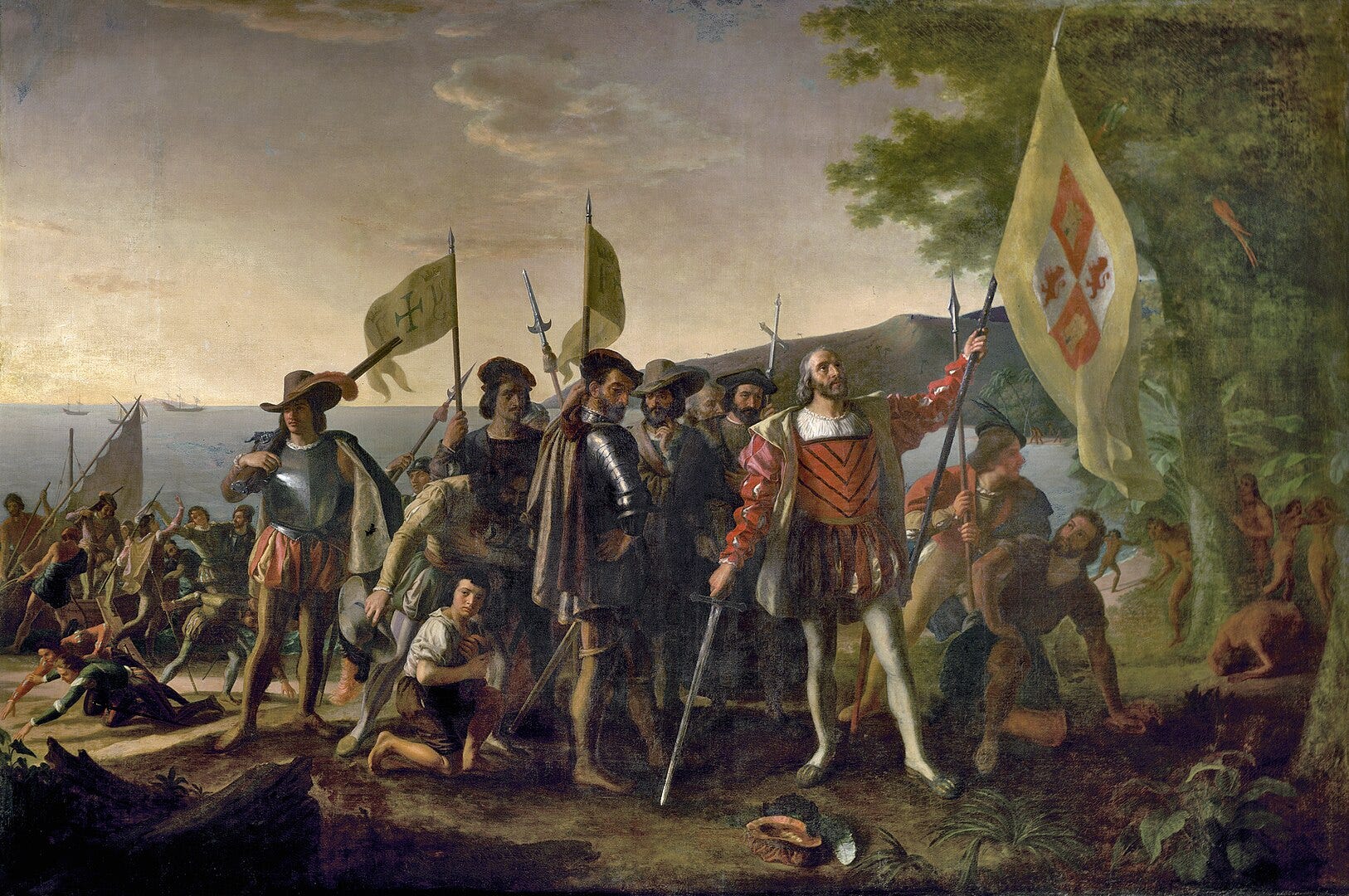
October 12, 1492: Christopher Columbus’s first expedition makes landfall in, as it turned out, the Americas (as they’d soon be known). Columbus dubbed the island he’d encountered “San Salvador” and it’s believed to correspond with modern San Salvador Island in the Bahamas. Mistakenly believing he’d sailed all the way to India, Columbus began the European practice of referring to the Indigenous peoples of the Western Hemisphere as “Indians” and spent the next three months exploring the region (losing his flagship, the Santa María, in the process).
October 13, 1307: The Knights Templar order is purged on the orders of Pope Clement V and at the strong encouragement of French King Philip IV. Many Templars, including the order’s senior leaders, were arrested, and in 1312 the order was officially dissolved by the Catholic Church. Clement and Philip charged the Templars with heresy and many members confessed to an array of crimes, albeit under intense torture. But the real issue was Philip’s very large debt to the order and his strong desire not to pay it, as well as concerns about the order’s relocation from the Holy Land to southern France.
October 13, 1943: Italy declares war on Germany. This abrupt shift of alliances was a symbolic culmination of Italy’s very chaotic late-World War II upheaval. A new Italian government under Prime Minister Pietro Badoglio surrendered to the Allies on September 3. Germany responded by springing former PM Benito Mussolini from prison and establishing on September 23 the Italian Social Republic (RSI), AKA the Republic of Salò. This Italian declaration of war came as the Allies were moving on German-occupied/RSI-ruled Rome.
MIDDLE EAST
TURKEY
Turkish sources are confirming that the Kurdistan Workers’ Party (PKK) has pulled its fighters out of four positions in northern Iraq’s Metina region under the terms of its peace deal with the Turkish government. The PKK is standing down from areas that are “considered to pose a risk of conflict for Turkey’s security,” according to those sources. The process of implementing the peace deal gained new momentum after the Turkish parliament passed an amnesty bill covering many people affiliated with the PKK back in August.
LEBANON
A New York Times satellite imagery analysis shows that the Israeli military (IDF) has turned much of occupied southern Lebanon into a “wasteland,” demolishing “48 of the roughly 60 villages and towns” in that area and focusing in particular on places with majority Shiʿa populations. It has leveled most of those since the “ceasefire” went into effect in April. The IDF insists it’s done this to prevent Hezbollah from operating out of those towns and villages but the effect, intentional or not, has been to leave them completely uninhabitable. Though that may not matter, because imagery also shows indications that the IDF is building new outposts in the region that suggest plans for a long-term occupation.
On a somewhat related note, Hezbollah has announced that it is offering up to $14,000 to families that have lost their homes to the IDF’s invasion. This seems like a strong indication that it has, contrary to US denials, obtained financial assistance from Iran in order to fund this program. The $14,000 payout applies to families from Beirut and its suburbs while families from other parts of the country will receive $12,000.
ISRAEL-PALESTINE
The IDF killed at least two people in an airstrike on southern Gaza’s Khan Younis area on Monday. The previous evening another IDF airstrike in the Mawasi displacement zone killed at least three people.
YEMEN
An apparent Saudi airstrike on an oil facility in Yemen’s Hudaydah province killed at least two people on Tuesday. The Saudis also attacked an oil facility in Sanaa after issuing an evacuation warning to anyone in the vicinity. There’s no indication of casualties from that bombing as far as I can tell, but residents of northern Yemen do appear to be lining up at fueling stations out of concern about potential shortages. Ansarullah likewise issued evacuation warnings for a number of sites in Saudi Arabia, including Aramco’s headquarters in the city of Dhahran as well as the already-battered King Khalid International Airport in Riyadh. The latter facility remains closed, and the overall disruption to Saudi air traffic now seems to have spread to King Abdulaziz International Airport in Jeddah, the kingdom’s busiest airport.
(Later in the day Reuters reported that the Aramco offices in Dhahran had been hit and there was a “limited fire” on the site but no reports of any casualties.)
On the ground, conditions are continuing to worsen in the city of Taiz, which remains under a siege or near-siege by Ansarullah. Reuters is reporting that food prices are up and government forces may be retreating into the city from areas on its outskirts. The Yemeni Network for Rights and Freedom claimed on Tuesday that Ansarullah shelling had killed at least five civilians in the city over the previous day. And the World Health Organization is reporting a significant spike in the number of cholera cases in Yemen, largely as a result of mass displacement brought on by the latest rounds of fighting. Nearly all of the cases occurred among displaced populations that have relocated to parts of southwestern Yemen.
IRAN
In Iran-related news:
It turns out that no fewer than six commercial vessels came under attack in and around the Strait of Hormuz on Sunday, and while Iranian officials claimed responsibility for only one of those incidents it’s safe to assume that they were involved in at least a few of the others, presumably in retaliation for the US attack on an Iranian tanker the previous day.
The Islamic Revolutionary Guard Corps claims that its forces raided the hideout of a militant group in southeastern Iran’s Sistan and Baluchistan province on Tuesday, killing at least five people. While the IRGC did not specify the militants in question, Iranian media later reported that it was the Jaysh al-Adl jihadist group. Allegedly the group had kidnapped an engineer and was preparing to smuggle him out of Iran to an unspecified neighboring country. The Baluch human rights organization Haalvsh is telling a different story, which is that the IRGC unleashed its Fatemiyoun unit (composed mainly of Shiʿa Afghan nationals) on an area near the city of Zahedan and that unit indiscriminately began attacking people. It claims that at least 20 Fatemiyoun personnel were killed.
The US military added two more names to its list of Iran war dead on Friday, including one who died in Kuwait back in March. The Intercept has been pursuing that inconsistency with the Pentagon and continues to track what appear to be efforts to manipulate official casualty figures.
ASIA
TAIWAN
According to the Wall Street Journal US and Taiwanese military needs are driving the development of the island’s drone sector:
American drone-tech startups like HavocAI are swarming into Taiwan and—with the encouragement of U.S. government matchmakers—finding partners who can help them turn blueprints into reality.
The emerging industry has the potential to serve the U.S. military’s demand for a secure drone supply chain that steers clear of China, while providing Taiwan with an arsenal that it sees as essential to its survival as a self-ruled democracy.
U.S. startups working with Taiwan on sea and air drones range from small defense-tech firms to Anduril Industries, an arms supplier to the Pentagon and the Taiwan military whose drone contracts with Taipei have already passed the $1 billion mark. At least 13 U.S.-Taiwan collaboration agreements have been signed since September 2025.
CHINA
The Chinese government blacklisted Paraguayan Communications Minister Gustavo Villate and Belizean Foreign Minister Francis Fonseca on Monday, citing their relationships with Taiwan. According to the Chinese Foreign Ministry “certain politicians in Paraguay and Belize have willingly served as pawns of the Taiwan authorities in their attempts to seek Taiwan independence by soliciting external forces.” In particular their offenses include visiting Taiwan, meeting with Taiwanese politicians, and spreading “disinformation about Chinese cyberattacks to smear and attack China.”
AFRICA
SUDAN
Mada Masr’s Hassan Alnaser suggests that a perceived need to centralize the Rapid Support Forces’ command structure may wind up destroying the militant group:
Two tracks emerged within the tangle the war’s continuation has produced. Abdel Rahim [Dagalo] represents the military track — the belief that the answer comes with the sound of Land Cruiser engines, that military power dictates its own terms. He is the one who mobilized fighters from every corner, whose strategy succeeded in securing the RSF political influence.
The other track holds that a parallel civilian authority must be built with enough political capacity to exert negotiating pressure and impose its terms, represented by Hemedti [Muhammad Hamdan Dagalo], the younger and most trusted Dagalo brother in the RSF’s leadership. He is the godfather of the RSF project, going back to the days when they were rovers in Nyala’s plains, eating manasees in the shade of Cruisers paid for with ousted-President Omar al-Bashir’s money.
But if centralization could save the project, it could also undo it.
With every passing month, the state casts the “rebels” back into its sacred shadow. One military defection here, one political defection there. Each proving the failure of the RSF’s attempt at centralization — the kind of centralization that Hemedti once broke with the state over, when he cast himself as the son of the margins against the center, and is now trying to restore in the form of a project whose capital is Nyala. The other, out in the field, has failed to mobilize his fighters or even hold on to the ones still there. Between the meeting rooms and the battlefield, the seeds of further splits are taking root inside the military and political body of this difficult Sudan war — the war that sparked the country’s great fire.
Elsewhere, the Egyptian military has claimed responsibility for the airstrikes that killed at least 72 and possibly many more Sudanese miners on Saturday. It’s claiming that it dropped warning leaflets ahead of the attack, which I guess is supposed to absolve it of responsibility for the carnage. Egyptian authorities regularly accuse illicit, or “artisanal,” Sudanese mining operations of straying into southern Egyptian territory. The death toll from Saturday’s incident was so high that Sudanese military boss Abdel Fattah al-Burhan ordered an investigation into it, though he’s very reliant on Egyptian support so it would be surprising if the inquiry went any farther than that.
A gunman killed two Egyptian nationals near Khartoum on Monday in an attack that appears to have been motivated by Saturday’s airstrikes — the shooter’s brother was reportedly among those killed. Further retaliatory violence against Egyptians in Sudan is certainly not out of the question.
MOROCCO
New Moroccan Prime Minister Fatima Ezzahra El Mansouri’s Authenticity and Modernity Party (PAM) concluded a four-party coalition agreement on Monday with the nationalist Istiqlal (“Independence”) party, which finished second to PAM in last month’s general election, and two smaller center-left parties. The new alliance will hold a collective 207 seats in the 395 seat Moroccan House of Representatives. PAM and Istiqlal were part of Morocco’s previous governing coalition, so this new group is expected to reflect more continuity than change.
NIGERIA
Reuters is reporting that gunmen attacked a “convoy of traders” and its “military escort” in northwestern Nigeria’s Zamfara state on Saturday, killing at least 20 people. One of the region’s bandit gangs was likely responsible. The Nigerian military, meanwhile, is claiming that it killed “more than 40 Islamic State West Africa Province (ISWAP) fighters, including a senior commander” in airstrikes in northeastern Nigeria’s Borno state also on Saturday.
ETHIOPIA
The Ethiopian military reportedly entered the town of Adwa in northern Ethiopia’s Tigray region on Sunday without resistance. Adwa is just 40 kilometers from the Eritrean border, which suggests that Tigray People’s Liberation Front fighters (as well as any Eritrean forces that have allegedly entered Ethiopia) have been pushed back almost to the border itself. Adwa is also, hypothetically speaking of course, a town that the Ethiopian military would need to secure if it had any plans to invade Eritrea, again purely hypothetically.
DEMOCRATIC REPUBLIC OF THE CONGO
Former Congolese President Joseph Kabila announced on Monday that he’s forming a new opposition group, the “Front for the Refoundation of the Nation,” that includes the M23 militant group now controlling parts of the eastern DRC. Kabila has been based in the M23-controlled city of Goma since returning to the country last year, and Congolese authorities convicted him in absentia and sentenced him to death for various crimes including treason last September. This new group apparently supplants the Congo River Alliance, which previously served as the political wing for M23 and a number of other militant groups.
EUROPE
RUSSIA
The European Union blacklisted nearly 1600 entities and people with ties to Russia on Monday. Most appear to be connected in some way to the Russian arms industry but a subset of 77 people were targeted for helping to organize and run last month’s Russian parliamentary election (in a surprise outcome Vladimir Putin’s party won) in occupied parts of Ukraine.
Elsewhere, two more ships were targeted by drone strikes in the Black Sea off of the Bulgarian coast on Tuesday. One sank and 11 of its 16 crew members were still missing at time of writing. The Bulgarian government has summoned the Russian ambassador in Sofia under the assumption that the Russian military was responsible.
UKRAINE
Even though Donald Trump insisted that both the Russian and Ukrainian governments agreed to the energy ceasefire he announced over the weekend, there is no indication as yet that the Russian military has ceased firing at Ukrainian energy facilities. The Russian government has yet to comment publicly on the alleged ceasefire, while the Ukrainian government has said that it is willing to participate if Russia does as well.
In the meantime, with Trump once again frustrated with Volodymyr Zelensky over the aforementioned ceasefire and the Big Diesel Deal that the US and Russia just concluded there are new indications that the US may have stopped sharing intel with Kyiv. Ukrainian officials reported on Tuesday that they’d received no Western alerts ahead of Russian bombardments for two straight nights, which is an unusual occurrence. To be sure, Trump insisted on Tuesday that “we are sharing intel” and Ukrainian Foreign Minister Andrii Sybiha suggested that the Russian military may be using munitions that are harder to track. Nevertheless, Zelensky laid the blame squarely on the US and European countries on Tuesday.
AMERICAS
ARGENTINA
The Argentine government announced on Tuesday that it has lodged a case with the International Tribunal for the Law of the Sea seeking a temporary halt to British energy exploration projects around the Falkland (or Malvina if you prefer) islands. It’s arguing that the projects threaten to violate “Argentina’s sovereign rights over its continental shelf.” Argentine President Javier Milei, with some help from Donald Trump, has seized on the Falklands to inject a little jingoism into a presidency that’s appeared to lose some public support of late.
UNITED STATES
Finally, Jacobin’s Hank Kennedy argues that it’s time for the US Congress to revive an earlier crusade against war profiteering:
In April, President Donald Trump requested a $445 billion increase to the defense budget, meaning the United States will be spending around $1.5 trillion on the military. Much of the largesse will benefit the Big Five war contractors: Boeing, General Dynamics, Lockheed Martin, Northrop Grumman, and RTX (formerly Raytheon). These are the companies behind such budget-shredding boondoggles as the F-35 and the littoral combat ships.
If the promises of these weapons salesmen are to be believed, the US war with Iran should already be over. The enormousness of the Pentagon’s budget, on paper, means that any conflict the United States enters should be a decidedly short and lopsided affair. Yet Iran has not crumbled against an onslaught that one analyst calculated has cost the United States $72 billion and counting. What has all this spending accomplished?
A US Patriot interceptor missile costs $4 million; a Terminal High Altitude Area Defense (THAAD) interceptor runs around $13 million. America has fired plenty of both in the war with Iran. Contrast that with the Iranian attack drones these systems are meant to shoot down, which run anywhere from $20,000 to $50,000 apiece. These swarms of cheap drones are able to effectively counter US aircraft carriers whose price tags run into the billions (that is, when laundry room fires don’t do the job). The United States has fired off so much ordnance that talk has turned to a possible missile shortage.
All this weaponry comes at a steep price for the average American back home. In April, a report from the Institute for Policy Studies found that the average taxpayer spends approximately $4,000 per year on war and weaponry. What is all this money going toward? Who has really benefited from over a trillion dollars a year in annual military spending? In a spirit sorely lacking today, Congress tried to answer these and other questions ninety years ago when it forthrightly challenged the Pentagon and military contractors in its famous Nye Committee of 1934.