

You’re reading the web version of Foreign Exchanges. If you’d like to get it delivered straight to your inbox, sign up today and get 40% off on your first year:
PROGRAMMING NOTE: With tomorrow being a holiday in the US I’m going to play it by ear with respect to doing a roundup. If I opt not to do one I will double up on Tuesday. Thanks for reading!
TODAY IN HISTORY
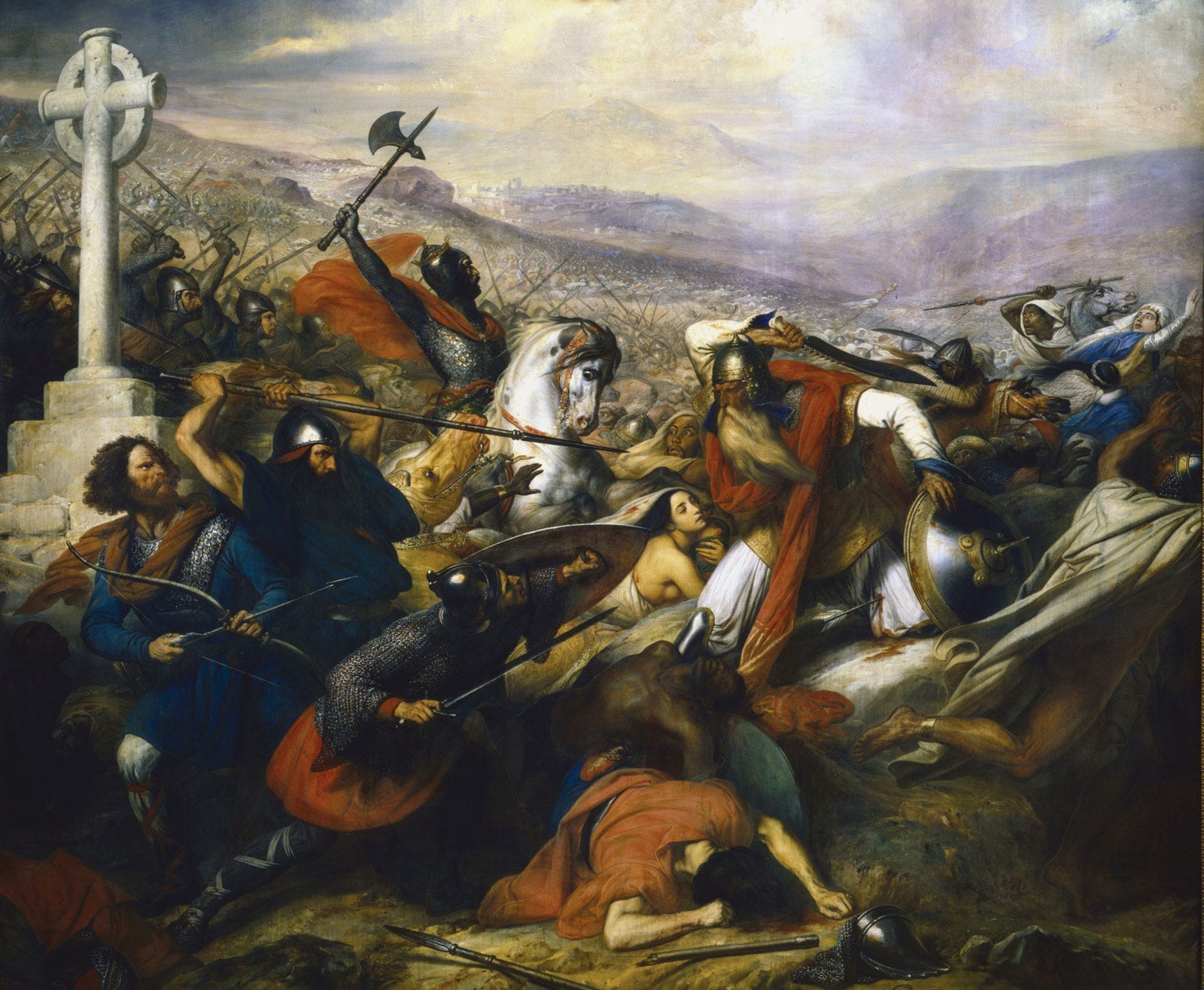
October 10 (maybe), 732 (again maybe): A Frankish Merovingian army under Mayor of the Palace and de facto ruler Charles Martel (namesake of the future Carolingian Dynasty) defeats an invading Arab-Berber army at the Battle of Tours (Poitiers) in what is today western France. Not terribly much is actually known about this battle, at least not that can be disconnected from the legends that grew up around it. In the European consciousness Martel would be credited with saving Latin Christendom from certain annihilation at the hands of a massive conquering Islamic army. Contemporary historians question whether the army was really all that massive and whether its aim was really conquest or just raiding and pillaging.
October 10, 1911: An uprising in the city of Wuchang (which is now a part of the city of Wuhan) led by the Tongmenghui movement leads to the Xinhai Revolution. It ended in February 1912 with the toppling of the Qing Dynasty and the formation of the Republic of China. This marked the end of thousands of years of imperial Chinese rule. Commemorated today in Taiwan as the National Day of the Republic of China.
October 11, 1142: The Jin and Song monarchies ratify the Treaty of Shaoxing, establishing a formal boundary between the two Chinese kingdoms. The Song were obliged by the treaty to give up their dynastic claims on northern China, which they’d ruled from 960 until the Jurchen people rebelled and drove the Song south of the Yangtze River in the 1110s (historians sometimes refer to the dynasty moving forward as the “Southern Song” to mark this geographic shift). The treaty also required the Song to pay an annual tribute to the Jin, though a subsequent war in the 1160s ended with a Song victory that established a more equal relationship between the two dynasties. The Mongol invasions of the 13th century eventually did away with both kingdoms and reunified China.
October 11, 1899: The Second Boer War begins. Though the Boer states had some initial success, the war ended in May 1902 with an overwhelming British victory and the collapse of both the South African Republic and the Orange Free State. Among the war’s many legacies was the popularization of the concentration camp, which Britain used to house large numbers of Boer civilians, many of whom died due to the treatment to which they were subjected.
MIDDLE EAST
LEBANON
The Israeli military (IDF) killed at least one person in southern Lebanon on Sunday when it shelled a town in Nabatiyeh province. A second person was killed in that same province by previously unexploded IDF ordnance, characterized as “a foreign object” by state media.
ISRAEL-PALESTINE
The IDF killed at least eight people, including a child, in Gaza on Saturday (the one year anniversary of the territory’s current “ceasefire”). A group of more than 100 NGOs issued a joint statement on Friday arguing that “the ceasefire exists in name only, with Israeli forces continuing to kill and injure Palestinians daily, and restrictions on aid, equipment and rebuilding materials preventing families from recovering.” Elsewhere, Palestinian Authority President Mahmoud Abbas made it official late Friday, canceling the Palestinian elections that had been scheduled to take place next month. He’s postponed them until September 2027, so expect sometime around next August that Abbas (or whoever is running the PA by then) will announce another postponement. The PA is in no shape to organize elections but, more than that, its unpopular ruling Fatah party would prefer not to risk control in a vote.
At his newsletter, Séamus Malekafzali considers the third anniversary of the October 7, 2023 “al-Aqsa Flood” attacks on the Middle East and, in particular, on Israel and Gaza:
The genocidal campaign that has been visited upon Gaza has led to a shift in [] public opinion [in Gaza], with support for October 7 declining from 71% in early 2024 to 37% by mid-2025. Support for Hamas has ebbed and flowed but has remained roughly the same inside Gaza throughout the war. Belief that Hamas would win the war, however, has declined from a high of 50% in December 2023 to 20% in August 2026. That devastation has even led some officials within Hamas, both former and current, to suggest that the calculations behind October 7 should perhaps have been different, as in the case of Hamas representative in Lebanon Ahmad Abdel Hadi. Former Gaza Minister of Culture Muhammad al-Madhoun has gone further, suggesting that the operation should have been called off had its planners known what kind of destruction would befall the Strip. The question for many of those who expressed this regret was not about the righteousness of the action (as Abdel Hadi said, the difference in calculation would not be “about the act of resistance and liberation itself”) but about the cost, a cost that has left the Strip, in the words of Gaza’s former minister of housing, “no longer fit for habitation.”
In addition to being the world’s largest open-air prison, a “concentration camp,” as many described it even before the war, Gaza has now effectively become a killing cage, ever-tightening as the Yellow Line encroaches without halt. A population of millions fenced in on all sides, forbidden from fighting against their attacker but exposed to weapons of mutilation and death.
YEMEN
Ansarullah battered King Khalid International Airport in the Saudi capital, Riyadh, over the weekend, killing at least 13 people and wounding more than 300 in an attack on Saturday and causing a fire along with at least one additional death in another strike on Sunday. These were the third and fourth attacks on that facility in the span of less than a week, the previous attacks having killed at least four people in total. Saturday’s attack killed at least one US national and drew criticism from the Trump administration, with Donald Trump going so far as to tell reporters that “we’re going to look at” entering the Yemen conflict more directly. “We’re going to look at that” is a verbal tic that Trump uses when he doesn’t know what else to say so I wouldn’t necessarily read very much into that statement.
Ansarullah also attacked King Fahd International Airport in the eastern Saudi city of Dammam as well as a number of Aramco facilities over the weekend. These strikes have heavily disrupted air traffic and prompted Saudi authorities to cancel in-person classes at all schools in Riyadh through at least Thursday.
The nominal Yemeni government claimed on Saturday that its forces are making gains at Ansarullah’s expense around the Bab al-Mandeb Strait, an assertion that would probably carry more meaning if this weren’t the second or third time in about a week that it had made a similar claim without any independent verification to support it. Yemeni officials are also warning of an “imminent health and humanitarian catastrophe” in Taiz as Ansarullah’s siege of that city is apparently preventing supplies and fuel from reaching its medical facilities. Under normal circumstances Taiz is Yemen’s third largest city, which means that the scope of the catastrophe could be immense and that its loss could be a severe blow to the government.
IRAN
The US military’s Central Command fired on a commercial vessel that “attempted to run the ongoing naval blockade against Iran” on Saturday, apparently disabling it. US officials are claiming no casualties in the strike. Iran’s Islamic Revolutionary Guard Corps, meanwhile, claimed to have struck a liquefied natural gas tanker that was traversing what Iran regards as the “illegal route” (the southern channel along the Omani coast) through the Strait of Hormuz. The United Kingdom Maritime Trade Operations center confirmed the basic details of both incidents.
Supreme National Security Council Secretary Mohsen Rezaee told state media on Sunday that the US response to Iran’s most recent proposal for reopening the strait was “insufficient.” Donald Trump had already publicly rejected that proposal but negotiations had apparently continued anyway. The Iranians proposed a seven day ceasefire followed by reopening the strait, provided the US met seven conditions. I have not seen any discussion of exactly what those conditions include, let alone which ones the US is refusing to meet. According to Rezaee the Trump administration has “accepted some of our conditions, while others remain unclear.”
ASIA
PAKISTAN
The Pakistani government has declared a state of emergency in Khyber Pakhtunkhwa province and apparently arrested provincial chief minister Sohail Afridi. It explained the move in light of what it called the “provincial government’s deliberate disengagement from the fight against terrorism,” but this appears to be a response to new protests by imprisoned former Prime Minister Imran Khan’s Pakistan Tehreek-e-Insaf (PTI) party. PTI has been organizing a new march on Islamabad from Khyber Pakhtunkhwa to demand Khan’s release. The party controls the Khyber Pakhtunkhwa government and it may be easier for the national government to suppress that march with provincial officials sidelined.
JAPAN
The Diplomat’s Tsuruoka Michito says that the US development of sea-launched nuclear cruise missiles (SLCM-N) may force the Japanese government to reconsider its “three non-nuclear principles” and specifically the principle regarding the introduction of nuclear weapons into Japan:
Once U.S. attack submarines begin carrying SLCM-N – or, more precisely, once they become capable of carrying it – Tokyo will find it difficult to avoid allegations that the United States is introducing nuclear weapons into Japan, regardless of whether a particular visiting submarine actually carries them. Under its longstanding “neither confirm nor deny” (NCND) policy, Washington will not disclose whether visiting submarines carry nuclear weapons. Moreover, under the U.S. definition, neither transit nor port visits constitute introduction.
This will therefore be primarily a problem for Japan. Some, particularly critics of the U.S.-Japan alliance, will argue that Tokyo should ban visits by submarines that might be carrying nuclear weapons. Doing so, however, could undermine the alliance’s deterrence and damage relations with Washington.
Part of the issue here is that the US and Japanese governments define “introduction” differently, with the US maintaining that it refers to “the permanent deployment of nuclear warheads in storage facilities ashore.” The Japanese definition includes the passage of nuclear-armed naval vessels through Japanese waters, according to which the US military did “introduce” nukes to Japan during the Cold War. The US Navy ostensibly stopped carrying nukes on its ships in 1992, eliminating the problem, but the development of the SLCM-N means that it is changing that policy. Tokyo may need to bring its definition into alignment with the US to accommodate the shift.
AFRICA
SUDAN
Drone strikes killed at least 72 “artisanal” gold miners in northern Sudan on Saturday, and when I say “at least” we should note that Sudan Tribune is reporting a death toll of “at least 200” with “hundreds more” wounded. In all likelihood the Egyptian military was responsible — Egypt frequently attacks illicit or “artisanal” Sudanese mining operations that it accuses of straying across the border onto Egyptian soil. Egyptian forces carried out a similar if less deadly drone attack back in June. There’s been no comment from Egyptian officials and Sudan’s military government relies too much on Egyptian support to make an issue out of this.
Elsewhere:
The Kordofan Observatory human rights group reported on Saturday that Sudanese military (SAF) drone strikes had killed at least 16 people in West Kordofan state over the previous 48 hours. Most (at least 12) were killed in the town of En Nuhud. The SAF’s recent gains in neighboring North Kordofan state have shifted the conflict’s focus toward West Kordofan.
The Sudan People’s Liberation Movement-North killed at least four people in shelling the capital of South Kordofan state, Kadugli, on Saturday, according to the Sudan Doctors Network. Kadugli is under military control and is frequently targeted by the SPLM-N and the Rapid Support Forces group.
Sudan’s Emergency Lawyers activist group is reporting that the death toll from Friday’s RSF drone strike in Blue Nile state has risen from at least 30 to at least 41. At least eight children were among those killed by the strike, which apparently targeted a group of displaced persons and another illicit gold mining operation near the state capital, Ad-Damazin.
ETHIOPIA
The Ethiopian government submitted a letter to the United Nations Security Council on Friday invoking its right to self defense against what it claims is an invasion from neighboring Eritrea. Eritrean soldiers have allegedly been spotted in Ethiopia’s Tigray region, where they are allegedly collaborating with the rebelling Tigray People’s Liberation Front, though Ethiopian drone strikes have reportedly driven both the TPLF and the Eritreans back toward the latter’s border. The letter is meant to justify military action against Eritrea though what specific actions the Ethiopian government is looking to justify remains unclear. It definitely suggests that the conflict is going to intensify. In response, the Eritrean government reiterated its accusation that Ethiopian officials are fabricating a threat in order to justify their own plans to seize Eritrean territory and urged the council to “condemn Ethiopia’s deplorable declaration of war against Eritrea.”
EUROPE
RUSSIA
According to the Financial Times, European intelligence agencies have decided that the Russian government is planning to assassinate defense industry executives:
With progress on the battlefield deadlocked in Ukraine and Russia’s economy struggling, the Kremlin has ordered an expansion of sabotage and “hybrid” operations in Europe as it seeks to fatally weaken support for Kyiv in the coming months.
Assassinations against European civilian targets — once considered taboo, even by Russia’s spy agencies — are an increasingly prominent part of those plans, European intelligence services have told the FT.
The FT spoke with officials from five different European intelligence agencies who warned that chief executives and other senior employees at defence companies were being targeted by Kremlin operatives.
Executives at smaller companies — especially those involved in the manufacturing of drones or their components — are also in their sights, the people said.
I have no idea if there’s anything to this but it seemed important enough to flag.
UKRAINE
Donald Trump’s frustration with Volodymyr Zelensky is spiking again after the Ukrainian president criticized his Big Diesel Deal with Russia. On Saturday, Trump complained to reporters that Zelensky had disobeyed his orders to stop attacking Russian oil facilities and opined that Ukraine ought to “get a new leader who can make a deal, because [Zelensky] could have made many deals that, for some reason, he never does.” It may be worth noting that a few months ago, before he started to freak out about the effect that high fuel prices might have on the US midterm election, Trump was reportedly “impressed” by the long-range strike campaign that has included Ukrainian attacks on Russian refineries. But I digress. It should also be noted that while Trump was complaining the Russian military was killing at least 21 people across Ukraine, including at least 20 in one strike in the city of Zaporizhzhia.
On Sunday Trump took to social media to declare that “effective immediately, there is an ENERGY CEASEFIRE in the War between Russia and Ukraine” and that “both parties” had agreed to it. Asked about this news later in the day, Zelensky said that it “was news for me,” and there doesn’t seem to be any indication that the Russian military has stopped attacking Ukrainian energy infrastructure. Zelensky did say that he’s prepared to order a halt to attacks on Russian oil facilities if Moscow does stop carrying out such strikes.
The punchline to this drama is that Trump’s Big Diesel Deal probably won’t bring down diesel prices in the US very much, if at all, at least not in time to help Trump and his Republican Party. There’s not enough fuel involved to matter much and the timetable for its release probably pushes any impact to beyond the election.
AMERICAS
UNITED STATES
Finally, Donald Trump is really mad that he didn’t win this year’s Nobel Peace Prize. I don’t think we’re quite at the “sending an aircraft carrier to Norway” stage but he did uncork a lengthy and mostly unhinged social media rant about what he regards as the snub late Friday night. Now far be it from me to try to tell the President of the United States how to win a peace prize, but one idea might be not to start any new wars. I mean, he tried winning the prize this year after starting another war with Iran and it didn’t work, so I’m just spitballing here. Unfortunately for his chances, CBS reported a couple of weeks ago that it looks like the Pentagon is ramping up plans for an invasion of Cuba so I think next year’s prize may be off the table as well.
Another way to appeal to the peace prize folks might involve not spending obscene amounts of money on things related to war. Sadly that appears to be out the window as well. Forget the fact that Trump publicly wants to spend $1.5 trillion on the US military next year, TomDispatch’s David Vine contends that the real defense budget could be much larger than that:
Long before Trump took office, U.S. taxpayers have spent far more on the Pentagon — and its wars — than most know. For decades, Congress, the White House, and the Pentagon have hidden the military’s true cost through little-known bureaucratic practices and budgeting tricks. Journalists, academics, and think tank experts have, with rare exceptions, perpetuated the problem by repeating “official” numbers that don’t come close to telling the full story.
Data shows that the budget was already between $1.5 trillion and $1.8 trillion in the last full fiscal year, 2025, as detailed by a recent Project on Government Oversight, or POGO, report I co-authored. Trump’s requests would add another $781 billion, bringing the potential total to at least $2.581 trillion in 2027.
The troubling revelation that the government is misleading the public and effectively hiding hundreds of billions in military spending reflects the out-of-control nature of the Pentagon budget. It’s also the only sector of government spending that seems largely insulated from public scrutiny: Imagine the outrage if news broke that the government was hiding hundreds of billions in spending for public housing, Medicaid, or hunger prevention programs.
People have a right to know how much tax money goes to military spending. This is critical to debating the proper size of the military budget both on its own and compared to other spending priorities, particularly any program related to education or the social safety net. Understanding the military’s true cost means understanding where and how the government has been hiding the money.