

You’re reading the web version of Foreign Exchanges. If you’d like to get it delivered straight to your inbox, sign up today:
Happy Diwali to those who are celebrating!
TODAY IN HISTORY
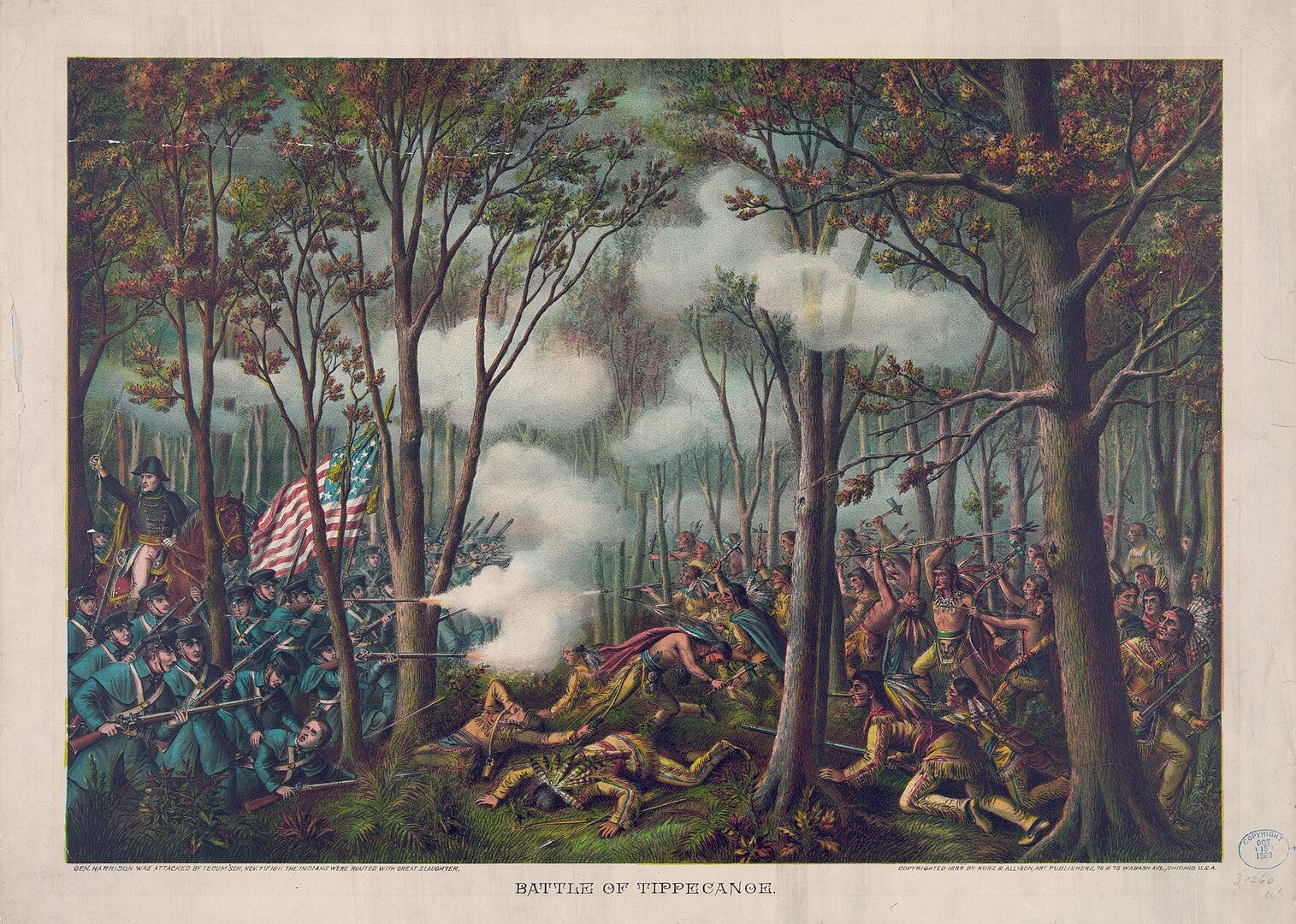
November 7, 1811: At the Battle of Tippecanoe, a US force led by future President William Henry Harrison (then governor of the Indiana Territory) defeats a group of Shawnee and allied tribal fighters and is able to destroy their nearby base, known as “Prophetstown.” Though fairly indecisive in its outcome the battle is considered one of the key engagements in “Tecumseh’s War,” a conflict that bled into the War of 1812. Today it’s probably best known as part of the campaign slogan for the Harrison-John Tyler presidential ticket in 1840: “Tippecanoe and Tyler Too!” The “Tyler Too!” bit turned out to be far more relevant than I think anybody expected.
November 7, 1917: The Third Battle of Gaza ends with the Ottoman Yıldırım Army Group abandoning Gaza and Britain’s Egyptian Expeditionary Force occupying the town. The first (in March) and second (in April) battles of Gaza had both ended in indecisive Ottoman victories, by which I mean the Ottomans held their positions but were unable to force the EEF back. Britain’s capture of Beersheba a week earlier was decisive and an extended British bombardment on November 6 proved to be the final straw for the Ottoman defenders. Capturing Gaza put the EEF well on its way to taking Jerusalem, which it would do around Christmas.
November 8, 960: An Arab army from Aleppo is returning from a raid into Byzantine territory when it is ambushed and resoundingly defeated by a smaller imperial force at the Battle of Andrassos. The near-destruction of its army was a crippling blow to Aleppo’s ruling dynasty, the Hamdanids, who within the decade would be reduced in stature from bitter Byzantine foe to imperial vassal.
November 8, 2002: The United Nations Security Council unanimously passes Resolution 1441, calling on Iraqi dictator Saddam Hussein to disarm under the terms of previous UN resolutions or face “serious consequences.” Funny story: Hussein had already disarmed, but we got to see what the serious consequences were anyway! It all really worked out just swell.
INTERNATIONAL
The European Union’s Copernicus Climate Change Service declared on Friday that 2026 is on track to be the second hottest year ever recorded. More than that, cumulative planetary warming from 2023 to 2026 is likely to exceed the 1.5 degrees Celsius threshold that was set out in the 2015 Paris climate agreement. An exceptionally strong El Niño event is fueling higher temperatures as the year goes on and could make 2027 the undisputed hottest year ever.
MIDDLE EAST
ISRAEL-PALESTINE
As expected, Israeli President Isaac Herzog gave current opposition leader Gadi Eisenkot first crack at forming a government on Saturday. Eisenkot received more recommendations than current Prime Minister Benjamin Netanyahu when Herzog consulted party leaders a few days ago. As I mentioned on Friday Eisenkot may have found a new path to a slim parliamentary majority when Yisrael Beiteinu party boss Avigdor Liberman seemingly gave up (or at least softened) his insistence on ending the ultra-orthodox military exemption, but he’s still got some work to do to close any potential deal. On Sunday Eisenkot expressed an interest in forming a “wide” government, by which he means a government that is just narrow enough to exclude Palestinian-Israeli representation but is open to everyone else. Toward that end he’s reaching out to even the far-right elements of Netanyahu’s coalition and potentially Netanyahu’s own Likud party about forming a “national unity” (again if you exclude Palestinian-Israelis) government.
Axios is reporting that Donald Trump spoke with Netanyahu by phone on Thursday and asked him “to take steps to implement [Trump’s] Gaza peace plan.” I don’t believe this, or at least I don’t believe that Netanyahu will do anything about it (though that may not matter for much longer), but if he did want to make a gesture to Trump he could start by finally allowing durable shelter materials into the territory. Heavy winter rain and wind have impacted tens of thousands of displaced Palestinians who are living in ramshackle tents that were inadequate when they were first used three years ago and are now worn down to boot. Rain caused a “sandy embankment” to collapse onto a group of tents in central Gaza on Sunday, killing at least five people. The Israeli government was supposed to allow sturdier shelter materials into the territory as part of the “ceasefire,” but over a year later it has not done so.
YEMEN
Ansarullah is claiming that Saudi airstrikes killed at least 33 people (including 13 children) and wounded at least 39 in a village near the city of Sanaa on Saturday. This incident took place one day after strikes killed at least 30 people near the city of Taiz. There’s still no indication as to responsibility for that attack but the Saudis had been attacking that area for days prior to Friday’s incident. Ansarullah, meanwhile, attacked the financial district in the Saudi capital, Riyadh, on Saturday and caused what appears to be substantial damage to Aramco Tower. Though the Saudi Energy Ministry characterized the damage as “minor,” footage appears to show that several floors of the building were partially blown out.
The Syrian government is once again denying rumors that it’s agreed to deploy military forces to Yemen. This is the second time it has had to issue such a denial in about a month and we may be entering “where there’s smoke there’s fire” territory at this point. Reuters reported on Friday that Syria has sent military personnel to Saudi Arabia to provide “support and training” and it’s certainly possible that there’s more to it than that. It sounds like Damascus may be auditioning for membership in the “Mecca defense pact” and that may include direct intervention in Yemen.
IRAN
Donald Trump reportedly told CNN on Sunday that in his view it is “highly unlikely” that another round of war with Iran is “going to be necessary.” This is contingent upon negotiations continuing to progress and ultimately concluding with what Trump would view as “a very strong agreement,” so stay tuned. In the meantime, the Qatari government has reportedly submitted a new proposal that would see International Atomic Energy Agency inspectors visit Iranian nuclear sites, in return for which the US would end its naval blockade of Iran and release a portion of Iran’s frozen assets. Iran would also reopen the Strait of Hormuz under this framework. Tehran would be under no obligation to take any other action regarding its nuclear program pending follow-on negotiations with the US. There’s no indication that this proposal is acceptable to either Iran or the US.
Elsewhere:
The US military fired on and apparently disabled a commercial ship in the Gulf of Oman on Saturday after it left an Iranian port and tried to run the US blockade. There were reports of multiple explosions around southern Iran on Saturday evening, but it’s unclear if any of them were connected to this incident. Iranian media had initially reported another US airstrike on Qeshm island, but subsequent comments from Iranian officials seemed to indicate that the explosions may have been connected to other unspecified military activities (they claimed, for example, that two ships had hit mines in the strait) so it’s possible that there were no US strikes.
The US military announced on Saturday that it is beginning “Task Force Iron Gate,” a new operation designed to expand the Iranian naval blockade to interdict Iranian commerce by land. The focus will be on blocking shipments of weapons as well as “dual use” products that have military application. Iran imports military equipment via the Caspian Sea as well as overland through Central Asia, and by air from China. Interfering with those shipments would likely violate international law — in contrast with the naval blockade, as there is at least some legal gray area permitting naval blockades in wartime.
Phase one of “Task Force Iron Gate” apparently involves pressuring the Iraqi government to close all of that country’s checkpoints along the Iranian border. Iraqi Foreign Minister Fuad Hussein said as much to Al Jazeera on Sunday. In addition to being a monumental security commitment, this would also likely devastate the Iraqi economy. It remains to be seen whether Baghdad will actually acquiesce to it.
The US State Department announced on Friday that it is offering a reward of up to $20 million, as well as as “possible relocation,” for information regarding the Iranian nuclear program. This is the same nuclear program that Donald Trump insists that he destroyed last year and then destroyed again earlier this year, so surely there can’t be that much information to report.
Iran’s Islamic Revolutionary Guard Corps announced on Saturday that it has scrapped its previous, self-imposed, 2000 kilometer missile range limit. This is unsurprisingly in response to the ongoing threat from the US and previous statements from Iranian officials that any resumption of the war would be met with a response that was not geographically limited. Iran is not known to possess at present any missiles with ranges beyond 2000 kilometers, but since the country has an active space program it could likely manufacture longer-range missiles (even up to the intercontinental level) in fairly short order.
ASIA
MYANMAR
Myanmar’s ruling junta announced on Friday that it will hold dozens of by-elections in April to fill vacancies in federal, regional, and state legislatures. Many of the seats that will be contested have been vacant since the elections that the junta staged in December and January to create the impression of a transition to civilian governance. They are in parts of Myanmar where conflict made it impossible to hold elections at that time, and it remains to be seen how many of them will be pacified by April. Regardless, we can assume that military-backed candidates will have a leg up in these races, given the shambolic nature of this entire contest.
CHINA
The Financial Times reported on Friday that US authorities believe that the CEO of chip manufacturer Nvidia, Jensen Huang, “had a romantic relationship with a Chinese woman who was recruited to spy for China’s main intelligence agency.” The woman in question is Alice Huang, an executive at “a Singapore-based customer” of Nvidia. Her firm, Megaspeed, has already been accused of “smuggling advanced Nvidia chips into China in violation of US export controls,” though an internal Nvidia investigation supposedly found “no evidence of wrongdoing.” Jensen Huang seems to have a good (albeit not romantic) relationship with Donald Trump and has been “personally” lobbying him to ease those export controls.
OCEANIA
NEW ZEALAND
New Zealand voters headed to the polls on Saturday for a general election whose results cannot yet be determined. Preliminary results give the current right-wing government of Prime Minister Christopher Luxon 67 seats, one more than required for a majority in New Zealand’s 131 seat House of Representatives. However, some 14 percent of the vote remains uncounted, including expatriate and absentee ballots, and that share of the vote traditionally shades left. There may be enough outstanding votes to nudge the race to the left or at least deny either the left or right blocs an outright majority. In the latter case the new centrist Opportunity Party would likely have an opportunity (see what I did there?) to play kingmaker.
AFRICA
SUDAN
The Sudanese military (SAF) claimed on Saturday that its forces had captured the town of Iyal Bakhit in Sudan’s West Kordofan state. This is a significant setback for the Rapid Support Forces militant group, which has used Iyal Bakhit as a staging area for operations in neighboring North Kordofan state. It also brings the SAF to within 100 kilometers of the town of al-Khuwai, which is the next major stop along the highway running from the city of El Obeid into West Kordofan. According to Sudan Tribune there were reports of fighting between the SAF and the RSF just 55 kilometers outside of al-Khuwai on Sunday.
LIBYA
Egyptian Foreign Minister Badr Abdelatty reopened Cairo’s embassy in Tripoli on Saturday, and while that may seem like a rather mundane occurrence, consider that that facility has been closed since 2012. The Egyptian government supported Khalifa Haftar and his “Libyan National Army” throughout Libya’s civil war, but just as the Turkish government has been trying to improve its relations with the Haftar family the Egyptian government is now trying to make some inroads with the rival government in Tripoli.
EUROPE
EUROPEAN UNION
At Responsible Statecraft, Eldar Mamedov argues that the European establishment is taking the wrong lesson from Tuesday’s US midterm election:
The EU high representative for foreign policy, Kaja Kallas, unsurprisingly, saw in the election a hope that the new Congress will strengthen transatlantic unity and support for Ukraine, presumably reversing [Donald] Trump’s insufficient devotion to the Ukrainian cause, which she criticized earlier.
In a similar vein, Christel Schaldemose, a vice president of the European Parliament, voiced “cautious optimism” that the results could “benefit Ukraine and the green transition.” Spain’s center-left prime minister, Pedro Sanchez, meanwhile, interpreted the vote as a “rejection of inequality, hatred, sexism and climate denial.”
Yet there is no evidence that the GOP debacle was caused primarily by Trump’s perceived lack of support for Ukraine or that it was a vindication of a progressive social agenda.
Rather, the polls, including Associated Press-NORC, New York Times/Siena, Fox News, and Gallup, consistently showed that, on average, around 75% to 80% said the “cost of living” (gas prices) and Iran war played an important role in how they planned to vote. In exit polls, 74% of voters said the war was a “crucial” or “major” factor in their decision Tuesday. Vice President JD Vance himself rated the Iran war as the top reason for the Republican wipeout.
Those in Europe who quickly seized on the anti-war sentiment were, revealingly, not the centrists opposed to Trump for ideological reasons, but his erstwhile admirers on the nationalist right.
Despite Trump’s occasional complaints about perceived disloyalty, that same centrist European establishment mostly supported the Iran war even if some of its members are now upset that it has raised energy prices.
UKRAINE
When US, Ukrainian, and Russian delegates head to Abu Dhabi on Tuesday to resume peace talks they will apparently be joined by a European contingent. French Foreign Minister Jean-Noël Barrot told French media on Sunday that “the Europeans will be well represented” in Abu Dhabi and “France will certainly be there.” He didn't say who would be representing either Europe or France, nor is it clear if they would be there to participate directly in the talks or indirectly via the Ukrainians.
Ukrainian President Volodymyr Zelensky accused Russia on Saturday of “intensifying its attacks” on Ukraine ahead of the peace talks. Overnight Friday to Saturday Russian strikes killed at least two people across Ukraine and heavily damaged power and heating infrastructure, especially around Kyiv. The Saturday-to-Sunday Russian bombardment left some 600,000 people without power in Ukraine’s Dnipropetrovsk oblast and likewise for another 250,000 in Kharkiv oblast.
AMERICAS
COLOMBIA
A drone strike killed at least three soldiers and wounded another 16 on a military base in northern Colombia’s Bolívar department on Saturday. There doesn’t appear to be any indication as to responsibility but that area is replete with insurgent groups including the National Liberation Army (ELN), the Gulf Clan, and remnants of the Revolutionary Armed Forces of Colombia (FARC).
HAITI
The leader of Haiti’s 400 Mawozo gang, Wilson Joseph, told the AP on Friday that he had contacted the Haitian government’s National Commission for Disarmament, Demobilization, and Reintegration to express his openness to negotiations and, potentially, disarmament. Earlier this month Joseph contacted the United Nations requesting “dialogue and mediation” over concerns about the escalation of El Salvador’s Haitian military operation. There is no indication that either the UN or the Haitian government is interested in talking with him.
UNITED STATES
Finally, Foreign Policy’s Catherine Osborn considers what the Democratic Party’s midterm victory could mean for US policy in Latin America:
The Democrats’ resounding victory in the U.S. midterm elections on Tuesday could spell change in the Trump administration’s approach to Latin America. It has also kicked off a debate about how the next U.S. president might approach the region.
Latin America has already received significant attention from U.S. lawmakers pushing for foreign-policy accountability for President Donald Trump. They have called for subpoenas related to Trump’s opaque oil deal in Venezuela, introduced a resolution to block deadly boat strikes in the region, and demanded hearings on deportee detentions in El Salvador.
Without legislative majorities, those efforts have moved slowly. That will change in January, when the new Congress is sworn in.
With control of Congress, Democrats could aim to “shut down” Trump’s boat strikes by attaching a funding prohibition to must-pass legislation, former State Department legal advisor Brian Finucane told FP’s John Haltiwanger. As an example of this tactic, Finucane pointed to Congress’s 1973 threat of a government shutdown to halt the U.S. bombing of Cambodia.
Aside from stricter oversight the election fallout may bring some personnel changes to the Trump administration’s foreign policy team. If he’s not fired for cause, there’s a reasonable chance that Defense Secretary (and boat strike enthusiast) Pete Hegseth will be impeached, though his removal by the US Senate is a long shot. Trump could fire him just to remove a potential distraction. Of potentially greater significance is the likelihood that Marco Rubio will abandon ship as he tries to distance himself from Trump ahead of his 2028 presidential run. Rubio has been the point man for the administration’s regime change efforts in Venezuela and Cuba so his departure would create some uncertainty in those areas.