

You’re reading the web version of Foreign Exchanges. If you’d like to get it delivered straight to your inbox, sign up today:
TODAY IN HISTORY
November 3, 644: The second Muslim caliph, Umar, is assassinated. Between the total conquest of the Persian Empire and the capture of most of the Byzantine Empire, Umar’s caliphate saw a massive expansion in the Arab empire that had been established by Muhammad. He was murdered by a slave, Piruz Nahavandi (or “Abu Lulu”), who had previously been a soldier in the Persian army. His motives are unclear, but revenge for the Arab conquest was probably among them.
November 3, 1903: Panama declares itself independent of Colombia, at the encouragement of a US government that wanted to deal with an independent and…oh, let’s say “persuadable” Panamanian government in constructing the Panama Canal. Commemorated annually as Panamanian Separation Day.
MIDDLE EAST
ISRAEL-PALESTINE
Leaders of Israel’s opposition parties met on Tuesday and agreed to recommend Yashar party boss Gadi Eisenkot to be the country’s next prime minister, following last week’s Knesset election. Assuming that the two Palestinian-Israeli parties, the Joint List and the United Arab List, follow suit that should mean that Eisenkot will get the first crack at forming a government, ahead of current PM Benjamin Netanyahu. Israeli President Isaac Herzog will begin party consultations tomorrow and whichever leader gets more recommendations from the parties will likely be his pick. That doesn’t mean Eisenkot will actually be able to form a government, given the tensions within his coalition about working with the Palestinian parties.
Donald Trump told Fox News on Tuesday that he and Netanyahu have “already agreed that by the end of this year we won't be paying Israel” the $3.8 billion in military aid that it currently gets from the US. This seems to have been news to just about everybody. Netanyahu and some US officials have talked about phasing out that aid when the current 10 year agreement authorizing it lapses in 2028, but that’s two years away and I’m not even sure that Trump can legally stop that aid before then. Regardless, Trump is apparently tired of “the left” criticizing that aid and wants to eliminate it as an issue. And the legislative work being done in the US Congress to meld the US and Israeli militaries could simply shift that aid from a separate item in the US State Department budget to an integrated part of the US defense budget. US support for Israel could remain constant or even increase under that structure but it would be harder to isolate it as a political issue.
YEMEN
Ansarullah claimed on Tuesday that Saudi airstrikes had killed at least 17 people across Yemen over the previous two days. Saudi officials, in turn, are accusing Ansarullah of another attempted drone strike on the holy city of Mecca. The Saudis have repeatedly alleged that Ansarullah has tried to attack Mecca while the group has repeatedly denied those allegations.
The nominal Yemeni government is accusing the Iranian government and Hezbollah of sending 21 “experts” (14 from the former and seven from the latter) to Yemen to support Ansarullah. They are supposedly advising/overseeing the group’s military operations in a wide range of areas. Whether true or not, these claims are intended to internationalize the Yemen conflict and draw additional external actors into it on the government’s side.
IRAN
Signals from the US over the past couple of days have been peculiarly optimistic regarding the prospects for a peace deal with Iran. That even includes Monday night’s airstrikes on Iran’s Qeshm island, which the US military has been at pains to characterize as “defensive” in off the record comments to media so as to stress that they don’t signal a resumption of full-blown war (leave aside the absurdity of using the term “defensive” in this context). Both Donald Trump and Vice President JD Vance have talked about progress in negotiations, with the former claiming on Monday that the contours of a deal were “coming together very nicely.”
(On Tuesday evening Trump gave a brief interview to The Financial Times in which he again downplayed the idea that a resumption of war is imminent. Of course he based that assessment on the claim that “we seem to be getting everything we want” from Iran in the negotiations, which may not quite comport with reality. If his assessment changes then perhaps war becomes more likely.)
Trump and Vance are routinely full of shit so there’s no reason to take their word(s) for it. But The New Arab reported on Tuesday that its “sources” were saying “that both the US and Iran made compromises that allowed a proposal to move ahead, with a possible joint announcement soon.” So maybe something really is in the works. On the other hand, public statements from Iranian officials have been decidedly more pessimistic, with “a senior Iranian official” telling Reuters on Tuesday that the two sides “are still far from a deal” and Iranian Supreme National Security Council Secretary Mohsen Rezaee calling the latest US response “not convincing” via social media.
The Israeli government is continuing to pull out all the stops to get its war back on. According to The New York Times it “has shared intelligence with the United States asserting that Iran is considering the use of chemical weapons against its adversaries.” It’s unclear whether Iran has any chemical weapons, let alone that it might be about to use them. The Iranian government admitted to working on chemical weapons during the Iran-Iraq War but has insisted that it ended that program. US intelligence has asserted Iranian research into chemical weapons but has stopped short of claiming that the country has actually operationalized that research, which would require developing more than just the chemical agents themselves (this is similar to US claims about Iran’s nuclear program).
The above is not dispositive, particularly since “chemical weapons” could include something as ubiquitous as chlorine, which Iran surely does possess. But chemical weapons are a particularly sensitive issue for the Iranian government, considering how heavily the Iraqis used them against Iran during the Iran-Iraq war, and there’s no question that the Israelis are incentivized to run the WMD gamut as they repeatedly pitch the Trump administration on resuming this war. That argues for a healthy level of skepticism about this alleged “intelligence.”
ASIA
PAKISTAN
Militants killed two police officers who were guarding a polio vaccination team in northern Pakistan’s Khyber Pakhtunkhwa province on Tuesday. There’s been no claim of responsibility but this sort of attack has been a hallmark of the Pakistani Taliban and affiliated groups.
INDIA
The Diplomat’s Tarushi Aswani reports on indications that the Indian government may be attempting to assert control over the practice of Islam in Kashmir:
Ghulam Sofi’s forehead bears a dark mark right in the center; it is from years of offering namaz, he says. It is Friday and Sofi is getting ready for the prayers at his home in the Khanyar area of Indian-administered Kashmir’s Srinagar city.
As Sofi neatly adjusts his skullcap, without ruining the thin layer of grey hair under it, he says, “In Kashmir, Islam and politics have always remained inseparable. We can smell the link this time too.”
Sofi is referring to the recent order by Kashmir’s Waqf Board, a body overseeing Muslim shrines in the region.
On October 10, the Jammu and Kashmir Waqf Board – headed by Dr. Syed Darakhshan Andrabi, a Kashmiri leader associated with Indian Prime Minister Narendra Modi’s Hindu supremacist Bharatiya Janata Party (BJP) – proposed developing common themes for Friday sermons across mosques and shrines in the conflicted region. Soon after the news of the homogenizing of sermons spread, it came under fire for political interference in religious affairs. Locals feel that the board’s plan to dictate Friday sermons is an assault on their faith, dressed up as “coordination.”
AFRICA
SUDAN
A drone strike, likely carried out by the Rapid Support Forces militant group, killed at least seven people and wounded 36 in Sudan’s South Kordofan state on Tuesday. The attack hit a fueling station in the Abassiya district in the northeastern part of the province, which has apparently seen an escalation in RSF drone activity of late. Sudan in general has seen a surge in drone activity this year, which The New York Times reports has mostly benefited drone manufacturers and mostly punished civilians:
The use of drones in Sudan’s bloody civil war is accelerating, the United Nations human rights chief, Volker Türk, said last month. The weapons have enabled the Sudanese military and its adversary, the paramilitary Rapid Support Forces, to reach far beyond the front lines and wreak havoc deep inside enemy territory.
But analysts say the use of sophisticated drones has not given either side a decisive edge in the civil war. Instead, they have become the No. 1 killer of civilians this year, adding to famine and a drought that the United Nations says now covers half of Sudan.
The main benefit of the drone war goes to the Turkish and Chinese companies making the drones, as well as the foreign powers who help to supply or fund them, analysts say.
NIGERIA
Gunmen ambushed a police convoy in northwestern Nigeria’s Zamfara state on Tuesday and killed at least eight people, according to Reuters. Five of the dead were police officers and three were members of a state-backed vigilante group called the “Zamfara Community Protection Guard.” The attackers were probably bandits though there is jihadist activity in that part of Nigeria as well.
SOMALIA
Drop Site’s Mohamed Gabobe is reporting two stories from Somalia. First, an al-Shabab mortar attack “killed four civilians in Somalia’s semi-autonomous Puntland region” on October 27. Regional security forces ultimately repelled the attack. Second, a pair of Turkish airstrikes killed at least two civilians “and sparked anti-Turkish protests” in Somalia’s Southwest state last week. The Turkish military was tracking two Somali military vehicles that had been captured by al-Shabab fighters on October 26 but apparently waited too long to catch any jihadists.
EUROPE
UKRAINE
The Russian and Ukrainian militaries traded shots at their countries’ respective energy infrastructure overnight and into Tuesday. Russian strikes took a number of Ukrainian power plants off-line and damaged transmission lines, as well as threatening a substation connected to the Ukrainian nuclear power plant at Khmelnytskyi. Ukrainian attacks, meanwhile, caused a fire in an oil refinery in the Russian city of Yaroslavl and killed at least two people near the Zaporizhzhia nuclear power plant in Russian-occupied Ukraine.
POLAND
Polish Prime Minister Donald Tusk claimed on Tuesday that security forces had prevented a potential “provocation” along the border between Poland and Russia’s Kaliningrad exclave. Details here are minimal but apparently involve a group of flashlight-wielding people who were observed in the vicinity of the border overnight. Polish border guards apparently decided that they were up to no good and responded accordingly. Polish police, meanwhile, are reportedly involved in a “special operation” to beef up security along the Belarusian and Russian borders.
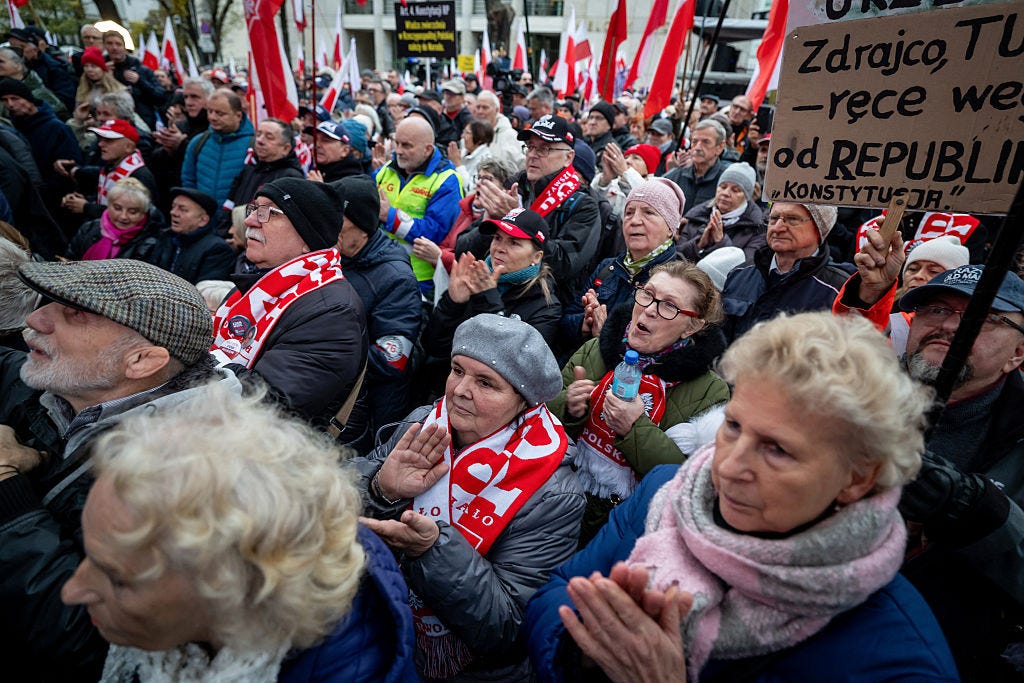
Tusk is also accusing Moscow of involvement in an ongoing political dispute over the selection of judges to Poland's Constitutional Tribunal that has pitted his centrist government, which has suspended the tribunal’s president, against right-wing Polish President Karol Nawrocki, who opposed that move. The dispute has fueled anti-government protests (and pro-government counterprotests) in Warsaw (this is where the Russians allegedly enter the picture) and may provide a boost to the opposition Law and Justice party, which is friendly with Russia and with which Nawrocki is aligned.
SERBIA
Though the “Student List” has yet to actually take control of the Serbian parliament, the AP reports that it is already pursuing anticorruption efforts:
While waiting to form the new government, the election winners have called on prosecutors and judges to start doing their jobs or step down.
Scores of investigations into alleged top-level corruption cases remained incomplete under the previous government, including one into a Nov. 1, 2024, train station tragedy that triggered two years of student-led anti-graft protests.
Now, the Serbian public is waiting to hear what will come out of a review into some of the longstanding probes after the student movement promised there will no longer be untouchable officials.
In a statement on Tuesday, the Higher Prosecutor’s Office in Belgrade complained of “an atmosphere of persecution and lynching,” after the election, along with “open political pressure by some social and political actors.”
The statement said the alleged pressure was designed to force resignations and that the European Union mission in Belgrade and the Organization for Security and Cooperation in Europe have been informed.
AMERICAS
VENEZUELA
The New York Times’ Edward Wong reports that the Trump administration is negotiating a “status of forces” agreement with the nominal Venezuelan government that would cement that country’s status as a US dependency:
The talks could open the door to a remarkable and perhaps risky new stage in the U.S. relationship with Venezuela, as the two former adversaries attempt to move toward military cooperation.
Venezuela’s top officials have become subservient to President Trump since U.S. troops killed scores of people in a nighttime assault on Venezuela in January and took Nicolás Maduro, the country’s leader, to a prison in New York.
In a speech in Washington on Monday, Mr. Trump referred to “our conquest of Venezuela.”
The negotiations are the latest manifestation of the U.S. government’s increasingly militarized policies in Latin America. Mr. Trump and his top aides have ordered troops to carry out operations across the region, including joint actions with forces in Colombia, Ecuador and Venezuela.
The US and Venezuelan militaries are already collaborating — according to the NYT, they carried out a joint operation on Friday against Colombian National Liberation Army (ELN) rebels who were operating on the Venezuelan side of the border. Drone strikes killed at least 23 people, and it’s unclear how many of them were ELN fighters but at least some of the casualties do appear to have been civilians.
UNITED STATES
Finally, votes are being counted in Tuesday’s midterm election and at least for tonight that is all I’m going to have to say on that subject. Instead, The Intercept’s Séamus Malekafzali discusses US Secretary of State Marco Rubio’s recent public call for CIA collaborators in Cuba and what it says about the state of the intelligence world:
This kind of overt recruitment stems from the difficulties Western intelligence agencies face against adversaries who have built sophisticated surveillance networks of their own. A CIA official told ABC News in May 2025, “in today’s world of [universal technical surveillance], we can’t recruit sources the same way that we did 20 years ago, probably the same way you did 10 years ago.” This has not only affected intelligence operations targeting Beijing, but also Tehran and Havana, where both the U.S. and Israel’s lack of on-the-ground connections and limited official presence has led the CIA and the Mossad to try to recruit willing informants online.
While these limitations may govern the particulars of this strategy, those in power in their respective countries may not see it as evidence of constraints, but instead as evidence of the power of their new strategy: boasting about their national power, rather than keeping it behind closed doors where it supposedly remains useless. After all, what is the use of a deterrent if nobody knows it was you?
Unsurprisingly the pioneer in this new era of bragging about intelligence activities is Israeli Prime Minister Benjamin Netanyahu, who has spent years openly boasting about his country’s “covert” operations against Iran. Donald Trump has also gotten in on this racket, but that may simply be due to his inability to keep his mouth shut.