

You’re reading the web version of Foreign Exchanges. If you’d like to get it delivered straight to your inbox, sign up today:
TODAY IN HISTORY
November 29, 903: An Abbasid army defeats the Ismaʿili Shiʿa Qarmatian sect in a battle near the Syrian city of Hama. Caliphal forces seem to have more or less overwhelmed the smaller Qarmatian army, which lost several commanders and was eventually surrounded and routed with heavy casualties. Nevertheless this was a fairly minor setback for the sect, which continued to grow in prominence in eastern Arabia and in 930 even sacked Mecca and carried off the Black Stone of the Kaaba. The main outcome of Hama was that the Abbasids were able to seize direct control of Syria and eventually Egypt from the Tulunid dynasty, whose “autonomous” governorship of those regions had grown increasingly independent from Baghdad.
November 29, 1890: Japan’s Meiji Constitution goes into effect, codifying a semi-constitutional monarchy modeled along the lines of Prussia and the United Kingdom. In principle the charter vested substantial powers in the person of the emperor, though in practice most executive function was meant to rest with a prime minister and civilian government, while the elected Diet was to hold legislative power. Ambiguities over the power dynamics among these institutions may have facilitated the country’s slide into totalitarianism prior to World War II. After Japan lost that war its US occupiers drafted a new constitution, which explicitly limited the emperor to a symbolic role.
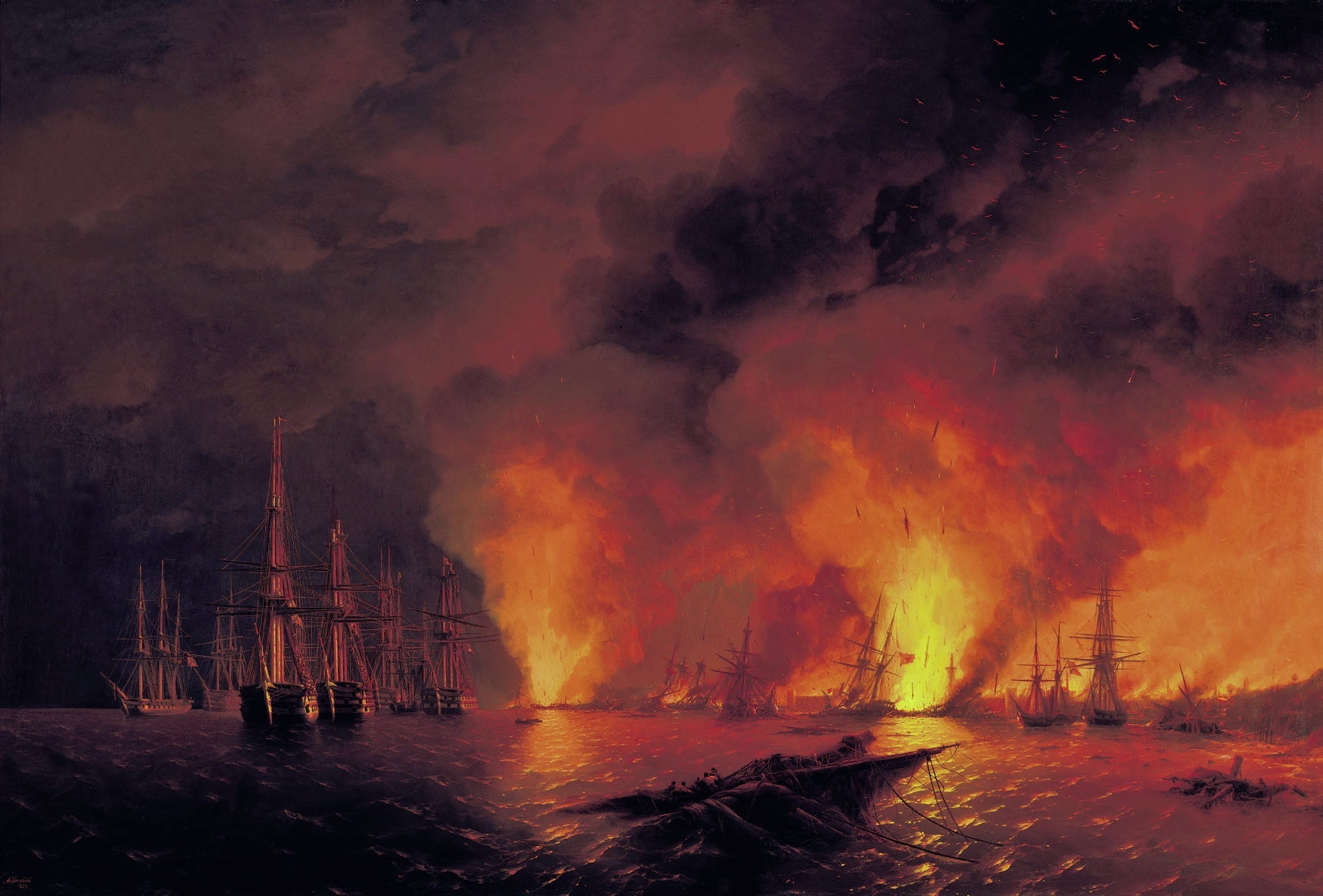
November 30, 1853: A Russian naval expedition attacks and destroys an Ottoman supply convoy in the harbor of the Black Sea port city of Sinop. The engagement proved to be the first battle of the 1853-1856 Crimean War, as France and Britain seized on it as a pretext to declare war on Russia and come to the aid of the beleaguered Ottoman Empire.
November 30, 1947: Palestinian gunmen attack several buses carrying Jewish passengers across Mandatory Palestine. The attack was a response to the United Nations General Assembly’s adoption of its partition plan for Palestine the day before and began a five and a half month period of paramilitary clashes and terrorist attacks between Jews and Arabs, essentially a “civil war” within the British colony. That conflict “ended,” along with the UK’s mandate, in May 1948, when joint Arab League forces invaded Israel-Palestine and the civil war became the Arab-Israeli War.
MIDDLE EAST
TURKEY
There are new indications that the peace process between the Kurdistan Workers’ Party (PKK) and the Turkish government is stalling. Amed Malazgirt, a senior PKK figure, told AFP over the weekend that the Kurdish movement is done making concessions until the Turkish government begins to reciprocate. Malazgirt argued that the PKK has now undertaken “all the steps” laid out by its imprisoned leader, Abdullah Öcalan, earlier this year, leaving the proverbial ball in Ankara’s court. The PKK has two primary demands: Öcalan’s release from custody and constitutional protections for the Kurdish people in Turkey. The former may be a bridge too far for the Turkish government, at least as far as an immediate release is concerned, though there is likely room to negotiate on the conditions and maybe even the length of Öcalan’s confinement.
SYRIA
The Israeli military (IDF) assaulted the village of Beit Jinn in southern Syria’s Rif Dimashq province on Friday, killing at least 13 people. Israeli officials claimed that their target was a group of militants from al-Jamaʿah al-Islamiyah, the Lebanese Muslim Brotherhood branch, who were allegedly planning attacks against Israel. According to this narrative these JI fighters attacked the IDF unit, which returned fire in self-defense. Village residents are describing the deceased as civilians who were themselves acting in self-defense against an IDF attack. JI insists that it doesn’t operate outside of Lebanon.
At the risk of seeming obtuse, I think it may be worth considering who has the stronger claim to self-defense in a situation like this: the Syrians who suddenly found their village being raided by Israeli soldiers who had no legal right to be there, or the Israeli soldiers who conducted the raid. I suppose if there really were JI fighters in Beit Jinn that would change the picture a bit, though the IDF still has no right to be in southern Syria at all let alone to be carrying out preemptive military actions there.
LEBANON
An IDF airstrike on Beirut last weekend killed senior Hezbollah official Haytham Ali Tabatabai. Although the IDF has continued to bombard Lebanon on a daily basis despite its November 2024 “ceasefire” with Hezbollah, attacks on Beirut have become pretty infrequent and Tabatabai is the highest ranking Hezbollah figure the Israelis have killed since the “ceasefire” went into “effect.” Hezbollah leader Naim Qassem argued in a speech on Friday that the group has the “right to respond” to Tabatabai’s killing, though he didn’t indicate whether or when a response might be forthcoming.
ISRAEL-PALESTINE
There are several items of note:
The IDF said on Sunday that its personnel killed at least four “militants” seen exiting a tunnel in southern Gaza’s Rafah region. They were among multiple Palestinian fighters still holed up in tunnels on the Israeli side of Gaza’s “yellow line” partition. The IDF says it killed some 30 of them on Friday so at this point it’s unclear how many are left—Hamas has put their total number between 60 and 80 (before Friday) while Israeli estimates run as high as 200. There have been negotiations on evacuating these fighters from the tunnels and out of IDF-controlled territory but the Israeli government has so far rejected that idea.
The official post-October 7 death toll in Gaza continues to rise and passed the 70,000 mark over the weekend. There are two sources for the continued increase in this number: IDF attacks since the ceasefire went into effect nearly two months ago and the discovery of bodies that have been recovered from rubble. By the way, Israeli soldiers killed two children in southern Gaza on Saturday.
Amnesty International accused the Israeli government on Thursday of continuing its genocidal campaign in Gaza despite the ceasefire, arguing that “there has been no meaningful change in the conditions Israel is inflicting on Palestinians in Gaza and no evidence to indicate that Israel’s intent has changed.” Secretary-General Agnès Callamard warned that “the world must not be fooled” simply because the Israelis “have reduced the scale of their attacks and allowed limited amounts of humanitarian aid into Gaza.”
There’s apparently been no progress toward forming Donald Trump’s international stabilization force for Gaza. No Arab country has committed any troops toward the effort and the governments of Azerbaijan and Indonesia, which previously made commitments in principle, are now “backpedaling.” Concerns about what would be expected of this force are the overarching issue, particularly concerns that it would be expected to confront Hamas and other Palestinian armed factions.
Israeli border police gunned down two Palestinian men in the West Bank city of Jenin on Thursday even though video and witness accounts made it clear that both of them had surrendered and demonstrated that they were unarmed. Israeli officials described the two as “suspects” wanted for alleged ties to a “terror network,” but even if that’s true this still appears to have been an extrajudicial execution. National Security Minister Itamar Ben-Gvir, who has responsibility for the border police, decided on Friday to promote the commander of the unit that carried out this killing. Israeli forces are continuing to keep much of the northern West Bank under an effective lockdown.
Israeli Prime Minister Benjamin Netanyahu has formally requested that President Isaac Herzog pardon him. Netanyahu is still on trial for corruption, and while requesting a pardon usually suggests some admission of guilt his lawyers are contending that he would be acquitted if the trial went to completion so all Herzog would be doing is speeding things up a bit. It’s all very simple and believable. Donald Trump has been advocating for a pardon, but Israeli opposition leaders are pressuring Herzog to condition one on Netanyahu’s retirement from politics.
IRAN
Iran’s Islamic Revolutionary Guard Corps seized another tanker in the Strait of Hormuz on Sunday, alleging that it was carrying “smuggled fuel.” This was the second such seizure this month. There’s a bit of a twist here inasmuch as the latest seized vessel was supposedly flying the Eswatini flag, but the Eswatini government is claiming that there are no ships that are “currently authorized to fly its flag.”
ASIA
KYRGYZSTAN
Kyrgyz voters headed to the polls for a snap parliamentary election on Sunday that, to no great surprise, supporters of President Sadyr Japarov nearly swept. The reason that is not surprising is because Japarov has more or less outlawed Kyrgyzstan’s political opposition. Kyrgyzstan is in the midst of an economic upturn, though much of that appears to be based on its status as a clearinghouse for trade with Russia that skirts Western sanctions. The parliamentary election had been scheduled for next November, but legislators opted to dissolve parliament and hold a snap election to reduce the administrative and financial burden of holding that election in 2026 and the next presidential election in 2027.
AFGHANISTAN
There are indications that another Afghanistan-Pakistan conflict is brewing:
Kabul accused Pakistan of launching airstrikes on eastern Afghanistan on Tuesday that killed at least 10 people, including nine children, and vowed to retaliate. Pakistan denied responsibility for the attack.
The Taliban-run Afghan government believes the strikes were retribution for an attack on the headquarters of a Pakistani paramilitary force in Peshawar on Monday that killed at least three personnel. Pakistan blamed Tehrik-e-Taliban Pakistan, or TTP, a militant group that has pledged allegiance to the Afghan Taliban leader.
Similar tensions last month led to a week of cross-border clashes.
The Indian government has intensified its outreach to the Afghan Taliban in recent months, though it has not yet gone as far as to recognize it as Afghanistan’s legitimate government. Nevertheless that appears to have raised alarms in Islamabad, which is fueling those tensions as Pakistani officials accuse Kabul and New Delhi of colluding with militant groups like the Pakistani Taliban and Baluch separatists.
CHINA
Bloomberg reported on Wednesday that the Pentagon has recommended adding three major Chinese firms—Alibaba, Baidu, and BYD—to the US government’s list of companies with ties to the People’s Liberation Army. It’s unclear if they’ve already been added or will be added to that list. Inclusion on this list doesn’t carry any automatic penalty but it can discourage other firms or individuals from doing business with listed entities due to the potential for sanctions. It can also affect designated firms’ ability to do business in military-related areas, though it’s unclear whether or how much that would impact these three companies.
AFRICA
SUDAN
An investigation by France 24’s “Observers” unit has determined that the Sudanese military deployed a chemical weapon (specifically chlorine gas) on two occasions on September 5 and 13 of last year. The target in both cases was al-Jaili refinery just north of Khartoum, which at that time was held by Rapid Support Forces militants. It has further determined that the chlorine was brought into Sudan ostensibly for civilian use in water purification, which is certainly a critical need in Sudan but could also simply be a cover story for the military.
GUINEA-BISSAU
Guinea-Bissau’s general election last Sunday led into a coup on Wednesday, with military chief of staff Horta Inta-A assuming power as “interim” president. Two contenders in Sunday’s presidential election, incumbent Umaro Sissoco Embaló and opposition candidate Fernando Dias, both claimed victory in that contest—which took place amid an ongoing controversy about Embaló’s legitimacy and after an alleged coup attempt last month. Wednesday’s coup came about a day before the official results were to have been released (more on that in a moment) and involved the arrests of Embaló, Dias, and several other people including military and election officials as well as former Prime Minister Domingos Simões Pereira, the leader of the opposition African Party for the Independence of Guinea and Cape Verde (PAICG). The African Union, in keeping with its usual policy in these situations, has suspended Guinea-Bissau’s membership.
Embaló was apparently allowed to leave the country and is now in Brazzaville, capital of the Republic of the Congo. This seems to have fueled speculation that he engineered the coup with the intention of thwarting a Dias victory and shedding his legitimacy crisis while continuing to govern Guinea-Bissau by proxy. I’m not sure I can get all the way there, but the timing of the coup (just before the election results were to be announced) and the decision to arrest Dias and Pereira (who endorsed Dias after he was barred from running himself) are consistent with this conspiracy theory. It’s also a little strange that Embaló himself was apparently the first person to announce his own removal from office, via a French media outlet. He’s also been accused in the past of fabricating phony coup plots as an excuse to suppress opposition—most recently in the case of that plot his security forces allegedly foiled in October. PAIGC is among those accusing Embaló of couping himself, and the theory has also been picked up by former Nigerian President Goodluck Jonathan (who was in Guinea-Bissau as part of a West African election observer mission) and current Senegalese Prime Minister Ousmane Sonko. The latter is awkward because Embaló went first to Senegal after leaving Guinea-Bissau (maybe this explains why he then moved on to Brazzaville).
Still, this would be a huge risk for Embaló to take—even if the plan is for him to return to power at some indeterminate point there’s now nothing to stop Inta-A from scrapping that plan and staying in power. And leaving the conspiracy aside, Guinea-Bissau has gone through four successful military coups since it gained independence in 1974, along with multiple failed attempts. So there’s a history there. The controversy over Embaló’s legitimacy left the civilian government weakened and ripe for toppling. In recent years the country also become essentially a narco-state, as a main transit point for Latin American cocaine bound for Europe. That only adds to its instability, particularly inasmuch as elements within the military are alleged to be heavily involved in the drug trade. So there’s plenty of reason to think that this was a real military coup, not a stunt by Embaló.
DEMOCRATIC REPUBLIC OF THE CONGO
According to Reuters, Rwandan President Paul Kagame and DRC President Félix Tshisekedi will sign a peace deal in Washington on Thursday. There’s no confirmation of this from either the US or Rwandan governments but a spokesperson for Tshisekedi appears to be one of the sources for this report. Assuming this session takes place it will reify a preliminary peace deal that the countries signed earlier this year as well as the “Regional Economic Integration Framework” that they approved earlier this month. There’s been little tangible progress in terms of implementing that June agreement, though Congolese officials and the Rwanda-backed M23 militant group did agree on a new peace “framework” a couple of weeks ago.
UPDATE: The Trump administration has now confirmed that it will host the two leaders on Thursday for a signing ceremony.
EUROPE
RUSSIA
The initial stir caused by the Trump administration’s 28-point Russia-Ukraine “peace plan” seems to have dissipated to some degree and now even the Russian government—which by most accounts (including one allegedly from US Secretary of State Marco Rubio) basically drafted the framework—appears to be backing away from it a bit. At any rate it’s reportedly been heavily revised after panicked input from the Ukrainian government, though I haven’t seen any details about what those revisions look like and one can assume they are unacceptable to the Russians.
Rubio held what he said was a “productive” meeting with Ukrainian representatives in Florida on Sunday regarding the peace process and US envoys Jared Kushner and Steve Witkoff are reportedly heading to Russia in the coming week to continue the discussion. Witkoff’s role received some additional scrutiny last week when Bloomberg published the transcript of a call between him and an aide to Vladimir Putin, Yuri Ushakov, in which Witkoff appears to be coaching Ushakov about how to make Russia’s case to Donald Trump. It’s unclear how Bloomberg obtained a recording of that call but the Russian government has denounced it as part of an effort to quash the peace process (such as it is).
UKRAINE
Ukrainian sea drones struck two oil tankers in the Black Sea on Friday, both of them allegedly linked to Russia’s sanctions-evading “shadow fleet.” There’s no indication of casualties and no details as far as the extent of any damage. One of the vessels did catch fire and its crew had to be evacuated. The Turkish government has condemned the strikes, which took place inside Turkey’s maritime economic zone and could pose environmental and navigation risks.
Elsewhere, the kickback scandal involving Ukraine’s state-owned nuclear energy firm, Energoatom, extended deep into Volodymyr Zelensky’s “inner circle” on Friday when his chief of staff, Andriy Yermak, resigned following a search of his home by investigators. Yermak was not only Zelensky’s chief advisor, he’d been serving as his lead negotiator with the Trump administration—a role now assumed by former Defense Minister Rustem Umerov. Given the intensity of recent talks (see above) this is perhaps the worst possible time for the Ukrainians to have this sort of upheaval in their negotiating team.
AMERICAS
VENEZUELA
Donald Trump appeared to take the US at least one step closer to military action against Venezuela on Saturday, when he declared via social media that airlines should regard Venezuelan airspace as “CLOSED IN ITS ENTIRETY.” He left it there but the implication is surely that he’s close to ordering airstrikes at a minimum. The Venezuelan government criticized his statement as a “colonialist threat.” Interestingly, Trump on Sunday acknowledged a New York Times report that he’d spoken by phone with Venezuelan President Nicolás Maduro earlier this month. He did not attempt to describe or characterize their conversation.
HONDURAS
Trump attempted to intervene in Sunday’s Honduran presidential election, issuing another social media statement on Saturday backing former Tegucigalpa Mayor Nasry Asfura against leftist and current Defense Minister Rixi Moncada. He threatened a breach in US-Honduran relations should his chosen candidate lose.
Asfura is the nominee of the right-wing National Party, whose most recent former president, Juan Orlando Hernández, is currently serving a 45 year prison sentence for trafficking cocaine to the US. But Trump also announced that he’s going to pardon Hernández, a man who—unlike Maduro or any of those Caribbean boaters the US military has gleefully murdered over the past three months—has demonstrably tried to flood the US with narcotics. So a president who is currently racking up a double-digit kill count and potentially about to launch a regime change war in the name of stopping drug trafficking is a) pardoning a convicted drug trafficker and b) trying to cow Honduran voters into electing a president from said trafficker’s party. To call this “farcical” would probably be an understatement.
ST. VINCENT AND THE GRENADINES
The conservative opposition New Democratic Party appears to have won Thursday’s general election in St. Vincent and the Grenadines, taking 14 of the 15 House of Assembly seats that were up for grabs. The outcome puts the NDP in power and means that party leader Godwin Friday will take over as prime minister from Unity Labour Party head Ralph Gonsalves, who’s been PM since 2001.
UNITED STATES
Donald Trump announced on Friday that he “will permanently pause migration from all Third World Countries to allow the US system to fully recover, terminate all of the millions of Biden illegal admissions.” Leaving aside the oxymoron that is “permanently pause” and the fact that he didn’t (deliberately, one assumes) define “Third World Countries,” Trump’s announcement was both a denouement for his xenophobic politics and a reaction to the shooting of two members of the West Virginia National Guard—one of whom has since died—in DC on Wednesday. The administration is also apparently “reviewing” the status of green card holders from 19 countries highlighted in a June executive order Trump issued restricting immigration. Those countries are Afghanistan, Burundi, Chad, Republic of the Congo, Cuba, Equatorial Guinea, Eritrea, Haiti, Iran, Laos, Libya, Myanmar, Sierra Leone, Somalia, Sudan, Togo, Turkmenistan, Venezuela, and Yemen.
The suspect in that shooting, Rahmanullah Lakanwal, was recruited into a CIA-backed “Zero Unit” kill squad in Afghanistan at the age of 15 (if my math is right) and was evacuated from the country prior to the US withdrawal in 2021. It’s unclear what motivated him to carry out this attack (allegedly) but given that background and the fact that he’d been in the US for four years apparently without incident it seems unlikely that he’d been planning something like this before his evacuation. There are indications that some “Zero Unit” veterans are struggling both with the trauma of their wartime experiences and with navigating legal difficulties in the US that have impacted on their ability to obtain stable employment among other things. But it’s probably not worth thinking too hard about this stuff so let’s just move on.
Finally, The Washington Post has uncovered new and disturbing details around the US military’s initial boat strike back in September:
The longer the U.S. surveillance aircraft followed the boat, the more confident intelligence analysts watching from command centers became that the 11 people on board were ferrying drugs.
Defense Secretary Pete Hegseth gave a spoken directive, according to two people with direct knowledge of the operation. “The order was to kill everybody,” one of them said.
A missile screamed off the Trinidad coast, striking the vessel and igniting a blaze from bow to stern. For minutes, commanders watched the boat burning on a live drone feed. As the smoke cleared, they got a jolt: Two survivors were clinging to the smoldering wreck.
The Special Operations commander overseeing the Sept. 2 attack — the opening salvo in the Trump administration’s war on suspected drug traffickers in the Western Hemisphere — ordered a second strike to comply with Hegseth’s instructions, two people familiar with the matter said. The two men were blown apart in the water.
Hegseth’s order, which has not been previously reported, adds another dimension to the campaign against suspected drug traffickers. Some current and former U.S. officials and law-of-war experts have said that the Pentagon’s lethal campaign — which has killed more than 80 people to date — is unlawful and may expose those most directly involved to future prosecution.
It’s probably worth nothing that one rationale for Hegseth’s “kill everybody” order is that the US government doesn’t have enough evidence to prosecute any survivors of these attacks. It’s also probably worth noting that his order and the double-tap strike absolutely put the lie to the Trump administration’s dubious legal claim that the “real” target of these boat strikes is the drugs, not the people. At any rate, this is murder. There are various euphemisms that get tossed around to describe what’s happening here, some of which I’ve used myself if only to avoid repetition, but it boils down to murder ordered by a TV talk show clown who thinks that this sort of thing makes him seem tough.
Is there any reliable information out there at all about Imran Khan being alive or dead? There's so much misinformation and confusion on anything related to Pakistan on social media that I'm struggling to figure out what we really know about his situation.