

You’re reading the web version of Foreign Exchanges. If you’d like to get it delivered straight to your inbox, sign up today:
PROGRAMMING NOTE: As I said previously tonight’s roundup will be our last before the US Thanksgiving holiday. I will resume on Tuesday, December 1.
TODAY IN HISTORY
November 20, 1910: This is the date that Mexican politician Francisco I. Madero set in motion his “Plan of San Luis Potosí” manifesto for the start of a revolution against the government of President Porfirio Díaz. When Mexican authorities proved unable to stymie a handful of local uprisings, Díaz resigned and fled to Europe in May 1911. This date is now considered the start of the Mexican Revolution and is commemorated annually in Mexico as “Revolution Day.”
November 20, 1979: A group of Salafi extremists seizes the Grand Mosque in Mecca, taking a number of hostages in the process. The gang, which traced its ideological and in some cases genealogical roots back to the 1928-1930 Ikhwan Revolt, managed hold on to the holiest site in Islam for about two weeks and repulsed several Saudi attempts to dislodge it. A final and indiscriminately violent operation on December 4 forced the remaining militants to surrender, after which they were beheaded. Officially the Saudi government puts the death toll from this incident around 250; unofficially it may have been considerably higher.
November 21, 1877: A hitherto relatively obscure inventor named Thomas Edison announces his latest product: the phonograph. Edison had been working on a device to record telephone communications, and his initial rudimentary invention involved a grooved cylinder wrapped in tin foil. As you might expect, the sound quality wasn’t good and the recordings could only be replayed a few times before degrading. Edison seems to have regarded the phonograph as no big deal but (spoiler alert) it made huge waves with the public.
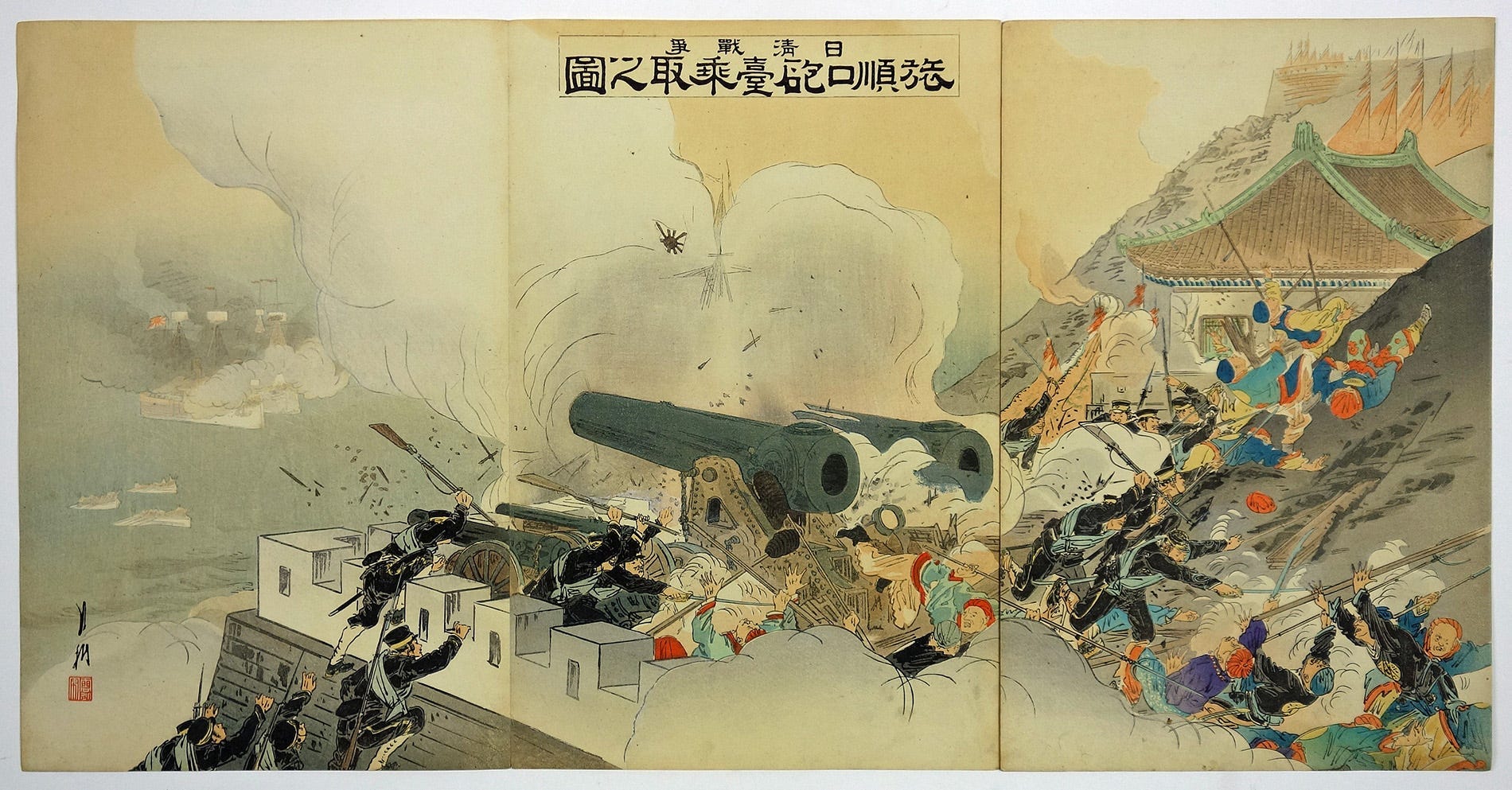
November 21, 1894: The First Sino-Japanese War’s Battle of Lüshunkou, also known as the Battle of Port Arthur, ends with a decisive Imperial Japanese victory. The capture of Lüshunkou was a major achievement for the Japanese, but the battle may be better remembered for what followed, the alleged “Port Arthur Massacre.” Over the following 2-3 days, possibly in retaliation for earlier atrocities committed by Chinese soldiers, Japanese forces are said to have killed between 2600 and 20,000 people in the city (some estimates go as high as 60,000, but 20,000 seems a more plausible upper bound).
November 22, 498: Rival groups of Roman clergy separately elect two different popes, Symmachus and Laurentius, to replace the departed Anastasius II (who had died on November 19). This papal election took place during a period of tension between eastern and western Church officials. Roman clergy were divided between a majority who supported a hard line against the eastern officials (who elected Symmachus) and those who supported reconciliation (who elected Laurentius). In 506 Laurentius abandoned his claim on the papacy and the schism ended under Symmachus’s successor, Pope Hormisdas, in 519.
November 22, 1963: US President John F. Kennedy is assassinated, either by Lee Harvey Oswald or [REDACTED]. Oswald was later arrested and then was himself killed while in police custody on November 24, either by Jack Ruby or [REDACTED]. Successive US presidents have promised to declassify documents related to the assassination, but those promises have so far been [REDACTED].
INTERNATIONAL
There are a number of United Nations-related stories today:
The UN’s COP31 climate summit collapsed in Turkey on Sunday when participants failed to reach agreement on a final statement even after extending the event for two days to allow for additional negotiations. As happens every year, the oil and gas producing bloc insisted that the statement on fossil fuel-caused climate change include no mention of fossil fuels, but in contrast to past summits they were unable to force other participants to concede. The European Union in particular refused to join a statement that didn’t reference fossil fuels, and so there was no statement at all. This is a fairly incredible outcome. Even though nobody should expect these annual summits to actually drive meaningful change, the participants almost always manage to cobble together some milquetoast final statement so that they can pretend to have achieved something. I don’t know if this failure portends a new international approach to the crisis but it is at least something different.
The UN’s conference on regulating lethal autonomous weapons similarly ended on Saturday without an agreement. As expected, a group of killer robot enthusiasts led by the US, Russia, and Israel rejected any regulatory mechanism that might be considered binding and thereby blocked any chance of consensus.
The race for a successor to outgoing UN Secretary-General António Guterres remains deadlocked, after frontrunner and former Costa Rican Vice President Rebeca Grynspan drew two Security Council vetoes in a new poll on Friday. She nevertheless outperformed all of the other candidates. This was a secret ballot so there’s no indication as to which two veto-holders are opposed to her candidacy. Guterres’ term ends at the end of this year and it looks increasingly likely that the UN will not have a replacement lined up by then.
MIDDLE EAST
SYRIA
A landmine killed at least five children and wounded another in northwestern Syria’s Idlib province on Sunday. The device appears to have been an artifact of the Syrian civil war, and this is just the latest of hundreds of incidents involving hitherto unexploded ordnance that have killed or wounded over 2375 people in Syria since December 2024 according to the UN Mine Action Service.
ISRAEL-PALESTINE
The Israeli military (IDF) killed at least four people in Gaza on Saturday, including three in an airstrike that hit what appears to have been a food distribution truck. The truck reportedly carried markings that tied it to the World Central Kitchen charity but that organization denied that it was one of its vehicles. The IDF later claimed that the three people who were killed were actually members of Palestinian Islamic Jihad, though I’m unclear whether it provided any evidence. In the West Bank, Israeli settlement security guards gunned down one Palestinian near Ramallah on Friday.
YEMEN
Ansarullah attacked targets across Saudi Arabia on Saturday in retaliation for an intense Saudi bombardment of northern Yemen the previous day. The Saudis’ main target was the port city of Hudaydah, ostensibly to disrupt “smuggling operations and the transport of weapons and ballistic missiles,” though they also attacked targets in Sanaa and elsewhere. According to Ansarullah those Saudi strikes killed at least 41 people in total. Along with Saturday’s retaliatory strikes the group also issued evacuation warnings for Saudi Arabia’s Red Sea ports and a general warning about the kingdom’s airspace. On the ground there are indications that Ansarullah is focusing its attention on southern Yemen’s Abyan province, which is situated east of the port city of Aden. The group could be aiming to encircle Aden or at least increase pressure on the Yemeni government to defend its de facto capital.
IRAQ
The Iraqi army entered the town of Jurf al-Sakhar on Friday under the terms of Baghdad’s last-minute deal with the Kataʾib Hezbollah militia. The militia now has a month to withdraw from the town, though it sounds like some of its personnel could stay under a new “joint operations center” that will also include other militia personnel and national police and military forces. Iraqi Prime Minister Ali al-Zaidi had previously accused the group of running an oil smuggling ring out of Jurf al-Sakhar, so if that’s the case then presumably that ring will be shut down.
IRAN
Iran’s Islamic Revolutionary Guard Corps reportedly attacked an industrial area near the Bahraini capital, Manama, on Saturday, wounding at least two people. The IRGC claimed to have targeted US air defense units, and it’s entirely possible that both of these claims are accurate. On Sunday Iranian officials reported that at least two more oil tankers had hit “mines” in the Strait of Hormuz, and I put mines in quotes because there’s been a surge of such incidents in recent days and it’s unclear whether the vessels are actually hitting mines or the Iranians are obfuscating some of their drone activity.
The Financial Times reported on Saturday that the increase in attacks on shipping in and around the strait has been substantial enough that the number of ships passing through it dropped by about 15 percent for the week ending on Thursday and the amount of oil passing through has dropped by about half (at least according to official statistics, which can miss transits by tankers that have turned off their tracking systems). Maintaining a robust oil traffic through the strait is part of the calculus behind the Trump administration’s interest in maintaining the “status quo” with respect to Iran, so if that’s changing so could the likelihood of a return to full-scale military conflict. Lo and behold, Donald Trump told Fox News on Sunday that he is “inclined” to resume that conflict in January, though of course anything he says on any given day can’t be regarded as reliable.
ASIA
BANGLADESH
At least four people have been killed since November 14 amid a series of protests by supporters of former Bangladeshi Prime Minister Sheikh Hasina and her Awami League party. Those demonstrations have coincided with the anniversary of Hasina’s conviction in absentia for the security crackdown against the 2024 protests that ousted her from power, for which she was sentenced to execution. Much of the violence has been between supporters of the Awami League and supporters of the rival Bangladesh Nationalist Party (at least two of the deaths have been BNP members) and has perhaps been intensified by Hasina’s stated intent (whether or not she actually means it) to return from exile in India to face sentencing. The Awami League is currently outlawed in Bangladesh, leaving its supporters with no political outlet, and there have been calls for lifting its ban in hopes of reducing tensions.
MYANMAR
Myanmar’s ruling junta has a number of grievances that it’s aired out over the past couple of days. First and foremost it is unsurprisingly dissatisfied with Thursday’s International Court of Justice ruling that Myanmar committed a genocide against the Rohingya people in 2017. The junta’s foreign ministry called the ruling “a great disappointment” on Friday and stressed that it was “not decided unanimously.” Second, but of possibly greater short-term significance, the junta is unhappy that the Association of Southeast Asian Nations is refusing to restore Myanmar to normal status within that organization. The ministry referred to that decision as “unfair and imbalanced” on Saturday. During ASEAN’s annual summit, members opted to maintain a ban on high-level Myanmar participation in the bloc’s events though they did agree that the ban could be lifted based on progress toward a peace deal to settle Myanmar’s civil war.
AFRICA
SUDAN
Apparent Rapid Support Forces drone strikes killed at least four people in the vicinity of Khartoum on Sunday. At least three were killed in one strike in the neighboring city of Omdurman and the fourth, a child, was killed south of Khartoum. Sudanese officials are claiming that the drones were launched from Bahir Dar airport in Ethiopia, but there’s no confirmation of that.
Elsewhere, the RSF claimed new advances in southeastern Sudan’s Blue Nile state on Friday, prompting a new round of displacement as residents fled toward the state capital, Ad-Damazin. And the Kordofan Monitor human rights organization is accusing the RSF of extrajudicially executing one civilian in West Kordofan state and of killing two other civilians in the same province in the process of “looting their cattle.” The RSF often targets civilians who are accused of collaboration with the Sudanese military, which has been advancing in West Kordofan of late.
SOMALIA
Now that the Somali government has fully severed ties with the United Arab Emirates, Al Jazeera’s Faisal Ali grapples with the country’s increasingly fragmented, and regionally linked, political situation:
The federal [Somali] government has aligned itself closely with Turkiye, Qatar and Egypt, while some regional administrations have cultivated ties with the UAE and Ethiopia, and Somaliland has drawn closer to Israel.
“These countries have their own issues, and they’re overlapping with Somalia’s internal rivalries,” [Chatham House Somalia expert] Aweis Ahmed said.
At home, Mogadishu has increasingly deployed its growing military strength, including Turkish-trained troops, against UAE-aligned rivals opposed to [President Hassan Sheikh] Mohamud’s constitutional and electoral agenda.
Turkish-trained federal forces helped remove Southwest State leader Abdiaziz Hassan Laftagareen from power, while a similar attempt to dislodge Jubbaland’s Ahmed Mohamed Islam, also known as Madobe, following his disputed re-election in 2024 failed.
In Puntland, tensions with Mogadishu prompted regional forces to seize several federal military bases and expel federal institutions.
Beyond Somalia, Sudan has complained to Mogadishu about the UAE’s alleged use of facilities in the port cities of Bosaso and Berbera to supply the Rapid Support Forces (RSF), the paramilitary group fighting the Sudanese army.
EUROPE
RUSSIA
Apparent Ukrainian drone strikes have targeted two Russian ships at a considerable distance this weekend. On Saturday the target was a Russian cargo vessel, the Sparta II, in the Baltic Sea while it was apparently en route to Russia’s Kaliningrad exclave. The ship drifted into Finnish waters, where authorities recovered it enough that it could be towed away by the Russians on Sunday night. Earlier on Sunday the second Russian ship, a naval vessel, was struck in the eastern Libyan port city of Benghazi. The Wall Street Journal reported that “satellite images showed the warship smoldering and partially submerged” after the attack. There’s been no comment from either the Russian or Ukrainian governments on these incidents.
Elsewhere, the Danish government expelled the Russian defense attaché from the country on Friday. Authorities accused him of “plotting to kill a Ukrainian rapper at a concert near Copenhagen.” Danish police thwarted a planned attack on the rapper, “Kyivstoner,” before the concert back in September. They’ve suspected that the Russian government coordinated the operation with a Danish gang. The Russian government is denying involvement and will presumably retaliate for the expulsion at some point.
UKRAINE
The Russian military killed at least six people in and around Kyiv on Sunday, including at least three in an overnight strike that hit an apartment block north of the city. Rescuers were still clearing rubble from that site at time of writing so the death toll may rise. Overnight Friday into Saturday Russian strikes killed at least two people in the city of Kryvyi Rih, which is Ukrainian President Volodymyr Zelensky’s hometown, while attacks throughout Friday killed at least eight. The Russians appear to be venting some frustration at Ukraine’s multiple recent attacks on the Kerch Strait bridge that links Russia to Crimea.
UNITED KINGDOM
The UK government and the European Union announced their new “reset” deal on Friday, as expected. The package covers three main issues: “the movement of animals, plants and related products between the UK and EU,” the merging of the UK and EU carbon markets, and a “youth mobility” program that will give 100,000 young people on each side the ability to live and work in the other’s jurisdiction for at least three years. There are also a few agreements in principle in other areas like defense, immigration, and preferential university tuition. UK Prime Minister Andy Burnham has been broaching the subject of returning the UK to the EU fully — though he hasn’t committed to that course of action — and this agreement could be a first step toward a more comprehensive tightening of relations.
AMERICAS
EL SALVADOR
To I assume zero surprise, Salvadoran President Nayib Bukele announced late Thursday that he intends to run for a third term in office in next year’s election. Bukele’s public approval rating remains sky high but even if it wasn’t there is no coherent political opposition in El Salvador largely because he won’t permit one, so we can assume he’ll win. Salvadoran presidents used to be limited to a single term, but Bukele had the country’s subservient Supreme Court permit him to run for reelection in 2024 and then amended the constitution to remove term limits the following year.
MEXICO
The Mexican military captured Fausto Isidro Meza Flores (AKA “El Chapo Isidro”), the leader of the Meza-Flores cartel, in a Friday night operation in Sinaloa state that left at least seven cartel members and four soldiers dead. Meza Flores is on the US Federal Bureau of Investigation’s top ten fugitives list for allegedly trafficking drugs into the US, so aside from the legal/criminal implications of his capture this is something that the Mexican government can use to demonstrate to the Trump administration that it is cracking down on the drug trade (for whatever good that will do). The Mexican Defense Ministry cited US intelligence support in making the operation possible. It’s also likely that this will trigger a succession war within the Meza Flores cartel, which could bring more violence to a state that has already been heavily impacted by the breakup of the Sinaloa Cartel.
CANADA
The Washington Post is reporting that US Defense Secretary Pete Hegseth has imposed new limits on US-Canadian military cooperation:
Hegseth issued the guidance, which has not been previously reported, in a classified memo circulated [earlier this month], the officials said, speaking on the condition of anonymity because of the issue’s sensitivity. The new restrictions are sure to be seen as a “slap in the face” to the Canadians, and they raise questions about how the two militaries’ interaction will be curtailed, one official said. The Washington Post has not reviewed the classified memo.
A spokesman for Hegseth, Sean Parnell, said in response to questions that the Pentagon is “taking steps to ensure its engagements with Canada advance tangible U.S. defense objectives and ultimately support a reinvigorated defense relationship.”
The Defense Department, Parnell said, “is prioritizing opportunities for bilateral cooperation that strengthens the defense of our Homelands and shared hemisphere, while supporting Canada’s ability to meet NATO obligations.”
These nebulous restrictions apparently don’t involve military intelligence sharing or anything having to do with NATO or the North American Aerospace Defense Command (NORAD), whose Santa Tracker will presumably function normally this holiday season. Apparently it involves “social engagements between American and Canadian service members, such as attending conferences or academic events.” I have no idea why this is an issue for Hegseth but I’m sure it all makes sense to him.
UNITED STATES
The Pentagon is planning to “detonate 68 barrels of toxic lead azide in Iowa by Tuesday.” It is doing so despite a federal court order suspending the detonation plan on environmental grounds, which it will simply ignore by citing “an emergency munitions and explosives exception to federal environmental protection laws.” Apparently there are concerns that if the military doesn’t go ahead with a controlled detonation, the onset of winter temperatures could trigger an uncontrolled detonation of the substance. Lead azide is used in fuses and detonators, devices that are meant to explode in order to trigger a larger secondary explosion involving another substance. This blast will almost certainly contaminate the surrounding area and it is unclear why the Defense Department doesn’t have a better disposal plan than this.
Finally, ProPublica reports that a US Labor Department program that is intended to assist federal contractors in war zones has instead become a vehicle for apparently rampant corruption:
It was supposed to be a safety net for the workers who helped the United States fight its wars — a federal program that provided healthcare and financial support to the employees of government contractors injured or killed in Iraq and Afghanistan.
Instead, a handful of America’s insurance companies have become its biggest beneficiaries. While reaping billions in government payments, they have delayed care for legitimate injuries and received reimbursements for fraudulent claims, a ProPublica investigation found.
Over the past decade, American taxpayers have paid nearly $5 billion to insurers through the obscure program, which the government itself has described as “ripe for potential fraud or, at the very least, gamesmanship for profit,” according to an internal memo ProPublica obtained.
Nobody knows the true amount of misspent money. The official who oversaw the program under the Biden administration estimated that between $100 to $150 million is being wasted annually. The money has poured from a forgotten system for forgotten people who suffered forgotten injuries and deaths in America’s wars.
It would be difficult to find another federal program with more incentives for graft and fewer controls to prevent it, the investigation found.