

You’re reading the web version of Foreign Exchanges. If you’d like to get it delivered straight to your inbox, sign up today:
TODAY IN HISTORY
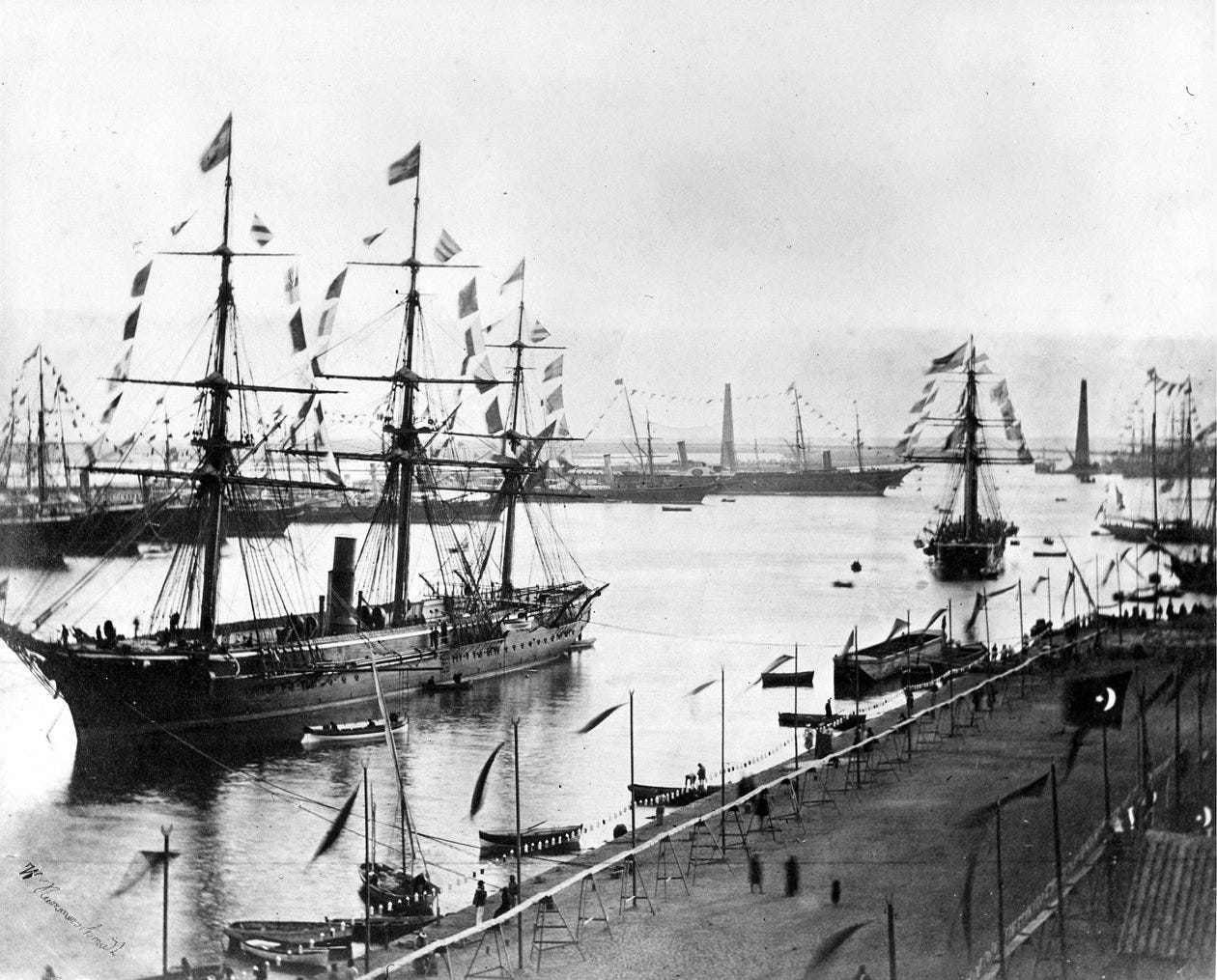
November 17, 1869: The Suez Canal officially opens in a joint French-Egyptian ceremony. Although it quickly came under financial pressure due to the costs of construction and some technical flaws that required improvements, the canal made an immediate impact on international commerce, both for better and worse (it helped cause the Panic of 1873 because of its detrimental effect on British maritime trade). The Egyptian monarchy’s heavy debt obliged it to sell its shares in the canal to the British government, which provided an opening for Britain to establish control not only over the canal, but ultimately over all of Egypt.
November 17, 1885: The decisive engagement of the brief (two week) Serbo-Bulgarian War, the Battle of Slivnitsa, begins in western Bulgaria. It would end two days later with a decisive Bulgarian victory that allowed the Bulgarian army to enter Serbian territory. Alarmed by the merger of Bulgaria and Eastern Rumelia, two polities created by the 1878 Congress of Berlin, the Serbian government used a border dispute as a pretext to declare war and invade, but their defeat at Slivnitsa turned the war on its head. Austria-Hungary subsequently threatened to intervene and thereby halted the Bulgarian invasion a few days after it began. But the war, short as it was, affirmed the Bulgarian-Rumelian merger and sparked a military reform effort in Serbia.
November 17, 1989: What became known as the “Velvet Revolution” begins with demonstrations against Czechoslovakia’s Communist government in Prague and Bratislava (the latter having actually begun the previous day). Riot police in Prague responded violently, prompting a larger public backlash particularly over the (fictitious, as it turns out) claim that they had killed a student protester named “Martin Šmíd.” By November 20 upwards of 500,000 people were in the streets of Prague and on November 28 the Communist Party announced the dissolution of the country’s government. The election of dissident Václav Havel as president in a unanimous parliamentary vote on December 29 is thought to mark the end point of the revolution.
MIDDLE EAST
ISRAEL-PALESTINE
An Israeli settler mob killed a 72 year old Palestinian woman in the West Bank city of Jericho overnight. In what certainly seems to meet the actual definition of an act of terrorism, the mob reportedly stormed into a section of that city and began firing guns at people’s homes. They shot the victim while she was standing outside her home. The mob wounded several other people in the assault. The Israeli military (IDF) is claiming that the shooting was precipitated by some sort of attempted vehicle ramming attack on the crowd of settlers. On a somewhat related note, the UK government blacklisted eight Israeli construction firms on Tuesday over their settlement building projects in the West Bank.
The Israeli Attorney General’s office has suspended the construction tender for the proposed “E1” settlement, which is intended in part to foreclose on any remaining possibility of a contiguous Palestinian state, until a new Israeli government is in place. On that front, opposition leader and would be prime minister Gadi Eisenkot won an important victory on Tuesday when he and his parliamentary allies elected a member of his Yashar party, Matan Kahana, as Knesset speaker. Kahana replaces Amir Ohana, a member of Prime Minister Benjamin Netanyahu’s Likud party. The Knesset speaker has control over the legislative agenda, so this vote means that Eisenkot’s ad hoc parliamentary bloc can start passing legislation even as he struggles to form a government.
YEMEN
Ansarullah claimed on Tuesday that a Saudi airstrike had killed at least seven people and wounded another nine in a “sponge factory” in the port city of Hudaydah. Saudi strikes also killed at least two people and wounded another four in northern Yemen’s Saada province, while an attack on a “shoe factory” wounded at least nine people in Sanaa. The Yemeni military claimed to have carried out 661 attacks along Yemen’s multiple front lines, killing and wounding at least 173 Ansarullah fighters. Yemeni officials frequently make grandiose claims about the intensity of their attacks on Ansarullah and the mass casualties they’re causing, but at the risk of understating things those claims are incongruous with Ansarullah’s continued advances — especially, of late, around the city of Aden
IRAQ
The Kataʾib Hezbollah militia is warning that it will “confront” any Iraqi security forces who enter the town of Jurf al-Sakhar. Iraqi Prime Minister Ali al-Zaidi has ordered the Iraqi military to surround (and eventually enter) that area with the intent of expunging the militia and breaking up what his government asserts is an illegal KH-run oil smuggling operation. The AP is reporting that Iranian Quds Force commander Esmail Qaani turned up in Baghdad on Monday to try to mediate a resolution to this situation, which is prompted mainly by US demands that Zaidi disarm or otherwise establish control over Iraq’s Iranian-aligned militia groups. KH is one of the most powerful of those organizations and is also proving to be one of the most recalcitrant when it comes to submitting to Zaidi.
IRAN
Residents of our nation’s capital will no doubt be reassured to know that Donald Trump is “looking into” claims that the Iranian government may be planning to attack Washington DC with a “dirty bomb.” He added that “we take it very seriously.” And rightly so, if this is how his administration (and/or its Israeli partner) intends to justify restarting the Iran war. Iranian officials are denying the substance of this story, and outside of one conspicuously leaked report to CNN there is no evidence that they are actually planning such an attack. But that doesn’t matter because, as Trump said, “they happen to be crazy.” It’s comforting to see this sort of rigorous analysis brought to bear on matters of war and peace.
The Iranians did carry out an attack on Tuesday, but of a significantly more mundane nature. They conducted a drone strike ostensibly targeting a US military facility in Bahrain, which is the third time in five days that they’d carried out an operation like that. As with the two previous instances Bahraini and US officials insisted that the attack had been thwarted by air defense systems. They also appear to have struck a liquefied petroleum gas tanker off the coast of Oman, forcing the evacuation of its 24 crew members. The US military reportedly struck Iran’s Qeshm island again, targeting a “missile launch site” according to Reuters. There’s no indication as to any casualties or damage. Bahraini and Kuwaiti authorities were reporting new Iranian attacks on Wednesday morning, but there’s little detail available beyond that.
ASIA
MONGOLIA
Mongolian President Ukhnaagiin Khürelsükh announced his resignation on Tuesday amid an emerging corruption scandal. Another politician in the Mongolian People’s Party alleged over the weekend that Khürelsükh benefited financially from a railway construction project that was awarded in 2019, when he was prime minister. Khürelsükh is insisting that he did nothing wrong despite his decision to resign. Assuming that the State Great Khural accepts his resignation later this week he will be replaced on an interim basis by that body’s chairperson, Sandagiin Byambatsogt.
NORTH KOREA
Donald Trump appears to be getting some help from his buddies to set up a meeting with North Korean leader Kim Jong-un during this week’s Asia-Pacific Economic Cooperation conference in China. The Russian government declared on Monday that Vladimir Putin would “of course” meet with Kim if the latter were to make a trip to China while the conference is taking place, which probably means that Kim is planning to turn up or may have been intended as an enticement to get him to turn up. It seems unlikely that Kim would stand Putin up given their close relationship, and as long as he’s going to be there anyway why not say hi to Trump? It’s unlikely that they would do much more than exchange pleasantries but that would still be enough for Trump to portray himself as a Serious Statesman.
AFRICA
WESTERN SAHARA
Inkstick’s Maxine Betteridge-Moes considers what the closure of the United Nations Western Sahara peacekeeping force (MINURSO) could mean for the already beleaguered Sahrawi people:
MINURSO is the only modern UN peacekeeping force that doesn’t have a human rights monitoring mandate. Freedom House ranks Western Sahara among the lowest in the world for civil liberties. Sahrawi activists face forced disappearances, arbitrary arrests, surveillance, restrictions on freedom of movement and criminal proceedings. Morocco also maintains a total media blockade in the territory and international journalists are regularly denied entry. Human rights abuses have also been documented in the Polisario-run refugee camps in neighboring Algeria, but to a far lesser extent.
The refugee camps are also known as the Sahrawi Arab Democratic Republic, the Polisario’s official state in exile. Massive demonstrations in the camps in the lead up to the Oct. 30 [UN Security Council] vote [that ended the peacekeeping force’s mandate] culminated with a joint letter by Sahrawi and international civil society to the UNSC calling on member states to refrain from supporting a resolution that would deny Sahrawis their right to self determination. “Our future must be decided by us through a genuine, uncoerced exercise of self-determination, not dictated from distant offices by actors who will never bear the consequences of their decision,” said Sahrawi women’s rights activist Najla Mohamed Lamin, at a protest in the Smara refugee camp on Oct. 28, where thousands gathered to demand their rights to self-determination. “How can anyone claim to know what is best for our children, our communities, and our nation while denying us the right to speak and decide for ourselves?”
Following the vote on Oct. 30, Oxfam warned that the failure to extend MINURSO was “a significant setback for the Sahrawis” and that “After five decades of displacement, Sahrawi resilience must never become an excuse for international inaction, or for them to be asked to surrender their rights.” The charity urged the international community to provide adequate humanitarian funding for the camp population, which already suffers from high levels of malnutrition and food scarcity.
DEMOCRATIC REPUBLIC OF THE CONGO
Reuters has reviewed the data on the DRC’s ongoing Ebola outbreak, which shows that it has expanded and is continuing to expand at a “record pace.” In the six months since the outbreak was officially declared it has grown to at least 11,254 confirmed cases and at least 5505 deaths. The West African outbreak that began in late 2013 and ran through mid-2016, by contrast, saw 5325 cases and 2622 deaths over that same period. It peaked at 28,646 cases and 11,310 deaths, figures that this outbreak is well on its way to surpassing unless it can be interrupted either via a medical breakthrough or a surge in containment efforts that the Congolese government and international organizations have thus far failed to implement.
The Wall Street Journal reports that, by limiting agricultural and commercial activity, the outbreak is exacerbating malnutrition and that malnutrition is in turn exacerbating the outbreak:
Over the past five months, 2.3 million people have slipped into crisis levels of hunger, mainly in the Congolese provinces that make up the epicenter of the outbreak—Ituri, North Kivu and South Kivu—according to the [World Food Program]. While infection rates have stabilized in some areas, they are rising in others that are also dealing with insurgents, according to humanitarian officials.
“Patients who are already malnourished may have fewer nutritional reserves to withstand the disease,” said Bill Clemmer, a physician who works in the city of Goma for Corus International, an American charity. “Women and young children in eastern Congo are among the groups most affected by chronic malnutrition, and malnutrition may reduce their ability to withstand severe infectious diseases, including Ebola.”
EUROPE
UKRAINE
Ukrainian drone strikes killed at least two people in Crimea on Tuesday and appear to have destroyed a portion of the bridge that links Russia to the peninsula over the Kerch Strait. This was the second Ukrainian strike on the bridge in as many days, this one significantly more impactful than Monday’s attack. Russian officials are already pledging to rebuild the bridge, though that will be hard to do under the risk of further Ukrainian attacks. The strike may also have implications for sea traffic through the strait, depending on where the debris ends up. Russian attacks, meanwhile, damaged two major bridges across the Dnipro River in Kyiv as well as the city’s metro system.
MOLDOVA
Moldovan President Maia Sandu claimed on Tuesday that a Russian drone had flown over Chișinău. While Russian drones have occasionally buzzed Moldovan airspace in the past, overflying the country’s capital city is a bit more provocative than a random airspace violation. The Moldovan government could take diplomatic action in response but will probably settle for a stern condemnation.
AMERICAS
HAITI
Protests were held in several Haitian cities on Tuesday in support of the ongoing Salvadoran military operation in that country. This outburst seems to be in response to a statement from the government of El Salvador the previous day stressing that the operation will end upon the location of the four Salvadoran military personnel who went missing following a gang attack last month. It would seem that a fair number of Haitians would like the Salvadoran forces to stick around to battle the gangs. The Salvadoran intervention has enabled Haitian police to make some gains at gang expense, and an abrupt withdrawal could leave those police forces vulnerable to counterattack.
UNITED STATES
Finally, in US news:
For the ninth year in a row the US Department of Defense has failed its annual audit. The good news, I guess, is that the department has improved its internal record-keeping somewhat. This year 14 of its 25 reporting entities passed, covering 56 percent of the DOD’s assets. Incredibly that’s the first time that more than half of the Pentagon’s assets have passed the audit. Bear in mind that the Trump administration wants to give this fiasco a $1.5 trillion budget next year.
The National Security Agency’s internal communications network crashed on Tuesday, causing disruptions to operations that seemed to be easing by Tuesday evening. You may have noticed that a lot of Online has been collapsing in recent days, starting back on Thursday when Microsoft Outlook went down and continuing through the FAA’s system crash on Friday and various banking and other snafus since then. Apple apparently also had problems on Tuesday. The Trump administration insists that there’s nothing nefarious happening and in fairness there’s nothing so far, other than timing, that conclusively links these incidents. It’s actually possible that the system failures are happening as companies and government offices patch their systems in hopes of preventing anything nefarious from happening, which could be considered ironic if true.
Donald Trump’s first stop on his APEC tour was the Philippines, where he and the other leaders of the “Quad” group — Australian Prime Minister Anthony Albanese, Indian Prime Minister Narendra Modi, and Japanese Prime Minister Takaichi Sanae — announced new agreements that are intended to circumvent China’s chokehold on the global critical minerals market. This may be the first time that Trump has acknowledged the “Quad” in his second term so that’s noteworthy, but as far as the critical minerals plan is concerned let’s say that this group has a tendency to be more bark than bite. Trump asserted that the US will have “everything it needs” to compete with China on the critical minerals front “within 10 months,” which seems wildly optimistic but what do I know?