

You’re reading the web version of Foreign Exchanges. If you’d like to get it delivered straight to your inbox, sign up today:
Happy Mother’s Day!
TODAY IN HISTORY
May 9, 1271: Lord Edward, Duke of Gascony—the future King Edward I of England, AKA “Edward Longshanks”—lands at Acre to begin what historians now regard as the Ninth Crusade or, if you prefer, “Lord Edward’s Crusade.” Edward’s army was too small to make any major gains—the French army that was supposed to join him was busy besieging Tunis—but he did win a few minor victories against Mamluk forces that bought the Crusader states a few more years before they finally fell completely in 1291. The campaign is perhaps best known for the attempted assassination of Edward in June 1272 by parties (still) unknown. Edward famously fended off and killed the assassin although he did receive a nasty wound in the process.
May 9, 1865: US President Andrew Johnson issues a proclamation declaring that the Confederacy’s armed resistance was “virtually” over and obliging any countries or ships at sea that were harboring Confederate fugitives to turn them over to authorities. There were still small rebel units in the field, so the fighting wasn’t completely at an end, but this date is frequently cited as the formal conclusion of the US Civil War.
May 10, 1857: A unit of sepoys in the town of Meerut mutinies against their commanders in the British East India Company, marking the start of the Indian Rebellion of 1857. This was more a widespread series of local uprisings than a unified revolt, and its causes and aims varied from place to place, but overall it proved to be too great a challenge for the EIC to manage. Although British forces did eventually suppress the movement, finally declaring an end to hostilities in July 1859, the result was the end of the EIC’s control of India and the onset of direct crown rule, also known as the British Raj. This had the additional effect of formally ending the Mughal Empire, though Mughal emperors hadn’t held real power in over a century.
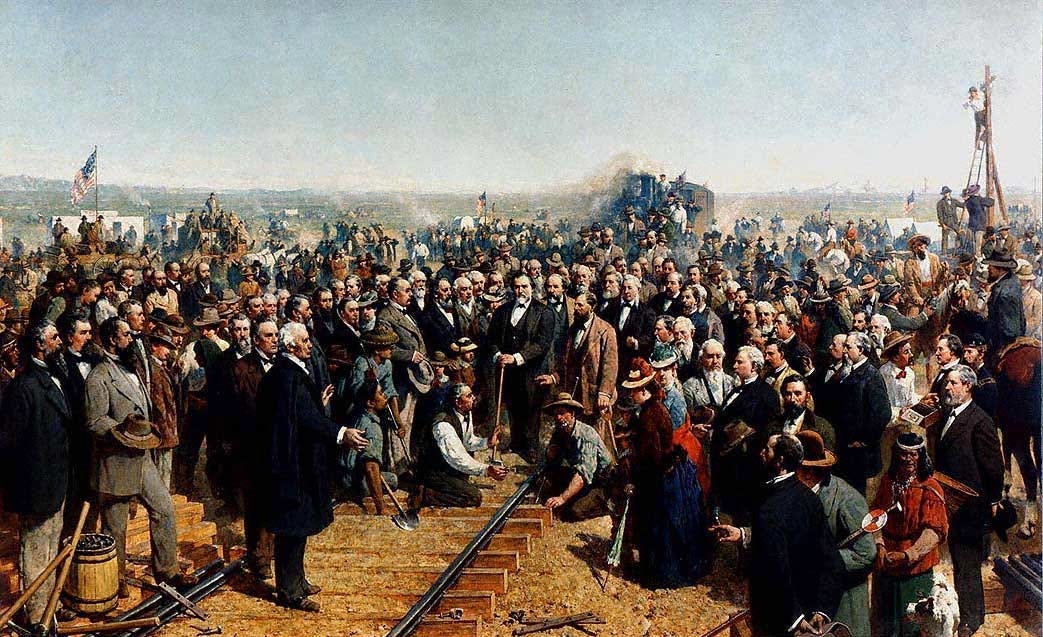
May 10, 1869: The First Transcontinental Railroad, a track linking the eastern US rail network to California, officially opens when Central Pacific Railroad boss Leland Stanford ceremonially drives in the “Golden Spike” at Promontory, in the Utah Territory. The CPRR track, which began at Sacramento, linked up with a section of rail built by the Union Pacific Railroad Company that ran from Omaha to Council Bluffs, Iowa, where it linked up with the eastern network. By November the line had been extended all the way to the Pacific Coast at the Oakland Long Wharf.
MIDDLE EAST
LEBANON
The Israeli military (IDF) killed at least 51 people in Lebanon over the weekend, according to the country’s health ministry. Officials in the ministry now say that at least 2842 people have been killed since the resumption of Israeli-Hezbollah hostilities on March 2. Of course that conflict has been in a nominal “ceasefire” since April 16, but that seems to be an afterthought at this point.
The Los Angeles Times reports on the targeting system that the IDF is using in Lebanon, rooted in a combination of Israeli hacking and artificial intelligence:
Much of the [Lebanese] data infrastructure — including databases with information on mobile phone subscribers or vehicle registrations — has been accessible to the Israelis for two decades; they also hacked into Hezbollah’s terrestrial network and its signal corps, [retired Lebanese General Mounir Shehadeh] said. Hezbollah’s involvement in the civil war in Syria from 2011 to 2024 further compromised the group’s security.
“These factors allowed Israel to construct a precise target bank encompassing both field commanders and high-ranking leadership figures,” Shehadeh said.
The AI comes in at this stage. Rapidly going through terabytes of data, it detects patterns, and compares them to the movements of someone who is a known threat or has shown up near flagged zones. It also analyzes deviations from a subject’s routine. All that is used to create a so-called threat profile.
The result, according to an Israeli colonel interviewed in a February 2023 Israeli military article about AI in combat, is a system that could find targets quickly.
“The system does this process in seconds, while in the past would have taken hundreds of investigators several weeks to do,” said the head of Israeli military’s Artificial Intelligence Center, identified only as Col. Yoav.
But one concern, the [anonymous] AI specialist said, is that these systems use data, not logic, to determine if someone is dangerous. And if that information is flawed, then it would keep repeating the same mistakes, but “faster and with more confidence.”
ISRAEL-PALESTINE
The IDF killed at least three people in Gaza on Sunday, after killing at least one person in the territory the previous day. Reuters characterized those deaths as “testing” the “fragile ceasefire.” With the IDF having killed at least 850 people since the “ceasefire” went into effect, one wonders how much more testing is really necessary here before it’s OK to call this situation what it really is.
IRAQ
The Wall Street Journal reported on Saturday that the IDF “set up a clandestine military outpost in the Iraqi desert to support its air campaign against Iran and launched airstrikes against Iraqi troops who almost discovered it early in the war.” Those airstrikes killed at least one Iraqi soldier. The facility serves “as a logistical hub for the Israeli air force” and was established in southwestern Iraq’s Najaf Desert sometime in February with the knowledge of the US government but possibly not with the knowledge of the Iraqi government. In fact, the US military reportedly warned Baghdad to keep its security forces away from the base, giving them the false impression that it was a US facility.
IRAN
Stop me if you’ve heard this one: the Iranian government submitted its reply to the latest US negotiating proposal on Sunday and Donald Trump immediately deemed it “TOTALLY UNACCEPTABLE!” It’s getting somewhat absurd to try to analyze each iteration of this dance so I will be brief and say that the Iranian response doesn’t appear to have been much different than its previous negotiating outlines so it’s unsurprising that Trump didn’t like it. He’s looking for something that he can spin as an Iranian surrender and Iranian leaders won’t give that to him. Substantively the US and Iranian positions remain relatively far apart but my sense is that the more immediate issue is one of timing. The Iranians want to end the war, lift the blockade(s), and then work out the details. The US wants the Iranians to capitulate on several details, then end the blockade(s) while the two sides negotiate a few remaining issues. If they can’t even agree on the sequence of events then the substantive disputes are irrelevant.
Low-level military activity will likely continue in and around the Strait of Hormuz—there was more of that this weekend, though to no significant effect as far as I can tell—but a resumption of a full-scale shooting war seems unlikely at least ahead of Trump’s planned visit to China on Thursday. Beyond that, who knows? The status quo seemingly cannot continue indefinitely, and the Iranians may actually try to up the ante by threatening the undersea fiber-optic cables that run through the strait, which would be a massive blow to the Gulf Arab states and also probably to US military operations in the region. Iranian media apparently speculated about those cables over the weekend. Maybe by midweek (although the timing of the China trip could affect this as well) we’ll get another impeccably timed Barak Ravid scoop about how the White House is optimistic that a peace deal is at hand and we can run through this cycle again.
ASIA
PAKISTAN
A suicide bombing and follow-on attack on a security outpost in northern Pakistan’s Khyber Pakhtunkhwa province left at least 21 police officers dead on Saturday night. Ittehad-ul-Mujahidin Pakistan, a Pakistani Taliban (TTP) affiliate that emerged relatively recently out of a merger of several other TTP factions, claimed responsibility for the attack. Pakistani authorities don’t tend to differentiate between the various TTP factions and they already appear to be pointing fingers at the Afghan government for allegedly sheltering TTP fighters in Afghanistan. That could fuel another round of cross-border conflict.
THAILAND
The Washington Post reports that farmers in Thailand and other parts of the Asia-Pacific region are among the first to confront fertilizer shortages caused by the Iran war:
In Thailand, the Philippines, Bangladesh and Australia, which are the first since the war to enter key sowing periods, farmers are choosing to skip or reduce planting, or cut fertilizer use, which will lower yield.
As the war stretches deeper into the crop calendar, farmers from more countries will be forced to make similar choices, said Maximo Torero, chief economist for the FAO. “Right now, the impacts are more severe in Asia,” Torero said. “But clearly, this is moving east to west and south to north.”
In June, India and Brazil, two of the world’s biggest agricultural producers, will ramp up orders for urea. If, by then, vessels carrying urea are not sailing, there will be “significant yield loss” across many countries, Torero said. Commodity prices will climb, stoking inflation. The hit to economic growth, he said, will be “very close to what happened in covid-19.”
To make matters worse, scientists say the planet is likely to be hit with a super El Niño climate pattern this year, which could result in extreme heat and drought that will deal another blow to harvests.
AFRICA
SUDAN
The Sudanese military claimed on Saturday that its forces had retaken the region of al-Kayli, situated along the Ethiopia border in Blue Nile state. The Rapid Support Forces group and its Sudan People’s Liberation Movement-North allies took that area last month. Al-Kayli is near the strategic border town of Kurmuk, which fell to the RSF in late March and has been a conduit (allegedly) through which the militants have been receiving support from Ethiopia.
LIBYA
Operations at Libya’s largest oil refinery, in the western city of Zawiya, resumed on Sunday. The facility had shut down two days earlier amid reports of factional conflict in the vicinity. I still haven’t seen any indication as to which factions were fighting.
MALI
Multiple attacks by Jamaʿat Nusrat al-Islam wa’l-Muslimin jihadists on villages in central Mali’s Mopti region have reportedly killed at least 70 people in recent days. Those attacks began on Wednesday and a “security source” claims that the group is “targeting villages that refused to sign local agreements.” JNIM seems to be operating more or less with impunity since its fighters and Azawad Liberation Front rebels swept through much of northern Mali in a joint operation late last month.
NIGERIA
Nigerian officials are claiming that their forces killed at least 50 Islamic State West Africa Province fighters on Thursday, when they repelled an ISWAP attack on an army base in Borno state. That’s quite a bit higher than the eight dead attackers they originally claimed, and an “intelligence source” who spoke with AFP is claiming that the army has “grossly underdeclared its casualties and bloated the losses suffered by the terrorists.”
Meanwhile, the Chadian military has reportedly been carrying out airstrikes in the Lake Chad region inside Nigeria since Friday, in retaliation for a Boko Haram attack on a Chadian military outpost on Monday. According to AFP those strikes may have killed at least 40 Nigerian fishermen. That figure is very preliminary and could change. Local fishermen often pay tax to Boko Haram in return for permission to fish from islands that the group controls, which can leave them vulnerable to attack from parties that can’t (or don’t bother to) tell the difference between them and the jihadists.
SOMALIA
Somali security forces apparently shot and killed a protester in Mogadishu on Sunday. Opposition parties had organized a demonstration over a number of recent evictions in the city and government forces responded heavy-handedly to contain that protest. Somali officials have accused the opposition of intentionally provoking the violence but organizers denied that allegation.
DEMOCRATIC REPUBLIC OF THE CONGO
AFP is reporting that CODECO militia fighters attacked “several villages” in the northeastern DRC’s Ituri province back on April 28, killing at least 69 people. It took several days before the fighters dispersed and authorities could enter the area to search for bodies. CODECO is an ethnic Lendu militia and has been engaged in an inter-communal conflict with the Hema people in Ituri going back to the Second Congo War in the late 1990s. These latest attacks apparently took place after a Hema militia attacked Congolese military positions near an Ituri village called Pimbo. That group, the Convention for the Popular Revolution (CRP), has according to AFP been experiencing a “resurgence” since early last year.
EUROPE
RUSSIA
Speaking with reporters after his big (though not as big as in previous years) “Victory Day” celebration in Moscow, Vladimir Putin said “I think the matter is coming to an end” with “the matter” referring to his war in Ukraine. Needless to say this was a surprising comment, particularly coming as it did on the first day of a three day ceasefire in which Ukrainian and Russian officials have already accused one another of multiple violations. At least three people have been killed near the front line in eastern Ukraine so it’s at least certain that there have been violations. Putin even went so far as to say that he’s prepared to meet Ukrainian President Volodymyr Zelensky, something he’s resisted thus far, and that he’d be willing to do so “in a third country” albeit only after there’s a “finalized” peace deal in place.
It’s possible that Putin has come to believe that he has more to gain from ending the war than from continuing it, though a couple of uncharacteristic remarks in a single press conference don’t do much to prove that. Maybe he was just feeling sad because his parade wasn’t as big as last year’s.
HUNGARY
Péter Magyar officially took office as Hungary’s new prime minister on Saturday, ending Viktor Orbán’s 16 year rule following last month’s parliamentary election. He will have immediate work to do with respect to Hungary’s struggling economy and in particular in accessing European Union funds that have been frozen over multiple grievances that Brussels had with Orbán’s government.
AMERICAS
CUBA
CNN reports on what could be US military preparations for an operation in Cuba:
US military intelligence-gathering flights are surging off the coast of Cuba, a CNN analysis of publicly available aviation data shows.
Since February 4, the US Navy and Air Force have conducted at least 25 such flights using manned aircraft and drones, most of them near the country’s two biggest cities, Havana and Santiago de Cuba, and some coming within 40 miles of the coast, according to FlightRadar24.
Most of the flights were by P-8A Poseidon maritime patrol aircraft, which are designed for surveillance and reconnaissance, while some were by an RC-135V Rivet Joint, which specializes in signals intelligence gathering. Several MQ-4C Triton high-altitude reconnaissance drones have also been used.
The flights are notable not only for their proximity to the coast, which puts them well within range of gathering intelligence, but for the suddenness of their appearance – prior to February, such publicly visible flights were exceedingly rare in this area – and for their timing.
UNITED STATES
Finally, The Intercept’s Adam Federman reports on the latest atrocity committed by the Trump administration in the name of its border wall:
A rare archaeological site in the Sonoran Desert was bulldozed by a Department of Homeland Security contractor involved in building the latest sections of Donald Trump’s border wall, according to multiple sources briefed on the incident.
The area, in a remote corner of Arizona’s Cabeza Prieta National Wildlife Refuge, is a roughly 280-by-50-foot etching in the desert sand known as an intaglio.
Last Thursday, without any notice, a contractor working for DHS cut a roughly 60-foot swath across the middle of the intaglio, doing irreparable damage to the 1,000-year-old artifact.
Cabeza Prieta, one of the largest wilderness areas outside of Alaska, also encompasses lands sacred to the Tohono O’odham Nation, which borders the refuge to the east. The O’odham have fought to prevent border wall construction across their reservation and during Trump’s first term largely prevailed; they also managed to protect the intaglio and a nearby burial site that they consider to be part of their ancestral lands.