

You’re reading the web version of Foreign Exchanges. If you’d like to get it delivered straight to your inbox, sign up today:
TODAY IN HISTORY
May 7, 1487: The army of Ferdinand and Isabella, the Catholic rulers of what would eventually become Spain, lays siege to the city of Málaga in what at the time was the Emirate of Granada. The Catholic forces were able to blockade the city’s harbor and surround its landed portions with earthworks, initially intending to starve its garrison into submission. But after several weeks they began assaulting Málaga’s walls and were eventually able to take control of a tower. Between hunger and a sense that it was becoming impossible to maintain their defense, city officials surrendered on August 13 and the garrison capitulated on August 18. The loss of Málaga cost the reeling Nasirid rulers of Granada their main seaport as well as their second largest city. Because Málaga’s leaders had rebuffed several surrender offers from the Catholics during the course of the siege, Ferdinand had most of the city’s population either enslaved or executed.
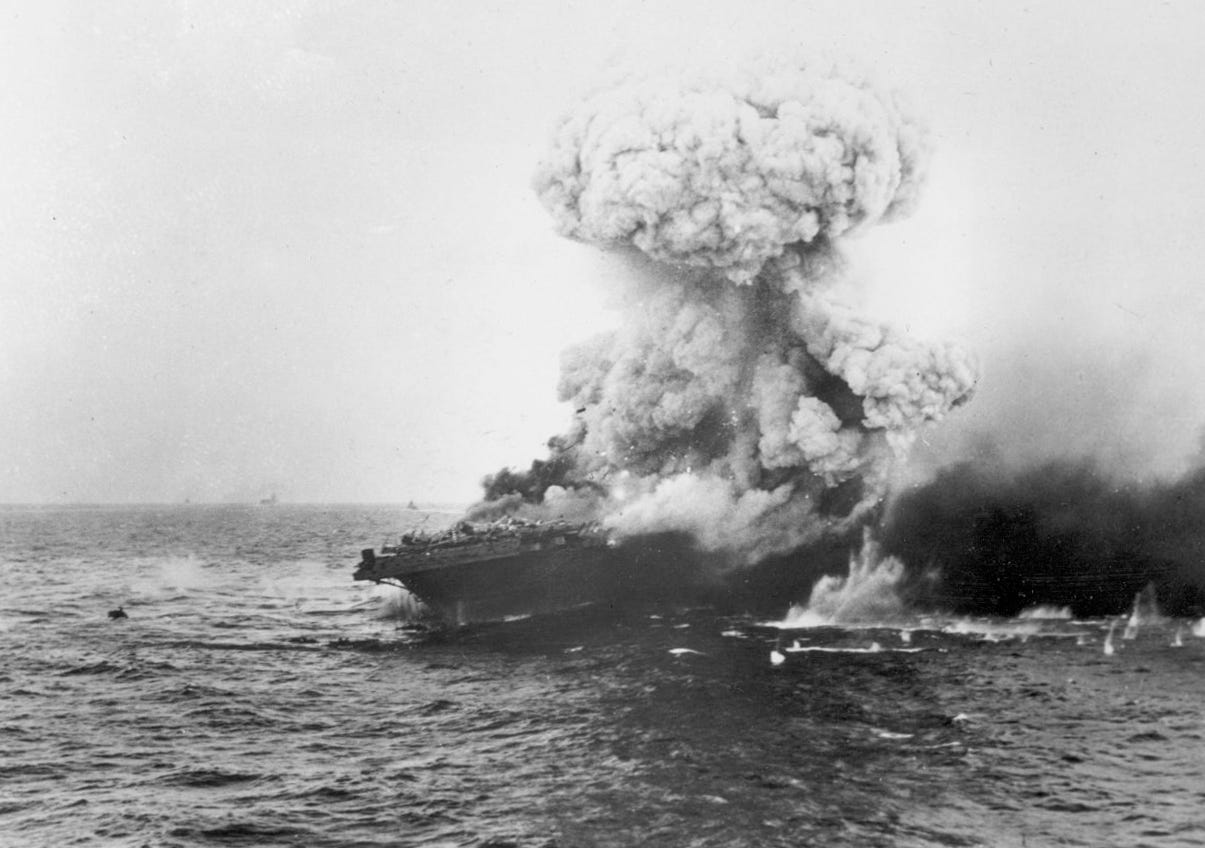
May 7, 1942: World War II’s naval Battle of the Coral Sea reaches its climax, which is…mixed. The Japanese Navy won a tactical victory, sinking several heavy US vessels. But the losses Japan suffered severely curtailed its naval strength, preventing a planned invasion of Port Moresby in Papua and contributing to the Allied victory at the Battle of Midway in June. What’s most noteworthy about this engagement is that it was the first naval battle in history in which the actual ships involved never directly fired on one another. The entire battle was fought via carrier aircraft. Needless to say this had a profound impact on naval warfare moving forward.
MIDDLE EAST
TURKEY
The Turkish military unveiled a prototype intercontinental ballistic missile named the “Yıldırım Han” on Tuesday at a defense expo in Istanbul. The name seemingly refers to Ottoman Sultan Bayezid I, who went by the sobriquet “Yıldırım” (“lightning”) and was known for his military prowess right up until he got his army walloped by Timur in 1402. The “Yıldırım Han” reportedly has a range of 6000 kilometers, which puts it in ICBM territory (5500 kilometer range minimum) assuming that holds up (it’s not in production yet).
This has the feel of a weapon designed more for show than for potential use. It’s difficult to imagine a scenario wherein Turkey goes to war with a country 6000 kilometers away although I guess it is possible that an ICBM could come in handy if one of Ankara’s relationships in Africa draws it into a regional conflict. But to my knowledge ICBMs have never been used in combat and they’re typically thought of as a nuclear delivery device though Turkey is not a nuclear-armed state. That said there is a certain stature that comes with having ICBMs that I imagine appeals to Turkish President Recep Tayyip Erdoğan. It is also the case that Turkey has a civilian space program and the overlap in technologies makes ICBM development a potential offshoot of (or contributor to) the development of rockets for space launches.
LEBANON
The Trump administration will host another round of Israeli-Lebanese negotiations in Washington sometime later this month—there are conflicting reports about whether it will happen late next week or the week after. Al Jazeera is reporting that, in the meantime, the administration “is trying to de-escalate Israel’s actions in Lebanon” prior to the talks. The Israeli military (IDF) has been on quite a spree over the past week—it killed at least one more person in southern Lebanon on Thursday, a day after striking southern Beirut—and there are growing concerns that it could undermine (intentionally or otherwise) the negotiating process.
ISRAEL-PALESTINE
An IDF strike on Thursday killed at least three “Hamas-affiliated security forces,” which I guess is how the AP is characterizing Gazan police officers now. This continues its effort to decimate the territory’s police force. Additionally, the son of lead Hamas negotiator Khalil al-Hayya died of wounds he suffered in an Israeli attack the previous day. He was presumably targeted, either to undermine negotiations or to weaken Hayya’s negotiating position.
Doctors Without Borders released a new report on the effect of what it called a “manufactured malnutrition crisis” that the Israeli government imposed on Gaza:
Israel’s manufactured malnutrition crisis in Gaza, Palestine, had a devastating impact on pregnant and breastfeeding women, newborns, and infants under six months old during periods of intense hostilities and siege, such as mid-2025, according to an analysis of medical data released today by Médecins Sans Frontières (MSF).
At four health facilities that were either run or supported by MSF between late 2024 and early 2026, our teams recorded higher levels of prematurity and mortality among infants born to mothers affected by malnutrition during their pregnancy, high levels of miscarriage, and observed sharp increases in treatment interruption among malnourished children.
MSF links these outcomes to Israel’s blockade of essential goods and attacks on civilian infrastructure, including medical facilities. Insecurity, displacement, restrictions on aid, and limited access to food and medical care have had devastating consequences for maternal and newborn health. MSF warns that the situation remains extremely fragile, despite the so-called ceasefire, and urges Israeli authorities to immediately allow the unhindered entry of vital assistance and supplies into Gaza.
IRAQ
The Trump administration blacklisted Iraqi Deputy Oil Minister Ali Maarij Al-Bahadly on Thursday for allegedly helping the Iranian government sell oil despite US sanctions. Bahadly is accused of participating in a scheme to blend Iranian and Iraqi oil, sell the blend as purely Iraqi oil, and then divert the revenues to Iran and/or Iranian-backed militias in Iraq. The administration also blacklisted three senior militia figures. The designations freeze any US assets they might have and bar US citizens from interacting with them.
IRAN
With Donald Trump hyping up the possibility of a peace deal as the US awaited Iran’s response to its latest proposal, the ceasefire came under new pressure on Thursday as US and Iranian forces exchanged fire again in and around the Strait of Hormuz. The US military is characterizing its attacks on at least two Iranian sites, the port city of Bandar Abbas and Qeshm Island, as defensive responses to Iranian attacks on three US naval vessels. Iranian officials are insisting that the US broke the ceasefire by shooting at two vessels in the strait, including an Iranian oil tanker, as well as “civilian areas.” Regardless of whose narrative is closer to the truth none of the US vessels were damaged and I have not yet seen any reporting as to casualties or damage from the Iranian side.
As for that Iranian response, it’s still forthcoming and it would not be surprising if Thursday’s flareup delays that process or even upends it. If no agreement is forthcoming the Trump administration will likely revert to relying on its blockade to force Tehran to submit. But a new US intelligence assessment calls that approach into question and points toward the entire war’s shocking degree of futility:
A confidential CIA analysis delivered to administration policymakers this week concludes that Iran can survive the U.S. naval blockade for at least three to four months before facing more severe economic hardship, four people familiar with the document said, a finding that appears to raise new questions about President Donald Trump’s optimism on ending the war.
The analysis by the U.S. intelligence community, whose secret assessments on Iran have often been more sober than the administration’s public statements, also found that Tehran retains significant ballistic missile capabilities despite weeks of intense U.S. and Israeli bombardment, three of the people familiar with it said.
Iran retains about 75 percent of its prewar inventories of mobile launchers and about 70 percent of its prewar stockpiles of missiles, a U.S. official said. The official said there is evidence that the regime has been able to recover and reopen almost all of its underground storage facilities, repair some damaged missiles and even assemble some new missiles that were nearly complete when the war began.
By the by, The Wall Street Journal confirmed on Thursday that tensions between the US and Gulf Arab states contributed to the collapse of Trump’s “Project Freedom” operation on Tuesday. In fact, not only did Saudi Arabia bar the US military from using its bases and airspace because of the operation, so did Kuwait. Both countries have lifted those restrictions now that the operation is kaput.
ASIA
THAILAND
Earlier this week the Thai government cancelled a 2001 memorandum of understanding under which it and its Cambodian counterpart were supposed to collaborate on exploiting offshore energy resources. This is a holdover of last year’s military conflict between the two countries and fulfills a campaign pledge from Thai Prime Minister Anutin Charnvirakul, so it’s not at all unexpected. But it also reflects the fact that the two countries have made little to no actual headway on implementing that MOU over the past quarter century. Thai nationalists, who make up a substantial portion of Anutin’s base of support, have especially opposed the MOU out of fears that it could undermine Thai maritime claims.
CHINA
A Chinese court sentenced former defense ministers Wei Fenghe and Li Shangfu to death on corruption charges on Thursday. Their sentences were suspended for two years and will probably be commuted to life in prison but even so these are believed the be the first two death sentences handed out as part of President Xi Jinping’s years-long anti-corruption campaign/military purge. Dozens of other senior military officers have been investigated, removed from office, and tried in that effort.
OCEANIA
SOLOMON ISLANDS
Solomon Islands Prime Minister Jeremiah Manele lost a parliamentary no confidence vote on Thursday. Back in March 12 MPs from Manele’s OUR Party defected to the opposition, taking his parliamentary majority with them. He’ll stay on in a caretaker capacity until Governor-General David Tiva Kapu formally removes him from office. Manele was regarded as generally favorable toward China, so his ouster and replacement will likely be of interest in Washington.
AFRICA
SUDAN
The Sudanese military (SAF) is reportedly deploying forces to Al Qadarif state along the Ethiopian border. This move comes after the SAF earlier this week accused Ethiopia of conducting drone strikes in Sudan on behalf of the Rapid Support Forces militant group, to which the Ethiopian government responded by accusing the SAF of supporting Tigray People’s Liberation Front militants in Ethiopia. One assumes that these forces could otherwise be put to use against the RSF directly, so even if there’s no real threat of conflict breaking out with Ethiopia this tension could still impact the Sudanese civil war.
SENEGAL
In case you missed it, Alex Thurston’s latest FX piece considers the limitations of the emerging “sovereigntism” movement across West Africa when it runs up against the power of Western financial institutions and particularly the International Monetary Fund:
Sovereignty is a cherished concept for the military rulers of the Sahel, and for the millions who support their rule. Between 2020 and 2023, juntas overthrew civilian governments in Mali, Burkina Faso, and Niger. The new military governments then expelled Western forces, particularly French troops but also, in Niger’s case, American ones. The juntas also rebuked the Economic Community of West African States (ECOWAS), a regional bloc that tried to pressure them into restoring civilian rule. The military governments have further asserted themselves in the economic sphere, confronting powerful foreign firms to demand greater royalties and greater control over gold, uranium, and oil.
This new Sahelian “sovereigntism” has paralleled some trends in nearby countries, including Chad and Guinea and even civilian-ruled Senegal, where an opposition victory brought a reformist president and prime minister to power in 2024. As the meaning of sovereignty is debated and contested worldwide, from Ukraine to Iran and beyond, the Sahel is on the frontlines of negotiating what it means for a country to truly rule itself. But the ultimate test, for the Sahelian juntas and the civilian administration in Senegal, lies in how much freedom they can assert vis-à-vis powerful multilateral lenders, above all the International Monetary Fund (IMF). So far, both the Sahelian juntas and the IMF seem content with maintaining familiar patterns, while in Senegal, the IMF’s disciplinarian approach is threatening to hamstring and divide that country’s leaders.
MALI
Jamaʿat Nusrat al-Islam wa’l-Muslimin fighters attacked two villages in central Mali’s Mopti region on Wednesday, killing at least 30 people and perhaps 50 or more according to some accounts. JNIM is still attempting to blockade Bamako, the Malian capital, while the country’s security forces try to collect themselves after last month’s major northern Mali offensive involving the jihadists and the rebel Azawad Liberation Front. Things seem to have settled back into an equilibrium of sorts, which raises questions about whether JNIM and company have the capacity to offer a genuine threat to the country’s ruling junta.
EUROPE
EUROPEAN UNION
Donald Trump announced via social media on Tuesday that he is giving the EU until July 4 to give final approval to the trade deal that he and European Commission President Ursula von der Leyen reached last July. If the bloc does not move forward by then, Trump intends to impose new tariffs including (but likely not limited to) the 25 percent automobile tariff that he declared late last week.
UKRAINE
The Ukrainian military bombarded Russia with somewhere around 350 drones overnight, after Moscow ignored Volodymyr Zelensky’s May 6 ceasefire proposal. It seems unlikely that the Ukrainians are going to abide by Vladimir Putin’s proposed May 9 “Victory Day” ceasefire—I guess we’ll find out soon enough. Russian officials have threatened a major retaliation against Ukraine if it attacks during the Victory Day commemoration.
AMERICAS
MEXICO
El País reports that the Trump administration’s recently-released 2026 National Drug Control Strategy singles out Mexico and Colombia as areas of concern and may put additional pressure on the governments of both countries:
The Trump administration, determined to relaunch the war on drugs, will increase pressure on Mexico and Colombia to implement tougher and more effective policies, according to its recently published National Drug Control Strategy 2026. The 100+-page document outlines a more aggressive approach to tackle the global drug production, transit, and distribution chains, with several references to these Latin American countries as well as China, India and Canada. The strategy, which Washington describes as a “relentless offense,” calls for stricter measures, particularly in key sectors such as transportation, the chemical and pharmaceutical industries, and logistics.
“The primary, most lethal drug threat to our nation is the flood of synthetic drugs, principally fentanyl and methamphetamine, and the transnational criminal organizations behind it. These criminal organizations purchase precursor chemicals from China and, to a lesser extent, India to produce these poisons on an industrial scale and traffic them across our borders,” the document warns. “This, combined with the persistent and increasing flow of cocaine from South America, forms the baseline of the crisis killing tens of thousands of Americans.”
CUBA
The US State Department blacklisted two entities and one individual on Thursday over their ties to the Cuban military. The main target was the Grupo de Administración Empresarial SA (GAESA), which the AP describes as “a business conglomerate operated by” the Cuban armed forces. Despite the ratcheting up of sanctions over the past week and despite Donald Trump’s repeated suggestions that Cuba is “next” after his Iran war ends, AP sources are claiming that “the United States is not looking at imminent military action against Havana.”
UNITED STATES
The Court of International Trade ruled on Thursday that Donald Trump exceeded his authority in imposing a new “global tariff” after the Supreme Court overturned his previous tariff regime back in February. However, it left the global tariff mostly in place pending appeal, exempting only the specific plaintiffs in the case on which it was ruling—two companies and the state of Washington.
Finally, with the CIA now assessing that the Iran war has achieved little in the way of military objectives (see above) this seems like a good time to highlight a new estimate of the war’s costs by Popular Information’s Stephen Semler:
Secretary of War Pete Hegseth and Acting Comptroller Jules Hurst told Congress last week that the Iran War had cost $25 billion through the first 60 days. The next day, CBS reported that officials familiar with the Pentagon’s internal assessments estimated the cost was actually closer to $50 billion — double the amount department leadership had just stated publicly. However, even the figure reported as the war’s “true cost” is at least $22 billion too low.
Popular Information conducted a cost estimate of the Iran War based on officials’ statements, military procurement and operations data, and reporting on deployments and armament use. Through 60 days, the US spent an estimated $71.8 billion on the Iran War, or $1.2 billion per day on average. This includes the cost of operations, munitions, combat losses, and arming co-belligerents. Like the estimates from Pentagon leadership and unnamed officials, this figure refers only to direct war costs — near-term expenses for military operations, munitions, and the like — and not indirect costs, which include broader economic impacts, interest on the national debt and longer-term expenses like veterans’ care.
As Semler points out, one of the accounting tricks the Pentagon does to keep costs low on paper involves pricing spent munitions according to their original cost rather than what their replacement will cost. In the example he offers, when the US military fires an SM-2 air defense missile that goes on the balance sheet as a $1.2 million expenditure, which reflects what that munition cost when it was purchased c.2010. But the US military doesn’t use SM-2s anymore, and the unit cost for its actual replacement, the SM-6, is $6.3 million. Extended over hundreds or thousands of munitions, that sleight of hand can really start to add up.
I shouldn’t be surprised I suppose but I find it incredible and very funny that they put Ataturk’s
signature on the tip of the ICBM prototype