

You’re reading the web version of Foreign Exchanges. If you’d like to get it delivered straight to your inbox, sign up today:
TODAY IN HISTORY
May 28, 621: With only around 10,000 soldiers at his disposal, prince Li Shimin of the nascent Tang Dynasty defeats an army of the rival Xia regime that was at least ten times that size at the Battle of Hulao. Considered by some historians to be one of the most important battles ever fought, Hulao was the decisive engagement of the civil wars that followed the collapse of the Sui Dynasty and Li’s victory ensured that the Tang would emerge as the new ruling dynasty of China.
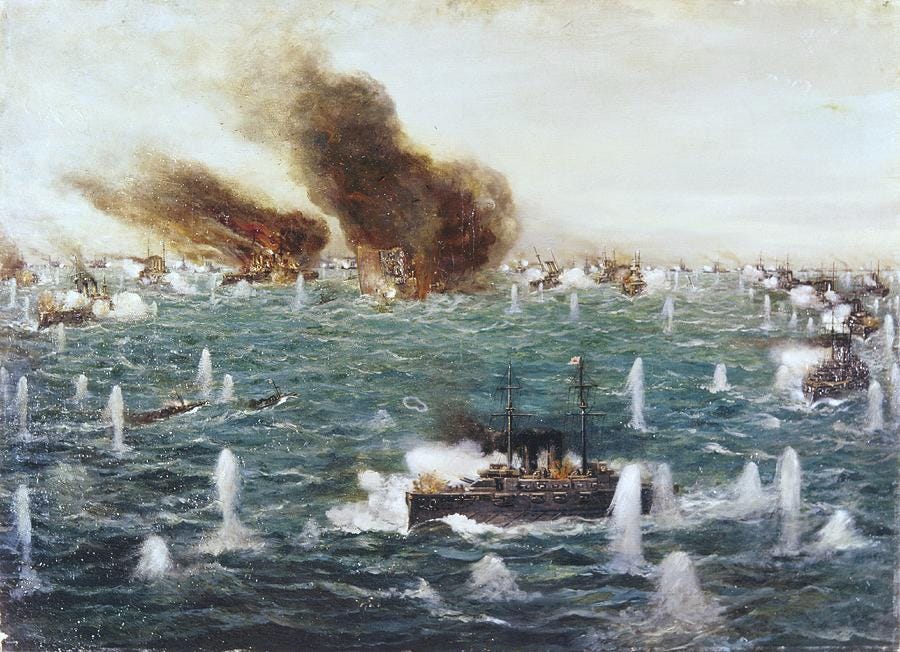
May 28, 1905: A Japanese fleet decisively defeats a Russian fleet at the Battle of Tsushima, sinking 21 Russian vessels and capturing seven more while losing only three of its own. Tsushima is noteworthy in that it was the first naval battle fought between two fleets built around modern battleships using the telegraph for communications. It’s also noteworthy for the overwhelming nature of the Japanese victory, which brought the Russo-Japanese War to an end on Japanese terms, marked the beginnings of Japan’s imperial expansion, and caused a wave of “Yellow Peril” discourse to sweep through the West.
MIDDLE EAST
LEBANON
The Israeli military (IDF) killed at least 19 people in Lebanon in a bombardment that focused primarily on the southern city of Tyre overnight and then expanded all the way to the southern suburbs of Beirut by Thursday afternoon. This was the first IDF attack in the Beirut vicinity in about three weeks and appears to have targeted the commander of a military unit affiliated with Hezbollah and with Iran’s Islamic Revolutionary Guard Corps. It’s unclear whether he was killed in the strike. Israeli and Lebanese negotiators were scheduled to meet again in Washington on Thursday but I don’t know if that meeting actually took place, and with the Israelis apparently intensifying their Lebanese operations it’s unclear what difference another meeting would make.
ISRAEL-PALESTINE
The IDF killed at least ten people in one airstrike in Gaza city late on Wednesday, targeting a Hamas military official who was among the dead along with his daughter. On Thursday, Israeli Prime Minister Benjamin Netanyahu said publicly that he’s ordered the IDF to occupy 70 percent of Gaza, up from the ~60 percent it currently holds and well above the 53 percent that is supposed to be under Israeli control during the first phase of the “ceasefire.” Defense Minister Israel Katz, meanwhile, took to social media to reiterate that the Israeli government is committed to the “voluntary migration” (really ethnic cleansing) of Palestinians from Gaza. It’s been clear for a while that the Gaza “ceasefire” was mostly fictional, but I think it’s fair to wonder whether it’s even still that anymore.
Elsewhere, the United Nations will add “Israeli entities” to its annual list of parties accused of practicing sexual violence in conflict. In response, Israeli UN ambassador Danny Danon said on Thursday that the country will cut off contact with UN Secretary-General António Guterres and his office. Danon called the listing “outrageous.”
OMAN
US Treasury Secretary Scott Bessent threatened to sanction Oman on Thursday if it enters into any sort of toll/fee relationship with Iran in the Strait of Hormuz, one day after Donald Trump threatened to blow the country up for the same reason. The New York Times reported last week that Omani officials were discussing such a relationship with their Iranian counterparts but that’s as far as they seem to have gone.
As long as these threats remain rhetorical it’s been kind of funny to see Oman become Public Enemy #2 over this, given that Oman is a) a close US regional partner and b) not all that significant in the big scheme of things. I expect that, as the administration reckons with its overwhelming failure of a war, this kind of lashing out may be a somewhat regular occurrence.
IRAN
Tracking the peace talks saga is starting to feel doing a daily recap of The Young and the Restless, except possibly less meaningful. Multiple outlets reported on Thursday that the US and Iran have reached agreement on a “memorandum of understanding” instituting a 60 day ceasefire while reopening the Strait of Hormuz and lifting the US blockade. However, there are a couple of tiny complications: Donald Trump hasn’t agreed to it and, according to Iranian media, the actual text hasn’t even been finalized. Given those caveats it’s unclear whether the two sides are actually closer to an agreement than they were yesterday.
Reports of this non-agreement began to emerge shortly after the Islamic Revolutionary Guard Corps fired a ballistic missile toward what it said was a US airbase in Kuwait, in retaliation for earlier US strikes in the vicinity of Bandar Abbas. The Iranian “attack” was obviously pro forma but it may have effectively conveyed the message that the US cannot continue to take periodic shots at Iran without the Iranians responding. That may have helped refocus the principals on concluding that MoU, though again to say they’ve agreed on anything is a big stretch at this point.
Meanwhile, the Trump administration blacklisted eight tankers that are allegedly part of the “shadow fleet” moving Iranian oil and oil products despite US sanctions. It also blacklisted 15 entities allegedly involved in the Iranian oil trade.
Amid the alleged peace talks, Capital & Empire’s Aída Chávez reported on Thursday that Israeli officials are “lobbying” the Trump administration to assassinate Iranian negotiator Mohammad Bagher Ghalibaf and then start bombing Iranian civilian infrastructure as had been the stated plan prior to the ceasefire. Their pitch to Donald Trump is that one more round of airstrikes will be enough to topple the Iranian government without wrecking the global oil market, an argument so obviously fallacious that it would be unlikely to work on anybody other than Trump.
ASIA
AFGHANISTAN
It’s gone overlooked partly because of the Iran war, but Pakistan’s conflict with Afghanistan hasn’t ended even if it hasn’t been as intense of late as it was last year or even a couple of months ago. Pakistan has kept the Afghan border closed, for example, which according to The New York Times is beginning to take a serious toll:
The border closure has badly hurt the Afghan economy, which relies on Pakistan as a destination for agricultural exports and as a source of imports of other food products, construction materials and medical supplies.
Afghan pharmacists say they are facing a critical shortage of medicine for diabetes and other diseases. The Taliban government has ordered domestic pharmaceutical companies to ramp up production and has sought help from Russia and India to fill the gap.
“We are mostly dependent on foreign medicines,” said Parwez Khairi, a pharmacist in Kabul. “Afghanistan is a landlocked country and has always been, and continues to be, harmed by border disputes.”
CHINA
The Diplomat’s Michael Clarke notes an important divergence Russian and Chinese readouts of the recent Xi Jinping-Vladimir Putin summit:
The [Xinhua news] report noted that both Xi and Putin called for a “more just and reasonable international order” but it did not repeat the more pointed criticisms of “hegemonism” and “unilateralism” that peppered the Kremlin’s declaration. Rather, Xinhua recorded Xi telling Putin that Russia and China as “permanent members of the U.N. Security Council and major global powers” should focus on “their respective countries’ development and revitalization” and “promote the construction of a more just and reasonable global governance system.”
In contrast to the Russian declaration, the Xinhua report noted Xi’s emphasis that Sino-Russian relations are “a strategic choice made by both sides focusing on the fundamental interests of both countries. As such, the two parties must promote both “pragmatic cooperation in economic and trade investment, energy resources, transportation, and technological innovation” and “multilateral cooperation” in such forums as the United Nations, Shanghai Cooperation Organization (SCO) and BRICS to “safeguard the postwar international order and the authority of international law, unite the Global South, and lead the correct direction of global governance system reform.”
This illustrates a key distinction between Russian and Chinese revisionism. Beijing presents itself not as a revolutionary actor or agent of “upheaval” but rather as a defender of the existing, U.N.-centered international order advocating for “reform” from within.
AFRICA
SUDAN
The Sudanese military (SAF) announced on Wednesday that its forces are approaching the town of Kurmuk in southeastern Sudan’s Blue Nile state. The SAF has been on the move in Blue Nile for a few weeks now and Kurmuk, strategically situated along the Ethiopian border, is a prime target. The Rapid Support Forces and its Sudan People’s Liberation Movement-North partners captured Kurmuk earlier this year and it’s allegedly been serving as a conduit for support from Ethiopia to the militants.
Foreign Policy’s Suha Musa writes that the Iran war is worsening conditions in Sudan, because it’s caused this conflict to slip even further out of any international consciousness and also because of its humanitarian impacts:
Beyond the diplomatic circus, the ongoing closure of the Strait of Hormuz and resulting price spikes are worsening an already dire humanitarian crisis. The International Rescue Committee estimated that Sudan alone accounts for more than 10 percent of global humanitarian need, which is reflected in rising starvation and disease outbreaks in the absence of a functioning state.
The Iran war’s disruptions to supply chains have brought the global humanitarian delivery pipeline to its knees. More than $130,000 in pharmaceutical supplies bound for Sudan were stranded in Dubai in late March, while lifesaving medical shipments for more than 400,000 children were delayed. According to the U.N. Refugee Agency, the costs for some relief shipments have more than doubled.
A U.N. World Food Program official warned in March that if disruptions persist through June, 45 million additional people across multiple countries could face acute hunger. In a world without the U.S. Agency for International Development, and with aid infrastructure already hollowed out, even minor delivery disruptions put countless lives at risk.
As Musa notes, even if the strait is reopened soon serious damage to Sudan’s food supply may be locked in, as high fertilizer prices will impact the country’s planting season in June.
MALI
According to World Politics Review’s Corinne Dufka, Jamaʿat Nusrat al-Islam wa’l-Muslimin (JNIM) really does seem to be patterning itself after Syria’s Hayat Tahrir al-Sham (HTS) in an attempt to seize power in Mali:
According to people allied with JNIM who spoke with me on condition of anonymity, the group’s leadership has found inspiration in HTS’ transformation in Syria. With the support of neighboring Turkey, HTS transformed itself from a dogmatic Islamist militia into a more tolerant political-military entity during the years it functioned as the de facto government in Syria’s northwestern Idlib province. It stunned the world with a 12-day lightning offensive that ended Bashar al-Assad’s 24-year rule.
Of course, as my sources are well aware, there are many differences between the two situations. For starters, JNIM lacks a powerful backer like Turkey that could provide military aid and training. However, there is some room for optimism that certain aspects of the Syria template could apply.
Much like HTS, JNIM is trying to shed the terrorist label, distance itself from al-Qaida and evolve into a religious insurgency against Mali’s junta. My sources point to JNIM’s ditching of the lethal attacks on civilian soft targets that were typical of its operations a decade ago. One villager in central Mali told me the group’s representatives are “talking much less these days about global jihad and much more about local problems.”
Following JNIM’s recent offensive, evidence has emerged that it is seeking to establish its own version of Idlib in the swaths of northern and central Mali that it effectively governs. Villagers living in JNIM-controlled areas say that, like HTS, the group has moderated some of its strictest practices to accommodate the demands of local populations, including Christians. It has also established parallel institutions to resolve local disputes over land and water, particularly between sedentary farmers and nomadic pastoralists, as well as to address banditry. By filling the vacuum created by the Malian state’s absence, the group’s attempts at governance have resonated with many villagers.
(Foreign Exchanges readers can sign up for WPR’s free newsletter here and try out an all-access subscription free for 30 days, then $35 off—$77/year—after that.)
As far as the absence of a patron is concerned, there is some possibility that Algeria could fill that role but there are a number of things to consider there. One is that Algeria is no Turkey, so the extent to which it could really support a “reformed” JNIM is unclear. The other is that while the Algerian government definitely does not get along with Mali’s junta that doesn’t necessarily mean it would favor a jihadist (or even “post-jihadist”) takeover in Bamako.
EUROPE
LATVIA
The Latvian confirmed new Prime Minister Andris Kulbergs and his cabinet on Thursday, just under two weeks after President Edgars Rinkēvičs charged him with replacing former PM Evika Siliņa. Latvia must hold a parliamentary election by October, so this new government won’t have much time to make any significant policy shifts and may serve more or less in a caretaker capacity. Notably the new coalition is not expected to alter Latvia’s policy toward Ukraine, though it will aim to stop the pattern of Ukrainian drones entering Latvia airspace since that’s what brought down Siliņa’s government.
UKRAINE
European Union foreign policy coordinator Kaja Kallas claimed on Thursday that the US, and only the US, had pulled its embassy staff from Kyiv in response to Russian threats against the Ukrainian capital earlier this week. She told reporters in Cyprus that “what we heard from Ukraine yesterday was that all the embassies stayed, except one, so that also takes courage from those embassies, but yes, all the European stayed, America left.” This drew a social media response from the US embassy, which insisted that “there are no changes to our operations and reports otherwise are false.” The Ukrainian government is supporting the US claim, and an EU transcript of Kallas’s remarks was edited to remove the “America left” comment.
AMERICAS
BRAZIL
The Trump administration said on Thursday that it will designate two Brazilian gangs, “First Command of the Capital” and “Red Command,” as foreign terrorist organizations. This is in keeping with the administration’s general policy of mislabeling Latin American criminal networks as terrorist groups but it’s also specifically an intervention in Brazilian politics, as this designation is meant to paint the current government as weak and is something that Trump-friendly challenger Flávio Bolsonaro can use to attack incumbent Luiz Inácio Lula da Silva as “soft on crime” heading into October’s presidential election.
UNITED STATES
Finally, Reuters reported on Thursday that “commercially available location data” is apparently being used to track and potentially target US soldiers in conflict zones, specifically in the Middle East. The US military’s Central Command apparently sent a letter to US Senator Ron Wyden (D-OR) to that effect last month. But according to Wired, this is a problem that the Pentagon and lawmakers have known about for quite some time:
For the better part of a decade, US lawmakers have heard the same alarms about the dangers of commercially available location data that the Pentagon did—from the same intelligence assessments, from witnesses, from their own colleagues. Yet comprehensive privacy legislation has repeatedly stalled in Washington, and the one narrow fix that did pass—a requirement that data shared with military contractors not be resold—left the broader industry untouched.
One of the earliest warnings came in 2016. At the Joint Special Operations Command compound at Fort Bragg, California, a government technologist briefing senior officers demonstrated how commercial location data—bought, not hacked—could track phones from Fort Bragg and MacDill Air Force Base in Florida, the home stations of America’s most elite units, through Turkey and into northern Syria, where they clustered at a covert forward operating base. The same data was available to any advertiser or foreign intelligence service.
Even as the Pentagon was warned that the location-data marketplace was placing its own people in danger, parts of the department were eager to become its customers. The Defense Intelligence Agency disclosed to Congress in 2021 that it uses commercially purchased phone location data—including on Americans—without a warrant, taking the position that none is required. Months earlier, Motherboard reported that the US military was buying location data harvested from popular consumer apps.