

You’re reading the web version of Foreign Exchanges. If you’d like to get it delivered straight to your inbox, sign up today:
GiveDirectly is raising funds to help families affected by the Ebola outbreak in the Democratic Republic of the Congo. If you’re able to contribute, please do so!
TODAY IN HISTORY
May 26, 1908: A British drilling operation discovers a commercially-viable oil deposit at Masjed Soleyman, in Iran’s Khuzestan province. This was the first oil find in the Middle East and obviously began the region’s transformation into the stable, economically advantaged paradise it is today. The strike was made under the terms of the “D’Arcy Concession,” a 1901 agreement between British oil baron William Knox D’Arcy and Iranian ruler Mozaffar al-Din Shah Qajar that gave D’Arcy exclusive rights to explore for oil in Iran in exchange for a payment of 20,000 pounds and a mere 16 percent of any future profits. Let’s just say this led to some problems down the road and leave it at that.
May 26, 1918: The short-lived Democratic Republic of Georgia declares independence from the considerably shorter-lived Transcaucasian Democratic Federative Republic, which in turn formed out of the collapse of the Russian Empire. Although Georgia fell to a Red Army invasion in early 1921 and became a Soviet republic, this not-quite-three year period of independence was formative in terms of the development of Georgian nationalism, and after the country regained its independence from the USSR the Georgian government established May 26 as Independence Day.
MIDDLE EAST
IRAN
I didn’t plan this, but as it happens my Memorial Day break coincided with yet another will they-won’t they negotiating cycle. The outcome is that they won’t, at least not yet. In fact, the most recent turn in this saga involved the US military attacking Iran again early Tuesday morning, specifically “missile launch sites and Iranian boats attempting to emplace mines” according to US Central Command. These attacks took place in and around southern Iran’s Hormozgan province, with US officials characterizing them as “self-defense strikes” though calling anything about the US military posture in the Middle East “defensive” is debatable at least. Iranian officials accused the US of violating the ceasefire, though they’ve made no move to resume hostilities as far as I can tell.
Prior to these latest US strikes there did seem to be some movement toward expanding the ceasefire and resuming peace talks. There was a flurry of diplomacy involving mediators Qatar and Pakistan over the weekend, and while the specifics are unclear (reporting has offered varying and sometimes contradictory details and at any rate the principle that “nothing is agreed until everything is agreed” certainly applies in this case) the basic framework would involve a full ceasefire of at least 30 (possibly at least 60) days (in Lebanon as well as Iran) along with the reopening of the Strait of Hormuz and the lifting of the US naval blockade. The US would also allow the unfreezing of some amount of Iranian assets and/or the suspension of oil sanctions as well. The sequencing of these steps is among the details that still seem to be in flux and the really difficult issues will wait for a new round of negotiations that is supposed to begin during the 30/60 day ceasefire window.
After that aforementioned flurry of diplomacy, by Sunday night the White House was preaching patience and then it decided to bomb Iran again, so a breakthrough that may have seemed imminent on Saturday now looks like it may take days or not come at all. There has been at least one positive indication amid all the chatter, however. There have been multiple reports that Iranian negotiators have agreed in theory to giving up the country’s stockpile of highly enriched uranium, one of the main sticking points in this process. The details would be negotiated during the ceasefire window, and the reason why there seems to be some cause for optimism is that Donald Trump appears to have dropped his demand that the HEU be surrendered to the United States. His latest public comment, while difficult to parse because he’s an idiot, seems to open the possibility of eliminating the HEU by transferring it to a third party or in a monitored process within Iran. Either of those would be much more palatable for the Iranians than turning it over to the US.
In other items:
Leaving aside the specifics of any particular issue involved in the negotiations, one major obstacle to an agreement seems to be Trump’s awareness that he’s lost this war and his inability to acknowledge it. The major elements of the emerging deal appear to favor Iran and most of the movement toward compromise has come from the US. Still, Trump needs something that will allow him to claim victory and right now he seems focused on using the threat of continuing the war to force other states to join the “Abraham Accords.” On Monday he took to social media to declare that “it should be mandatory” for Egypt, Jordan, Pakistan, Qatar, Saudi Arabia, and Turkey to join, apparently in thanks for the US negotiating an end to the war it started. This would also serve as Trump’s pitch to Israeli Prime Minister Benjamin Netanyahu, who doesn’t want peace, to stop trying to thwart the process by escalating in Lebanon (more on this in a moment). There is no indication that any of these countries is prepared to enter the Abraham Accords at Trump’s behest.
The Iranian government partially restored internet access on Tuesday, 88 days after throttling it in response to anti-government protests back in January. Iranian President Masoud Pezeshkian had ordered the restoration the previous day. However, a full restoration may not be in the cards anytime soon, as Iran’s Administrative Court of Justice ordered the suspension of the “Special Headquarters for Organizing and Governing the Country’s Cyberspace” on Tuesday. Pezeshkian had established that body earlier this month to oversee internet issues including a potential lifting of the internet ban.
The Pentagon upped its Iran war casualty figure (killed and wounded) to 423 on Tuesday, three higher than its previous update on Friday. The US military continues to offer little to no transparency about this figure, which inexplicably rose from 385 to 428 after the ceasefire went into effect and then inexplicably dropped to 413 on April 21.
LEBANON
According to Reuters, Israeli Prime Minister Benjamin Netanyahu has been lamenting “that Israel has little ability to influence Donald Trump’s decision-making on Iran” amid this latest stab at a peace process. Trump, we’re told, hasn’t been consulting Netanyahu, and at one point last week even told reporters that the Israeli PM will “do whatever I want him to do” regarding the war. That would certainly mark a shift in their dynamic to date.
Netanyahu may be trying to undermine the negotiations in Lebanon. The Israeli military (IDF) carried out at least 120 airstrikes across southern and eastern Lebanon on Tuesday, killing at least 31 people in total after killing at least 11 in strikes on a village in eastern Lebanon the previous night. IDF ground forces are also reportedly operating north of the “yellow line” that’s marked the extent of their southern Lebanese occupation. Netanyahu had threatened to intensify operations in Lebanon on Monday, ostensibly in response to Hezbollah drone strikes and potentially including attacks on Beirut and its environs.
However, while Netanyahu has not earned the benefit of the doubt, none of the above really marks a major “escalation” over what the IDF was already doing in Lebanon and one could argue that he may be trying to hype a phony escalation to appease domestic constituencies that are frustrated about a potential US-Iran peace. He could be forced into accepting another “ceasefire” alongside the US but find some way to maintain the occupation of southern Lebanon, in which case the IDF would get to keep carrying out “defensive” operations. Trita Parsi suggests that the Iranians might respond to that type of scenario by attacking the UAE, which as he notes would risk restarting the whole war.
ISRAEL-PALESTINE
The IDF killed at least seven people in Gaza on Tuesday, including at least five in one strike on the Maghazi displacement camp. According to Netanyahu one Israeli attack targeted Mohammad Odeh, who allegedly replaced Izz al-Din Haddad as commander of Hamas’s Qassam Brigades after the IDF killed the latter earlier this month. This feels like an appropriate time to reiterate that there is no “but we really wanted to kill this guy” exemption to the “ceasefire.” On the subject of “ceasefire” violations, another Forensic Architecture satellite analysis at Drop Site finds that the IDF has built some 25 kilometers of earthen walls in Gaza to contain Palestinians within the portion of the territory that is controlled by Hamas. “Much” of the new barrier apparently runs deeper into Gaza than the “yellow line,” effectively annexing territory that is not supposed to be under Israeli control according to the “ceasefire’s” terms.
Elsewhere, Middle East Eye is reporting that the US and Israeli governments are planning to strip the Jordanian-run Jerusalem Waqf (the term waqf refers to a religious endowment) of its authority over al-Aqsa Mosque and its surrounding compound, replacing it with “a new body created by the Israeli government.” That body would manage the compound as a “multi-faith” site and tourist attraction rather than a place of primarily Islamic worship. The Israeli government would also have “a major say over the appointment of imams, preachers and senior mosque officials” and “the content mentioned in Friday sermons.” This is an anonymously sourced piece so I don’t want to give it undue credence but if it’s true it would mark a massive upheaval in the status of that site with unpredictable ramifications. It’s worth noting that the Israeli government may be moving to strip the Waqf of its role in managing the Tomb of Samuel, located just north of Jerusalem in the West Bank. That could be a dress rehearsal for what it has planned for al-Aqsa.
ASIA
MYANMAR
Reuters reported on Monday that the Myanmar military has undertaken significant new offensives against rebel forces in three important border regions—in Chin state near the Indian border, in Kachin State along the Chinese border, and in Karen State on the Thai border. Last week, military commander Ye Win Oo (who recently succeeded Min Aung Hlaing when the latter made himself president), claimed the capture of a border town in Chin and an important “arterial route” in Kachin. His focus is on regaining control over key economic regions and in particular over “rare earth” deposits in Kachin.
TAIWAN
Acting US Navy Secretary Hung Cao told a Senate subcommittee hearing last week that the Trump administration is “doing a pause” on a planned $14 billion arms sale to Taiwan over concerns that the Pentagon is running out of munitions because of the Iran war. Donald Trump has been sitting on this sale for months and given the outcome of his recent summit with Chinese President Xi Jinping there’s unsurprisingly been some speculation that he’s decided to halt Taiwan arms sales as a concession to Beijing. Cao’s claim prompted an anonymous denial from the administration, under the argument that Taiwan arms sales are arranged so far in advance that they couldn’t possibly be subject to near-term supply issues. That doesn’t seem terribly convincing as denials go, but I digress.
AFRICA
SUDAN
Rapid Support Forces drone strikes killed at least 21 people in Sudan’s North Darfur state on Sunday and Monday, according to The Sudan Tribune. The strikes hit the towns of Kornoi and Al-Tina, both of which are among a handful of population centers in that province that are still controlled by forces aligned with Sudan’s military government. There are indications that the RSF is softening those towns up ahead of a major push to secure control over the rest of North Darfur.
Elsewhere, Human Rights Watch issued a new report on Tuesday accusing the UAE government of hiring and training Colombian mercenaries who were then sent to Sudan to support the RSF. HRW alleges that the Emiratis trained the mercs at two facilities in Abu Dhabi before deploying them. One of the alleged mercs says that he was involved in training RSF recruits, “many” of them “young children,” in South Darfur state. The UAE Foreign Ministry is denying the accusation.
SENEGAL
After months of mounting tension, Senegalese President Bassirou Diomaye Faye sacked his prime minister and former political patron, Ousmane Sonko, on Friday. The two were once joined at the proverbial hip, particularly when Sonko backed Faye as his PASTEF party’s presidential candidate in the 2024 election (Sonko was legally barred from running). But they’ve fallen out over a number of policy disagreements, including their diverging positions on managing the International Monetary Fund’s austerity demands (Faye favors appeasing the IMF, Sonko did not), and Faye may have been a bit frustrated by the fact that he technically held the more powerful position but Sonko was the senior partner in their arrangement.
Faye named economist Ahmadou Al Aminou Lo, who formerly ran Senegal’s branch of the Central Bank of West African States and should be much more in tune with the IMF, as Sonko’s replacement. But the story isn’t going to end there. Senegalese parliament speaker Malick Ndiaye, also a PASTEF member, stepped down from that post on Sunday and the body promptly elected Sonko to replace him on Tuesday. Needless to say this doesn’t bode terribly well for Faye’s ability to pass legislation moving forward. It also positions Sonko as the outsider voice of opposition to what may prove to be an unpopular presidential agenda (depending on how heavily Faye leans into austerity), which could position him well for 2029.
ETHIOPIA
Foreign Affairs’ Hilary Matfess argues that Ethiopian Prime Minister Abiy Ahmed is putting the country on a path to war:
A few months after coming to power in April 2018, Ethiopian Prime Minister Abiy Ahmed signed a peace deal to end a decades-long insurgency in the country’s Oromia region. The same summer, he struck a peace agreement with Eritrea, resolving a border dispute that since the late 1990s had produced a two-year war and several smaller-scale clashes. That effort earned Abiy the Nobel Peace Prize in 2019. But his reputation as a peacemaker did not last. By 2020, the Ethiopian government was fighting a brutal war in the Tigray region; the conflict would go on for two years, killing hundreds of thousands of people and displacing more than a million Tigrayans. The 2022 Pretoria Agreement ended hostilities and aimed to secure a lasting peace through measures related to disarmament, humanitarian access, and transitional justice. Yet today, as Ethiopians prepare to go to the polls on June 1—and all but certainly deliver Abiy’s party another term in office—Tigray remains combustible, and insurgencies continue in several other regions.
Rather than bringing stability, the deals the government has brokered with various armed groups have fomented uncertainty, mistrust, and fresh violence. They have caused new factions to emerge with fresh grievances. Some of these splinter groups have objected to the terms of the peace agreements—including the prospect of having to disarm and demobilize—while others have resented the government’s halfhearted implementation of key provisions, such as power-sharing. And growing friction between Ethiopia and its neighbors has added to the volatile mix as diplomatic disputes threaten to escalate into proxy fights or even open confrontation.
Ethiopia’s security problems are solvable. Openings for regional diplomacy exist, and following through on the terms of current peace agreements could go a long way to address the grievances that are now fueling armed conflict, as well as set the groundwork for future negotiations. Yet the necessary action will require political courage and an earnest commitment by the government to reforms. If Ethiopia’s leaders instead keep the country on its current path, they run the risk of letting the security crisis simmer until tensions eventually boil over and send the country into war.
EUROPE
UKRAINE
The Russian government issued a statement on Monday announcing a plan to carry out “systematic strikes on facilities located in Kyiv that are used for the needs of the Armed Forces of Ukraine” and warning foreign nationals (including diplomatic and presumably military staff) to leave the city. This was one day after the Russian military heavily bombarded the Ukrainian capital in what could be viewed as a preview of coming attractions. The statement cited what it called “continuing terrorist attacks by the Kyiv regime” against Russian civilians as the justification for this new campaign, and specifically an apparent Ukrainian drone strike on Friday that killed at least 18 people in a dormitory in Russian-occupied Luhansk oblast.
SLOVENIA
The Slovenian parliament confirmed Janez Janša as prime minister on Friday, at the head of the right-wing coalition that he unveiled last week. Janša has an affinity for Donald Trump and during his last PM stint he worked closely with then-Hungarian PM Viktor Orbán at the European level, though of course that won’t be an option this time around. That said, his new coalition will need support from the far-right Resni.ca party, so that may steer things in a harder right direction.
AMERICAS
BOLIVIA
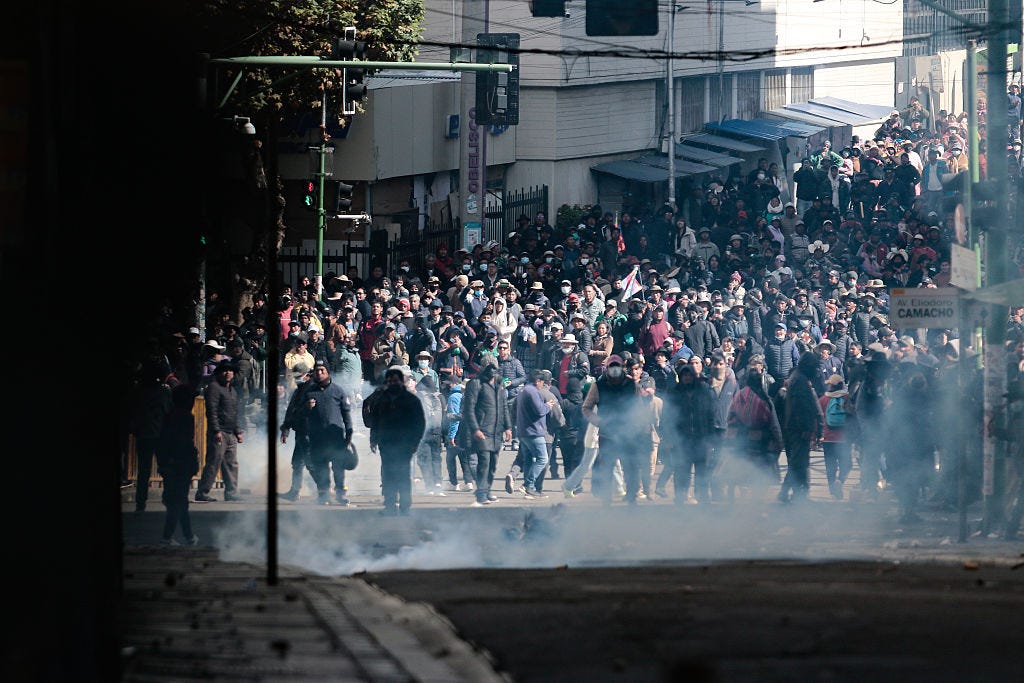
Bolivian President Rodrigo Paz offered on Monday to halve his salary and the salaries of his cabinet ministers, in another attempt to appease the anti-austerity protesters who have been demonstrating and blocking roads across the country for the past several weeks. That offer does not seem to have appeased them, as the protesters in La Paz continued to clash with police while demanding Paz’s resignation. The protesters’ roadblocks are really beginning to squeeze La Paz and there are now reports of food, fuel, and medicine shortages in the city.
UNITED STATES
Finally, in US news:
The US military struck another alleged drug trafficking boat in the eastern Pacific on Tuesday, killing at least one person and possibly leaving two survivors. The US Coast Guard has been deployed to search for them.
Tulsi Gabbard resigned as Donald Trump’s Director of National Intelligence on Friday. She cited her husband’s recent cancer diagnosis as the reason for her decision, though it is also true that she’d been generally sidelined within the administration—her past statements opposing military action clashed uncomfortably with Trump’s recent warmongering—and there had been rumors about her potential firing for several weeks prior to her resignation. Former deputy DNI Aaron Lukas has replaced her on an interim basis.
A new analysis from the pro-asylum NGO Human Rights First estimates that the Trump administration’s deportation flights emitted a whopping 370,240 tons of carbon dioxide in 2025—an 88 percent increase over similar emissions in 2024—and are on pace to emit even more carbon in 2026, making those flights an environmental as well as moral abomination. Though to be fair, for the Trump administration pumping more carbon into the atmosphere is a feature, not a bug.
According to Foreign Policy’s Alexandra Sharp, Trump’s about-face on the subject of sending additional US forces to Poland caught European NATO members off guard. This seems about right, given that Trump himself couldn’t really explain why he decided to send those forces days after he canceled their deployment, other than to note what a nice guy Polish President Karol Nawrocki is. But the inconsistency leaves the Europeans wondering exactly what he’s doing and could work against the administration’s stated goal of forcing those countries to take on a greater share of the NATO defense burden.