

You’re reading the web version of Foreign Exchanges. If you’d like to get it delivered straight to your inbox, sign up today:
PROGRAMMING NOTE: Apologies for this but as I was writing tonight’s newsletter I began to feel rather unwell, and while I was able to finish the written newsletter I am going to have to forego our usual Sunday voiceover. Those who need assistance should be able to use the text-to-voice feature in the Substack app.
TODAY IN HISTORY
May 16, 1916: The British government ratifies the Sykes-Picot Agreement, establishing it as the Allied blueprint for the post-war remains of the Ottoman Empire.
May 16, 1961: The South Korean military, under army general Park Chung-hee, overthrows the country’s civilian government in the appropriately named “May 16 Coup,” instituting a period of military rule in South Korea that lasted in one form or another until 1993. Park himself ruled the country until his assassination by the head of South Korea’s National Intelligence Service in 1979. The military government is credited, if you want to call it that, with rapidly industrializing the South Korean economy, at the cost of basic rights and liberties.
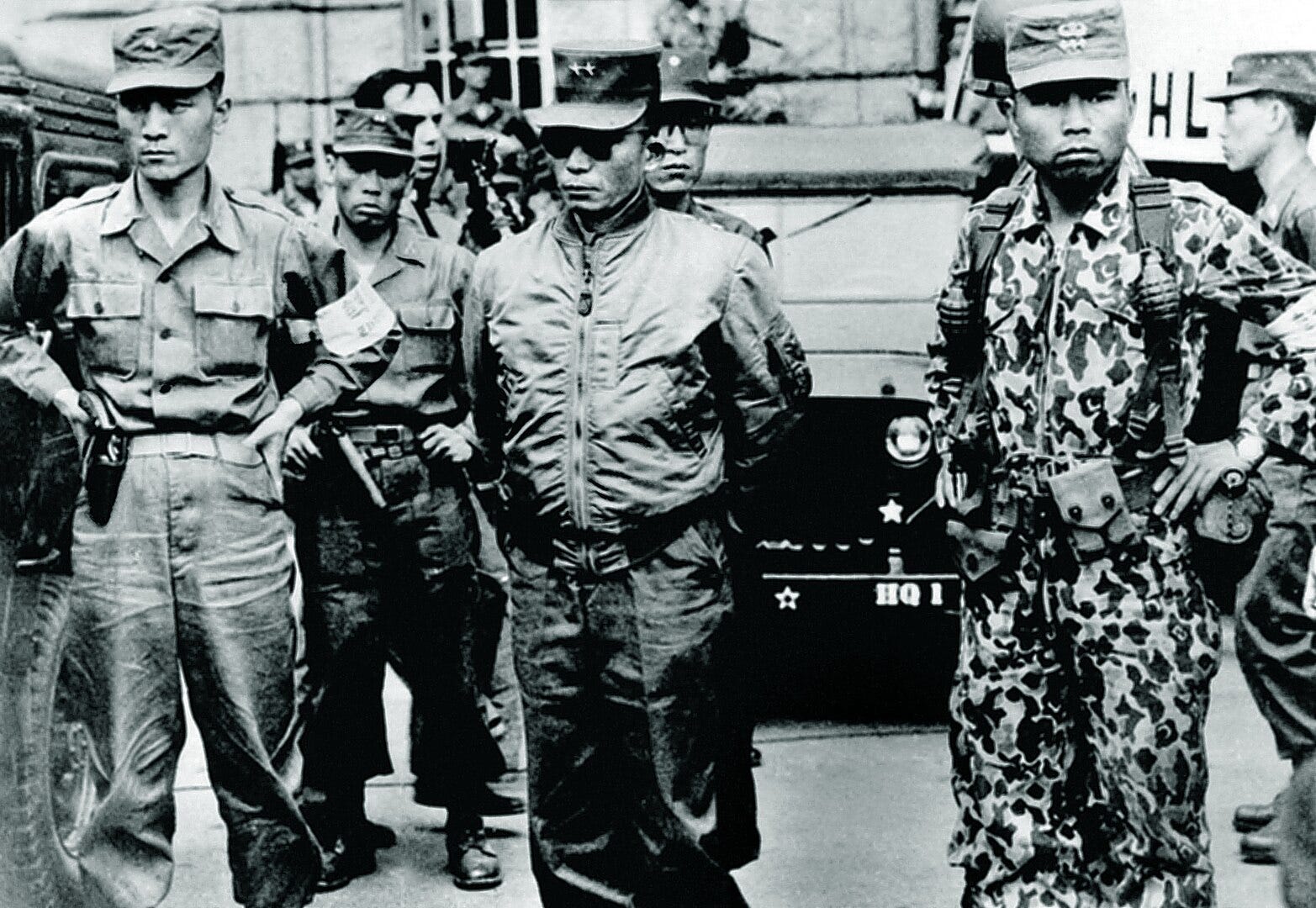
May 17, 1980: The South Korean military, under General Chun Doo-hwan and members of a secret military society called Hanahoe, overthrows the country’s nominally civilian government in the “Coup d’état of May Seventeenth.” The coup ended the South Korean “Fourth Republic” and reified the political power Chun had amassed following the assassination of Park Chung-hee in October 1979 and the subsequent “12.12 Military Insurrection.” Chun would serve eight years as an essentially dictatorial president, but in 1995 he was arrested, convicted, and sentenced to execution for his actions in Gwangju. The sentence was adjusted down to life imprisonment and commuted in 1997 by then-President Kim Young-sam.
May 17, 1997: Having chased Zaire’s dictator, Mobutu Sese Seko, into exile the day before, military forces aligned with Laurent-Désiré Kabila and the Alliance of Democratic Forces for the Liberation of Congo enter Kinshasa, bringing an end to the First Congo War. Kabila succeeded Mobutu as president of Zaire, which was renamed the Democratic Republic of the Congo. The war, which had begun the previous year when Rwandan Patriotic Front forces invaded Zaire in pursuit of fleeing Hutu génocidaires, resumed the following year when Kabila expelled Rwandan and Ugandan forces from the country. The Second Congo War technically ended in 2003, though conflict in the eastern DRC has persisted through the present day.
MIDDLE EAST
LEBANON
The Israeli military (IDF) killed at least seven people on Sunday in multiple airstrikes across southern and eastern Lebanon. That’s in addition to at least 18 people killed from Friday into Saturday, according to the Lebanese Health Ministry. On Friday, as you may recall, the Israeli and Lebanese governments agreed to extend their ceasefire for another 45 days. I offer that reminder just for a bit of context.
ISRAEL-PALESTINE
The IDF killed at least eight people in Gaza on Sunday and at least two people on Saturday. One IDF strike on Saturday reportedly killed a senior Hamas commander named Bahaa Baroud in Gaza city. Hamas also confirmed on Saturday that an IDF strike the previous day killed Qassam Brigades commander Izz al-Din al-Haddad. Israeli attacks have killed at least 870 people in Gaza since that “ceasefire” went into effect in October.
Elsewhere, the Palestinian Authority’s ruling Fatah party held its central committee election on Sunday. Marwan Barghouti, who has been in Israeli custody since 2002, was the leading vote getting while Yasser Abbas, newly reelected PA President Mahmoud Abbas’s son, also won a committee seat. That could set up a contest for succession to the 90 year or Mahmoud Abbas between Yasser, committee secretary-general Jibril Rajoub, and PA Vice President Hussein al-Sheikh. Barghouti will also be part of the discussion given his popularity, but his imprisonment likely rules him out as a potential president.
UNITED ARAB EMIRATES
Somebody carried out a drone strike targeting the UAE’s Barakah Nuclear Power Plant on Sunday, sparking a fire that fortunately did not have any radioactive repercussions. I say “somebody” because while Emirati officials pointed a somewhat oblique finger at Iran the drones apparently entered the country from the west. With the proviso that drones are maneuverable, it seems more likely that these drones were launched by either an Iranian affiliate or somebody else altogether. Perhaps an Iraqi militia was responsible—the Saudi Defense Ministry claimed that its air defenses intercepted three drones that entered the kingdom’s airspace from Iraq on Sunday.
IRAN
Donald Trump took to social media on Sunday to say that Iran’s “Clock is Ticking” with respect to reaching a peace deal, adding that if Tehran refuses to make the concessions he’s demanding “there won’t be anything left of them.” To give Trump credit where credit is due, not many US presidents have been as open about their intent to commit crimes against humanity as he is. Trump hasn’t put a deadline on the talks but he is reportedly scheduled “to convene his top national security team in the Situation Room on Tuesday to discuss military options.”
The Iranian government is apparently planning to roll out a new plan for “managing” the Strait of Hormuz. This will include the collection of tolls, though officials now appear to be referring to the collection of “fees” in return for “specialized services,” possibly because that’s an easier framework to square with international law. They would be aiming to block the passage of unfriendly military vessels through the strait and to restrict the passage of commercial vessels to countries that have sought and obtained permission—whether via payment or because they’re on good terms with Tehran. Needless to say it seems unlikely that Iran is actually going to emerge from this conflict with this framework in place.
The Trump administration is reportedly encouraging the UAE to “take” Iran’s Lavan Island. The Emiratis attacked Lavan back in April, but bombing it and seizing it are two very different things. Lavan is less than 20 kilometers off the Iranian coast and any attempted occupation would undoubtedly be subject to a massive barrage from Iranian forces. Emirati forces would be counting on the US military to protect them, and given that the US military doesn’t even seem interested in/capable of protecting the UAE proper I’m not sure relying on US forces to support the seizure of Lavan is a good idea. But what do I know?
ASIA
SRI LANKA
AFP reports that, with Southeast Asian nations cracking down on scam operations, many of them are turning instead to Sri Lanka:
A surge in arrests of suspected foreign scammers in Sri Lanka has authorities concerned that the island is fast becoming a hub for online crime, following sweeping crackdowns in hotspots Cambodia and Myanmar.
Officials say some scam networks forced out of countries in Southeast Asia have simply shifted to new bases, increasingly moving operations to Sri Lanka -- an attractive destination due to a relaxed visa regime and reliable, high-speed internet.
Since the start of the year, police have arrested more than 1,000 foreigners, mainly from China, Vietnam and India, for alleged involvement in cybercrime, spokesman Fredrick Wootler said, a jump from 430 for the entirety of 2024 and even fewer last year.
Last month, Sri Lankan customs officials intercepted nine Chinese nationals attempting to smuggle used mobile phones and laptops in the hundreds, raising suspicion they were to be used in large-scale fraud operations.
TAIWAN
Taiwanese President Lai Ching-te took to social media on Sunday to insist that his government will “not give up our national sovereignty and dignity, or our democratic and free way of life, under pressure,” while affirming that Taiwan (or the “Republic of China,” technically) is a “sovereign, independent, democratic country.” He was responding to Donald Trump’s recent Chinese summit, which was overall anticlimactic but did include Chinese President Xi Jinping warning Trump that Taiwan could be a flashpoint for a US-Chinese conflict and Trump seeming to downplay US support for the island in response. Specifically, he wouldn’t commit to future US arms sales and told reporters that he’s “not looking to have somebody say, ‘Let’s go independent because the United States is backing us’.”
Needless to say, Trump’s comments raised some eyebrows in Taipei. It’s also raised some eyebrows within the Trump administration—according to Axios, “some” of Trump’s “close advisers” are worried that the trip may have “heightened” the potential of a Chinese invasion of Taiwan within the next five years. That timeframe is particularly worrisome to tech types, since the Taiwan Semiconductor Manufacturing Company remains the world’s largest supplier of advanced chips and US companies can’t prepare to cope with its potential loss that quickly.
AFRICA
NIGERIA
Both Donald Trump and Nigerian President Bola Tinubu have claimed that a recent US-Nigerian military operation in northeastern Nigeria’s Borno state killed Islamic State commander Abu Bilal al-Minuki. Trump described al-Minuki as “the most active terrorist in the world” and IS’s global second in command, though he may have been exaggerating on both counts. Nevertheless Minuki was believed to be a very senior figure within the organization and has been blacklisted by the US since 2023. He’s alleged to have coordinated IS activities across West Africa.
On Saturday, an apparent jihadist attack on a military special forces training school in neighboring Yobe state left at least 17 police officers dead. They were there for some sort of “specialized” instructional program. It’s unclear whether this attack was the work if IS or Boko Haram.
DEMOCRATIC REPUBLIC OF THE CONGO
The United Nations World Health Organization declared a global health emergency on Sunday over a recent outbreak of Ebola in the eastern DRC and Uganda. It’s hard to know when the outbreak began with any precision but the WHO first began tracking it earlier this month. The epicenter appears to be the northeastern DRC’s Ituri province, but cases have been reported in neighboring North Kivu province and there have now been at least two cases reported in Uganda and one in Kinshasa, which while still in the DRC is over 1000 kilometers away from Ituri and heavily populated. The Africa Centres for Disease Control and Prevention has reported over 330 suspected cases and at least 88 deaths in this outbreak so far.
COMOROS
The Comoran government announced on Saturday that it is suspending a fuel price increase that it unveiled earlier this month. That’s because a protest against the price increase on the island of Anjouan on Friday resulted in a violent clash with police that left at least one person dead and five more injured. Workers had been striking over the price hike for several days leading up to Friday’s incident. The Comoran government attributed the increase to the Iran war’s impact on global oil prices and we can presumably expect this kind of unrest to hit other countries as the war causes further increases in fuel and food prices.
EUROPE
RUSSIA
Ukrainian drone strikes killed at least five people in Russia on Sunday, including at least three in the Moscow region. The Russian military said that its air defenses intercepted some 586 Ukrainian drones overnight and into Sunday, marking one of the most active Ukrainian barrages of the war. Russian forces have spent the past week launching similarly massive daily bombardments of Ukraine.
LATVIA
Latvian President Edgars Rinkēvičs has tapped current opposition leader Andris Kulbergs to replace outgoing Prime Minister Evika Siliņa. Kulbergs heads the United List alliance, a grouping of minor parties that is currently the largest opposition bloc in the legislature. That bloc is nowhere near a parliamentary majority so Kulbergs may have some work to do in terms of coalition building. That said, as I mentioned on Thursday Latvia is required to hold a parliamentary election by early October so Kulbergs would basically be serving as a caretaker. That probably makes his path to forming a government smoother than it otherwise would be.
UKRAINE
The Russian military claimed the seizure of two villages in Ukraine’s Kharkiv oblast on Saturday. As ever, there is no independent confirmation of that claim.
BULGARIA
Jacobin’s Martin Marinos argues that Western depictions of new Bulgarian Prime Minister Rumen Radev as “pro-Russia” are missing the domestic context that explains his election:
This sudden surge of interest in an election from the EU’s eastern periphery was largely driven by geopolitical concerns. With few exceptions, the vote was framed as a contest between pro-Russian and pro-Western orientations, and Radev’s victory was widely portrayed as a triumph for pro-Kremlin forces. Headlines reinforced this narrative. The Washington Post suggested the result “gives Moscow a new foothold in Europe,” and reasoned that, after Viktor Orbán’s loss in Hungary, Radev was the “Kremlin’s next best bet.” Similarly, NBC and CNN described Radev as “Kremlin-friendly,” while the Guardian labeled him “Moscow-friendly,” and the Financial Times characterized him as “pro-Russian.”
Radev, who has consistently maintained that Bulgaria (an EU and now euro member) should remain on a European path, has also emphasized the importance of dialogue with Russia and expressed skepticism toward military aid to Ukraine. Yet these positions alone hardly justify reducing Bulgaria’s recent election to a simple geopolitical contest. Uninformed readers abroad might get the misleading impression that Bulgarians live in relative affluence and are so detached from domestic concerns that they have become preoccupied with foreign policy, debating their country’s place in a grand clash between East and West.
To be sure, like many peripheral nations, Bulgarians are acutely aware of their position within the international order. However, the near-exclusive focus of US and European media on the Russia-versus-the-West framing obscures far more than it reveals about the underlying dynamics of Radev’s victory.
AMERICAS
PERU
Peruvian authorities confirmed on Sunday that next month’s presidential runoff will indeed pit right-winger Keiko Fujimori against leftist Roberto Sánchez. They also promised to attempt to resolve the issues that delayed the first round results for a full month so that the runoff would not be similarly marred. Right-winger Rafael López Aliaga, who narrowly lost out on a spot in the runoff to Sánchez, has been insisting that the first round was fraudulent and rejected the official results on Sunday. It’s unclear whether he could make a challenge that would impact the runoff.
VENEZUELA
The Venezuelan government deported businessman Alex Saab to the United States on Saturday. Saab had been arrested and taken into US custody back in 2020 before being pardoned and repatriated as part of a prisoner swap between the Biden administration and former Venezuelan President Nicolás Maduro. He served as an envoy for Maduro and has been accused of corruption and working to evade US sanctions. He’d apparently lost favor with interim Venezuelan President Delcy Rodríguez, who may also be hoping to fend off Donald Trump’s desire to make Venezuelan the 51st US state by acting as though it already is. Her subservience does seem to be winning her considerable support in Washington.
CUBA
Axios’s Marc Caputo reported on Sunday that US intelligence officials are worried because the Cuban government “has acquired more than 300 military drones” and may be planning to use them against the US in case of a military conflict. Caputo’s sources present this as somehow threatening to the US even though they apparently acknowledge that Havana is not “actively planning to attack American interests.” They appear to be using him to try to manufacture a very strained case for US military action. Caputo even acknowledges in his piece that what he’s reporting “could become a pretext” for military action against Cuba, before going on to provide said pretext. Full marks for candor, I guess.
UNITED STATES
Finally, Spencer Ackerman considers the predecessors of the Trump administration’s new domestically-oriented counterterrorism strategy:
Whether consciously or not, that mission statement is ominously similar to perhaps the most prominent of all COINTELPRO memos. In March 1968, FBI Director J. Edgar Hoover described the bureau’s approach to Black-liberationist leaders and organizations, whether Martin Luther King Jr. or the Black Panthers. “Through counterintelligence, it should be possible to pinpoint potential troublemakers and neutralize them before they exercise their potential for violence,” Hoover wrote.
Hoover’s classified memo was stolen from a Philadelphia-area FBI office and reported on by Washington Post reporter Betty Medsger in 1971. A congressional investigation known as the Church Committee later validated it and exposed additional aspects of COINTELPRO, along with other repressive domestic and foreign intelligence activities. A generation later, tens of millions of people heard singer Zack de la Rocha chant Hoover’s line on the Rage song “Wake Up.”
For 25 years, the so-called War on Terror’s sweeping expansions of domestic surveillance and watchlisting placed gigantic numbers of American Muslims under permanent suspicion.
It has lasted so long as to become normalized – and, as was predictable, to expand to other disfavored groups, like migrants targeted by ICE. Practically as soon as the Towers fell, War on Terror enthusiasts on the right demanded the security apparatus target left and liberal groups, starting with journalist Andrew Sullivan’s portrayal of the U.S. “decadent left” as a “fifth column“ functionally in league with al-Qaeda. Sullivan later apologized for his invective. Now it’s official policy.
Feel better soon Derek.
Hope you feel better soon!