

You’re reading the web version of Foreign Exchanges. If you’d like to get it delivered straight to your inbox, sign up today:
PROGRAMMING NOTE: As it turns out I had just enough time for an abbreviated roundup today, so here it is. Back to a more normal schedule tomorrow!
TODAY IN HISTORY
May 14, 1560: The Ottoman Empire wins a major naval battle against a Habsburg-led alliance at Djerba, just off the coast of modern Tunisia. The Ottomans caught the Christian fleet unprepared and dealt it substantial losses. The victory enabled the Ottomans to extend their Mediterranean control to include Tunisia and allowed their navy to threaten the central Mediterranean. Their defeat in the 1565 Great Siege of Malta more or less eliminated that threat.
May 14, 1796: English doctor Edward Jenner administers an experimental smallpox vaccine to the eight year old son of his gardener, inoculating the boy with pus from a woman who was infected with cowpox. This technique was already in use, but Jenner then intentionally exposed the child to smallpox and is thus credited with proving that the vaccine actually worked.
MIDDLE EAST
LEBANON
Israeli and Lebanese negotiators met in Washington for the third time on Thursday. That meeting was still taking place at time of writing so I don’t have anything to say about how it went, but the expectation was that they would discuss extending the current “ceasefire” since it’s set to expire on Monday. More fundamentally the Lebanese team was likely to push for an actual ceasefire as opposed to the farce that is currently in place (the Israeli military killed at least two more people in Lebanon on Thursday ahead of the talks). The Israelis were likely going to demand some sort of progress toward a Lebanese plan for disarming Hezbollah.
ISRAEL-PALESTINE
The Israeli government is threatening to sue The New York Times over the publication of Nicholas Kristof’s piece documenting sexual violence against Palestinians in the Israeli prison system. I think it’s noteworthy that while there’s been plenty of reporting on these allegations prior to Kristof’s, Israeli officials are worried enough about these claims appearing in the NYT to go to this length to try to muffle the story. Assuming the paper continues to stand by Kristof’s reporting it will be interesting to see if the Israelis actually file the lawsuit, which would open up a discovery process that I’m not sure they’d be willing to go through. Netanyahu has previously threatened to sue the NYT over claims that the Israelis were starving people in Gaza but never did so, probably fearing that the trial would have demonstrated that the Israelis were in fact starving people in Gaza.
YEMEN
The nominal Yemeni government and the Houthi movement agreed to a prisoner exchange involving some 1680 people on Thursday. Under its terms the Houthis will free 580 captives while the government will release 1100. Both parties agreed to work with the International Committee of the Red Cross to facilitate the process. This could be an important breakthrough that leads at the very least to additional prisoner releases if not more substantive negotiations.
UNITED ARAB EMIRATES
The Wall Street Journal argues that Wednesday’s Israeli-UAE dispute over claims that Netanyahu visited the Gulf state a few weeks ago show how sensitive its relationship with Israel is for the Emirati government:
Such disagreements are extremely unusual in the world of high-level international diplomacy. The prickly back-and-forth shows that while Israel has proven a valuable security partner for the U.A.E., there are still political considerations that need to be managed in the relationship.
Those considerations are personified by Netanyahu. The leader of Israel’s ultranationalist government is seen by many regional governments as a destabilizing force in the region following the war in Gaza, Israeli occupation of territory in southern Lebanon and southern Syria, and targeted killings of militant leaders across the region including in Qatar last year.
“The relationship between Israel and the U.A.E. is the best relationship Israel has with any other Arab country ever,” said Yoel Guzansky, a senior fellow at the Institute for National Security Studies, a think tank based in Tel Aviv, who specializes in the Gulf. “But we also see that even this has limits.”
There is copious evidence that Netanyahu did travel to the UAE but the revelation is embarrassing for Emirati leaders. As to why Netanyahu’s office felt the need to reveal the trip publicly despite those Emirati concerns, the most likely explanation is that with a parliamentary election looming Netanyahu wanted to brag about it.
IRAQ
The Iraqi parliament confirmed new Prime Minister Ali al-Zaidi and his cabinet on Thursday, finally giving the country a government a scant seven months after November’s election. There are a few holdovers from the previous cabinet, in particular Foreign Minister Fuad Hussein, and some offices have not yet been filled like that of interior minister. Zaidi will immediately have to manage/balance relations with both the US and Iran, which is a challenge for any Iraqi PM but more so now because of the war.
IRAN
Thursday proved to be another tense day in the Strait of Hormuz, as one unnamed ship that was anchored off the coast of the UAE’s Fujairah port was reportedly seized and began sailing toward Iran, while the Indian-flagged cargo ship Haji Ali sank near Oman after coming under attack the previous day while heading toward the UAE’s Sharjah emirate. There’s no definitive word as to responsibility in either of these incidents but one could probably hazard a guess. Omani authorities rescued the crew of the Indian vessel but the environmental damage could be considerable. The Indian government condemned the attack without blaming any party for it.
The Financial Times reported on Thursday that the Saudi government “has discussed the idea of a non-aggression pact between Middle East states and Iran as part of talks with allies on how to manage regional tensions once the US-Israeli war with the Islamic republic ends.” Saudi officials are using the 1975 Helsinki Accords, which sought to manage Cold War tensions in Europe, as a model. This is not the first time that pact has been floated as a potential answer to tensions in the Middle East but the issue will take on new importance after a conflict that has seen Iran and several Gulf Arab states attacking one another that will likely end without resolving any underlying grievances between those countries.
ASIA
NEPAL
The Diplomat’s Biswas Baral reports that a couple of diplomatic snubs have caused the Indian government’s previous enthusiasm for new Nepalese Prime Minister Balendra Shah to wane:
Yet cracks quickly emerged in India-Nepal ties. In keeping with the tradition, Indian Ambassador to Nepal Naveen Shrivastava wanted to congratulate Shah personally when he became the prime minister. But Shah, in a mood to break from the tradition of Nepali executive heads individually meeting foreign ambassadors, gave a collective audience to resident ambassadors in Kathmandu.
It later transpired that the Indian prime minister had invited Shah to visit India while extending his congratulatory message — and Shah had accepted the invitation. Kathmandu and New Delhi expedited preparations for the visit. Then, unexpectedly, the RSP issued a statement saying that the Nepali prime minister would not be making any foreign trip for at least a year.
This happened even as Indian Foreign Secretary Vikram Misri was scheduled to visit Kathmandu and extend Modi’s formal invitation to the Nepali prime minister.
Again, Shah did not agree to a meeting with Misri, in line with his stand that he would not meet any foreign leader below the rank of a minister.
Shah’s government has also protested New Delhi’s decision to resume a religious pilgraimage through the disputed Lipulekh Pass and has begun enforcing a tax on Indian goods purchased by Nepalese nationals. Previous Nepalese governments had ignored that levy and the enforcement is affecting Indian merchants.
CHINA
Day one of the Donald Trump-Xi Jinping summit in Beijing seems to have passed without major incident or any major new agreements, though those may manifest after the second day of their confab on Friday. The one item of note seems to have been Xi’s somewhat frank warning that tensions over Taiwan could leave US-Chinese relations in “a very dangerous place.” That’s not exactly a new message, though, so it doesn’t appear to have ruffled any feathers.
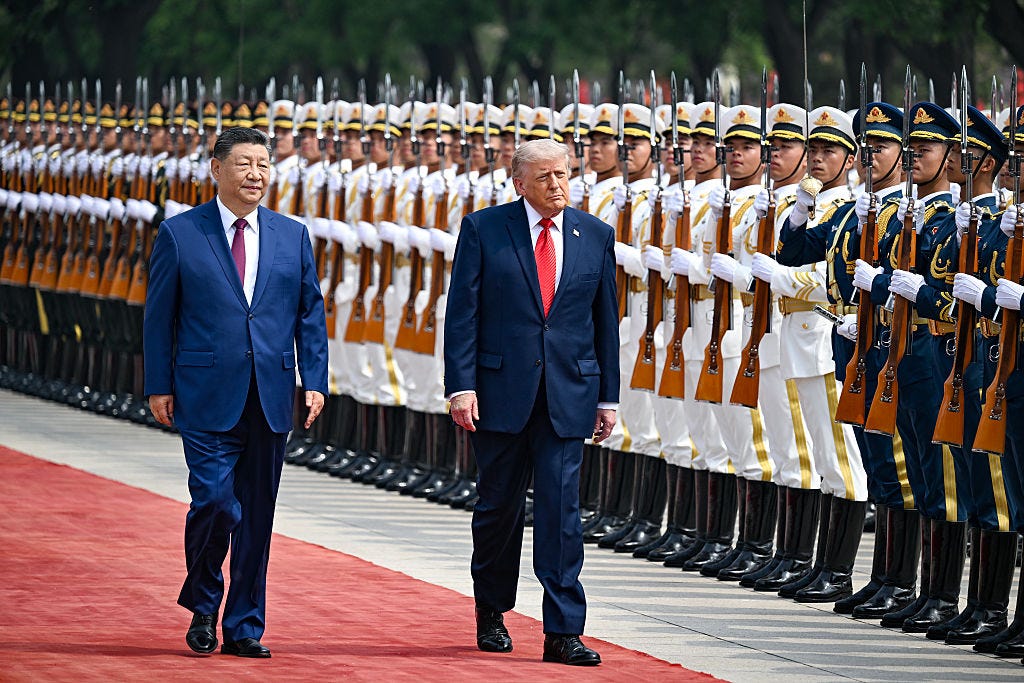
Trump and Xi also reportedly talked about the Strait of Hormuz, with the latter vaguely agreeing that it should be open and should not be militarized without committing to take any action about it. And Trump invited Xi to visit Washington in September.
AFRICA
SUDAN
The New Humanitarian reports on allegations of the mass deportation (its sources cite upwards of 12,000 cases) of South Sudanese nationals from Sudan:
When the SAF and allied forces pushed the RSF out of Khartoum and other towns last year, some South Sudanese were accused of supporting the rebels. SAF-aligned authorities also cited missing residence permits to justify deportations.
Deportees denied supporting the RSF to The New Humanitarian and said they were punished for remaining in place during the RSF occupation, having had no financial ability to leave. Some said they had valid permits when they were detained.
Many viewed the targeting as discriminatory, echoing a long-standing pattern against South Sudanese, many of whom lost their Sudanese nationality when South Sudan became independent in 2011.
The deportees – some of whom were born in Sudan or spent several decades living there – are now joining more than 900,000 other South Sudanese returnees who have escaped Sudan and gone back home since the war began in April 2023.
But in South Sudan many have struggled to find peace: The country is experiencing economic collapse and a resurgent civil war that has displaced nearly 300,000 people in the first quarter of this year alone.
SOMALIA
A new report from the Integrated Food Security Phase Classification (IPC) group finds that parts of southern Somalia are at risk of famine for the first time since 2011. The report estimates that 37 percent of young children in southern Somalia’s Bay region are facing “acute malnutrition,” which is one of the standards for a famine declaration. Insecurity and low levels of rainfall are the main causes.
EUROPE
LATVIA
Latvian Prime Minister Evika Siliņa resigned on Thursday, after the Progressives party quit her coalition and left her without a parliamentary majority. Siliņa was caught up in the political firestorm over several Ukrainian drones that have strayed into Latvian airspace in recent weeks. She’d forced Defense Minister Andris Sprūds to resign over those incidents earlier this week, and as Sprūds is a member of the Progressives party you can see where that backfired on her. Latvia is scheduled to hold a parliamentary election this year anyway, so the resolution here may amount to installing some sort of interim government until the vote takes place.
The problem of stray Ukrainian drones has affected all three of the Baltic states, with Ukrainian Foreign Minsiter Andrii Sybiha blaming the phenomenon on Russian electronic interference. Kyiv is reportedly offering to work with the governments of those states to address the issue.
UKRAINE
The Russian military launched another major bombardment of Ukraine on Thursday, killing at least nine people in one strike that hit an apartment block in Kyiv (UPDATE: the death toll as of Friday evening was at least 24). Many more people are missing after that strike so the death toll could rise. The Russians have spent the past couple of days making up for last weekend’s ceasefire, firing a whopping 1560 drones at Ukraine since Wednesday according to Volodymyr Zelensky.
UNITED KINGDOM
UK Health Secretary Wes Streeting resigned on Thursday, citing a lack of confidence in Prime Minister Keir Starmer. I mention this mostly because Streeting is viewed as a major potential challenger to Starmer for leadership of the UK Labour Party and, thus, the PM job. Starmer is reeling after local elections last week saw Labour take a pretty severe drubbing, and his response seems to have underwhelmed many people in the party. He’d promised a new bold agenda in the “King’s Speech” on Wednesday but it’s been received as more of the same timid “incrementalism” that has cost Labour considerable public support.
AMERICAS
CUBA
The Cuban power grid collapsed again on Thursday, causing major blackouts in the eastern part of the island. Cuban officials are now saying that the island has “absolutely” run out of fuel oil and diesel due to the ongoing US blockade, and the resultant economic strife is starting to spark protests in parts of Havana.
UNITED STATES
Finally, In These Times’ Basav Sen argues that the Trump administration is moving in the opposite direction of the rest of the world when it comes to energy policy:
In late April, dozens of world governments — led by Colombia and the Netherlands — convened the first ever international diplomatic conference on phasing out fossil fuels, demonstrating the kind of leadership the world needs today. It’s a refreshing contrast from what we’ve seen from Washington.
Just two days before Earth Day, for example, President Trump issued an order invoking his authority under the Defense Production Act to expand domestic production and exports of fossil fuels, purportedly to boost national security.
The Defense Production Act, which dates back to the Cold War, gives the president power to authorize robust government intervention in the economy and promote production in particular sectors in the interest of “national security.” But it takes a singularly narrow and flawed definition of “national security” to arrive at the conclusion that we need more oil, gas, and coal production in this country.
The U.S. is already the world’s largest oil and gas producer, and a major exporter. This should not be a point of pride. It exposes communities who live in the vicinity of fracking and drilling, pipelines, refineries, and export terminals to toxic air and water pollution and potentially deadly fires and explosions. A disproportionate share of these communities are Indigenous, Black, brown, and poor.