

You’re reading the web version of Foreign Exchanges. If you’d like to get it delivered straight to your inbox, sign up today:
PROGRAMMING NOTE: As I said last Sunday, tonight will be our final roundup until Tuesday April 7. This is FX’s annual Spring Break week, when my daughter’s time off from school coincides perfectly with my need to take a break from doing these before I lose what’s left of my faculties. I am cognizant of pausing these updates in the middle of a major US war and so I have asked our Week in Review writer, Ashley Gate, to compile an end of the week war roundup that you’ll get on Friday. If anything particularly major happens between now and then I will try to find some time to get back online to discuss. Thanks as always for reading and supporting the newsletter!
TODAY IN HISTORY
March 28, 1737: The expanding Maratha Empire deals a significant defeat to the past-its-peak Mughal Empire in a battle near Delhi. The outcome wasn’t decisive, as the Maratha Peshwa (think grand vizier or perhaps prime minister) Baji Rao I subsequently withdrew in the face of a large Mughal relief army, but it stands as one of the first definitive signs that the Mughals were being eclipsed as the dominant power in India. Subsequent battles would see the Mughals forced to cede territory and pay tribute to the Marathas.
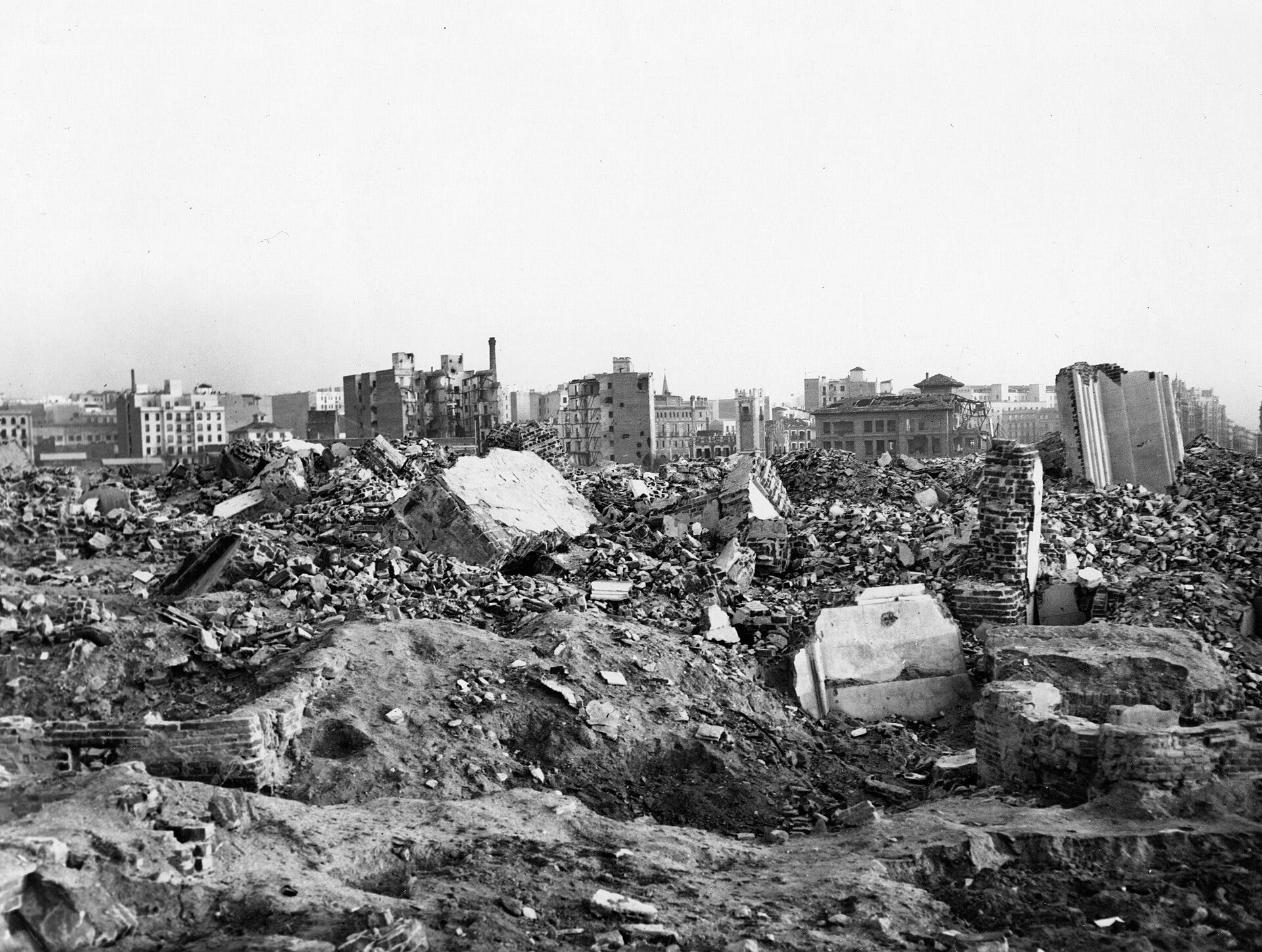
March 28, 1939: Francisco Franco’s Nationalist forces successfully capture Madrid after a nearly two and a half year siege. Franco’s initial assault on the city began in November 1936 and was beaten back by its Republican defenders, so he settled in for a long siege and steady bombardment that eventually wore the defenders down. Franco entered the city and declared victory just days later, on April 1, bringing an end to the Spanish Civil War.
March 29, 1430: The Siege of Thessaloniki ends with the Ottoman conquest of the Byzantine-turned-Venetian city.
March 29, 1857: An Indian sepoy named Mangal Pandey engages in an act of insurrection against East India Company officers at his military base outside of Kolkata. He was arrested and later hanged, as was his immediate superior for initially refusing to arrest him. Pandey’s case highlighted the growing dissatisfaction many sepoys were feeling toward the EIC, and his example (along with what many felt was a disproportionate punishment) helped spark the Sepoy Mutiny, also known as the Indian Rebellion of 1857. That insurrection failed, but it also prompted the British government to take direct control of India, stripping it from the EIC.
March 29, 1879: In arguably the decisive battle of the 1879 Anglo-Zulu War, a force of around 2200 British soldiers and auxiliaries defeats a Zulu army nearly ten times its size at Kambula. Coming just a few days after a smaller British force had suffered a devastating defeat in the Battle of Hlobane and two months after a decisive Zulu victory at Isandlwana ended the initial British invasion of Zululand, Kambula showed that a properly entrenched British army using rifles and field cannon could pick apart even a much larger Zulu force, and the effect on Zulu morale appears to have been profound. A second British invasion of Zululand brought the war to a close in early July. British authorities broke the Zulu kingdom apart into 13 chiefdoms.
MIDDLE EAST
LEBANON
Al Jazeera reported “intensified” fighting between Hezbollah and the Israeli military (IDF) on Sunday, shortly after Israeli Prime Minister Benjamin Netanyahu announced in a video message that he’s ordered an expansion of the IDF’s invasion of southern Lebanon. Israeli forces appear to be within “a few hundred” meters of the Litani River in some areas. Lebanese authorities now say that at least 1238 people have been killed since heavy fighting resumed on this front on March 2. That includes three journalists and nine paramedics whom the IDF killed on Saturday. Israeli officials claimed that one of the journalists was connected to Hezbollah. Additionally, a “projectile” killed one United Nations peacekeeper and badly wounded another in southern Lebanon on Sunday. It remains unclear who fired it.
ISRAEL-PALESTINE
The IDF attacked two police checkpoints in southern Gaza’s Khan Younis area on Sunday, killing at least six people including one child according to “local health officials.” The Israeli government has made Gaza’s police force a primary target in recent weeks, presumably to avoid its incorporation into the new police force that’s expected to deploy in the territory under the auspices of the “Board of Peace.” The IDF killed at least three Palestinians in two airstrikes in Gaza on Saturday and one Palestinian teenager near the West Bank city of Bethlehem on Friday night.
Africa Is a Country’s Jwan Zreiq considers the “expansionist logic” tying together the Middle East’s multiple conflicts:
There is a way of reading the current moment as a series of unconnected emergencies: a war in Gaza, Israeli incursions in Lebanon, strikes on Iran. Each has its own actors and logic of escalation.
Across Arab and Western media, the question circulating is often: Why is Iran hitting Arab countries? Framed this way, the presence of US military bases across the region is treated as natural, while Iran’s response is presented as an anomaly.
What disappears is the expansionist logic often described as Greater Israel. It is not only an ideological imagination, though it is that too. It is, right now, an observable fact on the ground.
IRAQ
A pair of airstrikes hit Iraq’s Kirkuk International Airport on Saturday, killing three Popular Mobilization militia fighters, while a separate airstrike killed two police officers in Mosul. The US and Israel (it’s unclear which was responsible for these incidents) have been attacking Iraqi militia targets consistently since they began the Iran war on February 28.
IRAN
Foreign Affairs’ Narges Bajoghli argues that Iran is winning this war because its government has spent decades planning for it:
Judging by the metrics of conventional conflict, Iran is not faring well against the United States and Israel. Its adversaries are destroying crucial targets in Iran, killing its commanders and degrading its military assets. But these are the wrong measures for assessing Iran’s position in the war. The right measure is not even an assessment of whether Iran is absorbing punishment well—which it is. The question that will matter when the fighting ends is whether Tehran is achieving its strategic objectives. And on that count, Iran is winning.
This outcome is not accidental. Tehran has been preparing for this war for nearly four decades, since the new revolutionary government faced its first major military test in the Iran-Iraq War, which lasted from 1980 to 1988. And it is now executing a strategy that has managed to neutralize key U.S. and Israeli air defense batteries, severely damage U.S. military bases in the Persian Gulf, inflict substantial economic pain, and drive a wedge between the United States and its Gulf allies. The Iranian regime, in other words, is not just surviving the U.S. and Israeli bombardment. The serious economic and political problems it is creating for its adversaries are, on a strategic level, giving Iran the upper hand.
In other items:
Potentially the most significant development of the past couple of days is that Yemen’s Ansar Allah, AKA the Houthi movement, finally entered the war on Saturday. I’m not entirely sure what to make of their “entry” though, inasmuch as it consisted of a couple of missile attacks on Israel. Most of the concern about the Houthis joining the fight has revolved around their ability to interrupt commercial shipping in and around the Red Sea, which would compound the economic damage already being done by Iran’s closure of the Strait of Hormuz. If they limit themselves to attacking Israel I’m not sure that will trigger a response from the US—technically it doesn’t even violate the May 2025 Houthi-US ceasefire. Then again, they may not actually need to attack any Red Sea commercial vessels to intimidate shipping companies into avoiding the region.
The Washington Post’s Dan Lamothe reported on Saturday that the US military “is preparing for weeks of ground operations in Iran.” This “would fall short of a full-scale invasion and could instead involve raids by a mixture of Special Operations forces and conventional infantry troops.” The objective or objectives are unclear and for that matter Donald Trump hasn’t actually decided to go ahead with a ground operation as yet according to Lamothe. If he does order one or more incursions, Lamothe’s sources are insisting that it/they will be brief—one source says that they will take “weeks, not months,” while another insists that they won’t go beyond “a couple of months.”
In a follow up of sorts, The Wall Street Journal reported on Sunday night that Trump is specifically considering an operation to extract Iran’s stockpile of highly enriched uranium, which is a bit over 440 kilograms in total. Some, though probably not all, of that material is believed to be stored under Iran’s Isfahan nuclear facility. The parameters of such a mission are even more batshit than seizing Kharg Island, because they would require US forces to remain in a potentially indefensible position for days on end while engineers dig for, recover, and ship out the uranium. Their work would be slowed by the possibility of booby traps and the logistics of transporting almost 1000 pounds of dangerously radioactive material in multiple containers out of Iran while under fire. The risk of casualties would be extreme and the possibility of success far from assured. The logistics become even more challenging if the uranium is stored in multiple sites, necessitating multiple raids. This is such a ridiculous idea that under any other president I would assume it was a bluff.
Trump is also pushing a diplomatic surrender of the uranium in lieu of a military operation to seize it. By the by, during the negotiations that this war interrupted the Iranians reportedly offered to downblend their stockpile to a lower level of enrichment, a process that could be pretty easily verified by inspectors under an arrangement similar to the 2015 nuclear deal.
Under normal circumstances there’s been so much chatter about ground operations that one could start interpreting it as just that—chatter, meant to intimidate the Iranians or mislead them. Ken Klippenstein’s reporting suggests that the Pentagon’s recent deployments to the region are less significant than they might seem, which would reinforce the idea that this talk (including leaks to the Post and other media outlets) is misdirection. But these are not normal circumstances, and given the way that the Trump administration has prosecuted this war from the start it is certainly plausible that it will order ground operations no matter how slipshod its preparations have been.
For what it’s worth, US Secretary of State Marco Rubio just got done assuring his fellow G7 foreign ministers that the US can achieve its aims in Iran—whatever those are at this point—without ground forces. He’s also insisting on the “weeks not months” schedule.
Iranian parliament speaker Mohammad Bagher Ghalibaf, who is still supposed to be the Trump administration’s Man in Tehran as it tries to arrange peace talks and/or calm roiling global markets, accused the US on Sunday of pretending to seek negotiations as cover for a potential ground operation. I mention this mainly to note that the Iranians seem to be prepared for a ground attack if that’s the plan.
As for the air war, the Islamic Revolutionary Guard Corps attacked aluminum manufacturing facilities in Bahrain and the UAE on Saturday, in obvious retaliation for Israeli strikes on several of Iran’s largest steel mills on Friday. The IRGC claimed that the aluminum facilities are linked to the US military, just as the Israelis claimed that the steel facilities are tied to the IRGC. Of note: US and/or Israeli strikes reportedly hit the campus of the Tehran University of Science and Technology over the weekend, so as you may have already guessed Iranian officials are now threatening to attack US university branches in the Middle East. There was also a report on Saturday of a possible attack on water infrastructure in Iran’s Khuzestan province, which could invite Iranian attacks on Gulf water facilities in retaliation.
Sociologist Ali Kadivar has a piece at his newsletter placing those steel mill strikes in a larger historical context of Western efforts to stifle Iran’s industrialization. The opposition to any Iranian nuclear program—not just a nuclear weapons program, the risk of which could be contained with proper international monitoring—also fits into this story.
Friday’s Iranian attack on the Prince Sultan airbase in Saudi Arabia apparently “damaged” (or destroyed) a US Air Force E-3 Sentry AWACS aircraft in addition to several refueling aircraft as initially reported. The USAF only has (or had) 16 E-3s in operation worldwide and those planes are now old enough to be irreplaceable. Losing one is a significant blow both in this conflict and to US military operations generally.
Although the proposed US-Iranian negotiations didn’t come together, the Pakistani government did host “peace talks” of a sort over the weekend. They just didn’t involve any of the combatants. Rather, the foreign ministers of Egypt, Saudi Arabia, and Turkey headed to Islamabad for a chat among would-be mediators. It very much remains to be seen whether their engagement is going to lead to US-Iranian engagement. To show its support for the venture, the Iranian government agreed to allow 20 Pakistani-flagged ships to transit the Strait of Hormuz. This is a no-lose proposition for the Iranians, since they get to appear magnanimous while still reinforcing the idea that countries now need to come to them for permission to pass through the strait.
Speaking of ships passing through the strait, remember when Donald Trump claimed a few days ago that the Iranians had let ten (originally eight, but then it became ten) vessels (also apparently Pakistani-flagged) make the transit as a special “present” to him? As it turns out there’s no evidence that they did anything of the sort. Well, as long as Trump was happy that’s the important thing.
The AP reported on the war’s impact on global fertilizer supplies on Friday and the news, with the Northern Hemisphere already in its planting season, is not good. It’s been all I can do to keep track of the day to day events of this conflict, let alone its potential long-term impacts. But this particular long-term impact may already be locked into place and its implications could be dire. Food insecurity fuels human suffering and political instability to unpredictable effect.
ASIA
AFGHANISTAN
The Afghan government accused the Pakistani military of shelling civilian residential areas near the city of Asadabad on Sunday, killing at least one person and wounding at least 16 others. Asadabad is located in eastern Afghanistan’s Kunar province, which has been frequently targeted by the Pakistanis over claims that it’s being used as a base of operations by Pakistani Taliban militants. There’s been no comment from Pakistani officials regarding this particular incident as far as I know.
MONGOLIA
The ruling Mongolian People’s Party has nominated its chairperson, Nyam-Osoryn Uchral, to replace outgoing Prime Minister Gombojavyn Zandanshatar, following his resignation on Friday. Zandanshatar, as it turns out, was embroiled in a corruption scandal involving one of his senior ministers and had been frustrated by a parliamentary boycott by the opposition Democratic Party. Uchral had also been serving as chair of the Mongolian parliament.
AFRICA
SUDAN
The Sudanese military claimed on Sunday that its forces had repelled a major assault by the Rapid Support Forces militant group and its Sudan People’s Liberation Army-North allies on the town of Al-Kaili in Sudan’s Blue Nile state. It further claimed to have killed some 94 militants in the battle. The RSF captured the town of Kurmuk in Blue Nile on Tuesday and has reportedly been threatening the Geissan district, displacing many of its residents.
Elsewhere, an RSF artillery attack on the town of Dilling (or Dalang) in South Kordofan state killed at least 14 people on Saturday, including five women and two children, according to the Sudan Doctors Network. This was part of a bigger assault on the town that the Sudanese military apparently drove off.
CAMEROON
The New York Times reports on another human trafficking arrangement between the Trump administration and an African government:
The Trump administration this winter secured a secret deal with the government of Cameroon to deport hundreds of migrants after remaining silent about a deadly crackdown against protesters there and withholding $30 million from a local United Nations office, according to officials and U.S. government documents.
The deal is part of a broader Trump administration campaign to coax countries to accept migrants who cannot be legally deported from the United States to their home countries because they would likely face persecution. It is also the clearest example to date of the diplomatic horse-trading the United States uses to engineer such agreements.
The documents obtained by The New York Times include confidential State Department correspondence and a funding memo, which connects the money transfer to the Cameroon deportation arrangement. The files, coupled with confirmation from officials, reveal how the U.S. government used financial pressure and political incentives to secure a deal that the deportees’ lawyer compared to “selling people.”
SOMALIA
Africa Is a Country’s Abdullahi Mohamed Boru argues that Israeli recognition of Somaliland and the Iran war are breaking down the post-Cold War order in the Horn of Africa:
The joint US–Israeli strikes on Iran—Operation Epic Fury—did not introduce great power rivalry into the Horn of Africa. The rivalry was already metastasizing. What the strikes ended was something more specific and more consequential: the last credible fiction that the post-Cold War political economy underwriting humanitarian progress in the Horn could be reconstructed.
To understand what was lost, you have to understand what it actually was, because it was not what it claimed to be. The Western humanitarian scaffolding that kept the Horn from total collapse after the Cold War was not, at its core, an expression of obligation or conscience, although those narratives were useful. It was a subcontracting arrangement. The West needed a Horn of Africa that was stable enough not to generate refugee crises that landed on European front pages, not to become a jihadist sanctuary requiring direct military intervention, not to produce televised famines that demanded political accountability. It found, in certain moments and certain leaders, local partners willing to provide that stability, in exchange for developmental concessions extracted with considerable strategic discipline.
REPUBLIC OF THE CONGO
You may be surprised, though probably not, to learn that incumbent Denis Sassou Nguesso officially won another term in office in this month’s presidential election, with a very simple and believable 94.9 percent of the vote.
EUROPE
RUSSIA
A Ukrainian drone strike killed at least one person in the city of Taganrog, in Russia’s Rostov oblast, on Sunday. It sounds like the damage was caused by a mid-air interception that then rained debris down on a residential area.
UKRAINE
Russian strikes killed at least three people and wounded another 13 in the Ukrainian city of Kramatorsk on Sunday. Kramatorsk is one of the cities in the “fortress belt” in what remains of Ukrainian-controlled Donetsk oblast and for that reason it has been a Russian target for several months now. With the Russian military reportedly opening a new “spring offensive” those cities are once again facing the brunt of its efforts. Russian strikes on Saturday killed at least four people across Ukraine.
Elsewhere, Volodymyr Zelensky followed up his new defense agreement with Saudi Arabia by concluding similar agreements with the governments of Qatar and the UAE on Saturday. Zelensky is frantically shopping Ukrainian counter-drone technology to the Gulf states in an effort to capitalize on their current predicament with respect to Iranian drone strikes. These agreements don’t seem to be particularly fleshed out but they include the prospect of joint investment (i.e., Gulf money for Ukraine). He’s also offering the Gulf states a cheaper and more effective way to counter Iranian drones than firing Patriot interceptors at them. Zelensky would very much like to free those Patriots up so that Ukraine might be able to use them to counter Russian missiles.
AMERICAS
CUBA
The Russian oil tanker Anatoly Kolodkin is approaching Cuba and it appears that the Trump administration is going to allow it to dock on the island, lifting its fuel blockade at least temporarily. Donald Trump told reporters on Sunday that “if a country wants to send some oil into Cuba, right now, I have no problem whether it's Russia or not.” It’s really unclear whether this reflects an actual policy shift or simply Trump’s desire to avoid a confrontation with Moscow over Cuba. If it’s the former it’s also unclear whether it’s a permanent shift or a one-time exception for this vessel. The tanker is carrying between 650,000 and 730,000 barrels of oil, enough to give Cuba a bit of a breather though it won’t last very long if this is just a one-off.
UNITED STATES
Finally, The Nation’s Mark Hertsgaard discusses the evolution of the oil industry’s climate rhetoric:
Over the years, companies like BP and ExxonMobil have employed various strategies to deflect public anger and the changes in policy it might encourage. For decades, the strategy was simply to lie. By the 1970s, their own scientists were telling senior management that burning fossil fuels would threaten the survival of civilization. But the industry chose to hide the truth anyway, spending millions of dollars on advertising, phony research, and other forms of propaganda to convince the public, government officials, and the press there was no cause for alarm.
Those efforts continue today, though the content of the propaganda shifts in response to evolving circumstances, as [a new report] Clean Creatives report illustrates. The group reviewed 1,859 public-facing messages—ads, social media posts, statements to investors and shareholders, and speeches by and interviews with CEOs—produced by BP, ExxonMobil, Shell, and Chevron from 2020 to 2024. They found that the messaging of each of these “Big Four” has shifted in remarkably similar ways over those years. Soon after Russia invaded Ukraine again in 2022, for example, throwing world energy markets into turmoil, the companies’ previous pledges of striving for net zero by 2050 all but vanished from their public statements. Instead, their messaging shifted to asserting that energy security required using more fossil fuels while still pursuing emissions reductions. By 2024, that messaging had morphed to the assertion that, like it or not, humanity simply can’t do without fossil fuels.
Take your time off! Glad you can spend some time with family