

You’re reading the web version of Foreign Exchanges. If you’d like to get it delivered straight to your inbox, sign up today:
TODAY IN HISTORY
March 26, 1344: The kingdom of Castile captures the key port city of Algeciras from its Moroccan and Granadan defenders after a roughly 21 month siege. This was the third of four times that Algeciras came under siege during the “Reconquista”—it would return to Granadan control after the fourth, in 1369, and the Granadans would subsequently destroy it rather than lose it to Castile again. Algeciras was rebuilt in 1704 by refugees displaced by the British conquest of nearby Gibraltar.
March 26, 1945: One of the most significant battles of World War II’s Pacific Theater, the Battle of Iwo Jima, ends with a US victory. The battle is remembered primarily for the famous photograph it produced of a group of Marines raising the US flag atop Mount Suribachi and it remains remains a formative event in the US Marine Corps’ history. However, the importance of the battle to the US war effort has been disputed. There are commentators who regard it as a waste of resources and particularly of lives, as some 25,000 combatants (around three-quarters of them Japanese) were killed over the course of the month-long engagement. Iwo Jima’s airfield was at the time viewed as an important way station for long range US fighters, but its use in this capacity proved so impractical that only a handful of US aircraft ever stopped there. Depriving Japan of the facility did degrade its military capabilities, but only marginally. That said, the US military did take lessons away from this battle that informed its approach to the subsequent Battle of Okinawa.
March 26, 1971: Bangladeshi (or “East Pakistan” at the time) leader Sheikh Mujibur Rahman issues a declaration of independence from Pakistan (“West Pakistan”), an act that marks the start of the Bangladesh Liberation War. That conflict ended in December, after an Indian intervention, with Bangladesh a newly independent state, and March 26 is annually commemorated as Bangladeshi Independence Day.
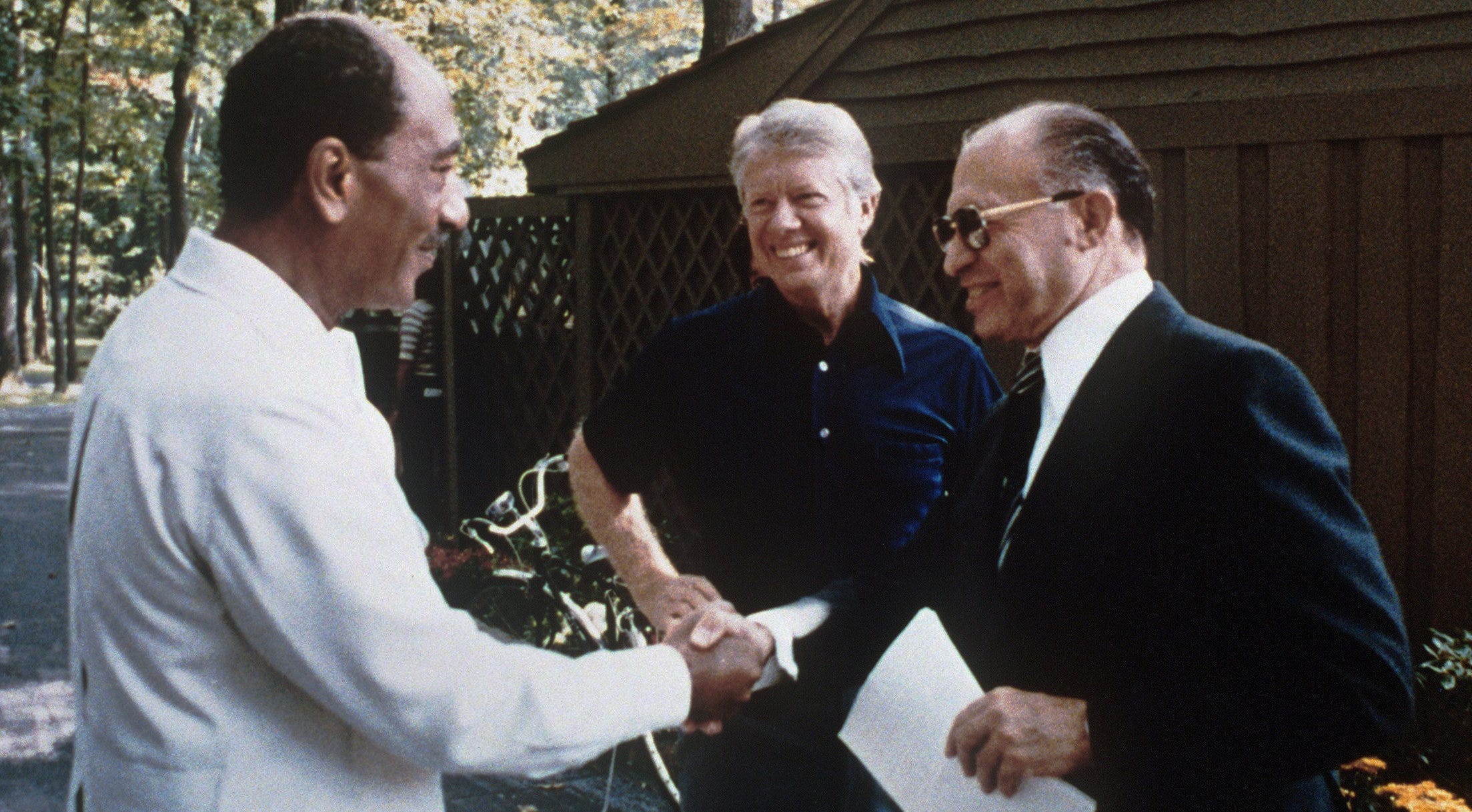
March 26, 1979: The governments of Egypt and Israel conclude a peace treaty with a signing ceremony at the White House. This was the culmination of the negotiating process that had begun about six months earlier at Camp David.
INTERNATIONAL
Arctic sea ice reached its lowest maximum extent ever recorded this winter, according to data from the National Snow and Ice Data Center in Colorado. It topped out on March 15 at 14.29 million square kilometers, just a smidge lower than last year’s then-record 14.31 million square kilometers. It also reached that maximum a week earlier than last year, which could presage a longer and more intense summer melting period with all the damaging environmental/ecological consequences that entails (including the likelihood that next winter’s freeze will be even lower). Scientists have been using satellites to monitor the extent of Arctic ice coverage for 48 years.
MIDDLE EAST
LEBANON
The Israeli military (IDF) is expanding its invasion (even the AP is calling it that now) of southern Lebanon. It announced on Thursday that it’s sending a third army division into the region “with the aim of expanding” its “buffer zone.” Benjamin Netanyahu had said the previous day that the IDF would be making that zone “larger” in the very near future. Israeli operations in Lebanon have now displaced over 1.2 million people and killed over 1100. The Lebanese government is lodging a complaint with the United Nations.
ISRAEL-PALESTINE
A new investigation involving The Nation and +972 Magazine reveals the strategic underpinnings of Israeli settler violence in the West Bank:
Since October 7, settlers have worked in tandem with the Israeli army to expel at least 76 entire Palestinian communities, while settlers have simultaneously established 152 new outposts. Among these outposts, at least 22 have are in Area B, including 12 in the “Agreed-Upon Reserve” (a plot of 167,000 dunams in the southern West Bank that is designated as Area B). One outpost has also appeared inside Area A.
According to mapping by +972 Magazine, Local Call, and The Nation, based on data collected by the Israeli organizations Kerem Navot and Peace Now, the settlers living in these outposts have taken control of around 98,000 dunams (almost 25,000 acres) in Area B and Area A. In total, settlers living in outposts now wield effective control over roughly 1 million dunams (250,000 acres) across the West Bank.
This dynamic has been building for a long time. For decades, settlers expanded herding outposts across Area C—which constitutes 60 percent of the West Bank—using grazing to take over vast tracts of Palestinian agricultural land.
Now, the settlers have shifted their focus toward Area B and the peripheries of larger Palestinian towns. The objective is to encircle them, restrict Palestinians’ access to surrounding farm land and open space, and consolidate territorial contiguity between settlement blocs while pushing Palestinians into fragmented cantons within the major cities.
Israeli Finance Minister Bezalel Smotrich’s vision for the territory, outlined in the “Sovereignty Plan” he released last year, calls for shunting Palestinians into six contained, isolated enclaves within the West Bank. The settlers appear to be following that plan, with the tacit (at least) support of Israeli occupation forces.
IRAN
The Iranian government definitively rejected Donald Trump’s peace/surrender proposal on Thursday, with one official describing it as “one-sided and unfair” to Reuters. Based on what’s been reported about the proposal that reaction is unsurprising, but it’s also worth noting that the Iranians have upped their demands for a settlement in the four weeks since this war began. They’re now reportedly seeking “guarantees against future military action, compensation for losses, and formal control of the Strait” in addition to an end to the Israeli war in Lebanon. Leaving aside the impossibility of “securing a guarantee against future military action,” the recognition of Iranian control over the Strait of Hormuz is surely a nonstarter from the US perspective.
Trump advised the Iranians to “get serious soon” about peace talks in a social media post on Thursday, though one might say the same thing about him given that he’s offering the same tired framework that the Iranians have already rejected. This assumes that he was ever serious about negotiations in the first place. There’s good reason to assume he was not and that this has been a week-long exercise in market manipulation ahead of some big new operation (presumably involving ground troops). Axios reported on Thursday that the Pentagon is working on several ideas for a “final blow” against Iran, involving the seizure/blockading of various Persian Gulf islands (including Kharg, though they’ve talked about that scenario so much that at this point I’m more inclined to see it as misdirection) and/or a naval blockade on Iranian oil tankers. I’m not sure how any of the options would qualify as a “final blow” but what do I know? Anyway, as Robert Pape notes the Pentagon’s maneuvers probably signal more about Trump’s intentions than his rhetoric does, and those maneuvers are pointing pretty squarely in the direction of escalation.
Despite all of the above, or maybe because he’s decided that he needs to string this theater out a bit longer, Trump announced via social media on Thursday afternoon that he’s extending his pause on attacking Iranian energy sites “to Monday, April 6, 2026, at 8 P.M., Eastern Time” while insisting that the supposed negotiations “are going very well.” I guess we can’t entirely discount the possibility that they’re “going very well” behind the scenes but there’s no overt evidence to support Trump’s assertion. That leaves two ways to perceive this extension. Either Trump is legitimately putting off the next phase of escalation for another 10 days for whatever reason makes sense to him, or he’s rather hamfistedly trying to make the Iranians think that he’s delaying things ahead of an imminent operation. I won’t blame anybody for being optimistic but I think it’s more likely the latter.
In other items:
Trump’s claim that this supposed ten day extension was requested by the Iranians (he told Fox News “I gave them a 10-day period. They asked for seven.”) was very quickly contradicted—not by the Iranians, who might have reason to obfuscate, but by the mediators. Make of that what you will.
Trump’s new line is that there are people in the Iranian government who are definitely negotiating with the US but they’re “afraid” to admit it because if they do they’ll be killed by other people in the Iranian government. It somehow doesn’t occur to him that someone in such a precarious position cannot possibly negotiate a peace deal on Tehran’s behalf. Or, again, maybe he just doesn’t care.
Trump acknowledged on Thursday that the “very big present” that he said Iran gave him on Tuesday was the passage of ten oil tankers through the Strait of Hormuz. He’s claimed this as a gesture of interest in peace talks but it’s unclear where those tankers were going and it’s entirely possible that the Iranians allowed them to pass because they’d made specific arrangements to do so.
What specific arrangements, you ask? Well, as it happens the Islamic Revolutionary Guard Corps has reportedly established a sort of “toll booth” for the strait, according to Lloyd’s List Intelligence. It’s requiring ships to transit the strait through Iranian waters rather than through the usual international channel and is then subjecting those vessels to checks—cargo, nationality, destination, etc. Those that pass the checks and/or pay a roughly $2 million fee are allowed to continue through the strait. Iran’s Fars news agency reported on Thursday that the Iranian parliament may soon consider a bill formalizing this toll system.
The IDF killed IRGC naval commander Alireza Tangsiri in an airstrike on Wednesday night. By Israel’s decapitation logic this is supposed to mean that the Iranians will now reopen the strait entirely and stop any naval activity whatsoever. They won’t, but that’s the rationale for these sorts of attacks. Generously, it seems the IDF has decided to forego assassinating Iranian parliament speaker Mohammad Bagher Ghalibaf and Foreign Minister Abbas Araghchi for the moment, so as not to interfere with US diplomacy.
When the IDF attacked Iranian naval assets in the Caspian Sea last week it was apparently trying to interdict weapons shipping from Russia to Iran. It’s unclear how many weapons Iran has been receiving from Russia, whose support for the Iranian war effort seems to be more in the realms of intelligence support and providing tactical guidance on the use of drones. Iran has certainly been sending munitions to Russia for use in Ukraine via the Caspian Sea but it’s unlikely that the Israelis would care about that. To the extent that there have been any weapons shipments in the other direction it’s also unclear how much this strike will actually impact that process.
The New York Times reported on Wednesday that Iranian attacks on US military bases in the Middle East are “forcing many American troops to relocate to hotels and office spaces throughout the region,” effectively instituting “work from home” policies for the Pentagon. In fact it seems that “many of the 13 military bases in the region used by American troops are all but uninhabitable,” particularly those in Kuwait. Some portion of the ~40,000 US military personnel who were in the region when the war started have left altogether and are “working from home” in Europe, while the rest are working in makeshift locations that are embedded in civilian areas—a practice that I’ve been told in other circumstances amounts to using civilians as human shields. The vulnerability of these facilities might lead one to question why the US military has been maintaining them at all, though I’m sure nobody at the Pentagon is going to ask that question once this is over.
ASIA
PAKISTAN
The Pakistani Foreign Ministry announced on Thursday that the country is resuming its war with Afghanistan. Pakistani and Afghan officials agreed last week on a five day Eid ceasefire that ran from midnight Thursday through midnight Tuesday. To my knowledge there hasn’t been any large-scale combat since the ceasefire expired, raising some hopes of a more extended pause in or even an end to the fighting. Thursday’s announcement shatters those hopes.
CHINA
According to Reuters, “China is conducting a vast undersea mapping and monitoring operation across the Pacific, Indian and Arctic oceans” involving “more than five years of movement by 42 research vessels.” That’s a substantial commitment of time and resources. There are plenty of perfectly valid civilian reasons for this sort of research, particularly given concerns about climate and sea levels in those regions, but times being what they are the crux of the Reuters report is that the Chinese navy wants this data because it could be useful in a potential naval/submarine war against the US. That’s certainly true, and indeed the US military does the same sort of thing. But of course what’s routine and permissible for Us to do is often noteworthy or even cheating when They do it.
AFRICA
SUDAN
A drone strike on a market in Sudan’s North Darfur state killed at least 22 people and wounded 17 on Wednesday. The Rapid Support Forces militant group, which controls most of Darfur, accused the Sudanese military of carrying out the attack. Separately, another drone strike killed at least six people and wounded another 12 in Sudan’s North Kordofan state. There’s no indication as to responsibility in that incident as yet.
Elsewhere, the RSF’s capture of the town of Kurmuk in Sudan’s Blue Nile state has reportedly displaced some 73,000 people and counting. The displaced persons have mostly been turning up in the capital of Blue Nile, Ad-Damazin, where they’re finding little in the way of shelter or basic humanitarian assistance.
LIBYA
The Libyan Coast Guard announced on Tuesday that it is now towing the listing Arctic Metagaz natural gas tanker to a “safe zone” near the coastal city of Zuwarah in northwestern Libya. The country’s National Oil Corporation said over the weekend that it had contracted with a firm, which turns out to be the Italian energy company Eni, to tow the Metagaz, a Russian tanker whose crew abandoned ship earlier this month after it was heavily damaged off the Libyan coast. Russian authorities have accused Ukraine of attacking the vessel with sea drones. After initially and mistakenly reporting that the tanker had sunk, Libyan authorities began efforts to recover it to avoid the environmental damage should it break apart and spill its fuel and oil into the water.
EUROPE
EUROPEAN UNION
The European Parliament has finally approved the trade deal that European Commission President Ursula von der Leyen reached with Donald Trump back in July. The EP suspended its consideration of that accord back in January amid Donald Trump’s threat to impose tariffs if European leaders didn’t sign Greenland over to his control, and then stopped deliberating it again late last month after a US Supreme Court ruling invalidated the tariffs that Trump had used as leverage in EU trade negotiations. Its passage on Thursday involved the addition of amendments that, among other things, will enable EU officials to suspend the deal in the event of future coercive or punitive action by the US (e.g., if Trump decides to make another threat over Greenland).
UKRAINE
With the war in Ukraine receding well into the background due to the Iran war, Ukrainian President Volodymyr Zelensky gave a somewhat provocative interview to Reuters on Wednesday in which he claimed that the Trump administration is conditioning any future US security guarantees on Zelensky ceding territory to Russia. As you are undoubtedly aware, the Russian government is demanding that Ukraine give up the remaining territory it controls in Donetsk oblast as a condition of any sort of peace deal. Zelensky has resisted making that concession, but he also cannot exit this war without some fairly robust deals with Western governments, particularly the US, that they will come to Ukraine’s aid should the Russians try to resume the war at a later date. The Trump administration seems increasingly desperate to rid itself of this conflict and has apparently decided that the most expedient way to do that is to adopt Russia’s demand as its own.
While we’re on the subject, The Washington Post reported on Thursday that the US military may “divert weapons intended for Ukraine to the Middle East” to replenish munitions stockpiles that are being depleted by the Iran war. This would especially seem to be true for air defense interceptors, which the US has been selling to European governments who then pass them along to Ukraine under the Prioritized Ukraine Requirements List program. That effort was supposed to make military aid for Ukraine more palatable to Donald Trump by converting it to arms sales from the US to Europe, but the Post report makes it clear that even under that program the administration increasingly views this conflict as a nuisance at best or an outright obstacle to US aims at worst. The Pentagon has already started telling European countries that it’s going to put some of its PURL revenues toward restocking its own inventories rather than toward additional weapons for Ukraine. Needless to say this puts Ukraine in an ever more precarious position.
On the battlefield, meanwhile, the Russian and Ukrainian militaries each claimed to have taken a village on Thursday, the Russians in Kharkiv oblast and the Ukrainians in Dnipropetrovsk. There’s no confirmation in either case.
AMERICAS
CUBA
The New York Times reports on the effect the US fuel blockade is having on the Cuban medical system:
The U.S. oil blockade on Cuba is fast exhausting the country’s supply of fuel, causing daily blackouts, food shortages, canceled classes and black-market gas prices approaching $40 a gallon. It is also crippling Cuba’s universal health care system, a state institution once considered a triumph for a poor nation, but is now struggling to provide basic care.
In interviews, six Cuban doctors said that rapidly deteriorating conditions at hospitals and clinics across Cuba were causing deaths that would otherwise be preventable.
“I can’t tell you how many deaths, but I’m sure there are more than in the same period last year,” said Dr. Alioth Fernandez, chief anesthesiologist at Havana’s largest pediatric hospital. “I see it in shift handovers, in colleagues’ comments and in children I’ve operated on.”
UNITED STATES
Finally, The Intercept’s Nick Turse highlights a three day period earlier this month that really put the extent of would-be Nobel Peace Prize winner Donald Trump’s warmongering on full display:
The United States made war on three continents over three days earlier this month, conducting attacks in Africa, Asia, and South America. During that span, the U.S. also struck a civilian boat in the Pacific Ocean. The globe-spanning scope of the attacks represents one of the few instances since World War II that the United States has been simultaneously involved in armed conflicts with such a wide geographic sweep.
The attacks in Ecuador, Iran, Somalia, and the Eastern Pacific from March 6 through March 8 are part of President Donald Trump’s escalating world war against variously defined “terrorists.” They highlight the administration’s increasing willingness to use the U.S. military as a solution to almost any perceived geopolitical problem.
“All war. All the time. Everywhere,” said Brian Finucane, a former State Department lawyer and specialist in counterterrorism issues and the laws of war, of the wide-ranging attacks over just a few days. “It’s unprecedented given the absence of any fresh congressional authorization.”
This month, Trump has repeatedly referenced his relentless war-making and even lamented it on occasion. “I built the military and rebuilt it in my first term, and we’re using it more than I’d like to use it to be honest with you,” he said.