

You’re reading the web version of Foreign Exchanges. If you’d like to get it delivered straight to your inbox, sign up today:
TODAY IN HISTORY
March 24, 1944: Dozens of prisoners at a German POW camp near the town of Sagan called Stalag Luft III escape in a daring overnight action. In total 76 prisoners escaped, but 73 of them were eventually tracked down and recaptured, and 50 of those were executed on Adolf Hitler’s orders in what was later deemed a war crime. The escape is best known as the inspiration for the 1963 film The Great Escape.
March 24, 1999: NATO begins its bombing campaign in Yugoslavia in an effort to force an end to the 1998-1999 Kosovo War. It took 78 days of sustained bombardment but the Yugoslav government of Slobodan Milošević did ultimately agree to stop fighting and Kosovo became de facto independent. Kosovo declared independence in 2008, but that declaration is still not universally recognized. The campaign was conducted without United Nations authorization and its legality has been disputed.
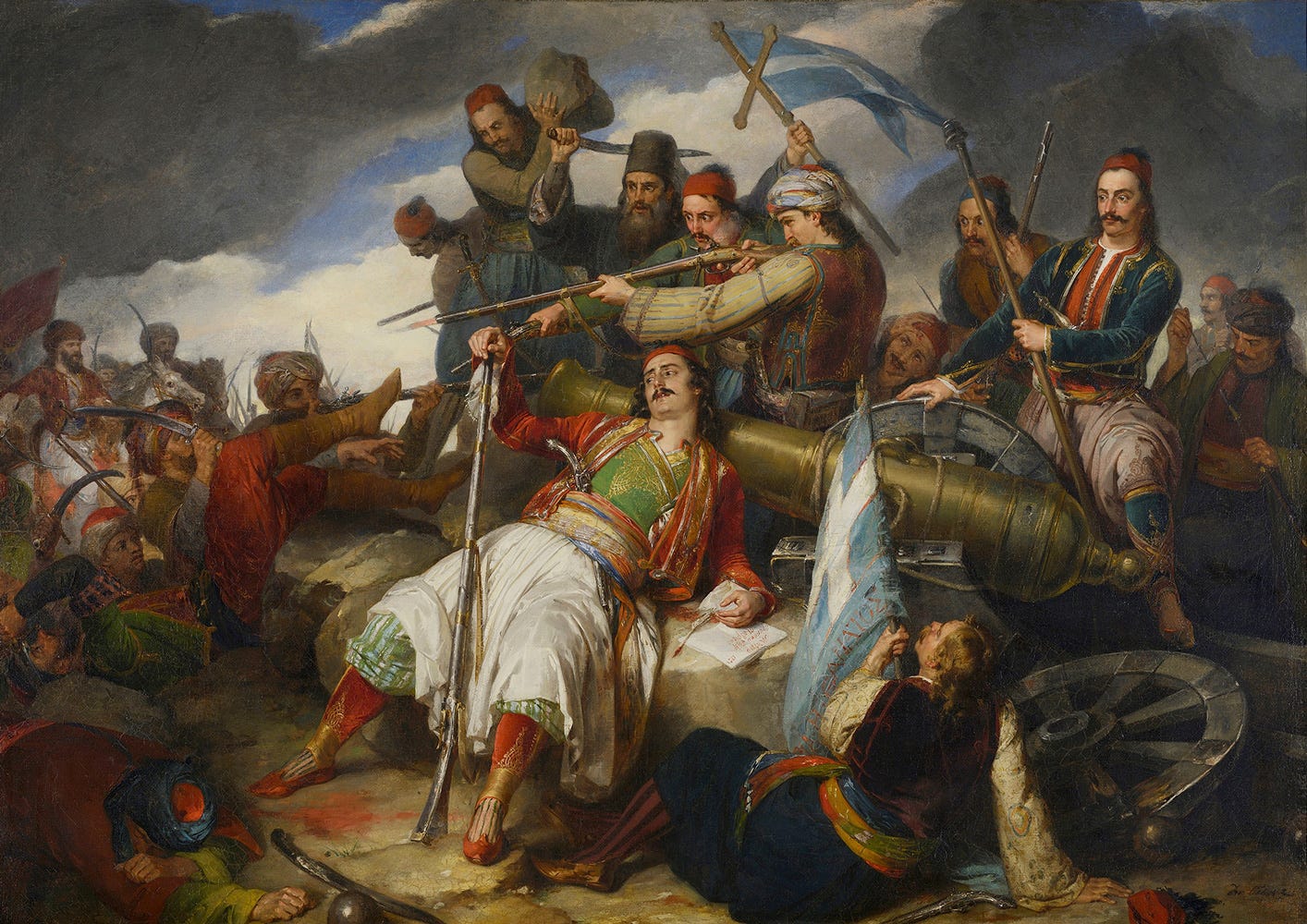
March 25, 1821: Greek insurrectionists officially declare a revolt against the Ottoman Empire, marking the start of the Greek War of Independence even though the fighting had actually begun in mid-February. The war did of course end with Greece seceding from the empire and becoming an independent state, and so this date is commemorated annually as Greek Independence Day.
March 25, 1975: King Faisal bin Abdulaziz of Saudi Arabia is shot and killed by his nephew, Prince Faisal bin Musaid, in the royal palace. Initially Prince Faisal was declared legally insane, but that diagnosis was overturned. It’s possible that the insanity diagnosis was an error or a failed attempt at a coverup and that Prince Faisal acted to avenge the death of his brother, Prince Khalid bin Musaid, who was shot and killed by police during a 1966 protest. On the other hand, it’s also possible that the Saudis revoked Prince Faisal’s insanity diagnosis simply so that they could execute him under Saudi law. King Faisal was succeeded by his brother, Khalid bin Abdulaziz, in what remains the only violent succession in Saudi history.
MIDDLE EAST
LEBANON
Israeli Defense Minister Israel Katz outlined his plans for the occupation of southern Lebanon on Tuesday. He’s anticipating that the Israeli military (IDF) will “control the remaining bridges and the security zone up to the Litani” River, some 30 kilometers north of the de facto Israeli-Lebanese border. This is an operation that is quickly becoming disconnected from the war with Iran in the sense that the Israelis seem intent on continuing it even if/when that conflict ends. One could easily look at Katz’s rhetoric and conclude that the Israelis are planning another years long occupation of the region—one that, as he’s said explicitly, would subject southern Lebanon to the same treatment the IDF has wrought upon Gaza. Apparently it’s already using white phosphorus to literally scorch the earth there.
Elsewhere, the Lebanese government expelled Iran’s ambassador on Tuesday, giving him until the end of the week to leave the country. Lebanese Prime Minister Nawaf Salam has accused Iran’s Islamic Revolutionary Guard Corps of directing Hezbollah’s military efforts against Israel. And a “foreign naval vessel” (presumably US) reportedly intercepted an Iranian missile near Beirut on Tuesday. Its intended target is unknown and it may have been passing through Lebanese airspace en route to Cyprus, but regardless that isn’t going to do much to improve Lebanese-Iranian relations.
ISRAEL-PALESTINE
The IDF bombed a displaced persons tent camp in central Gaza’s Deir el-Balah region on Wednesday, sparking a fire and killing at least one person according to civil defense officials. Another Israeli strike killed at least two people in the Nuseirat refugee camp, while at least four people were wounded in the Mawasi displaced persons zone near Khan Younis.
Al Jazeera reports that electricity and natural gas prices are skyrocketing in Gaza amid continued Israeli restrictions on fuel entering the territory. It cites Palestinian sources claiming that Gaza has received only 14.7 percent of the amount of fuel it should have received under the ostensible ceasefire agreement.
Israeli soldiers or settlers (if it’s possible to distinguish between them) ran down a vehicle in the southern West Bank’s Hebron region on Wednesday, killing at least one person and wounding three more. It’s unclear why they opened fire on the vehicle, which was reportedly carrying laborers.
IRAQ
The Iraqi Foreign Ministry is reportedly planning to summon both the US and Iranian ambassadors in Baghdad to lodge formal complaints over their respective military activity over the past several weeks. That activity includes an apparent Iranian rocket attack that killed six Kurdish Peshmerga fighters in Iraq’s Erbil province on Tuesday and a presumably US airstrike that killed at least seven Iraqi soldiers and wounded 13 more people in a military medical facility located near a militia base in Anbar province.
IRAN
Don’t look now but the prospects for Donald Trump’s proposal to end the Iran war aren’t looking so hot, after a “senior Iranian official” expressed disdain for it to Reuters and a “high-ranking diplomatic source” told Al Jazeera that Iranian officials viewed it as “extremely maximalist and unreasonable.” That could be because it is extremely maximalist and unreasonable, inasmuch as it is basically the same 15 point surrender document that the Trump administration presented to Tehran last year prior to the June “12 Day War.” To say that conditions have changed a bit since then would be a massive understatement, so the fact that the Trump administration’s proposed endgame hasn’t changed suggests either that the administration is staffed by imbeciles or that they’re not really interested in ending the war. Personally I’m going with both.
The US is reportedly pushing to open peace talks in Islamabad on Thursday but there’s no indication that Iranian officials are ready to talk (an Iranian military spokesperson asked whether Trump was “negotiating with [him]self” on Wednesday) and according to Axios they’ve told the would-be mediators that they believe this abrupt diplomatic initiative is a “ruse” to calm global markets and/or buy time for the US military to regroup and maybe prepare for a ground operation. There is no reason for the Iranians to give Trump any benefit of the doubt, given that two previous rounds of diplomacy have ended with Israeli and US bombs being dropped on Iran and the Pentagon is still moving new offensive forces (most recently elements of the US Army’s 82nd Airborne division) to the region. Even the White House’s own rhetoric is cause for skepticism as it hasn’t deviated from the “surrender or else” tone it’s been taking for over a year now.
And as I was putting tonight’s newsletter together the Iranian government outright rejected Trump’s 15 point peace/surrender proposal via state media. This is just developing so it’s unclear if that will end the possibility of negotiations and/or Trump’s five day ultimatum pause, but I would say that the already dim prospects of a resolution are even dimmer now.
In other items:
The war, in contrast to what you may be thinking after watching The Donald Trump Show, is proceeding essentially unabated with the sole exception that Trump’s threat to attack the Iranian power grid has been put off (at least allegedly, as there have been reports of Iranian power sites being struck). The Iranians are continuing to retaliate with drones and missiles, which considering we’re on roughly week three of the “Iran is about to run out of missiles” storyline (while Iran’s rate of fire is actually increasing) seems important to note.
Indeed it seems like the Israelis may be intensifying the pace of their strikes out of fear that this alleged peace initiative might actually end the war. They’re either trying to undermine that possibility or to do as much damage to Iran as they can before the fighting halts. The sense that Israeli officials are taking it seriously is the only reason why I have not dismissed Trump’s alleged peace initiative entirely.
I don’t know how else to put this but Donald Trump may have been hallucinating on Tuesday when he told reporters that Iran “gave us a present and the present arrived today, and it was a very big present, worth a tremendous amount of money.” The alleged present, which Trump wouldn’t explain at the time, turns out to have been allowing a handful of tankers to transit the Strait of Hormuz. As you may recall, that was something that vessels were doing routinely and in far greater numbers prior to the war. The reason Trump wouldn’t go into any detail about the “present” is that it’s the very definition of an empty gesture and he didn’t want anybody to notice.
Trump has taken to claiming that his war has already achieved “regime change” in Iran, which I guess is technically true in that the Israelis have killed several Iranian leaders but their replacements all seem more entrenched and hardline. I assume that’s not exactly what the intent was before the war. He’s also trumpeting what he says is an Iranian agreement to “never have a nuclear weapon.” This is a commitment that Tehran made in 2015, under the nuclear accord that Trump disparaged as the “worst deal ever negotiated” and then scrapped in 2018 in what remains arguably the single most significant US action in leading us all to the current war.
One reason why Trump seems disconnected from the realities of his war could be that, as NBC News is reporting, the briefings he’s getting about the conflict boil down to daily two minute snuff films of some of the airstrikes the US military has carried out. This is because a) he has no attention span, and b) he can’t bear to hear any bad news so his underlings refuse to give him any. This would explain why he thinks the war is going great for the US and the Iranians must be desperate to surrender, when it manifestly is not and they manifestly are not.
Speaking of hardline Iranian replacements, after a couple of premature announcements it now seems that Iranian leaders have settled on former IRGC general Mohammad Bagher Zolghadr as the replacement for deceased Supreme National Security Council Secretary Ali Larijani. The IRGC continues to deepen its control over the Iranian state and that’s likely to make negotiations harder.
The New York Times produced another entry in the “Mohammad bin Salman is encouraging Trump to escalate” series on Tuesday. This is perfectly plausible, though I will note that the sourcing in this piece is “people briefed by American officials on the conversations” between MBS and Trump. We’re not even citing anonymous US officials now, we’re citing anonymous recipients of anonymous briefings by anonymous US officials. Maybe for the next piece we can cite anonymous people who caught a vibe from other anonymous people who heard about the anonymous briefings from still other anonymous parties.
In other Gulf Arab news, Bahrain is pushing a draft United Nations Security Council resolution authorizing military action to reopen Hormuz. It seems likely to fail as currently written, but even if it passed which countries would take up the mission? Would Bahrain itself even do so? It does have a two frigate navy.
Did the Iranians actually try to attack the US military base on Diego Garcia? Adam Johnson notes that there has been nothing approaching any independent confirmation of this incident, which Iranian officials have denied (even the claim that Iran’s Mehr news agency boasted about the attack seems to be sourced to Israeli media). This lack of information of course hasn’t stopped Western media outlets from running a bunch of “IRAN WILL KILL YOU AND EVERYONE YOU’VE EVER LOVED”-type headlines on the basis of some theorized long-range strike capability.
What is going on with the USS Gerald R. Ford? A couple of pieces from the website 19FortyFive have gotten attention in the past few days, in particular one claiming that the aircraft carrier could be out of action for 12 to 14 months following the laundry room fire that forced it to leave the Red Sea and head into port on Crete. That’s not solely due to the fire but rather to an extended backlog of maintenance needs that have built up over the vessel’s nine month-plus deployment. A couple of outlets have reported that the US Navy is investigating whether personnel on the Ford intentionally set the fire to force an end to that deployment, though another 19FortyFive piece notes that those reports also appear to be unsourced.
ASIA
AFGHANISTAN
The Afghan government released US national Dennis Coyle on Tuesday in what it claimed was a gesture to mark the Eid al-Fitr holiday. Authorities arrested Coyle, whose family says he was in Afghanistan to do academic research, back in January 2025 for alleged crimes that they never elucidated. The US State Department designated Afghanistan a “state sponsor of wrongful detention” earlier this month so perhaps Coyle’s release was meant to address that grievance.
MYANMAR
The Myanmar National Democratic Alliance Army rebel group reportedly seized Kutkai township in Myanmar’s Shan state from its ostensible ally, the Ta’ang National Liberation Army, earlier this month. The groups reached a ceasefire on March 19, a couple of days after the Kutkai incident, but questions remain about what caused the fighting. The MNDAA and the TNLA have clashed in the past and in this case the MNDAA is claiming that TNLA fighters attacked one of its units on March 14. But Foreign Policy’s Joseph Rachman highlights speculation that the Chinese government may be manipulating its relationship with the MNDAA to try to fragment Myanmar’s “Three Brothers” (the MNDAA, the TNLA, and the Arakan Army) rebel coalition. Kutkai sits along a highway linking China’s Yunnan province to central Myanmar and Beijing may prefer to have the more pliant MNDAA in control there.
CHINA
The White House said on Wednesday that Donald Trump is now aiming to visit China on May 14-15. Trump had been scheduled to make this trip in late March but postponed it, initially because he was mad that Xi Jinping wouldn’t open the Strait of Hormuz for him but then ostensibly because he just can’t be away from DC in the middle of a war. Perhaps this means that he’s expecting the war to be over (one way or another) by the first part of May.
AFRICA
SUDAN
The Rapid Support Forces and its Sudan People’s Liberation Army-North allies reportedly seized the town of Kurmuk in southeastern Sudan’s Blue Nile state on Tuesday. The militants had been pressuring that area for several weeks as part of their latest offensive near the Ethiopian border. Kurmuk is an administrative hub for much of southern Blue Nile state and its position near the border is strategically significant (especially if the Ethiopian government has been aiding the RSF, as Sudanese officials keep alleging), so this is a substantial loss for the Sudanese military to absorb.
NIGERIA
Unspecified militants ambushed a security patrol in northwestern Nigeria’s Kebbi state on Tuesday evening, killing at least nine soldiers, one police officer, and one civilian. There’s no definitive indication as to responsibility but according to the AP local residents suspect that the attackers were part of the Lakurawa, a shady and possibly Islamic State-aligned jihadist group.
DEMOCRATIC REPUBLIC OF THE CONGO
Reporters Without Borders (the other RSF) is accusing the M23 militant group of using metallic shipping containers as makeshift detention facilities in the eastern Congolese city of Goma. Among the many (upwards of 80) people the group has detained in these units at any given time, RSF says that at least two of them were journalists. Some of the people detained in this fashion apparently died, though the organization didn’t offer any figures as far as I know. M23 is denying the charge.
EUROPE
UKRAINE
From Monday night through Tuesday the Russian military reportedly fired almost 950 drones into Ukraine in one of its most active 24 hour periods since the start of its 2022 invasion. Much of the barrage occurred during the day on Tuesday, which is somewhat unusual in that Russia’s biggest attacks tend to take place overnight. The bombardment killed at least eight people and may have been meant to signal the official start of a Russian “spring offensive.” Russian strikes killed at least two people in Kharkiv on Wednesday, while Ukrainian strikes killed at least one person on Tuesday in Russia’s Kursk oblast.
DENMARK
Danish Prime Minister Mette Frederiksen resigned on Wednesday, one day after an election in which her Social Democrats performed poorly but that still may see her return as PM for another term. Frederiksen will continue in a caretaker capacity until coalition talks either result in a new government or collapse and lead to another snap election.
Frederiksen had called Tuesday’s election in hopes of benefiting from a boost in nationalist sentiment following her defense of Greenland from Donald Trump’s predations, but the outcome was the Social Democrats’ worst result since 1903 and a net loss of 12 seats (to 38 from 50 in 2022). The left of center bloc of parties won a total of 84 seats, short of the 90 needed for a legislative majority. The right of center opposition, however, won a collective 77 seats so it’s also not in a position to form a government. Both blocs will instead be aiming to recruit Foreign Minister Lars Løkke Rasmussen’s Moderate party, which won 14 seats.
AMERICAS
ECUADOR
According to The New York Times, when the US military claimed earlier this month to have, in collaboration with its Ecuadorian counterpart, destroyed a “drug trafficker’s training camp” in northern Ecuador it was just a tad off in its assessment. Instead it “appears to have destroyed a cattle and dairy farm…according to interviews with the farm’s owner, four of its workers, human rights lawyers and residents and leaders in San Martín,” the “farming village” where the US-Ecuadorian airstrike “took place.”
The Pentagon trumpeted this strike as the opening of a new phase in its war against speedboats, taking the ostensible campaign against drug trafficking from sea to land. Instead, according to these accounts the whole episode was staged by the Ecuadorian military, which doused the farm’s buildings in gasoline and set them on fire on March 3 while filming the event, after torturing a few of its workers for good measure. Ecuadorian forces returned a couple of days later to drop explosives on the charred ruins via helicopter, presumably to put the finishing touches on their film. It’s not clear whether the US military was involved in this affair at all, though the Ecuadorians claim that they relied on US intelligence to determine that the farm was actually a drug facility. The workers and owner insist that it was just a farm.
UNITED STATES
Finally, in US news:
Speaking of the war on speedboats, the US military summarily executed another four people in a boat strike in the Caribbean on Wednesday. That’s the 47th such attack since the Pentagon’s killing spree began in early September, leaving at least 163 people dead in the process. In light of the revelation that the US military may not be able to tell the difference between a drug trafficking encampment and a dairy farm (see above), one might think that military planners would be a bit more circumspect when it comes to carrying out supposed drug-related airstrikes. Apparently that’s not the case.
The United Nations General Assembly voted 123-3, with 52 abstentions, on Wednesday to pass a resolution declaring the transatlantic slave trade “the gravest crime against humanity.” The resolution calls for “restorative justice” and while in itself is non-binding it could be used as the basis for legal claims seeking reparations—though that seems like something of a long shot under present circumstances. In case you haven’t already guessed, chief among the three “no” votes was indeed the United States. It was joined by Argentina and Israel.
While we’re on the subject of restorative justice, the United States is apparently on the hook for around $10 trillion in lost GDP worldwide since 1990 due to its excessive carbon emissions. That’s according to a new study published in the journal Nature on Wednesday. It estimates that the US has done around $500 billion in economic damage to India alone over that period, along with around $330 billion to Brazil. The US is by far the single largest carbon emitter in human history, and while China (which came in second in the Nature study at $9 trillion in damage) has surpassed it in total annual emissions, the US still emits more carbon per capita.