

You’re reading the web version of Foreign Exchanges. If you’d like to get it delivered straight to your inbox, sign up today:
PROGRAMMING NOTE: By way of a head’s up well in advance, I will be taking a break from the newsletter next week. I have traditionally taken my daughter’s Spring Break week off and since this is her last one of those before leaving for college I am going to stick to that policy despite the ongoing war (I also just need a break). Regular programming will continue through next Sunday and then resume on Tuesday, April 7.
TODAY IN HISTORY
March 21, 1814: At the Battle of Arcis-sur-Aube, Napoleon is successfully able to disengage his army and retreat in order in the face of a much larger Austrian-Russian-Bavarian opponent. Though a tactical success for the French army, strategically the retreat allowed the Allies to move closer to Paris, and that’s a big part of the reason why this battle was the second-to-last engagement Napoleon fought before the Allies forced him into his first exile.
March 21, 1935: Iranian ruler Reza Shah Pahlavi’s request that the rest of the world call his country “Iran” instead of “Persia” officially takes effect.
March 22, 235: Roman Emperor Severus Alexander is assassinated by mutinying legionnaires at the city of Moguntiacum (the modern German city of Mainz). His replacement was the legionary commander Maximinus Thrax, the first of the so-called “barracks emperors” (soldiers who were proclaimed emperor by legionaries rather than taking office via a political process). His unpopularity led to revolts in 238, the “Year of the Six Emperors,” and that chaos in turn led into the Crisis of the Third Century, during which the empire broke apart into three constituent pieces. The Crisis finally ended after Aurelian (r. 270-275) defeated the breakaway Palmyrene and Gallic Empires and Diocletian fully restored imperial unity in 285.
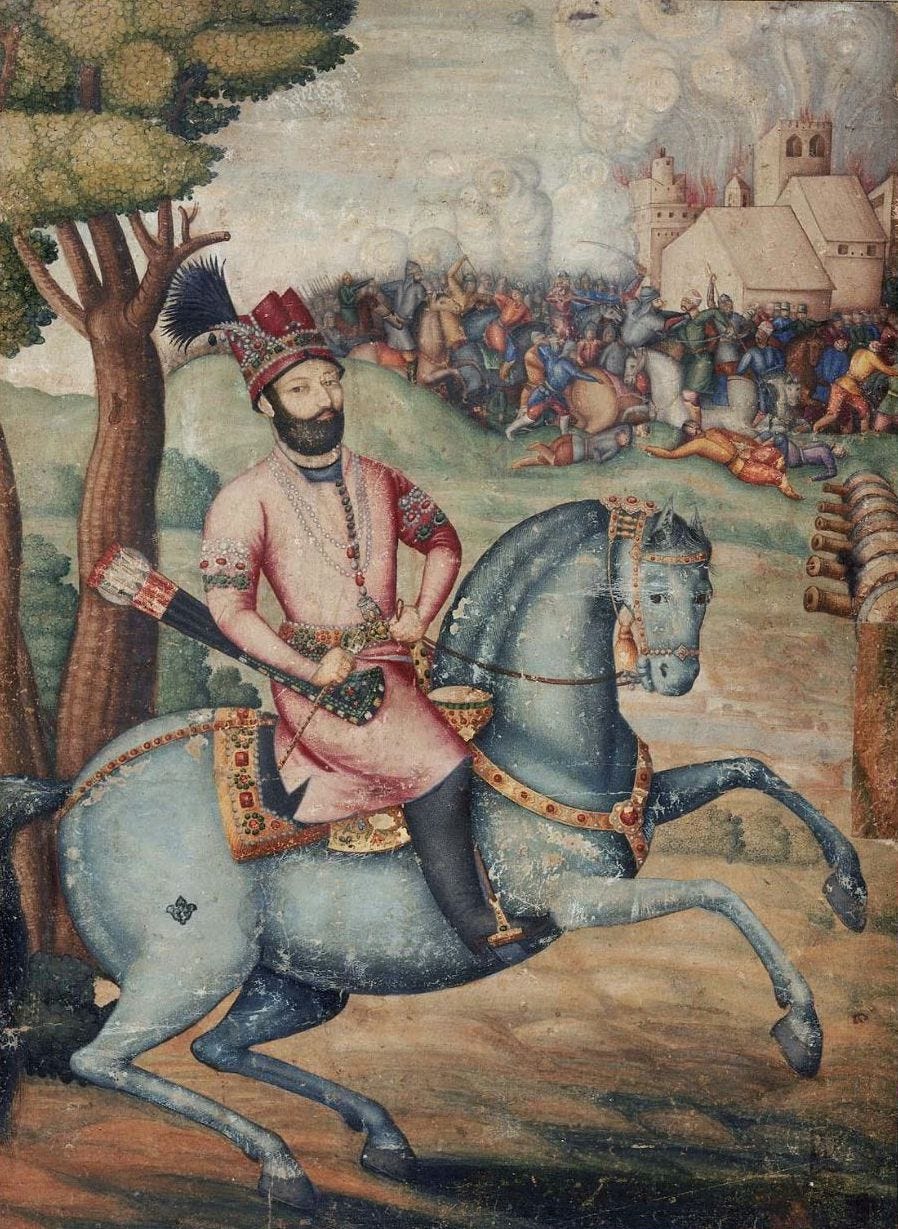
March 22, 1739: Amid rising tension between Delhi merchants and Nader Shah’s occupying Iranian army, rumors spread that Nader Shah himself had been killed in some sort of violent encounter. Perhaps sensing an opening, a mob of Delhi residents attacked the Iranians, killing hundreds of them. As it turned out Nader Shah was very much alive, and in response to the violence he unleashed his very angry army on the city. The ensuing sack was among the most violent in history, with perhaps as many as 30,000 people killed in a matter of hours.
MIDDLE EAST
LEBANON
The Israeli military (IDF) is advancing its invasion of southern Lebanon, bombing another major bridge across the Litani River (this onenear the town of Qasimiyeh) twice on Sunday while ordering its forces to demolish homes near the Israeli border. Presumably the IDF will destroy all bridges over the Litani in order to prevent Hezbollah from moving manpower and assets into southern Lebanon, even though that also means keeping civilians from getting out of the combat zone. This will effectively cleave southern Lebanon off from the rest of the country and allow the IDF to turn the whole place into a “buffer zone,” a fact that Lebanese President Joseph Aoun pointed out on Sunday. He is, of course, planning on doing nothing about that.
ISRAEL-PALESTINE
IDF airstrikes killed at least four people in Gaza on Sunday, including three members of the territory’s police force. The Israelis continue to make a point of killing Gazan police officers, who are linked to Hamas and could be incorporated into the “Board of Peace’s” Gazan police force if there are any still alive when that body manifests.
In the West Bank, Israeli settler mobs rampaged through several Palestinian villages near the city of Nablus on Sunday, after one settler was killed in a car collision the previous day. The settlers appear to have concluded that the collision was intentional. Their assaults left at least ten Palestinians wounded.
Also on Sunday, an apparent Hezbollah rocket attack (the group reportedly claimed responsibility for it) killed one person in northern Israel’s Misgav Am community. Hezbollah claimed that it had targeted a group of IDF soldiers and it’s unclear whether this person was military or civilian.
IRAQ
A drone strike that apparently targeted Iraq’s National Intelligence Service headquarters in Baghdad on Saturday killed at least one intelligence officer. The Kataʾib Hezbollah militia is believed to have been responsible.
IRAN
Donald Trump took everybody on another little roller coaster ride over the weekend. When we left off on Friday he’d taken to social media to say that he was thinking about “winding down” the war. This may have been another attempt at market manipulation, although if Trump were really interested in manipulating the markets then spouting off on Friday evening was probably not the most effective approach. There’s also the incongruity of talking about “winding down” the war while also deploying additional military forces to the region and telegraphing a potential ground operation on Kharg Island (or elsewhere, if all the Kharg talk is a red herring). But then, on cue, came Barak Ravid and the friendly conduits at Axios to report on Saturday that not only was Trump pondering a “wind down,” his administration is “game planning for potential Iran peace talks.”
All of this “peace” stuff went out the window on Saturday evening (in the US), when Trump once again took to social media to decree that the Iranian government had 48 hours to “FULLY OPEN, WITHOUT THREAT, the Strait of Hormuz” or else “the United States of America will hit and obliterate their various POWER PLANTS, STARTING WITH THE BIGGEST ONE FIRST!” This is telegraphing a war crime, although I feel almost silly pointing that out under these circumstances. It’s unclear why Trump’s position shifted in roughly 24 hours from “Hormuz isn’t my problem” to this. Maybe Iran’s heavy bombardment of southern Israel or its alleged attack on Diego Garcia had something to do with it (more on those below) or maybe his dying brain just experienced another abrupt mood swing. Was he even serious about the “winding down” stuff or the “game planning” thing that his people fed to Axios? One thing is certain—if he was trying to manipulate oil and stock markets on Friday, he blew any chance of doing that with Saturday’s ultimatum.
The Iranian government is unsurprisingly not showing any indication that it will do as Trump is demanding. Instead it’s threatening its own escalation if the US starts attacking Iranian power plants, including strikes on power and water infrastructure in the Gulf Arab states and the “complete” closure of the strait. I don’t know what that means but the Iranians have left the waterway open for their own oil shipments as well as certain negotiated transits so they do have some room to tighten things up. They could attempt to fully mine it, for example. I guess we’ll find out on Monday.
In other items:
Iranian officials informed the International Atomic Energy Agency and state media on Saturday that a US/Israeli airstrike had hit the country’s uranium enrichment facility at Natanz. There’s no indication of radiation leakage and much of that site was heavily damaged in last year’s “12 Day War” so it’s not clear what’s left to strike in terms of critical systems. This is at least the second time that Natanz has been targeted since the war began. Of potentially more interest was Iran’s response, which involved missile strikes in the vicinity of Israel’s Shimon Peres Negev Nuclear Research Center, which includes a working reactor. That bombardment wounded at least 180 people in two nearby towns, Dimona and Arad. The “research” in the facility’s name is a euphemism, since it is a critical part of Israel’s undeclared nuclear weapons program.
The Iranians also allegedly fired two projectiles at the US military base on Diego Garcia overnight Thursday into Friday. Neither made it to the target—one reportedly failed mid-flight and the other was reportedly intercepted. An Iranian official denied responsibility for this attempted attack to Al Jazeera but from what I can piece together that was after Iran’s semi-official Mehr news agency seemingly boasted about it. The incident raises questions about Iran’s missile capabilities, since hitting Diego Garcia from Iran (a distance of around 4000 kilometers) would require intermediate-range ballistic missiles while Iran’s missile program has been in theory capped at medium-range or around 2000 kilometers. In fairness, the Iranians could have put light/empty warheads on a couple of those medium-range missiles to extend their range, or (more likely) they could have adapted a couple of their satellite launch vehicles (AKA space rockets) for the purpose. But if we assume that they did fire these missiles I don’t think it justifies the overheated response, asserting that Iran must have the capability of hitting any target within a 4000 km radius (bear in mind that they didn’t actually hit Diego Garcia, for starters) and this justifies the war. We’re three weeks into the second US-Israeli war on Iran in under a year, so it’s a bit late to be landing on a justification now.
Late Friday the Trump administration announced that it is lifting US sanctions on the sale of Iranian oil that is currently at sea. The possibility of something like this was reported a few days ago. The move frees up some 140 million barrels of Iranian oil for sale, which probably isn’t enough to significantly move oil markets but could bring Iran a cool $14 billion in revenue at market prices. It seems a little odd for the administration to reward Iran in the middle of a war like this, but given how strategically it’s approached this entire conflict I’m sure this move is all part of the master plan.
The AP reported on Saturday that Iranian strikes on Qatar’s natural gas industry could have repercussions for the global helium industry. Qatar produces around 30 percent of the world’s supply of helium as a byproduct of natural gas processing, but it shut down much of that processing days after the war started, and damage from Iran’s recent attack on Qatar’s Ras Laffan facility could take years to fully overcome. Helium is important in semiconductor manufacturing so this is not a minor problem.
ASIA
AFGHANISTAN
The Afghan government is claiming that a Pakistani mortar attack killed at least one person and wounded another in Afghanistan’s Kunar province on Sunday. This is particularly notable in that Afghanistan and Pakistan are supposed to be in the midst of a five day Eid ceasefire that won’t technically end until midnight Tuesday. There’s no confirmation of the Kunar strike and I haven’t seen any comment from the Pakistani government.
VIETNAM
Vietnamese authorities released the results of the country’s March 15 parliamentary election on Sunday, with the Vietnamese Communist Party winning 482 of the 500 seats in the country’s National Assembly. That’s a net loss of three seats from 2021 but it seems unlikely to impact the party’s ability to make policy.
AFRICA
SUDAN
A drone strike killed at least 64 people in the capital of Sudan’s East Darfur state, Ed Daein, on Friday night according to the World Health Organization. The strike hit a hospital in the city, leaving it “nonfunctional,” and left at least 89 people wounded. Given that Ed Daein is controlled by Rapid Support Forces militants it’s no surprise that the Emergency Lawyers activist group has pinned responsibility for this attack on the Sudanese military.
LIBYA
The Libyan National Oil Corporation announced on Saturday that it has hired a firm to tow the drifting Arctic Metagaz liquefied natural gas tanker to port. The Russian Metagaz was heavily damaged in an alleged Ukrainian sea drone attack in the Mediterranean earlier this month and Libyan authorities claimed at the time that it had “completely” sunk. Apparently that was premature and there is still a possibility that it can be salvaged. Governments of several southern European countries have been warning that the tanker poses the risk of a “major ecological disaster,” due in part to its cargo—though if its cargo hold has been damaged some of the LNG may already have vaporized and dispersed—but also due to the diesel and oil that it’s carrying for its own fuel needs.
NIGERIA
Reuters reports on another expansion of the US military’s new Nigeria operation:
The U.S. military has multiple MQ-9 drones operating in Nigeria alongside 200 troops to provide training and intelligence support to the military, which is fighting Islamist militants across the north, U.S. and Nigerian officials told Reuters.
The troops are not integrated within Nigerian units on the frontline and the drones are collecting intelligence and not carrying out airstrikes, officials from the two countries said.
However, the U.S. deployment, which follows U.S. airstrikes targeting militants in northwest Nigeria in late 2025, shows the U.S. getting back involved in tackling Islamic State and al Qaeda-linked insurgencies that are spreading across West Africa.
Really, what could go wrong?
EUROPE
UKRAINE
A Ukrainian delegation wrapped up two days of peace talks in Florida with US negotiators on Sunday. Yes, the peace process is going so well that they’re back to negotiating without one of the two combatants. As such there was obviously little they could do in terms of meaningful progress, though they did agree that another prisoner swap would be nice. It’s unclear when another round of actual peace talks might take place now that the Trump administration has focused its attention on Iran.
In Ukraine, the Russian military is reportedly intensifying its operations in what looks like an emerging “spring offensive.” Its main focus continues to be on the remaining territory in Donetsk oblast that is held by the Ukrainian government. Elsewhere, a Russian drone strike killed at least two people in the city of Zaporizhzhia on Saturday, while Ukrainian artillery killed at least four people in Russia’s Belgorod oblast.
SLOVENIA
Slovenian voters headed to the polls for a parliamentary election on Sunday and the result was an effective tie between the ruling Freedom Movement (GS) party, which according to preliminary results took 29 seats, and the conservative Slovenian Democratic Party (SDS), which took 28 seats. The Slovenian National Assembly contains 90 seats so neither party is particularly close to a majority. With their expected coalition partners, the GS is projected to control 40 seats and the SDS 43, so the final outcome will depend on which bloc can appeal to the remaining smaller parties. Any result could prove to be ephemeral since neither grouping has a clear mandate from voters.
AMERICAS
CUBA
The Cuban power grid failed again on Saturday, plunging the island into its second full blackout in less than a week. The Cuban Electric Union is trying to restore power to critical facilities but I haven’t seen any updates yet in terms of its progress in restoring power generally. In somewhat more positive news, the “Our America Convoy to Cuba” aid operation arrived on the island over the weekend, bringing humanitarian relief with it. The convoy included participants from the US as well as several European and Latin American countries including Mexico, whose government has been Cuba’s largest aid supplier since the start of the US fuel blockade.
Having traveled with the convoy, Drop Site’s Ryan Grim and José Luis Granados Ceja are reporting on a significant concession that Cuban officials are offering to the US:
The Cuban government is prepared to offer compensation to Americans and American firms that saw property nationalized after the 1959 revolution, Deputy Foreign Minister Carlos Fernandez de Cossio told Drop Site News in an interview.
The “lump sum” agreement—meaning that Cuba would pay the U.S., which would then handle the claims—would need to be a part of a broader “holistic” deal that would address U.S. sanctions and the blockade and also allow for an amount of American investment in Cuba that previously had been forbidden, he said.
Cuban President Miguel Díaz-Canel revealed last week that his government was in direct talks with the United States. After the New York Times reported that the U.S. officials are pushing for the ouster of Díaz-Canel, Cuba rejected outright the possibility that the Cuban president’s role or the Communist-run political system is up for negotiation.
The Cuban government made this offer to the US after the revolution, when it reached similar agreements with several other countries, but Washington turned it down at the time. While it may appeal to Cuban expats in the US, it’s unclear whether it will be enough to satisfy Donald Trump now that he’s decided that he can “do anything [he] want[s] with” Cuba. That said, the Cubans are also reportedly offering to allow expats “to invest and own private businesses on the island” and they’ve reiterated that they’re open to investment by US entities though that is actually blocked by US, not Cuban, law. Taken in the aggregate these measures would represent a substantial reordering of Cuba’s relationship to the United States and could allow Trump to declare victory on this front. I still don’t know if that will be enough for him.
UNITED STATES
Finally, HuffPost’s Akbar Shahid Ahmed reports that morale among at least some of the US military personnel involved in Donald Trump’s Iran war is not great:
As the U.S.-Israel war on Iran enters its fourth week and President Donald Trump orders the deployment of thousands of additional sailors and Marines to the Middle East, the troops he is counting on appear increasingly wary of the conflict.
Interviews with active duty soldiers, reservists, and advocacy groups focused on service members found some U.S. troops who are caught up in the war are reporting vulnerability, overwhelming stress, frustration and disillusionment to the degree they may leave the military. The reservists and active duty soldiers spoke on condition of anonymity for fear of retaliation or because they were not authorized to speak to the press.
A military official who is treating service members evacuated from the Middle East to Landstuhl Regional Medical Center in Germany amid Iran’s retaliation said troops are suffering from “inadequate force protection and planning” and already reporting a severe, destabilizing toll from Iranian ballistic missiles and drones that have been repeatedly striking American military facilities. Thirteen troops have been killed amid the war so far, seven due to strikes, and at least 232 have been wounded.
A ground operation would be “an absolute disaster… we don’t have a plan for that,” the official said earlier this week. “We can’t even fully defend a single land base in the theater.”
A veteran and reservist who mentors younger officers told HuffPost her contacts are expressing a loss of faith to a new degree.
“I’m hearing out of service members’ mouths the words, ‘We do not want to die for Israel — we don’t want to be political pawns,’” she said. Another reservist in touch with current troops separately reported hearing similar comments.