

You’re reading the web version of Foreign Exchanges. If you’d like to get it delivered straight to your inbox, sign up today:
PROGRAMMING NOTE: Due to a family commitment there will be no newsletter tomorrow/Monday, March 16. Barring a technical malfunction, and this area is supposed to get some pretty severe storms tomorrow so that could include any extended power outage, we will double up on Tuesday. Thanks for reading!
TODAY IN HISTORY
March 14, 1369: King Peter of Castile (and León) is defeated by forces supporting his half-brother (and rival claimant to the throne) Henry of Trastámara in a battle at the city of Montiel, bringing an end to the 1351-1369 Castilian Civil War. Peter had been indirectly supported by England throughout much of that conflict, with Edward the Black Prince commanding his forces very ably. But he managed to alienate Edward in 1367 and his fortunes took a drastic downward turn. After this battle he fled into the nearby Montiel castle, but Henry drew him out and murdered him on March 23. Henry became King Henry II of Castile and León.
March 14, 1978: The Israeli Defense Forces invade southern Lebanon as far north as the Litani River in the cleverly named “Operation Litani.” The invasion was an outgrowth of both the 1975-1990 Lebanese Civil War and the longstanding conflict between Israel and the Palestine Liberation Organization. The aim was to drive the PLO out of southern Lebanon and strengthen the South Lebanon Army, a Christian militia that was supported by the Israelis. In about a week of fighting Israeli forces killed somewhere between 1100 and 2000 people and displaced tens of thousands more. They withdrew in late March, ostensibly in favor of UN peacekeepers though in reality in favor of the SLA. That militia continued to clash with the PLO, leading to a second and much more impactful Israeli invasion in 1982.
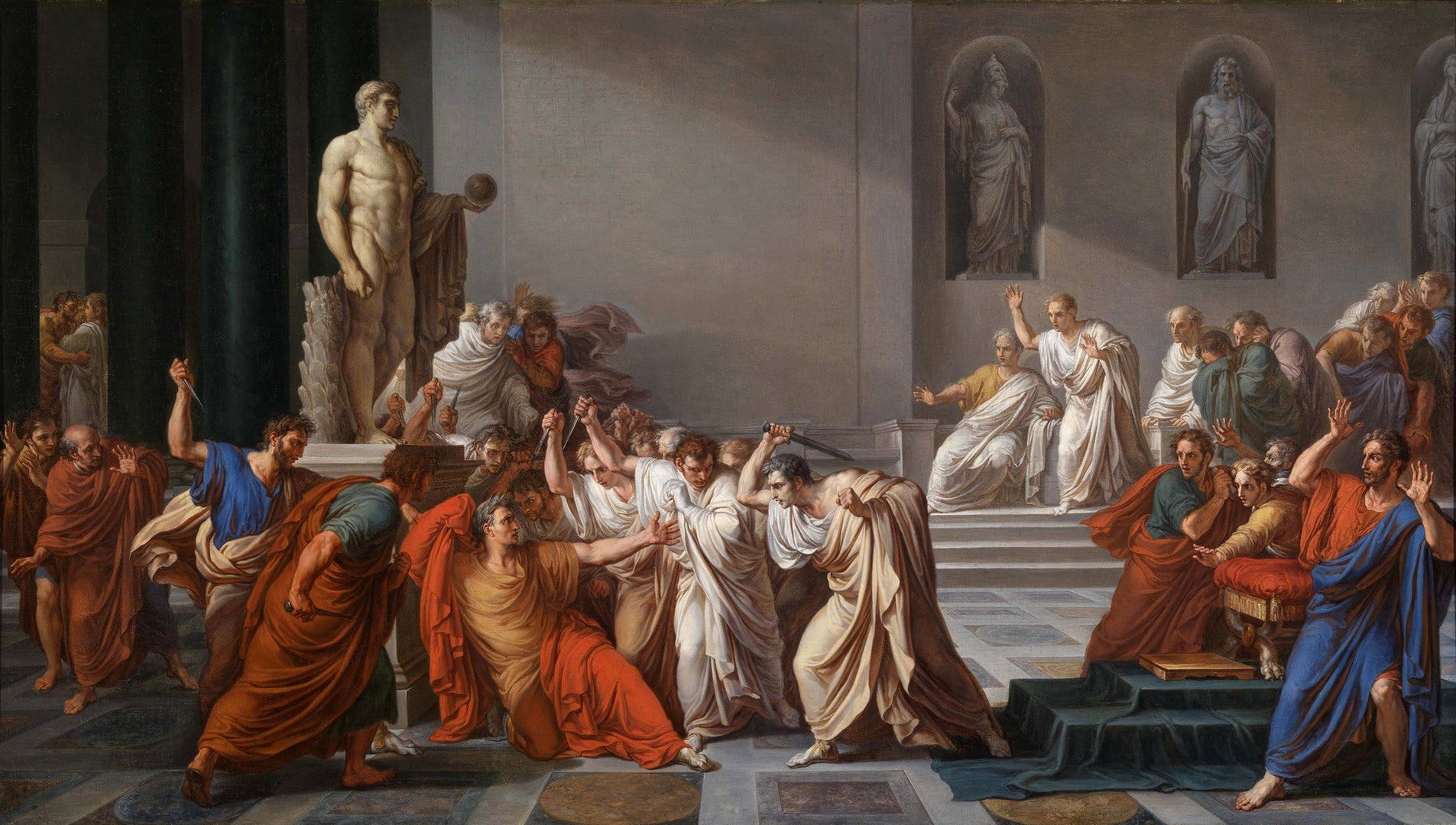
March 15, 44 BCE: A group of Roman senators calling themselves “the Liberators” assassinates Julius Caesar due to fears that he had designs on ending the Roman Republic and making himself a monarch. Their actions ironically hastened the end of the Republic, sparking first the Liberators’ Civil War and then the civil war between Triumvirs Mark Antony and Octavian, which left Octavian victorious and in so dominant a position that he was able to make himself emperor.
March 15, 2011: Protests against the government of Bashar al-Assad that had begun in the city of Daraa earlier in the month spread to Damascus, the Syrian capital. This is usually the date marked as the start of the Syrian civil war. That conflict finally ended in December 2024 when rebel forces entered Damascus and deposed Assad.
MIDDLE EAST
LEBANON
The Israeli military (IDF) killed at least four people in Lebanon overnight and has now killed at least 850 people (wounding over 2100) in that country over the two weeks since its war with Hezbollah resumed. The main question now hanging over this front seems to be which will come first: an IDF occupation of southern Lebanon or peace talks. Invasion seemed to be well in the lead on Friday, but Haaretz reported on Saturday that “Israeli and Lebanese representatives are expected to meet for a round of talks in the coming days, according to two sources familiar with the matter.” Diplomat extraordinaire Jared Kushner would participate as well, with the talks being organized around a French government proposal that would, among other details, see the Lebanese government extend diplomatic recognition to Israel.
It’s unclear how Hezbollah would fit into that picture and maybe that’s why Israeli Foreign Minister Gideon Sa’ar denied that there were any talks in the offing on Sunday. But then Reuters cited “two Israeli officials” in reporting that “Israel and Lebanon are expected to hold talks in the coming days aimed at securing a durable ceasefire that would see Hezbollah disarmed.” Benjamin Netanyahu’s close adviser Ron Dermer is reportedly leading the process on the Israeli side.
ISRAEL-PALESTINE
The IDF killed at least 13 people in multiple attacks across Gaza on Sunday, including two children and a pregnant woman. The previous day Israeli attacks killed at least five people in Gaza. The IDF seems to be targeting police officers in the territory, having killed at least 11 of them over the weekend, perhaps in an effort to prevent security forces connected to Hamas from becoming part of the police force that’s supposed to be established under the ceasefire. In the West Bank, Israeli forces gunned down a family (two parents and two children), then claimed that the parents attempted to ram a group of soldiers with their car. A settler mob attacked two Palestinian villages on Saturday and that violence is continuing on basically a daily basis at this point.
Benjamin Netanyahu is alive, a statement that may only mean anything to those of you who have been extremely online over the past few days. Netanyahu has been keeping a low public profile of late, sparking rumors (and one outright claim from Tehran) that he’d been killed or wounded in an Iranian attack. The Islamic Revolutionary Guard Corps is promising to get him eventually.
IRAQ
An airstrike on a Popular Mobilization militia facility in Baghdad killed at least three people on Saturday. It’s unclear whether this was a US or Israeli attack. Also on Saturday, a missile strike hit the US embassy in Baghdad and apparently damaged the facility’s air defense system. The embassy subsequently issued an alert for US citizens to leave Iraq.
IRAN
Donald Trump told NBC News on Saturday that he’s not interested in negotiating with the Iranian government “because the terms aren’t good enough yet.” It’s unclear what “terms” he’s looking for, especially given that as recently as nine days ago he was demanding “UNCONDITIONAL SURRENDER,” nor is it clear how he would know what “terms” the Iranians are offering, if any. Apparently “Iran wants to make a deal,” though, he seemed very sure of that. Reuters had reported earlier in the day that Trump was rejecting “efforts by Middle Eastern allies to start diplomatic negotiations” to end the war, but that piece also noted that Iranian officials don’t seem terribly interested in a ceasefire at this point either.
On a possibly more uplifting note it sounds like Trump has brainstormed a solution to the Iranian closure of the Strait of Hormuz, which is to beg other countries to reopen it for him. I’m not sure about the efficacy of that proposal but I guess we’ll see. In a pair of social media messages over the weekend Trump said that “many Countries, especially those who are affected by Iran's attempted closure of the Hormuz Strait, will be sending War Ships, in conjunction with the United States of America, to keep the Strait open and safe” and that “hopefully China, France, Japan, South Korea, the UK, and others, that are affected by this artificial constraint, will send Ships to the area so that the Hormuz Strait will no longer be a threat by a Nation that has been totally decapitated.” Actually that was all in just one message, making the disparity between “will be sending” and “hopefully will send” particularly stark. Later Trump implored that “the Countries of the World that receive Oil through the Hormuz Strait must take care of that passage, and we will help -- A LOT!” So far I am unaware of any country taking Trump up on his request. I must say, this is all starting to seem a little peculiar for a war that, according to Trump, the US has already won.
The Wall Street Journal reported on Sunday that “the Trump administration as soon as this week plans to announce that multiple countries have agreed to form a coalition that will escort ships through the Strait of Hormuz.” Then comes the inevitable kicker: “they are still discussing, however, whether those operations would begin before or after hostilities end.” Really extraordinary stuff.
In other items:
Did I say the Iranian “closure” of the strait? Sorry, that was in error. Iranian Foreign Minister Abbas Araghchi told MS NOW on Saturday that the strait is actually “only closed to the tankers and ships belong[ing] to our enemies, to those who are attacking us and their allies. Others are free to pass.” If ships are unwilling to attempt to transit the strait, perhaps because they’re not sure if they are covered under that description, that’s apparently their problem.
The US bombing of Kharg Island does not appear to have impacted Iranian oil exports, which is consistent with Trump’s claim that he’d ordered the Pentagon to spare the island’s infrastructure. It did, however, prompt the Iranians to launch an intensive retaliatory operation targeting the UAE, claiming that the US attack had originated there. Notably they struck oil terminals in the emirate of Fujairah, forcing a partial suspension of activity there. Fujairah is located outside the Strait of Hormuz and its oil port was built in part to avoid that bottleneck. It’s no mystery why the Iranians would have attacked it under these circumstances. Trump, by the way, said in that NBC interview that he might order additional attacks on Kharg “just for fun.” Personally I can think of a) better ways to have fun and b) smarter ways to fight a war, but I digress.
Semafor is reporting that the IDF informed the US military several days ago that it is running out of ballistic missile interceptors, presumably for its “Arrow” long-range air defense system. Israeli officials are denying this report but if it’s accurate that’s going to put greater stress on US air defenses, whose capabilities are not unlimited.
Araghchi gave an interview to The New Arab on Sunday in which he insisted, despite outward appearances, that Iranian forces have only attacked US military-related targets in the Gulf Arab states. He offered to undertake a joint investigation with the governments of those states to determine the precise nature of the sites the Iranians have struck, which could be interpreted as a concession or as an attempt to determine the degree to which those countries have been penetrated by, and are operating on behalf of, the US military.
Hamas issued a statement over the weekend decrying the US/Israeli war on Iran while also calling on Tehran to halt its attacks on the Gulf states. I wouldn’t read too much into this. Hamas depends on Gulf support (at least from Qatar) so it’s not exactly in a position to alienate those governments. It was trying to walk a political tightrope with this statement.
The Trump administration is considering a suspension of the Jones Act, a 1920 law requiring that goods being moved between US ports must sail on US-flagged vessels. It was intended to protect US shipping (and shipping jobs) from foreign competition. Suspending it is supposed to bring down gasoline prices domestically, though the evidence for that claim seems pretty thin and the administration may really be using this situation to strike a blow against organized labor.
Federal Communications Commission chair Brendan Carr is threatening to pull broadcasting licenses from those media outlets whose reporting on the Iran war causes Trump any dismay. This is probably an empty threat but even the fact that he felt comfortable making it says some pretty unflattering things about the state of US politics in 2026.
The Wall Street Journal reported late Friday that Joint Chiefs of Staff Chair Dan Caine told Trump before the war that Iran was likely to close the Strait of Hormuz, and Trump dismissed his warning. Trump apparently insisted “that Tehran would likely capitulate before closing the strait—and even if Iran tried, the U.S. military could handle it.” He’s a solid 0-for-2 there. At this point whatever anybody said or tried to explain to Trump before the war is irrelevant, but I do think it’s morbidly funny to see members of the administration already doing their “this isn’t my fault” media blitzes. We’re on day 16.
ASIA
KAZAKHSTAN
Kazakh voters headed to the polls on Sunday for a referendum on adopting a new constitution. As we’ve covered previously, among the changes that Kazakh President Kassym-Jomart Tokayev is pushing are the elimination of the Kazakh Senate and the reestablishment of a vice presidency. The senate would be semi-replaced by a new body called the “People’s Council” that would have some legislative functions but whose membership would be appointed by the president. Tokayev could use the adoption of a new constitution as an excuse to reset his presidential term and extend his time in office, though he’s insisted that he does not intend to serve beyond the end of his current seven year term. At the very least, the restoration of the vice presidency would allow him to designate an heir apparent.
AFGHANISTAN
The Pakistani military carried out multiple airstrikes in Afghanistan over the weekend, focusing particularly on parts of Kandahar province where, allegedly, the Pakistani Taliban has been operating and/or storing equipment. There’s no word on any casualties as far as I can tell. These strikes came after an attempted Afghan drone strike late Friday that Pakistani President Asif Ali Zardari claimed had “crossed a red line by attempting to target our civilians.” Pakistani air defenses intercepted the drones but their wreckage did apparently cause a few injuries.
AFRICA
NIGERIA
Unspecified gunmen ambushed a security convoy in central Nigeria’s Plateau state on Friday, killing some 20 people according to a local development group (government officials haven’t offered a casualty figure). Plateau frequently experiences violence between militias drawn from rival farming and herding communities and presumably one of those groups was involved here.
REPUBLIC OF THE CONGO
Voters in the Republic of the Congo headed to the polls on Sunday for a presidential election. Incumbent Denis Sassou Nguesso has been in office since 1979, save for a 1992-1997 interregnum, and he’s running against a collection of political nobodies so needless to say he’s expected to emerge victorious once again.
MOZAMBIQUE
The Rwandan government threatened on Saturday to pull its military forces out of northern Mozambique’s Cabo Delgado province unless the international community provides more funding for the counterinsurgency campaign there. The Mozambican government invited Rwandan forces into that region in 2021 at the height of the jihadist uprising there. The counterinsurgency has experienced some success though jihadist violence has been on the uptick in recent months, but the European Union program that’s funding it will cease in May and there doesn’t seem to be any impetus from Brussels to extend it beyond that.
EUROPE
NATO
Amid his pleading for somebody to open the Strait of Hormuz, Donald Trump singled NATO out on Sunday. In an interview with The Financial Times, he theorized that “if there’s no response or if it’s a negative response I think it will be very bad for the future of Nato.” He went on to argue that European NATO members owe the US a favor here because “we didn’t have to help them with Ukraine.” Trump also mentioned China, and even subtly threatened to postpone his visit to Beijing next month if the Chinese government doesn’t help him out, though he obviously has much less leverage with respect to China than he does with respect to NATO. It’s hard to imagine European NATO members jumping into this catastrophe, but they’ve been charting new horizons in obsequiousness ever since Trump returned to office so honestly who knows what they could do at this point?
UKRAINE
Russian strikes killed at least six people across Ukraine on Saturday, including five in Kyiv. The Russians once again focused much of their attention on energy infrastructure around the Ukrainian capital as well as in several other parts of the country. Also on Saturday the European Union announced that it is extending its sanctions designations for some 2600 individuals and entities through at least September 15. The governments of Hungary and Slovakia had been holding up that extension due to their grievances with Ukraine over the closure of the Druzhba oil pipeline. It’s unclear why they dropped their objections but the EU has apparently been pressuring Kyiv to repair and reopen the pipeline. I know that because Volodymyr Zelensky started complaining about said pressure on Sunday.
AMERICAS
VENEZUELA
The Trump administration reopened the US embassy in Venezuela on Saturday, according to a social media post by chargé d’affaires (perhaps soon to be ambassador) Laura Dogu. That’s seven years to the date after the first Trump administration closed the facility. The US and Venezuela restored diplomatic relations earlier this month so the embassy reopening was a matter of when, not if.
CUBA
Protesters set fire to a Communist Party office in the central Cuban city of Morón on Saturday. At least five people were arrested according to local authorities. Isolated acts of civil disobedience appear to be on the rise in Cuba of late, as economic conditions worsen under the Trump administration’s fuel blockade. This seems like something that is worth monitoring, particularly if the administration is aiming to trigger some sort of social or political collapse on the island.
UNITED STATES
Finally, Jacobin’s Juliano Fiori considers the collapse of the US-led “world order” without a clear successor:
If there was still any doubt about our coordinates after a decade of shocks to the normal order of things, the disorientating opening of this year has confirmed that we are not in Kansas anymore. A new geopolitics is taking form, particularly evident in the ongoing US-Israeli bombardment of Iran, in the US abduction of Nicolás Maduro from Venezuela, and in the positioning of European troops in Greenland following Donald Trump’s claims on the island.
Since the financial crisis of 2007–8, incipient challenges to the primacy of US power, as well as political turbulence within Western capitalist democracies, have provoked the production of a considerable body of angsty writing about the end of things. Much of this writing, as it pertains to the imperial situation now commonly referred to as “international order,” expresses the desire for a “return” to stability.
It’s perhaps unsurprising, then, that so many commentators on international affairs, of different political allegiance, have repeated the famous statement on “interregnum” authored by Italian communist Antonio Gramsci: a period in which “the old is dying and the new cannot be born.”
Today such anticipation of “the new” in the international system tends to betray a pursuit of partial restoration of “the old,” premised on the idea that order can be a product of the will, of the kind of moral entrepreneurship exercised in previous decades by the cadres of global civil service and the executives of aid agencies and financial institutions. But there is no guarantee that a new order will be established.