

GiveDirectly is raising funds to help families affected by the Ebola outbreak in the Democratic Republic of the Congo. If you’re able to contribute, please do so!
PROGRAMMING NOTE: I am fighting off an ear infection that has worsened over the past day or so, which means I will have to forego tonight’s voiceover with apologies. Those who need assistance can hopefully use the text-to-speech function in the Substack app. Also please note that there will be no newsletter tomorrow as I have a family obligation. Thanks for supporting the newsletter!
TODAY IN HISTORY
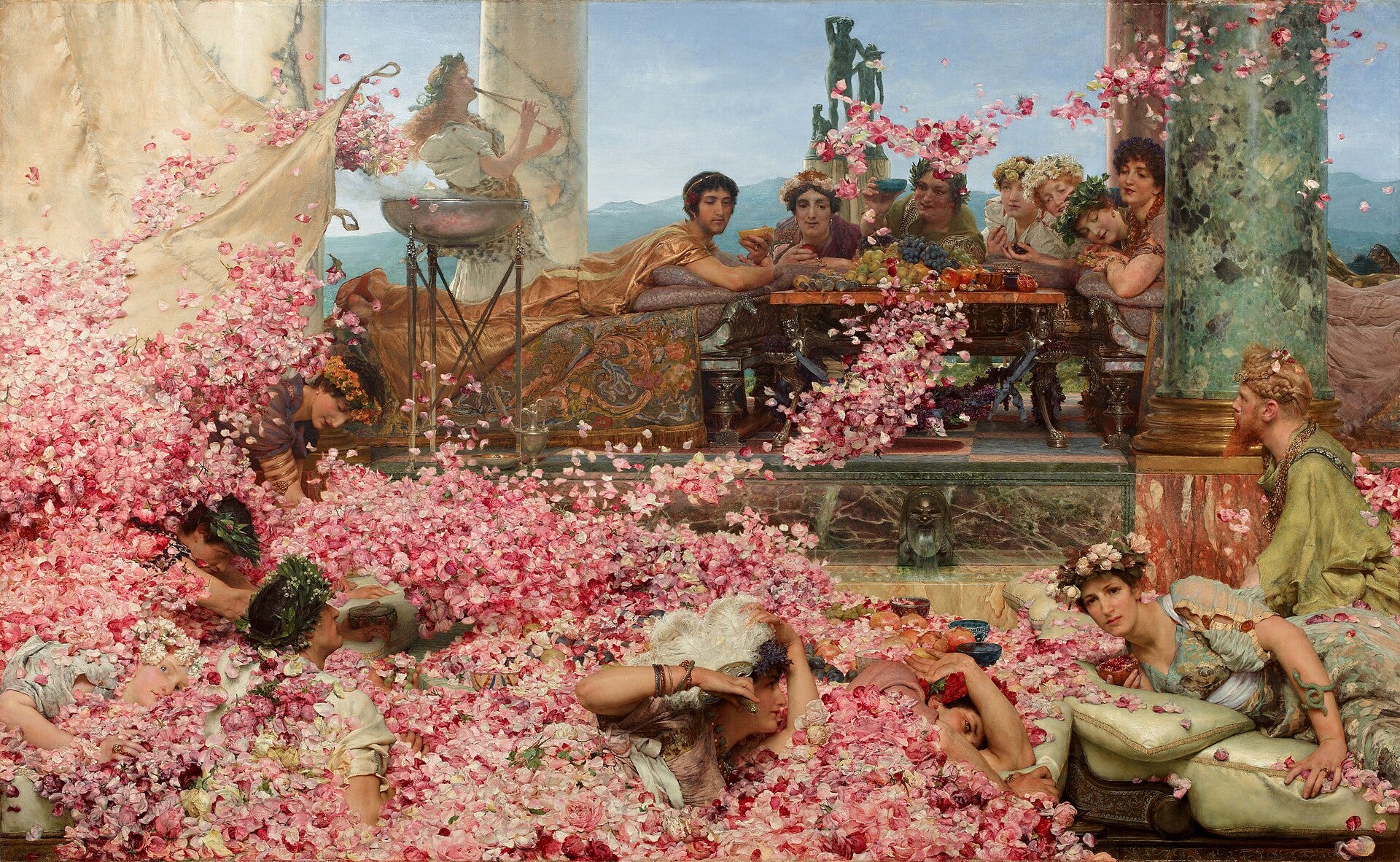
June 8, 218: In a battle near Antioch, a rebel army supporting 14 year old imperial claimant Sextus Varius Avitus Bassianus defeats an army under Roman Emperor Marcus Opellius Macrinus. After his defeat, Macrinus attempted to flee west but was captured at Chalcedon and later executed. The new emperor, who took the regal name Marcus Aurelius Antoninus Augustus, was later dubbed “Elagabalus” or “Heliogabalus” because he had previously been a priest of the Syrian sun god of the same name. He established that deity as the chief god of the Roman pantheon, displacing Jupiter, with himself as chief priest. Elagabalus is known today mostly for lurid and probably sensationalized accounts of the decadence of his court and of his sexual and romantic relationships. The Praetorian Guard assassinated him in 222 and elevated his cousin Severus Alexander to replace him.
June 8, 1941: World War II’s Operation Exporter begins. Allied forces invaded Syria and Lebanon and made relatively short work of their Vichy French defenders. The British government turned control of the region over to Charles de Gaulle’s Free French government under the condition that both mandates would be given their independence.
INTERNATIONAL
The Stockholm International Peace Research Institute’s 2026 yearbook paints a grim picture regarding the world’s nuclear weapons stockpiles:
The nine nuclear-armed states—the United States, Russia, the United Kingdom, France, China, India, Pakistan, the Democratic People’s Republic of Korea (North Korea) and Israel—continued programmes to modernize and enhance their nuclear arsenals in 2025, and most deployed new nuclear-armed or nuclear-capable weapon systems during the year.
Of the total global inventory of an estimated 12 187 warheads in January 2026, about 9745 were in military stockpiles for potential use (see the table below). An estimated 4012 of those warheads were deployed with missiles and aircraft and the rest were in central storage. Between 2100 and 2200 of the deployed warheads were kept in a state of high operational alert on ballistic missiles. Nearly all of these warheads belonged to Russia or the USA, and to a lesser extent France and the UK, but China and India may now occasionally deploy a small number of warheads mounted on missiles during peacetime.
‘Influential voices, including some world leaders, are advocating nuclear weapons as a guarantee against attack by a hostile state. But making national defence and security strategies dependent—or more dependent—on nuclear weapons could significantly increase nuclear risks,’ said SIPRI Director Karim Haggag. ‘The dangers associated with nuclear weapons are growing due to advances in weapon technology, the breakdown of nuclear arms control and heightened geopolitical tensions, among a range of other factors. At the same time, world events—not least the outbreak of conflict between nuclear-armed India and Pakistan—are challenging nuclear deterrence logic.’
Overall the number of nuclear munitions in the world continues to decrease, as Russia and the US have continued to dismantle defunct Cold War-era warheads faster than they are producing new warheads. But the rate of decrease seems to be slowing and indications are that the trend will start to move in the opposite direction in the next few years.
MIDDLE EAST
IRAN
An exchange of hostilities that began with an Israeli attack on Beirut and an Iranian retaliation against Israel continued overnight and into Monday, before both governments halted at least for the time being. I’m not going to try to predict how long that halt will last, but it is worth noting that the Israeli government will reopen schools on Tuesday, while Iranian authorities have reopened the country’s airspace. Those are not the actions of officials who think they’re going to be back at war in a few hours. The cessation of fighting came after an appeal from Donald Trump for both parties to stand down, which came after Trump said publicly that he would ask the Israelis not to retaliate for the first Iranian missile strike—a request the Israelis apparently rejected (more on that in a moment).
