

You’re reading the web version of Foreign Exchanges. If you’d like to get it delivered straight to your inbox, sign up today:
GiveDirectly is raising money to provide relief to those who have been affected by the devastating earthquakes in Venezuela earlier this week. If you are able to contribute please consider doing so!
PROGRAMMING NOTE: As I announced last week, I’m taking a break from the newsletter for the next several days. Barring any unforeseen developments I’ll be back on Tuesday, July 7.
TODAY IN HISTORY
June 27, 1658: An invading Spanish army is defeated by a slightly larger English force in the Battle of Rio Nuevo, the largest battle ever to take place on Jamaica. This was the second Spanish attempt to reclaim the island, which had been captured by English forces commanded by Sir William Penn in 1655. Of around 560 Spanish personnel at the start of the battle, some 300 were killed or wounded and another 150 taken prisoner. Spain finally gave up its claim on Jamaica in the 1670 Treaty of Madrid.
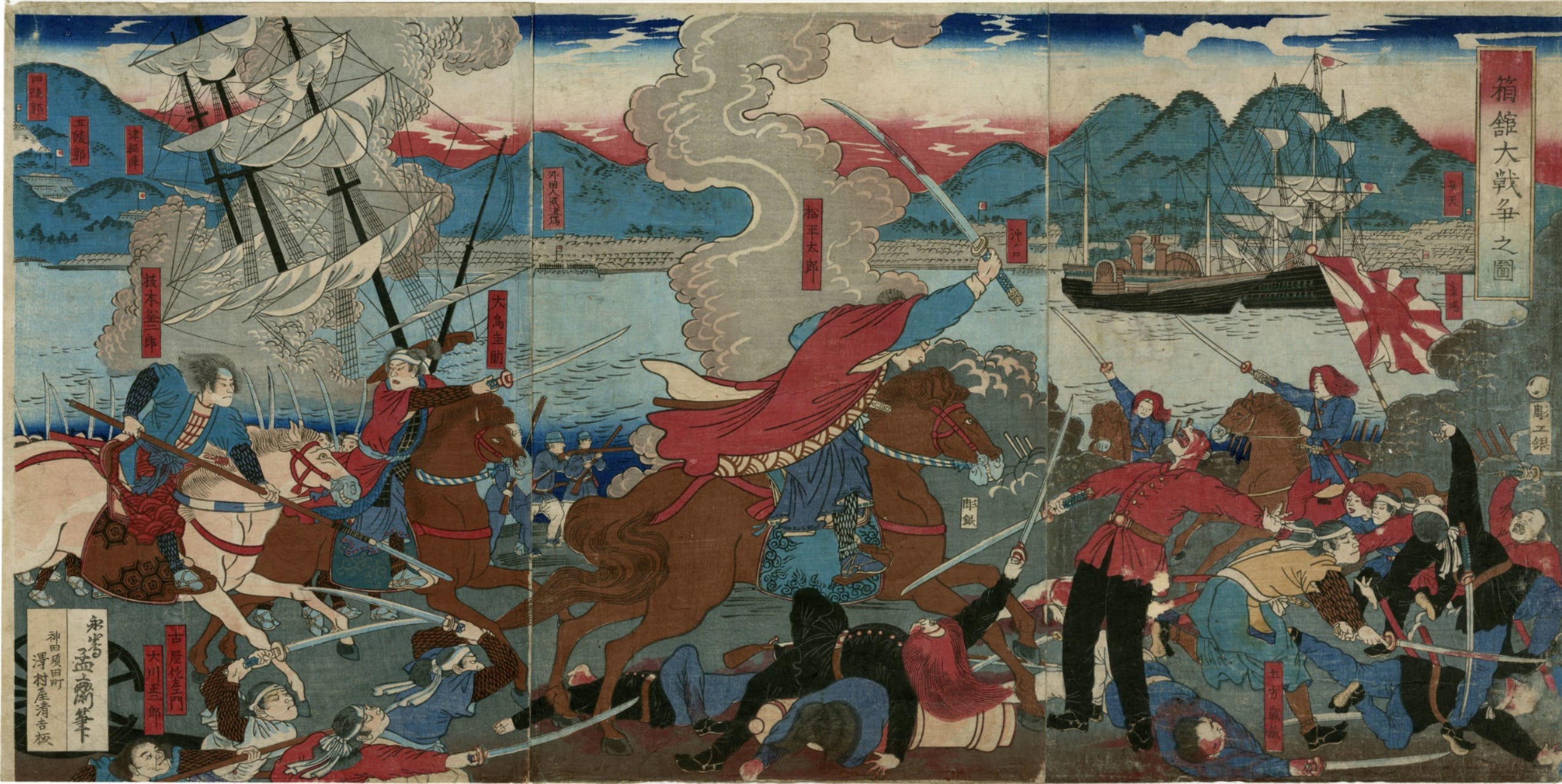
June 27, 1869: The remaining forces still loyal to the Tokugawa Shogunate are defeated by Meiji forces at the Battle of Hakodate, on northern Japan’s Hokkaidō island. After suffering a series of defeats that included the loss of Edo (renamed Tokyo), the Tokugawa remnants had fashioned themselves into a statelet called the “Republic of Ezo” (Ezo being another name for Hokkaidō) in late 1868 and, aided by several French military officers, focused their defensive preparations on the island’s southern Hakodate peninsula. Meiji forces landed on the island in April and were eventually able to force the rebels to surrender. The battle effectively ended the 1868-1869 Boshin War with the imperial/Meiji faction victorious.
June 28, 1914: A group of six attackers aided by a Serbian irredentist paramilitary group known as the “Black Hand” attack Austrian Archduke Franz Ferdinand and his wife as they’re visiting Sarajavo. Although their initial bombing attempt failed, one of the six attackers, Gavrilo Princip, shot and killed both targets after a reception involving the mayor of Sarajevo and the governor of Bosnia. Certainly one of the most consequential acts in world history, within a month the assassination had caused Serbia and Austria-Hungary to declare war on one another, and when their allies jumped into the pool as well the result was World War I.
June 28, 1919: Five years later, the Treaty of Versailles is signed, ending Germany’s involvement in World War I. This is the most important of the multiple World War I peace treaties, which include the Treaty of Saint-Germain-en-Laye with Austria in September 1919, the Treaty of Trianon with Hungary in June 1920, and the Treaty of Sèvres with the rump Ottoman Empire in August 1920. The terms of Sèvres were largely superseded by the July 1923 Treaty of Lausanne that ended the Turkish War of Independence.
MIDDLE EAST
SYRIA
The Israeli military (IDF) killed at least two people in occupied southern Syria on Saturday. Israeli officials later claimed that they were “Iran-linked” militants, though I haven’t seen any explanation beyond that.
LEBANON
It took two whole days but the IDF is already pounding southern Lebanon again despite Friday’s “framework agreement” between the Israeli and Lebanese (and US) governments. It killed at least one person on Sunday amid multiple airstrikes that it claimed were targeting Hezbollah.
Al Jazeera has more detail on the contents of the “framework agreement,” and its main component does appear to be the creation of “pilot zones” in southern Lebanon where the IDF will withdraw from a small area while the Lebanese army moves in to secure it. The Trump administration contends that this sets the conditions for the IDF to “progressively redeploy” out of Lebanon though what it mainly does is attempt to pit the Lebanese army against Hezbollah in hopes that the latter will stand down or, failing that, they will fight a civil war. I don’t think Israeli or US officials particularly care which outcome they get.
There is at least one other questionable detail in the 14 article agreement—its Article 13 obliges both the Israeli and Lebanese governments to “cease all hostile or negative actions in international political or legal forums.” That would seem to preclude any Lebanese action against Israel via the United Nations or the International Criminal Court for crimes related to the occupation, and may also preclude Lebanese individuals from pursuing cases against the Israeli government for harm that they’ve suffered. The deal seems to be that Israel gets impunity and an extended occupation and Lebanon gets a possible civil war and maybe, at an undetermined point in the distant future, some degree of sovereignty over its own territory—whatever part of that territory the Israeli government deigns to give back.
ISRAEL-PALESTINE
The IDF killed two people, one a 15 year old, in the Mawasi displaced persons camp in Gaza on Saturday and at least four people, including a 13 year old, in several strikes across the territory on Sunday. A 10 year old wounded in another IDF strike on Mawasi several days previously also died on Saturday.
I assume most readers will be pleased to learn that, according to The Guardian, Donald Trump’s “Board of Peace” is planning to adopt a resolution granting itself legal immunity as well as the right to seize public property in Gaza “free of charge,” two things that any reputable organization would do before committing absolutely no crimes whatsoever. The immunity would apply to members of the board as well as its executive committee, its Gaza high representative, its “technocratic” Palestinian governance committee, along with any military forces or contractors arrayed under its banner. The board would be responsible for policing itself, or in other words it would operate with total impunity. That seems less than ideal but in one sense it’s only acknowledging the reality that there is no legal structure in Gaza, or at the very least no legal structure that Trump and company would ever feel obliged to recognize.
IRAQ
Iraqi Prime Minister Ali al-Zaidi kicked off what appears to be a major anticorruption project on Sunday, as security forces rounded up at least 47 bureaucrats, members of parliament, and other political figures in Baghdad. The arrests were reportedly based on revelations gleaned from former Deputy Oil Minister Adnan al-Jumaili, who was arrested on corruption charges last month and is apparently cooperating with authorities. Iraq certainly has a problem with corruption, though whether Zaidi is serious about tackling it, or is just using it as an excuse to go after his political rivals, remains to be seen.
IRAN
The US and Iranian militaries went through two rounds of tit for tat violence over the weekend, following up their Friday-Saturday skirmish with a similar clash the next night. That second exchange began much as the first, with an Iranian drone striking a ship that was attempting to transit the Strait of Hormuz via the coastal route near Oman. At least one person was killed by shrapnel in Qatar on Saturday but Qatari authorities haven’t offered any additional details. If this continues then it might be time to start talking about what happened to the ceasefire. So far, though, I don’t get the sense that anything has happened that can’t be smoothed over (threats from Donald Trump notwithstanding).
And sure enough, after I wrote the above Barak Ravid, citing “a senior US official,” reported that the two sides have “agreed to stop attacking each other” and will hold a meeting to discuss the strait in Qatar on Tuesday. This makes sense—the Asian markets are opening in a few hours so it was time to stop the weekend horseplay and get back to business. Reuters also reported that the Iranians had skipped out on another round of technical negotiations that was supposed to happen on Sunday, due to the fighting as well as questions over the status of Tehran’s frozen assets. Maybe that forced the issue a bit.
What’s been happening over the past couple of nights seems like the byproduct of basing a very sensitive, potentially complex ceasefire on a “Memorandum of Understanding” that was written as vaguely as possible to facilitate an agreement. At issue is Article 5 of that MoU, which reads:
Upon the signing of this MoU, the Islamic Republic of Iran will make arrangements using its best efforts for the safe passage of commercial vessels, with no charge for 60 days only, from the Persian Gulf to the Sea of Oman, and vice versa. The traffic of commercial vessels will immediately start, and considering the need for removing the technical and military obstacles, and de-mining by the Islamic Republic of Iran, will be instated within 30 days. The Islamic Republic of Iran will conduct dialogue with the Sultanate of Oman, to define the future administration and maritime services in the Strait of Hormuz, in discussions with other Persian Gulf Littoral States, in line with applicable international law and the sovereign rights of coastal states of the Strait of Hormuz.
The US government is arguing that Article 5 means that Iran will permit free commercial transit through the strait for at least the 60 days covered under the MoU. As far as it’s concerned, for the Iranians to attack ships in or around the strait constitutes a violation of the MoU. The Iranian government is arguing that Article 5 recognizes Iran’s control over the strait in principle, with the details to be worked out later. In that interpretation the transit of ships through the strait without Iranian permission via that Omani coastal route constitutes a violation of the MoU.
There’s likely a Lebanon component to this as well though it’s not necessarily related to the continued IDF violence there. The Iranians see the US agreeing to one thing in the MoU (cessation of hostilities) and then immediately turning around and negotiating something contradictory in collaboration with the Israelis and the Lebanese government (continued occupation and “defensive” IDF action). Likewise, they see the US agreeing to a particular state of affairs in the strait (Iranian control) and then immediately turning around and insisting on something else. Whether that’s a fair interpretation or not is somewhat irrelevant. The MoU is ambiguous enough to allow for these sorts of arguments and the US and Iranian governments don’t yet have a mechanism for working those arguments out short of military action.
ASIA
PAKISTAN
The Pakistani military reported on Sunday that the country’s security forces had conducted an “intelligence-based” operation including “calibrated strikes” targeting alleged militants along the Afghan border, killing at least 29 people. The strikes apparently took place inside Afghanistan while a preceding ground operation was conducted in northern Pakistan’s Khyber Pakhtunkhwa province. There’s been no response from the Afghan government yet as far as I know. The previous day, the Pakistani Taliban’s Jamaat-ul-Ahrar faction attacked a Pakistan Rangers facility in the city of Karachi, killing at least three people.
VIETNAM
At The Diplomat, Yuhang Ding and Sailin Li argue that the war in Ukraine and resulting sanctions have severely undercut Russia’s arms business in Southeast Asia, even with long-standing customers like Vietnam:
The Philippines, a U.S. ally, has always relied heavily on American arms. By contrast, Vietnam’s military was built around Russian platforms, from Su-30 fighters to Kilo-class submarines to S-300 air defense systems. Hanoi had actually slowed its Russian purchases well before 2022, partly because of the risk of sanctions under the United States’ 2017 Countering America’s Adversaries Through Sanctions Act and partly because of a domestic anti-corruption campaign that scrutinized large defense contracts.
The Russia-Ukraine War sped up what had been a process of gradual disengagement. Access to Russian spare parts, software updates, and depot-level overhauls became unpredictable, threatening readiness across Vietnam’s most important platforms. In response, Hanoi embraced indigenous maintenance capabilities, deepening cooperation with India on submarine sustainment. It also turned to alternative suppliers, with a landmark $245 million deal to buy K9 howitzers from South Korea and a new arrangement to advance defense industry cooperation with Turkiye. Vietnam is even expected to officially ink a deal to acquire $100 million worth of used C-130 transport planes from the United States. Vietnam realizes it can no longer rely on Russia for its defense needs.
AFRICA
SUDAN
The Joint Forces, a Darfur militia coalition allied with the Sudanese military, reportedly captured the North Darfur town of Abu Qamra from the Rapid Support Forces militant group on Saturday. The RSF had seized Abu Qamra late last year, after its capture of the state capital, El Fasher.
NIGERIA
Gunmen attacked a village in northwestern Nigeria’s Zamfara state on Friday, killing at least 15 people. There’s been no claim of responsibility and the motive here may have been banditry and/or herder-on-farmer violence.
EUROPE
UKRAINE
Russian attacks killed at least five people across Ukraine on Sunday, while Ukrainian strikes killed at least one person in Russia’s Belgorod oblast and sparked fires at two Russian oil refineries. The previous day, Russia’s overnight bombardment killed at least two people in Ukraine while Ukrainian attacks killed at least two people in Russian-occupied Donetsk oblast and at least two others in Russia’s Bryansk oblast.
SERBIA
Serbian President Aleksandar Vučić announced at a political rally in Belgrade on Saturday that he intends to resign in “a couple of weeks,” cutting short a term that was supposed to run through the middle of next year. This would trigger an early general election, though Vučić didn’t say when that might take place. Vučić is term limited, so legally he won’t be able to run for president again. But assuming that his Serbian Progressive Party wins the parliamentary election, he could maneuver himself back into the position of prime minister and try to arrange the election of a pliant SPS comrade as president to maintain his status as Serbia’s preeminent political figure. Protesters have been demanding Vučić’s resignation since the Novi Sad train station collapse back in November 2024 and say they’re not going to stop now, partly out of concern about his plans for the election.
AMERICAS
UNITED STATES
Finally, Foreign Policy’s Antonio De Loera-Brust argues that this year’s World Cup should generate the same scrutiny about its host’s exploitation of migrant labor as the 2022 tournament did:
U.S. President Donald Trump’s administration is making undocumented workers more vulnerable than ever by simultaneously hardening exclusionary immigration policies while expanding guest worker programs. Despite running on a pledge to purge the country with mass deportations, visa programs such as the H-2A and H-2B are actually increasing the size of the foreign workforce.
According to labor unions, anti-trafficking groups, and migrant advocates, these guest worker programs are also rife with abuse, including human trafficking, forced labor, sexual assault, wage theft, and even incidents of what U.S. prosecutors have called “modern-day slavery.”
If the exploitation of migrant labor sounds familiar to World Cup fans, it’s because we heard a lot about it four years ago in the run-up to the 2022 Men’s World Cup in Qatar. Dozens of migrant workers within Qatar’s infamous “kafala” system died during the construction of new football stadiums, prompting an outpouring of outrage from around the world, including from some footballers themselves.
The 2026 Men’s World Cup, co-hosted by the United States, Mexico, and Canada, kicked off [earlier this month], with 78 of 104 matches set to be played on U.S. soil over the next month. Understandably, far greater scrutiny over treatment of migrant workers was directed at Qatar, where laborers were much more directly involved in building physical tournament infrastructure. (By contrast, the United States is utilizing already-existing stadiums.) Yet the tournament still offers an opportunity to revisit a broader discussion about exploitative labor systems in the United States, which bear striking similarities to Qatar’s kafala regime.