

You’re reading the web version of Foreign Exchanges. If you’d like to get it delivered straight to your inbox, sign up today:
Happy Father’s Day to those who are celebrating!
PROGRAMMING NOTE 1: Due to a family commitment tomorrow evening I will have to either forego tomorrow’s newsletter or write a very abbreviated version of it. Paid subscribers should be aware of that.
PROGRAMMING NOTE 2: I’m at a point mentally where I need to take a breather from the newsletter, and with the war at least paused this seems like a good time to do so. I’ll continue our regular schedule through this week, but after the June 28 roundup I’ll be taking a break and will resume on July 7. Barring unforeseen developments, of course.
TODAY IN HISTORY
June 20, 1631: Algerian pirates sack the Irish village of Baltimore. They carted off 107 captives, of whom only three ever made it back to Ireland.
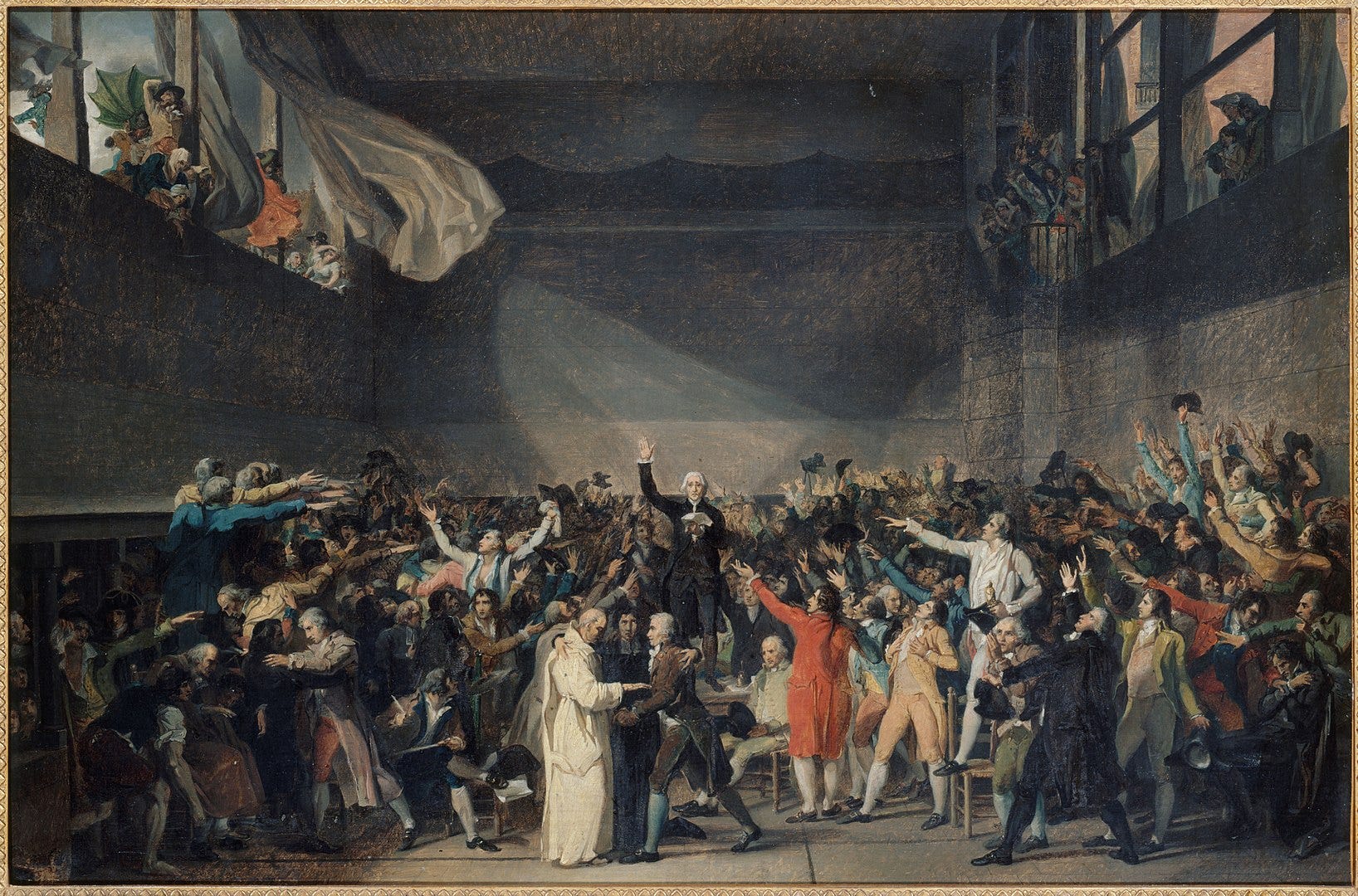
June 20, 1789: Members of the French Third Estate take the Tennis Court Oath, in which they pledged not to dissolve under royal pressure. This was one of the first serious acts of defiance in the French Revolution and helped to establish the power of the National Assembly.
June 21, 1791: French King Louis XVI and Marie Antoinette attempt to flee Paris to meet up with royalist troops at Montmédy in what’s become known as the “Flight to Varennes.” As the name suggests, they didn’t make it and were arrested in the town of Varennes-en-Argonne. The attempted escape made it clear to the French public that Louis was conspiring to end the French Revolution and caused popular sentiment to turn toward abolishing the monarchy rather than maintaining it under constitutional limitations.
June 21, 1813: A Bonapartist army under the command of then-Spanish King Joseph Bonaparte is badly defeated near the Spanish city of Vitoria by a joint British, Portuguese, and Spanish army commanded by Arthur Wellesley, Marquess (later Duke) of Wellington. Wellington outmaneuvered the Bonapartists so thoroughly that, in their retreat, Joseph’s men left behind their artillery as well as the (soon to be former) king’s considerable baggage train. While the Battle of Vitoria didn’t entirely end the Peninsular War (only Napoleon’s surrender and abdication in April 1814 did that), it did chase Joseph out of Spain. By December, the Allied army’s position was secure enough to restore—with Napoleon’s acquiescence—the previously abdicated Ferdinand VII to the Spanish throne.
June 21, 1942: Axis forces under Erwin Rommel capture the Libyan city of Tobruk. Rommel was promoted to field marshal for his trouble, but the Allies retook the city in November.
MIDDLE EAST
SYRIA
Islamic State jihadists killed two soldiers in northern Syria’s Aleppo province on Saturday. The Syrian government initially announced the attack without naming the culprit and without going into much additional detail.
LEBANON
The New York Times reported a noticeable decrease in Israeli military (IDF) activity in Lebanon on Sunday, one day after it killed at least 20 people there and two days after it killed at least 83 in one of its deadliest single days of violence since the start of the Iran war. The IDF announced on Saturday that it was shifting to a “defensive” posture within the “security zone” that it’s carved out across southern Lebanon, and the reason I put those things in quotes is because the “security zone” is a military occupation and there is nothing “defensive” about it. Israeli Defense Minister Israel Katz insisted on Sunday that forces in Lebanon are not under any operational restrictions, but according to Reuters there have been “no major strikes” by the IDF—and no Hezbollah attacks on the IDF—since 6:30 PM local time on Saturday.
These developments came after the Iranian government announced that it was re-closing the Strait of Hormuz (more on that in a moment). So for the time being, at least, Iranian officials seem more invested in achieving a ceasefire in Lebanon than the Lebanese government does. That’s not (entirely) altruistic—the Iranians want some proof that the US government can rein in its Israeli counterpart before they make any major negotiating concessions—but the impression is the same nonetheless. Foreign Policy’s Sam Heller argues pretty convincingly that, by pressuring the Lebanese government to accept IDF occupation and to negotiate with Israeli officials on Israeli terms, the Trump administration is pursuing a course of action intended to “humiliate and weaken Lebanon’s leaders.” The talks have offered zero benefit to the Lebanon people while positioning Lebanese officials as supporters of the occupation and of the continued violence. In contrast, Hezbollah and Iran are resisting those things.
ISRAEL-PALESTINE
IDF drone strikes killed at least three people in Gaza on Sunday, including a child. Israeli officials said that they had “eliminated” two “operatives” from Hamas and Palestinian Islamic Jihad, but there’s no indication from the reporting when they were killed. On Saturday the IDF killed at least 11 people in the territory, including Al Jazeera journalist Ahmed Wishah. It later claimed that Wishah was a “sniper operative” with Hamas, though as usual the only evidence it offered was “take our word for it.” The IDF has killed well over 200 journalists in Gaza since October 2023, including at least 13 Al Jazeera employees.
Overnight the IDF announced that its forces had killed two Palestinians in the Gush Etzion settlement near the West Bank city of Bethlehem. They had allegedly thrown Molotov cocktails at the settlement, causing a fire.
IRAN
There seems to be some uncertainty about what exactly is going on in Switzerland, where US and Iranian delegations finally began their 60 day negotiating period on Sunday. US Vice President JD Vance and Iranian parliament speaker Mohammed Bagher Ghalibaf turned up after all, though it’s unclear how long either intends to stay or indeed how long this initial session is supposed to last overall. Maybe it won’t last much longer than a day—AFP reported later on Sunday that the Iranian negotiators had “walked out” of the venue over two complaints: the situation in Lebanon and Donald Trump’s decision to hop on social media and Fox News to start threatening to attack Iran again. Why Trump thought that was a good idea is as unclear as most other things he does, but despite the “walk out” the talks did continue.
Overnight, Pakistani and Qatari mediators announced that the parties had agreed to form a “high-level committee” to oversee the talks and manage progress on a “roadmap” to a final agreement on nuclear and other issues. They also announced the formation of a “deconfliction cell” to oversee the “termination of military operations in Lebanon.” Neither of these things necessarily amounts to much but they are at least evidence that the Iranians didn’t quit the negotiations altogether.
The other open question at this point is whether or not the Strait of Hormuz is actually closed again and how long the Iranians intend to maintain the closure they announced on Saturday. The US military has insisted that the waterway is still open but there’s no reason to believe anything coming out of that institution, and ship tracking data did reportedly show a downturn in activity in the strait on Sunday. Iranian forces haven’t attacked any commercial ships yet and are presumably hoping that the threat will be enough to throttle traffic. They don’t need to completely close the strait to have the desired effect.
ASIA
PAKISTAN
Two roadside bombs killed at least seven people in northern Pakistan’s Khyber Pakhtunkhwa province on Saturday. As far as I know there’s been no claim of responsibility, but given the location the Pakistani Taliban is the likely culprit. This appears to have been a “double-tap” attack, with the second bombing targeting rescuers who had responded to the first.
CHINA
The Chinese government blacklisted ten US defense contractors on Monday (local time), blocking their access to any “dual use” products manufactured in China. This was a response to a number of similar designations made by the US Defense Department earlier this month.
NORTH KOREA
The Diplomat’s Geunho Ryu reports on the North Korean government’s efforts to portray itself as a “normal” nuclear state amid a decline in international scrutiny:
Analysts have discussed in depth the repercussions of the end of the [United Nations Panel of Experts or PoE, which previously monitored North Korea’s nuclear program]. But while the end of international accountability attracts attention, there is a parallel effort on Pyongyang’s part to change how the world understands North Korea’s actions. That campaign is being conducted in Korean, in the laws and state media that form the regime’s authoritative register. These nuances are routinely lost in the English summaries that most foreign analysts actually read.
In September 2022, the Supreme People’s Assembly codified North Korea’s status as a nuclear weapons state and framed the program as a permanent fixture of national security rather than a bargaining chip. Notably, the law was made possible by a diplomatic shift: the May 2022 Russian and Chinese vetoes of a U.S.-drafted sanctions resolution. It was the first time a UNSC effort to sanction North Korea had been blocked since the first such resolution passed in 2006, and it ended nearly two decades of great-power consensus. Two years later, the PoE disbandment and the deepening North Korea-Russia partnership marked the definitive end of nearly two decades of great power consensus on opposition to North Korea’s nuclear program.
In recent years Pyongyang has taken to using the term “responsible nuclear-weapons state,” though the “responsible” part is often omitted in Western translations (go figure). It’s also begun referring to its “nuclear deterrent capability” rather than its “nuclear weapons.” And it frames its posture as a defense against hostile US policy, which it applies to the overall US attitude toward North Korea rather than to a set of discrete actions. All of these measures are intended to portray the country’s nuclear program as both immutable and defensive, in contrast with Western portrayals that it is provocative and still negotiable.
AFRICA
SUDAN
According to The Sudan Tribune, the Sudanese military (SAF) undertook “intensive drone strikes” around the city of El Obeid on Saturday in an attempt “to foil preparations by the Rapid Support Forces (RSF) to assault” the city. El Obeid is the capital of Sudan’s war torn North Kordofan state and has been under RSF pressure going back to the early days of the SAF-RSF war. But the militants have intensified their drone activity in the city and massed forces around it in recent weeks in advance of what may still be an imminent assault.
ETHIOPIA
As expected, Ethiopian Prime Minister Abiy Ahmed’s Prosperity Party won a clear victory in the country’s June 1 election. Official results released on Sunday gave the party 438 seats in the 547 seat House of Peoples’ Representatives, a margin that is actually more lopsided than it appears because the election wasn’t held in Ethiopia’s Tigray region and parts of its Amhara and Oromia regions, so a considerable number of those 547 seats were not on the ballot. Those areas are all affected by insurgencies so they might not have supported Prosperity anyway, but that’s ultimately irrelevant given the party’s performance. Prosperity won roughly 90 percent of the seats that were contested. This is similar to the party’s margin of victory in the 2021 election.
There is some cause for concern here if Abiy decides to throw his new political momentum behind either a stepped up security effort in Tigray and/or Amhara or some sort of push to acquire (one way or the other) his long-desired Red Sea port.
EUROPE
UKRAINE
Russian attacks killed at least five people in Ukraine’s Zaporizhzhia oblast and at least one person in Kharkiv oblast on Saturday, while a Russian missile strike reportedly killed at least one person in Odesa oblast on Sunday. Meanwhile, Ukrainian attacks over the weekend killed at least four people in Russian-occupied Crimea and at least one person in Russia’s Krasnodar Krai region. Authorities in Crimea have been forced to suspend commercial fuel sales after weeks of Ukrainian attacks targeting energy infrastructure on the peninsula. Additionally a drone strike targeting a Panamanian-flagged ship in the Black Sea killed at least one person on Thursday, but there’s apparently no indication as to responsibility.
POLAND
Polish President Karol Nawrocki stripped Ukrainian President Volodymyr Zelensky of Poland’s highest honor, the “Order of the White Eagle,” on Friday. Zelensky’s offense was naming a Ukrainian military unit “Heroes of the UPA” earlier this month. The UPA, or the Ukrainian Insurgent Army, was a Banderite guerrilla force that operated in Ukraine during and after World War II and infamously massacred tens of thousands of ethnic Poles in the mid 1940s. The revival of its name proved quite offensive from the Polish perspective.
The Ukrainian government slammed Nawrocki’s decision as a “strategic mistake” that will benefit Russia somehow. I’m not really making the connection. If there was some risk here of damaging relations between Poland and Ukraine in a strategically harmful way, then one could argue that Zelensky should not have dredged up painful and politically divisive World War II memories for no discernible reason. At least the right-wing Ukrainian community will be happy.
UNITED KINGDOM
UK Prime Minister Keir Starmer may be resigning soon, perhaps very soon and possibly even by the time anybody reads this. The Observer reported on Saturday that Starmer would be resigning on Monday, but sources in his orbit pushed back on that and insisted that he was still considering his options. Greater Manchester Mayor Andy Burnham, who won a parliamentary by-election on Thursday, is expected to challenge Starmer for leadership of the Labour Party and it seems likely that he’ll win unless the PM resigns first.
AMERICAS
BOLIVIA
Bolivian President Rodrigo Paz finally declared a state of emergency on Saturday, raising concerns that he was about to deploy military forces to suppress anti-austerity protesters and the roadblocks they’d set up across the country. The Bolivian Congress voted to give him that authority late last month. However, by Sunday Bolivian authorities were declaring that there are “no active road blockades in the country” after a number of agreements between various protesting groups and the government apparently deescalated the situation. An umbrella group representing farming and Indigenous groups involved in the protests announced a “pause” in protests/roadblocks near La Paz, for example, while officials in Santa Cruz signed a deal with protesters in that region. So perhaps the military crackdown is no longer forthcoming.
COLOMBIA
While the margin remains quite small (around 1 percent) and there are still votes to be counted, it would appear that far-right candidate Abelardo de la Espriella has won Colombia’s presidential runoff, defeating leftist Iván Cepeda. I’m couching my language because Cepeda is likely to challenge the results, so it seems premature to declare the contest completely over though de la Espriella is certainly in the more favorable position at present.
Assuming that de la Espriella does emerge victorious he’ll likely have to navigate a fragmented legislature to enact his agenda. In terms of the issue that seems to have animated a large number of voters, insecurity, he’s pledged to crack down harshly against drug cartels and other violent armed groups. Without going into detail let’s say that this would not be in keeping with de la Espriella’s personal history, but I digress. It’s also an approach that hasn’t ever worked, but maybe this time will be different (SPOILER: it won’t).
UNITED STATES
The US military’s Southern Command announced on Sunday that it had carried out another extrajudicial execution involving an alleged drug-running boat in the Caribbean. It added two more victims to its boat killing spree.
Finally, in a fairly prescient piece Spencer Ackerman considers the repercussions of the Iran war:
At the risk of stating the obvious—worth doing, since Trump is out to obscure the obvious, lest it cause a sustained market reaction he can’t afford—the Memorandum of Understanding does not end the war. It inaugurates a 60-day period of negotiations, scheduled to begin tomorrow (we’ll see), for which every difficult question deferred by the MOU, particularly the nuclear file, must be resolved.
While extendable by mutual consent, the collapse of negotiations will mean Iran closes the Strait again, despite the risk of American bombing. If the Iranians perceive Israeli intransigence over the MOU’s demand for “the territorial integrity and sovereignty of Lebanon,” they will close the Strait. Should the Americans prove intransigent, including after any hypothetical deal is reached, Iran will—you guessed it—close the Strait. Welcome to a new regional reality.
The terms of the MOU reflect how thoroughly the United States lost the war it and Israel initiated. Section Four stipulates: “The United States of America further undertakes to remove its forces from the proximity of the Islamic Republic of Iran within 30 days after the final Deal.” I don’t presume to know the form that fulfillment of this clause will take, if it gets fulfilled at all. But the Trump administration has agreed in principle to a transformation of its military posture in the Middle East.
Every previous retrenchment from the Middle East or South Asia, with the exceptions of the 2019-20 Taliban negotiations and the collapse of the 2011 U.S.-Iraq basing negotiations, have been unilateral American decisions. All of them in the past 15 years have come in the form of bivouacking to what was thought to be defensible positions arrayed against Iran. However much Section Four is compelled by accurate Iranian missile and drone fire cratering the airfields and blowing up the radar systems of the constellation of U.S. bases hosted by now-nervous Gulf and regional allies, it’s an unambiguous retreat. This is categorically different and far worse for the U.S. than 2019-21 or 2011. Iran is flexing a might that neither the Taliban nor post-Saddam Iraq could possess.
Thanks for the heads-up about the break Derek, I can't imagine having to write about this stuff all the time