

You’re reading the web version of Foreign Exchanges. If you’d like to get it delivered straight to your inbox, sign up today:
TODAY IN HISTORY
June 16, 632: Yazdegerd III is crowned ruler of the Sasanian Empire. He ruled for 19 years, much of it in a fairly nominal sense, and was the last Sasanian emperor. He fled his capital, Ctesiphon, after the Persians’ catastrophic defeat to the invading Arabs at Qadisiyah in 636 and spent the rest of his life alternately running for his life and raising armies in a futile attempt to hold on to what was left of his empire. A miller assassinated Yazdegerd at Merv (near modern Mary, Turkmenistan) in 651, though it’s unclear whether he did so in an act of simple robbery or at the orders of the regional governor.
June 16, 1407: Ming Chinese forces capture the emperor of Đại Ngu (northern Vietnam today), Hồ Hán Thương, as well as his father and predecessor, “Retired Emperor” Hồ Quý Ly, thus bringing the 1406-1407 Ming-Hồ war close to its end. The conflict’s roots lay in the Hồ dynasty’s overthrow of the Trần dynasty, a Ming vassal, and the breakup of Đại Việt (Vietnam) in 1400. Hồ Quý Ly resisted a Ming demand for the reinstatement of the Trần and the rest, as they say, is history. The Ming annexed northern Vietnam, calling it Jiaozhi province, but that only lasted until 1427, when a rebellion led by Lê Lợi drove the Ming out and reestablished an independent Vietnam.
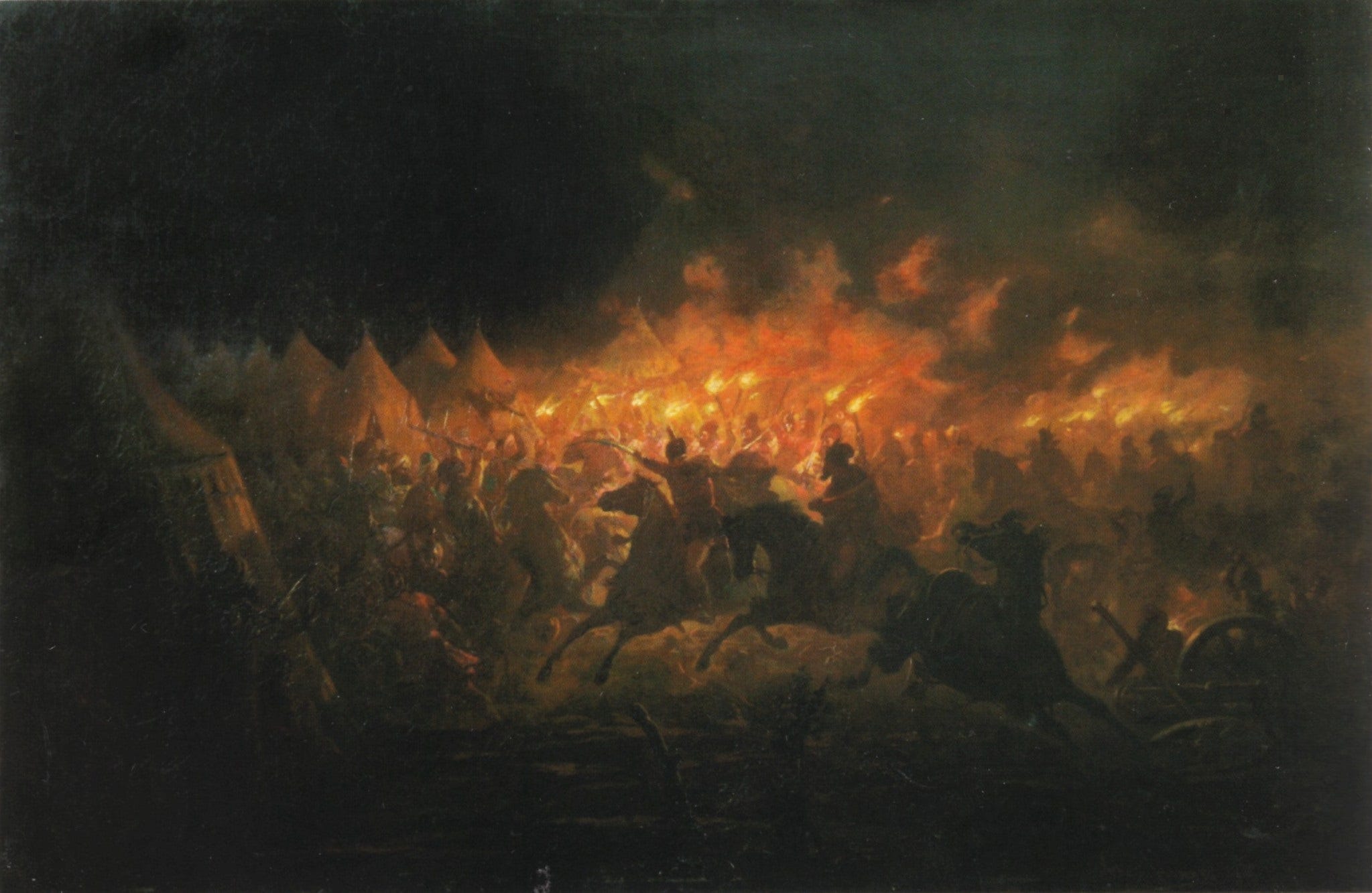
June 17, 1462: Wallachian ruler Vlad III—variously known as “Vlad Țepeș,” “Vlad the Impaler,” and the inspiration for the character “Dracula”—leads a daring night assault on an invading Ottoman army near the city of Târgovişte (in modern Romania). The Wallachians emerged victorious in the sense that they killed a lot more Ottomans than vice versa, but the attack failed in its main goal, which was killing Ottman Emperor Mehmed II. The Ottomans did ultimately withdraw, but Mehmed then engineered Vlad’s overthrow in favor of his more pliant brother Radu.
June 17, 1631: Mumtaz Mahal, the chief consort of Mughal Emperor Shah Jahan, dies in childbirth in the Indian city of Burhanpur. According to Mughal chroniclers her death caused the emperor tremendous grief and he withdrew into the palace for a year to mourn her loss. When he emerged he was, we’re told, clearly diminished. Shah Jahan had her body temporarily buried in Burhanpur then moved to an also-temporary tomb in Agra. In the meantime he ordered the construction of a monumental permanent tomb. The result, the Taj Mahal, was finally completed in 1653 and today is one of the most heavily-visited tourist sites in the world.
MIDDLE EAST
LEBANON
Donald Trump’s apparent frustration with Benjamin Netanyahu bubbled to the surface on Tuesday, when he told reporters at the G7 summit in France that the Israeli prime minister “has to be more responsible with respect to Lebanon.” Trump went on to say that the Israeli military (IDF) has been battling Hezbollah “too long and too many people are being killed” and that “you don’t have to knock down an apartment house every time you’re looking for somebody because there’s a lot of people in those apartment houses — and they’re not all Hezbollah.” He added that he’d “suggested to Israel to let Syria take care of Hezbollah because to be honest with you, I think they’d do a better job of doing it.” As I mentioned on Monday this doesn’t seem like something that the Syrian government actually wants to do at the present time, but the “I think they’d do a better job” bit is fairly scathing given the context.
Lebanon is the biggest of several unknowns about the US-Iran memorandum of understanding (more on this later), because it’s unclear both whether the Israeli government will abide by its terms and what the Iranian government will to if/when the Israelis do not abide by it. Iranian Foreign Minister Abbas Araghchi claimed on Tuesday that the MoU requires the IDF to withdraw from Lebanon, an idea that Israeli officials including Netanyahu have already rejected. Hezbollah appears to be under the impression that the Iranians will repudiate the MoU if the IDF does not withdraw. The IDF is worried that it might have to pull back at least to its “yellow line” in southern Lebanon, which is about ten kilometers north of the Israeli border.
For the moment the IDF is evincing no interest in honoring the MoU’s terms, given that it is continuing to carry out daily airstrikes in southern Lebanon. It killed at least four people on Tuesday and I think it’s fair to say that if the Israelis can’t even conform to a basic ceasefire they’re certainly not going to accept any mandate to withdraw. If that’s the case then the war in Lebanon and the survival of the MoU may both come down to Trump’s willingness to impose the MoU’s terms on the Israeli government rather than just wanly griping to the press.
ISRAEL-PALESTINE
The IDF killed at least two people in Gaza on Tuesday and two more on Wednesday, pushing the number of people it’s killed in the territory since the October “ceasefire” took effect to at least 1005. In the West Bank, meanwhile, the Israeli government is asserting greater control over the city of Hebron. Finance Minister Bezalel Smotrich announced on Wednesday that he’s authorizing new settlement construction in the city and seizing “planning and construction powers” over the Ibrahimi Mosque, a site known to Christians and Jews as the “Cave (or Tomb) of the Patriarchs.” The site was already located in the ~20 percent of Hebron that is under Israeli control according to the 1997 Hebron Agreement, but that same document left its administration under the purview of the Palestinian Authority. Smotrich’s move here effectively terminates that agreement, which could worsen tensions in Hebron and across the West Bank. It could also serve as a test run for an Israeli takeover of al-Aqsa Mosque in Jerusalem.
IRAN
Donald Trump and Iranian President Masoud Pezeshkian signed the US-Iran MoU on Wednesday. What’s that? No, this doesn’t preclude the formal signing ceremony that’s still (I think) scheduled for Friday in Switzerland. Trump signed the document in France (at Versailles, which is a bit on the nose for my taste) and Pezeshkian was presumably in Iran. You have another question? Yes, that’s true, people in the Trump administration were telling reporters on Monday that the two sides had already electronically signed the MoU. Please don’t ask me to make sense of this.
One of two sources who spoke to Axios’s Barak Ravid claimed that the first signing never happened, though what the administration would have gained by lying about that escapes me. The other said that it did happen and this was a second signing, done for reasons that also escape me. I’m really unsure why Trump and Pezeshkian had to sign it, since Trump had supposedly signed the document already and Pezeshkian is charitably a nonentity within the new Iranian government. Ravid says that this second signing was meant to speed up the reopening of the Strait of Hormuz and to allow the White House to release the text of the MoU. The plan had been to do both of those things only after Friday’s ceremony. I’m still not sure why advancing the timetable by two days required all this fuss but I guess that’s why I’m not involved in major international negotiations.
The administration was under pressure to reveal the MoU text because media speculation about its contents was running rampant and that speculating fueled substantial criticism of terms that appear pretty favorable to Iran. Bloomberg claimed to have published the full MoU on Tuesday (you can see an unlocked summary here), but Iran’s Tasnim news agency dismissed that on the basis of “multiple inaccuracies and omissions.” On Wednesday CNN published an MoU text that was apparently released by the administration and that does include language that is not in the Bloomberg version, but White House communications director Steven Cheung dismissed that report as inaccurate. Several other outlets have since published what appears to be the final MoU text, or at least final as of this latest signing.
Now that the text has been published we can really start to draw a few basic conclusions. The document immediately waives all barriers to Iranian oil sales (meaning not just direct oil sanctions but also the banking and logistical sanctions that would otherwise hamper the sale/export process, which is a massive concession), establishes a $300 billion private reconstruction fund (roughly half of which is “already committed” according to Reuters) for Iran, and eventually unfreezes all of the country’s assets. It also commits to an end to the conflict in Lebanon though anything beyond that (for example, the future of the Israeli occupation) seems muddled. Likewise it nods toward Iran and Oman having future administrative rights over the strait but stops short of any details in terms of what that might look like.
All of these elements point toward a deal that, as I wrote above, seems pretty favorable to Iran and that has sparked criticism of Trump. While the nuclear issue has been left for subsequent talks, at the very least the contours of this MoU seem pretty similar to the 2015 Joint Comprehensive Plan of Action, raising two obvious questions:
Why did Trump tear that deal up?
Why did we have to fight two wars and take a sledgehammer to the global economy just to get back to it?
The administration is insisting that the MoU is nothing at all like the JCPOA, without explaining any clear differences, while Trump’s own defense boils down to two main points: first, he had to make a deal to address the “economic catastrophe” that he’d caused, and second, if he decides that he doesn’t like the MoU for whatever reason, he’ll just start bombing Iran again. The latter argument is presumably meant to talk members of the DC Iran hawk community off of the ledge but it won’t do much for US credibility heading into the next round of negotiations. Trump is also very pleased that the Iranians have committed to never possessing a nuclear weapon, and at the risk of beating a dead horse I think it should be noted that they also did that in the JCPOA.
While I would never want to stop anybody from criticizing Trump, the failure here was in going to war in the first place and not in the terms of the agreement that is (probably) ending that war. To drive home that point, The Washington Post reported on Tuesday that the US didn’t even manage to stifle Iran’s oil exports during the conflict. In fact, Iran made more money off of its oil sales during the war than it was making prior to the war. CNN, meanwhile, reported that “US intelligence agencies have assessed that Iran can now effectively shut down the Strait of Hormuz at will.” When you lose a war the settlement tends to reflect that.
ASIA
CHINA
According to The Washington Post, even as the Chinese government has relaxed its restrictions on the critical mineral market amid negotiations with the US, it is activating other supply chain leverage points:
According to a survey by the US-China Business Council released this week, more than one-third of its member companies said they have been affected by Chinese export controls in the last year, with auto and logistics companies hit the most.
“Raw and refined minerals are the tip of the iceberg,” the research agency Rhodium Group warned in a recent note, which described Beijing’s leverage extending up and down industrial supply chains to include goods such as silicon wafers, permanent magnets, LEDs and battery materials.
“These intermediate manufacturing sectors create an additional layer of chokepoints, which Beijing is targeting,” Rhodium Group said.
SOUTH KOREA
South Korean Defense Minister Ahn Gyu-back announced on Wednesday that Seoul is moving the “Civilian Control Line,” which marks a restricted area around the “Military Demarcation Line” (MDL) that serves as the de facto border between South Korea and North Korea. That line currently sits at around ten kilometers south of the MDL, with most civilians barred from crossing the line without military authorization. Citing unspecified security improvements as well as “years of requests by residents,” Ahn said that the plan is to shift the line to around six kilometers south of the MDL. The shift should make life easier for local residents as well as people who work in the current restricted zone.
AFRICA
SUDAN
The Sudan Tribune is reporting that “several people were killed and others injured on Tuesday in drone and heavy artillery strikes targeting artisanal gold mining sites in Sudan’s River Nile State near the Egyptian border,” according to “local sources and miners.” The miners are accusing the Egyptian military of carrying out the attack. Egyptian forces have attacked mining operations in that area in the past and have accused Sudanese miners of conducting their illicit activity on the Egyptian side of the border.
SOUTH SUDAN
Al Jazeera reports on conditions in South Sudan’s war-torn Jonglei state:
Since the start [in late January] of what authorities refer to as “Operation Enduring Peace,” satellite imagery analysed by the Centre for Information Resilience (CIR), combined with verified videos, images and witness accounts, indicates widespread destruction across a swathe of Jonglei that has long been a stronghold of opposition groups.
Both the military and opposition forces have been accused of razing villages and attacking civilians in recent months. In this area of Jonglei, which is home to a section of the Nuer ethnic group that officials often cast as hostile to the state, more than a dozen residents who spoke to Al Jazeera said they believed the military was responsible for targeted destruction that experts say has pushed tens of thousands of people towards the brink of famine.
In most of the 23 incidents CIR documented between late January and February, civilian structures, including homes, health facilities and markets, appear to have been burned and looted. In its assessment, the CIR said the destruction was “likely to be more widespread and potentially part of a deliberate military strategy.”
SOMALIA
Somaliland Defense Minister Mohamed Yusuf Ali insisted to Reuters on Wednesday that “there is no Israeli military presence or military bases in Somaliland,” while acknowledging that Israeli personnel “are supporting to train some of our police and military.” Yusuf Ali was in Israel accompanying Somaliland President Abdirahman Mohamed Abdullahi’s first “official” visit to the country since the Israeli government recognized Somaliland’s independence back in December. Drop Site reported a few days ago that there is an Israeli “intelligence presence” in Somaliland now and that a military base is “under discussion.”
EUROPE
EUROPEAN UNION
The European Parliament finally voted on Tuesday to approve the bloc’s trade deal with the US. The agreement will now go to EU member states for final approval, which isn’t expected to be a difficult process. There had been some resistance in the legislature over terms that seem imbalanced in favor of the US and over Donald Trump’s repeated provocations regarding Greenland, and so MEPs added a clause that requires the agreement to be renewed by the end of 2029 lest it sunset. Trump has threatened to raise tariffs on EU cars from 15 percent to 25 percent if the bloc doesn’t adopt the trade deal by July 4.
UKRAINE
Russian attacks killed at least four people in eastern Ukraine on Tuesday, three in the city of Sloviansk and one in the city of Zaporizhzhia. On Wednesday, the annual G7 leaders summit in France ended with The Gang surprisingly in accordance with regard to the Ukraine war. Their joint statement expressed support for Ukraine and its “territorial integrity” as well as an intent to intensify sanctions against Russia. Perhaps to that end, Reuters reported on Wednesday that the Trump administration has “quietly” allowed its waiver on Russian oil sanctions to expire. I say “perhaps” because the lapse has been so quiet that nobody in the administration has said whether or not that means the sanctions are once again active. The administration issued the waiver in hopes of stabilizing the global oil market during the Iran war and subsequent blockade, a consideration that no longer appears to be relevant.
AMERICAS
UNITED STATES
The US military’s Southern Command bombed another alleged drug boat in the eastern Pacific on Tuesday, killing at least one person and leaving two survivors. The US Coast Guard undertook a search and rescue operation but I have not seen any reporting as to the outcome.
Finally, Foreign Affairs’ Isaac Kardon argues that the era in which the US military could effectively control international waterways is at an end:
These accelerating challenges to free navigation are fragmenting the formerly open trading system. Throughout the eight decades after World War II, those engaging in commercial maritime trade—which constitutes roughly 80 percent of global trade overall—could largely afford to ignore these kinds of threats. A framework of multilateral treaties and legal norms established order in the littoral zones (coastal areas and narrow straits that channel trade) that had previously been governed by whoever could effectively control them. With unmatched military power throughout much of this period, the United States policed this relatively free zone of commerce. Now, a proliferation of challenges to free navigation is threatening the world’s open trading system. Washington still commands the strategic heights and depths, fielding the world’s most capable force of aircraft, warships, and submarines, as well as dominating space communications. But changes to trading patterns, military technology, and the economics of warfare are eroding the efficacy of U.S. military power in contested littoral zones.
Like Wile E. Coyote running off the cliff and staying aloft until he looks down, Washington has belatedly discovered that its military power cannot provide sufficient lift for its soaring global ambitions. Without the ability to control crucial waterways, straits, and other littoral zones, the United States can no longer reliably secure the economic system that has underwritten an unprecedented era of openness and prosperity. Today, both small actors and the United States’ greatest competitor, China, no longer need to challenge U.S. conventional military supremacy in these domains directly. They can do so obliquely and asymmetrically, using cheap but long-range drones and missiles or economic tools that prevent open access without firing a shot.
Even if the United States were to sink extraordinary resources into an attempt to reestablish a high degree of control over the commons, restoring the old maritime order is no longer a realistic aim. Sea changes in military technology and industrial production are undermining the basic feasibility of a truly open order. Reckoning with this structural shift is a generational challenge that must begin with making peace with the fact that the American way of war is mismatched with the contemporary world’s strategic and economic geography.
The Pentagon has long asserted effective control over the global “commons”—international waters, international airspace, more recently cyberspace, etc. To the extent that was ever really true it’s certainly no longer the case, thanks to these changes in military technology and particularly in the economic imbalance between offensive and defensive weapons. State militaries and non-state actors can threaten international shipping with cheap drones while the munitions the Pentagon uses to defend against those weapons are multiple times more expensive. Kardon suggests that Washington can still exert some degree of control or at least coercion through other means (sanctions and access to the dollar, for example), but those tools lose effectiveness when they’re overused by US policymakers.
Just as everyone was premature in saying oil will go immediately to $200, they are also premature in saying oil will come straight back down. You only need to look at previous examples of oil price spikes to see that it often consolidates for a while after a major move up.
Look for oil to settle down for a bit before picking back up again in q3. Maybe china will start importing again, and maybe the straight opening takes much longer than hoped, and maybe there are some signs of shortages. Any number of narratives, but the narrative will likely follow the price.