

You’re reading the web version of Foreign Exchanges. If you’d like to get it delivered straight to your inbox, sign up today:
GiveDirectly is raising funds to help families affected by the Ebola outbreak in the Democratic Republic of the Congo. If you’re able to contribute, please do so!
TODAY IN HISTORY
June 11, 786: The Battle of Fakhkh, near Mecca, results in the decisive defeat of a small early Shiʿa uprising. What makes this battle notable is that one of the rebel leaders, Idris b. Abdullah, survived and fled to northwestern Africa, where he established the Idrisid dynasty and is credited with founding the nation of Morocco.
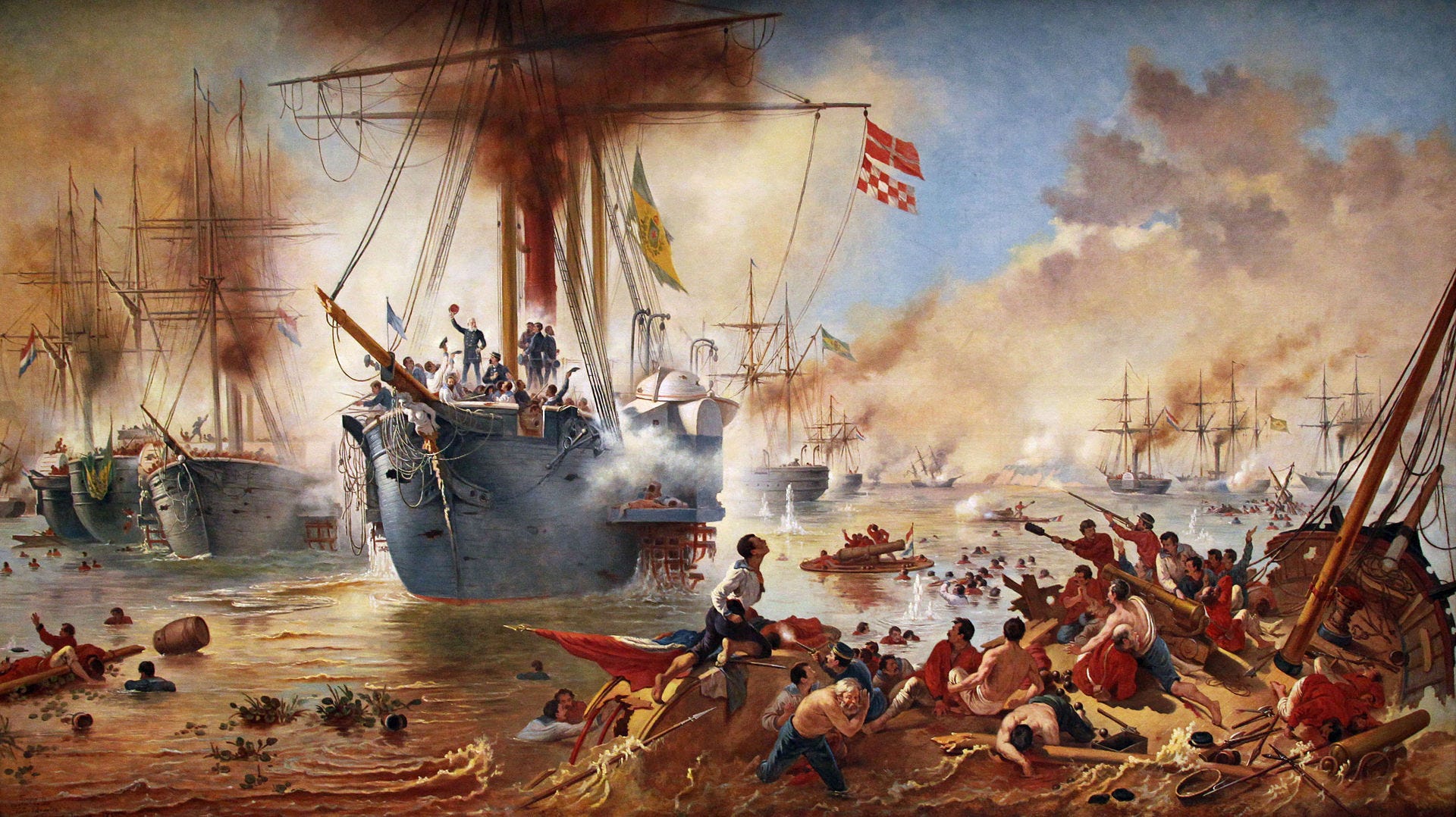
June 11, 1865: A Brazilian naval squadron virtually annihilates the Paraguayan navy in the Battle of Riachuelo, fought on the Paraná River and named for a stream that flowed into that waterway near the site of the engagement. The Brazilian fleet outclassed the Paraguayans, so the Paraguayans initially planned a surprise attack to seize the Brazilian vessels. Paraguayan commander Ignacio Meza abruptly decided to change plans and opened fire on the Brazilians, and after an initially chaotic response Brazilian commander Francisco Barroso used his flagship, the Amazonas, to ram a Paraguayan vessel and turn the tide of the battle. The Paraguayan navy was broken, and this battle is considered a turning point in the 1864-1870 War of the Triple Alliance in that after some initial success Paraguay now found itself on the defensive.
INTERNATIONAL
The United Nations refugee agency’s latest Global Trends Report finds that there were 117.8 million people “forcibly displaced by conflict, violence or persecution” around the world at the end of 2025. The good news is that reflects a 3 percent drop from 2024, which is the first time that number has declined year on year since 2016. The bad news is that number is still extremely high, and there are long-term challenges for both the global capacity to manage this level of displacement and the individual capacity to live displaced lives over periods of years (some 70 percent of current refugees have been in that status for five years or more). The number of internally displaced persons also remains quite high and major new displacements in Lebanon and Iran are adding to that challenge.
The National Oceanic and Atmospheric Administration published an “El Niño advisory” on Thursday, which means that it has observed El Niño conditions and is expecting them to stick. The likelihood of another El Niño has been reported for months now but its onset hadn’t yet been confirmed. Now that it’s clearly here it will likely mean higher average temperatures and more intense weather events moving forward.
MIDDLE EAST
LEBANON
The Israeli military (IDF) killed at least 11 people and injured at least 25 more in airstrikes across southern and eastern Lebanon on Thursday. One of those strikes targeted a residential building near the Hiram Hospital in the city of Tyre and caused “extensive material damage” to several hospital facilities.
ISRAEL-PALESTINE
The IDF killed at least three people in Gaza on Thursday. Meanwhile, negotiations in Egypt involving several Palestinian political factions reportedly ended “inconclusively,” with the groups agreeing to 14 of a list of 15 demands submitted by Donald Trump’s “Board of Peace” but failing to reach consensus on the most significant of those demands: Hamas’s disarmament. Two sources who spoke to Reuters said that “Hamas continues to link full disarmament to launching a political track toward a Palestinian state.”
+972 Magazine is reporting that a recent IDF land grab in the West Bank city of Jenin has raised concerns its long-term plans:
While Israeli land seizure orders are certainly not uncommon in the occupied West Bank, this case has alarmed residents and human rights organizations because the plots are located in Area A. This is the section of the West Bank where, under the Oslo Accords, the Palestinian Authority officially maintains full civil and security control; in Area B, the PA must coordinate security with Israel, while Area C, which comprises more than 60 percent of the territory, remains under full Israeli control.
The PA relayed the military seizure order to landowners in Al-Jabariyat via WhatsApp, with an Arabic-language PDF signed by the Israeli army’s Central Command chief Avi Bluth. According to the document and attached map, the designated plots are being confiscated for “military purposes” and transferred to the relevant defense authorities. The order states that the seizure will remain in effect until the end of 2028, though residents fear the confiscation could become permanent.
Dror Etkes, founder of the anti-settlement watchdog group Kerem Navot, told +972 Magazine that the seizure order and newly-paved military roads clearly indicate Israel’s plans to establish a large military base adjacent to Jenin refugee camp.
While Israel has previously issued a small number of seizure orders affecting Area A, such as for the construction of the separation wall in the early 2000s, Etkes sees the new order as marking a significant escalation. “This is the first time since Oslo that I have seen a seizure order for a military base in Area A,” he said.
It may be the first, but it is unlikely to be the last. And speaking of land grabs, the Israeli cabinet is reportedly considering a $338 million outlay for new West Bank settlement construction, which if approved would be one of the largest single settlement expansions in the history of the Israeli occupation. Cabinet members decided on Thursday to postpone a decision and refer the matter to the security cabinet first.
IRAN
Donald Trump began his Thursday with bellicose threats of another night of US airstrikes on Iran and even more bellicose threats of US forces seizing Iran’s Kharg Island seaport. By Thursday afternoon he had backed down from those threats, once again citing vague and possibly fictional progress in peace talks. Trump declared via social media that he was cancelling the planned strikes “based on the fact that discussions with the Islamic Republic of Iran have been brought to the highest level of Iranian leadership and approved” and claimed that “discussions and final points have been, in both concept and great detail, approved by all parties involved, including the United States, Israel, Saudi Arabia, UAE, Qatar, Turkey, Pakistan, Bahrain, Kuwait, Jordan, Egypt, and others” with the “time and place of the signing to be announced shortly.”
Notably the only real source for any of this is Trump himself. There’s been no definitive comment from any Iranian officials yet as far as I know, though Iran’s Fars news agency has reported that they are “likely” to approve the deal that is currently on the table. Even so, until proven otherwise I would treat this as another round of Trump either consciously manipulating the markets or hallucinating/exaggerating diplomatic progress. There is another possibility, one that I’ve seen speculated on social media, which is that Trump has backed away from the additional demands he added a couple of weeks ago to an earlier ceasefire proposal that appeared to have Iranian approval. If that’s the case then a deal really could be coming together. Whatever is happening, at the very least we can pencil in the resumption of the shooting war for another night.
ASIA
AZERBAIJAN
Responsible Statecraft’s Eldar Mamedov suggests that CNN’s big scoop last week regarding the presence of IDF personnel in Azerbaijan may have come from Israeli sources:
But why are the details being leaked now? While no official claims have been made, one possibility could be that the U.S. and Israel want to ensure Azerbaijan won’t rescind its cooperation. If so, by publicizing the alleged bases, Washington and Tel Aviv are burning Baku’s plausible deniability with Tehran.
This dovetails with a pattern. After the active phase of the war, reports emerged of a secret visit by Israeli Prime Minister Benjamin Netanyahu to the UAE. Emirati officials vehemently denied them, while their Israeli counterparts openly boasted about the trip. The leak may have been at least partially linked to Israeli domestic political considerations — Netanyahu needs to burnish his credentials as a statesman to see off a tough challenge from his main rival Naftali Bennett in elections later this year. But its effect was to further tie Abu Dhabi to Israel’s regional posture toward Iran. The same logic may apply here: tie Azerbaijan’s hands. If Iran lashes out at either UAE or Azerbaijan, or both, the logic presumably goes, they’d have to turn to Israel for protection, thus solidifying their security dependence on Tel Aviv.
So far, Tehran has shown restraint. The Iranian drone attack on Nakhchivan in March — which Aliyev called “an act of terror” — has been interpreted by Iranian sources as a warning shot, not an opening salvo for greater hostilities. Iran has avoided a northern front throughout the war, concentrating instead on the Persian Gulf and its missile exchanges with Israel. If that was indeed Tehran’s message, then it succeeded: despite his vows of retaliation, Aliyev has to date done nothing — and in fact, shipped humanitarian cargoes to Iran soon thereafter.
Neither Baku nor Tehran wanted an open confrontation at that stage, but the more recent revelations can provide fuel for Tehran to act against Baku next time — if the war resumes.
INDIA
The three Indian sailers who went missing when the US military attacked their oil tanker in the Gulf of Oman earlier this week are now confirmed dead. The Indian government says it has lodged a “strong protest” over the incident and I assume it intends to never speak of this again.
AFRICA
SUDAN
Sudan’s Emergency Lawyers activist group is reporting that overnight Rapid Support Forces drone strikes killed at least 23 people in North Kordofan state’s capital, El Obeid. According to local health officials those strikes hit a funeral procession and residential areas in addition to military targets.
ETHIOPIA
Ethiopian officials are renewing their claims that the Tigray People’s Liberation Front is gearing up for another war:
Hardline elements of the Tigray People’s Liberation Front (TPLF), a powerful party with tense relations with Addis Ababa, have “decided to launch an offensive against the federal government in the coming days”, said Ethiopia’s east African affairs minister Getachew Reda and intelligence chief Redwan Hussein.
In an editorial on the website of Al Jazeera, they said the TPLF was preparing to “trigger a new conflict” with the help of Eritrea, which has hostile relations with Addis Ababa.
The TPLF has not yet responded to requests for comment from AFP.
The federal authorities have previously accused the TPLF of growing closer to Eritrea, although the group has denied this.
The TPLF ousted the Tigray region’s interim government back in April, effectively suspending the 2022 peace deal that ended its last war against the Ethiopian government. At this point the situation in Tigray is precarious enough that any spark could ignite a serious conflict.
EUROPE
UKRAINE
The Russian military claimed on Thursday that its forces had captured two more Ukrainian villages in Kharkiv and Donetsk oblasts. Ukrainian officials have not acknowledged these losses nor is there any independent confirmation.
In Crimea, meanwhile, weeks of Ukrainian attacks on oil facilities and supply routes have left the territory scrambling to meet its fuel needs. Gas stations are running dry and fuel trucks are reportedly unable to get to major cities on the peninsula. Ukrainian drone units have particularly targeted the Novorossiya highway, which links Crimea to Russia through southern Ukraine, with the aim of isolating the peninsula from resupply.
UNITED KINGDOM
UK Defense Secretary John Healey resigned on Thursday while castigating embattled Prime Minister Keir Starmer for failing to commit to an increase in the country’s military budget. I mention this mainly to note that we seem to be entering a “last one out please turn off the lights” situation as regards Starmer’s remaining support within the UK Labour Party, though any formal challenge may have to wait for the outcome of Greater Manchester Mayor Andy Burnham’s upcoming parliamentary election.
AMERICAS
PERU
Expatriate election returns have moved Keiko Fujimori into the narrowest of leads in Peru’s presidential runoff, giving her 50.002 percent of the vote to Roberto Sánchez’s 49.998 percent. This effective tie means that the remaining ballots, which are contested and will be subject to judicial review, will prove decisive one way or the other. The loser may have ample cause to object to the outcome.
CUBA
Inkstick’s Tyler Hicks reports on deteriorating conditions in Cuba:
June marks five months since the Trump administration captured Venezuelan President Nicolás Maduro and cut off the oil Cuba received from Caracas, a key ally. The oil blockade marks the latest chapter in Washington’s long-running campaign of economic pressure on Cuba, helping push the island into its deepest crisis in decades.
William LeoGrande, a government professor and Latin America expert at American University, says the Trump administration’s approach to Cuba is fundamentally different from past governments, who often used secret negotiations and incentives to pursue specific goals. LeoGrande says the current strategy relies almost entirely on pressure, sanctions, and threats designed to force political change.
“The fuel thing is the worst, because with fuel people can produce food, they can transport the food from the fields to the cities,” says Anley Benitez, a 42-year-old tour guide on the island.
As a result, food and medicine have become exceedingly rare commodities. A carton of eggs costs the equivalent of hundreds of US dollars (more than many workers make in a month), and even when Cubans are able to locate and purchase food, they find themselves in a mad dash to cook it before the power goes out again. What’s more, hospitals are postponing any treatments they can while struggling to keep patients alive.
UNITED STATES
Amid a wave of anger over Donald Trump’s decision to name Federal Housing Finance Agency director Bill Pulte as his acting Director of National Intelligence, the Republican-controlled US House of Representatives on Thursday voted down a temporary renewal of Section 702 of the Foreign Intelligence Surveillance Act, which allows the federal government to wiretap communications involving foreigners without a warrant. Nearly every Democrat and 19 Republicans voted against the renewal, which was supposed to be an emergency measure before Section 702 expires at midnight on Friday. Conceding to the pressure Trump has now nominated Jay Clayton, US Attorney for the Southern District of New York, as his next DNI. It is unclear whether that will be enough to salvage Section 702 before its expiration.
Finally, the Iran war has pushed the US Strategic Petroleum Reserve to its lowest level since Ronald Reagan was president:
The US Strategic Petroleum Reserve has fallen to its lowest level in more than four decades as the Trump administration continues to draw on emergency oil stockpiles to offset supply disruptions caused by the war with Iran and the near closure of the Strait of Hormuz.
For the week ending June 5, the SPR stood at 349.2 million barrels, according to data from the US Energy Information Administration, just above the 345.7 million-barrel low recorded in August 1983.
As of June 5, the Trump administration had released 66 million barrels from the SPR since the war with Iran began on Feb. 28, according to the US Department of Energy. In March, Trump authorized the release of roughly 172 million barrels from the reserve, or around 40% of the available stockpile, with participating companies pledging to replenish it at a later date.