You’re reading the web version of Foreign Exchanges. If you’d like to get it delivered straight to your inbox, sign up today:
TODAY IN HISTORY
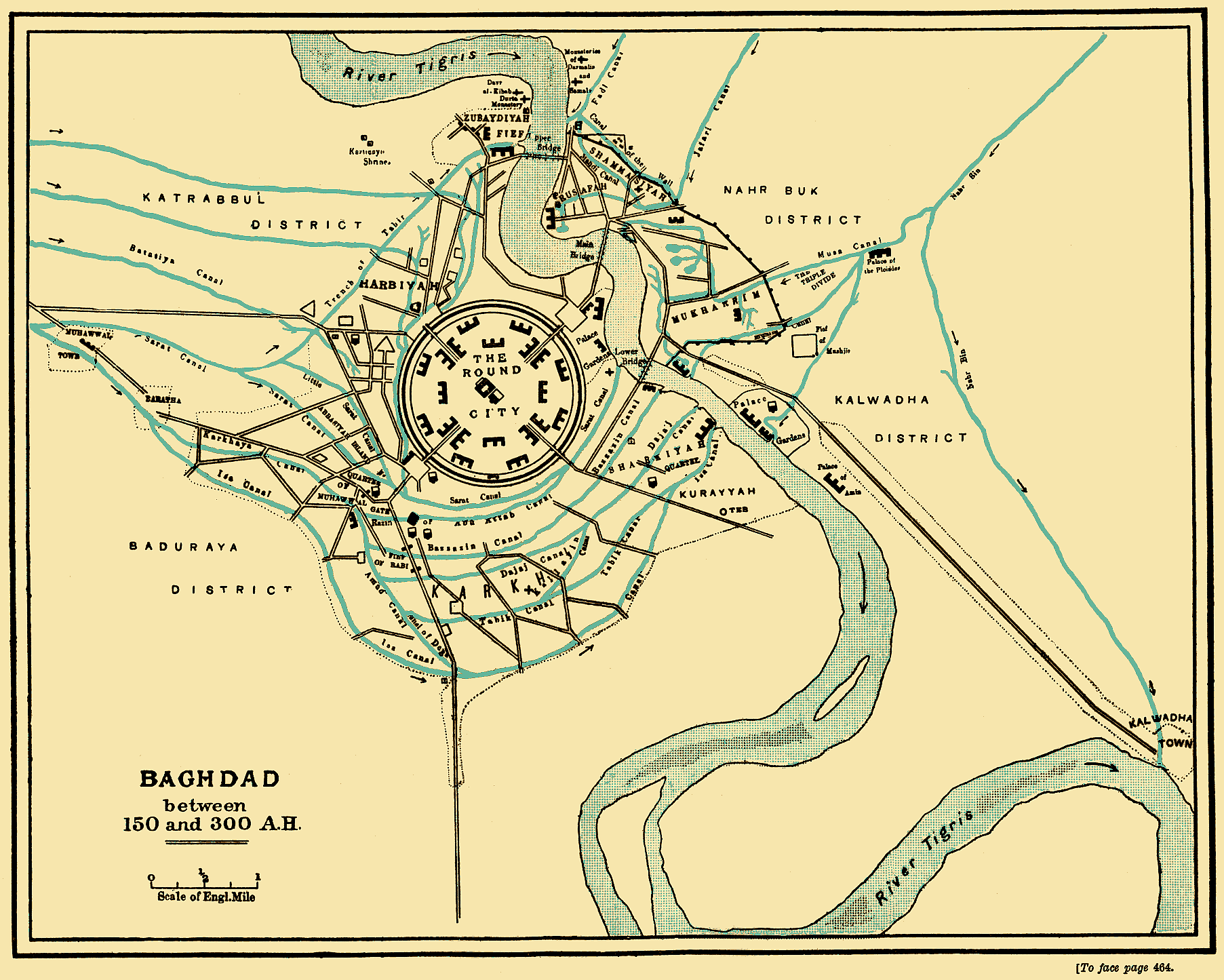
July 30, 762: Abbasid Caliph al-Mansur founds the city of Baghdad as his new capital. Located near the site of the former Sasanian (Persian) capital Ctesiphon, Baghdad replaced the Umayyad capital Damascus as the center of the caliphal court. Officially the new city was called Medinat al-Salam, or “the City of Peace.” It’s not entirely clear why it took the name Baghdad, but the prevailing theory as far as I know is that a village called “Baghdad” stood near the spot where the city was built, and common usage applied that name to the city. Eventually common usage won out. For several centuries Baghdad was arguably the most important city in the world. At its height it may have been home to more than a million people and was world-renowned as a center of learning and culture. Its decline mirrored the decline of the Abbasid dynasty, and the Mongol sack of the city in 1258 proved especially devastating.
July 30, 1619: The Virginia General Assembly meets for the first time in Jamestown. Today the Assembly bills itself as “the first representative government in the New World,” which I guess is true if you ignore the millions of people who were already living there when the first Europeans showed up, many of whom also practiced forms of “representative government.” Anyway this gives the Assembly a claim on being the true forerunner of the modern US government, which must be a source of great pride for everybody involved.
MIDDLE EAST
ISRAEL-PALESTINE
The Israeli military (IDF) killed at least six people in Gaza on Thursday, including two children. IDF officials insist that they were attacking “militants.” Later in the day, after reporting suggested that Hamas and the “Board of Peace” had made significant progress toward a disarmament agreement Donald Trump announced via social media on Thursday evening that the deal was done. Hamas later confirmed that it and the board had concluded what sounds like a somewhat bare-bones agreement on disarmament, with a fuller “roadmap” to be drafted within 14 days (a deadline that can be extended).
Full details are unclear but it basically it sounds like Hamas has expressed a willingness to transfer its weapons in stages to the National Committee for the Administration of Gaza, the “technocratic” Palestinian organ that’s supposed to administer Gaza under the board’s auspices. In turn, the IDF would withdraw from Gaza. There’s a lot that needs to be fleshed out in terms of details, sequencing, timelines, etc., but the more immediate concern may be that the Israeli government has not yet indicated its support. Indeed, reporting prior to Trump’s announcement suggested that it had rejected the emerging Hamas-board agreement. The US could certainly pressure Israel into acquiescence but a disgruntled Israeli government would have ample opportunity to disrupt any agreement.
EGYPT
The Egyptian government now says that it was most likely a drone strike that set fire to two ships in its Damietta port earlier this week. The apparent answer to one question only leads to a second: who is launching drones at Egypt? The New York Times reported the previous day, based on the claims of “two Iranians” (that was it as far as attribution), that the strike was “designed to show that global shipping and energy supplies could be more deeply disrupted if Iran chose to escalate.” That would point toward either Iran itself or one of its regional non-state allies. One such ally, Yemen’s Ansarullah group, denied responsibility on Thursday. The apparent target was a US natural gas tanker, which would also point toward Iran or an Iranian-affiliated entity. The NYT report, thinly sourced as it is, would suggest that this is was a one-off (at least for now) and no additional attacks on Egypt should be expected.
YEMEN
Reuters reported on Thursday that Ansarullah (the Houthi movement) has been carrying out drone strikes on Saudi Arabia from Iraqi territory, “in coordination with Iraqi armed groups.” The US and Saudi militaries carried out airstrikes against Iraqi militias earlier this week partly in retaliation for those strikes. The Iraqi government condemned those strikes as an insult to Iraqi sovereignty and has been demanding evidence that those drone attacks did in fact originate on Iraqi soil. Ansarullah and the militias (or at least some of them) do have a longstanding working relationship based on their mutual ties to Iran, but in recent years they’ve also developed their direct bilateral relationship.
The Guardian reported on Thursday, based on “Yemeni sources,” that the Saudi government “is preparing for a major military offensive against the Houthis by sea and possibly by land in central Yemen.” Saudi forces are reportedly redeploying from eastern Yemen in preparation for a ground campaign that may focus on southern Yemen’s Al-Bayda province. The maritime component appears to be the kingdom’s proposed “multinational military coalition” intended to counter Ansarullah’s challenge to Red Sea commercial shipping. So far 14 countries have declared their support for that coalition, out of 51 countries that the Saudis invited to participate. In terms of military capabilities Turkey and Pakistan are probably the two biggest names on the list. Notably absent is the United States, at least so far. It’s still unclear how the countries that have agreed to participate intend to contribute to the mission.
IRAN
The US military conducted roughly two-hours of airstrikes in Iran overnight in retaliation for the Iranian attack on Jordan’s Muwaffaq Salti airbase earlier this week. Among those strikes was one that reportedly hit a residential building on Iran’s Qeshm island, killing a couple and their child. There’s no word yet as to additional casualties. The Iranians retaliated with strikes on Jordan and Kuwait, killing one worker for an unspecified Chinese company in the latter. At time of writing I had not seen any indication of another round of US strikes so maybe the intention is to go back to the pause that was in place before that first Jordanian strike.
Elsewhere, the Trump administration blacklisted six individuals and organizations on Thursday with ties to Iran’s already blacklisted Mahan Air carrier. The US government has accused Mahan of ferrying Islamic Revolutionary Guard personnel as well as carrying arms and other materiel for the IRGC.
ASIA
NEPAL
Inter-communal violence between Hindu and Muslim populations in eastern Nepal has left at least three people dead and prompted Nepali Prime Minister Balendra Shah on Thursday to “sincerely appeal to the citizens, civil society, religious communities, all respected leaders, all political parties and responsible media, to exercise patience and restraint and maintain peace, harmony, brotherhood and national unity.” According to AFP the violence began on Sunday over some sort of dispute about “loud music and religious flags during a Hindu procession” in Koshi provinces’s Sunsari district. When a crowd began to gather police decided that the best way to get control of the situation was to start shooting people, leaving two people dead. A third person died on Thursday during a protest in neighboring Madhesh province.
MYANMAR
Malaysian Prime Minister Anwar Ibrahim announced on Thursday that Myanmar’s government has agreed to repatriate some 5000 Rohingya refugees. There are around 126,000 Rohingya refugees currently in Malaysia and there’s been an increase in tensions around their presence of late as Rohingya community leaders say their people are being mistreated and harassed. Nevertheless, Anwar’s announcement sparked accusations of refoulement as there does not seem to be any safe way to return those refugees to Myanmar at present. Even if the country’s essentially military government could be trusted to treat them humanely (it cannot be), much of Myanmar is still riven by civil war including the Rohingya homeland in Arakan state.
AFRICA
SUDAN
A new investigation by the AP looks at the extent of the Rapid Support Forces military group’s use of child soldiers:
The teenage boy’s hands and legs were shackled to the anti-aircraft gun mounted on a pickup as Sudanese warplanes attacked. He saw another child chained to the steering wheel.
As their captors sought cover, the terrified children were ordered to stay and shoot down the jets over the capital, Khartoum. If they tried to flee, they’d be killed by their captors — if the planes didn’t get them first.
The boy, now 17, told The Associated Press that those who ordered him strapped to the gun were Colombian mercenaries providing military aid to Sudan’s Rapid Support Forces against the army in the war, now in its fourth year. Another child said he was forced to carry out artillery strikes and beaten for disobedience.
The rare, firsthand accounts show the perils faced by tens of thousands of children believed to have been conscripted into the war by all sides. Six former child soldiers who were abducted and forced to fight with the Rapid Support Forces, known as the RSF, spoke to the AP on condition of anonymity for fear of reprisal. Two said they were trained by Colombians.
Their accounts point to a wider deployment of Colombian mercenaries, who rights groups say were recruited by a state-linked firm in the United Arab Emirates to fight with the RSF. Human rights groups and Sudan’s military accuse the UAE of arming the RSF, and a U.N. panel said it had tracked weapons shipments to the RSF originating in the Gulf federation that includes Dubai.
The UAE continues to deny, in a “who are you going to believe, us or your lying eyes” sort of way, that it is backing the RSF at all. Emirati officials insist that they’ve investigated the firm in question and found that it has “no links to mercenary activity in Sudan.” It’s all very simple and believable, really.
NIGERIA
At Sawahil, Alex Thurston decries the sensationalism of media coverage of Boko Haram and its offshoots, when in his view the group is “fairly boring” and that’s what makes it so dangerous:
But the boring questions are the ones that matter if we want to understand the insurgency’s long life: Why have thousands of people fought and died for Boko Haram? What are the everyday technologies and operational modes - from motorbikes to light arms to munitions captured from the military - that enable the insurgency to notch so many tactical successes? Why have the security forces not been able to defeat the group or to project government authority into rural parts of northeastern (and now northwestern) Nigeria? Who profits from the insurgency, and who is content with the status quo?
The questions are boring - but crucial - in part because Boko Haram and its successor groups resist neat narratives. The groups do not relentlessly expand. The jihadists have not, after fifteen years and counting, captured Maiduguri or Kano or Abuja or Lagos. The kinds of attacks that shock the world - Boko Haram’s bombing of a United Nations building in Abuja in 2011, or the mass kidnapping of the Chibok girls in 2014 - either become infrequent or become normalized. And the villains of yesteryear are gone, leaving behind them figures who illustrate even more the tragic cycles of a self-perpetuating nightmare. In all the coverage I read of the killing of Abubakar Mainok (or Abu Bilal al-Minuki) in a U.S.-Nigerian strike in May 2026, the most striking line came from HumAngle’s Aliyu Dahiru: “Al-Minuki was a product of the insurgency itself.” There was never a single mastermind one could remove from the battlefield and end the movement, even in 2009 - as the Nigerian security forces learned after they killed Muhammad Yusuf. And seventeen years later, the idea of a mastermind driving a mass insurgency is even less plausible. What matters most is that many young men are willing to get on the back of a motorbike and go attack the Nigerian military, or extort civilians for “zakat” in the name of Islam.
EUROPE
UKRAINE
The Russian military’s overnight bombardment killed at least ten people across Ukraine and wounded over 50 more. Six of them, including three children, were killed in Ukraine’s Dnipropetrovsk oblast. As if this were not alarming enough, amid the bombardment one Russian missile apparently crossed into Polish airspace and apparently struck farmland in Lublin province causing no casualties. NATO aircraft scrambled in response to the incursion.
HUNGARY
Amid the other extreme weather effects that Europe is experiencing this summer, the AP reports that the Danube River is drying up:
As wildfires rage in France and Spain and a renewed heat wave is bearing down on Western Europe, a prolonged drought half a continent away is setting record low water levels on one of Europe’s largest rivers, disrupting tourism and industry and confronting residents with the realities of climate change.
The Danube River, which runs through 10 countries from southwestern Germany to the Black Sea, has receded to never-before-seen lows along much of its course, exposing rocks, sand bars and old shipwrecks that have rarely been seen before.
In Budapest, Hungary’s capital, the national water authority measured the Danube’s water level at 23 centimeters (9 inches) on Wednesday morning, well below the previous all-time low of 33 centimeters (13 inches) set in 2018.
The river is expected to further ebb in the coming days with no significant rain in the forecast and temperatures expected to rise to over 38 degrees Celsius (100 degrees Fahrenheit) across the region.
AMERICAS
CUBA
Earlier this year The New York Times reported on a Russian “spy outpost” in Cuba, seemingly confirming an assertion made by the Trump administration. Belly of the Beast’s Reed Lindsay actually visited the side of this alleged facility and apparently found something much different:
For two months, the allegation that Cuba was hosting a major Russian spy base was largely ignored by U.S. media outlets. Then, on March 24, The New York Times published an article by Michael Crowley claiming not only that the Russian spy base exists, but that it “bristles with antennas and other eavesdropping equipment” capable of spying on the U.S. Central Command, the satellite launchpads of Cape Canaveral, and Trump’s Mar-a-Lago residence.
Crowley pinpointed the location: a former Soviet base on the outskirts of Havana called Lourdes that was “temporarily shut” by Vladimir Putin in 2001 but was reopened in 2014, according to the Times.
There is just one problem with this story: the base isn’t there.
The State Department did not respond to a request for comment. Belly of the Beast also sent requests to The New York Times and to Michael Crowley but received no response.
Today, Lourdes (also known as Torrens) is home to Cuba’s University of Computer Sciences (UCI). Belly of the Beast reporters spent the better part of two days walking the campus, searching the grounds and speaking with students, faculty and workers. We found no evidence of an active Russian intelligence base, much less the sort of extensive equipment described by The Times.
UNITED STATES
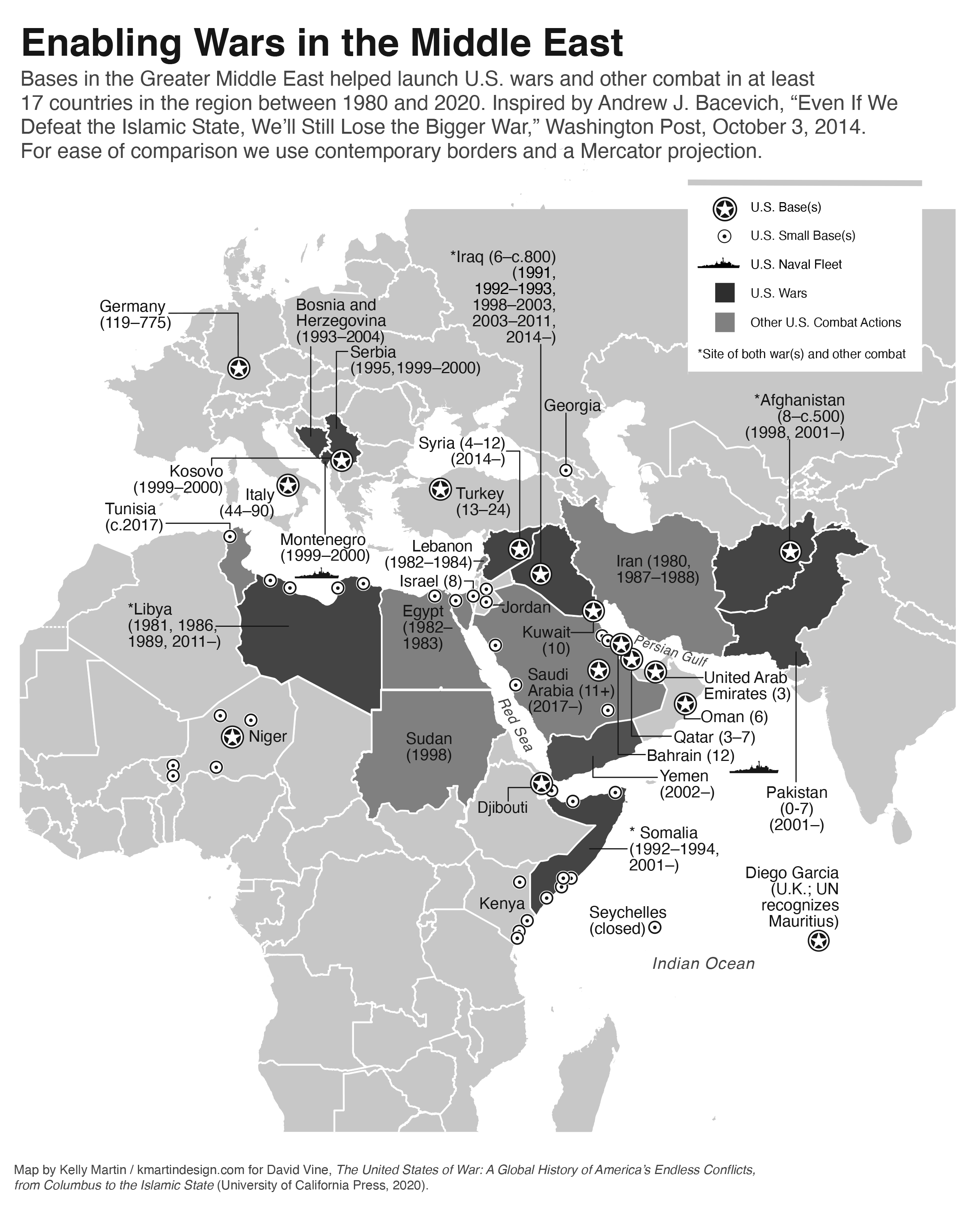
Finally, The Nation’s David Vine expects the Iran war to mark the beginning of the end for US military bases in the Middle East:
Since the illegal war’s first days, US bases have suffered extensive damage from Iranian retaliation. The losses include 18 US military deaths, dozens killed in host nations, and billions in infrastructure costs. This damage and the limited military utility of US installations are forcing a much-needed reconsideration of the US military presence in the Middle East. A growing consensus finds that dramatic changes are needed.
The result will almost certainly be the end of the nearly half-century-long era when scores of US bases have occupied the Middle East. The sooner US leaders accept this reality and start moving the military out of the region, the safer our nation, our troops, and our world will be.
US bases began dotting the Middle East around 1980 when Presidents Jimmy Carter and, after, Ronald Reagan started building installations in response to the Soviet occupation of Afghanistan and Iran’s 1979 revolution. More appeared during the 1991 Gulf War and the 2001 and 2003 wars in Afghanistan and Iraq. They remained long after original rationales disappeared. Today, the military has at least 80 installations in almost every country across the region.
The Iranian military has attacked most countries hosting US bases because they’ve helped enable the US/Israeli war. In addition to the human toll, damage to military infrastructure and hardware runs into the tens of billions of dollars.
US troops have been so vulnerable that military leaders moved many to local hotels and offices, likely violating the laws of war. Iran has made many Middle East installations “all but uninhabitable,” reports The New York Times.