

You’re reading the web version of Foreign Exchanges. If you’d like to get it delivered straight to your inbox, sign up today:
TODAY IN HISTORY
July 22, 1456: An Ottoman siege of the then-Hungarian city of Belgrade (Nándorfehérvár in Hungarian) ends in failure thanks to the city’s strong fortifications and the timely arrival of a relief army under Transylvanian warlord John Hunyadi. The defeat stymied Ottoman Sultan Mehmed II’s (“the Conqueror”) plans to advance west after his conquest of Constantinople and spared Hungary from Ottoman conquest—for a while, at least.
July 22, 1946: Members of the Irgun, a Zionist terrorist group that was one of the predecessors of the modern Likud party, bomb the King David Hotel in Jerusalem and kill 91 people in the process. Their target was the headquarters of the British mandatory authority and the attack was meant as a response to the British arrest of hundreds of Zionist militants in Operation Agatha in late June. Most Zionist leaders condemned Irgun, which in turn blamed British authorities for not evacuating the hotel despite telephoned warnings about the bomb.
July 23, 1319: A Knights Hospitaller-led fleet defeats and virtually annihilates a smaller fleet from the Anatolian Beylik of Aydin in a battle just off the coast of the Aegean island of Chios. The Aydinids controlled the port city of Smyrna (modern Izmir) and established a robust piracy operation in the eastern Mediterranean in the late 13th century. Their defeat at Chios was little more than an inconvenience for that operation, which thrived until a pair of Christian expeditions called the “Smyrniote crusades” took part of Smyrna from them in 1351. But the Hospitaller victory did serve as a model for later (and much larger) naval campaigns against the Ottomans.
July 23, 1952: Egypt’s 23 July Revolution sees the toppling of King Farouk in favor of a military junta led by the “Free Officers Movement.” One of the most consequential acts in 20th century Middle Eastern history, the coup ultimately brought Colonel Gamal Abdel Nasser to power. Suffice to say he turned out to be pretty important.
MIDDLE EAST
ISRAEL-PALESTINE
The Israeli military (IDF) killed at least two Palestinians in Gaza on Thursday after issuing evacuation orders for multiple parts of the territory. Al Jazeera reporter Ibrahim al-Khalili said that some of the IDF strikes targeted “the very areas where people have been told to flee.”
The Integrated Food Security Phase Classification organization warned on Wednesday that over two-thirds of the population of Gaza may be facing “acute hunger” by the end of the year. The main concern in this case is aid cuts due to budget shortfalls. The IPC had been painting a slightly more optimistic picture of conditions in Gaza, though the improvements have been limited to be sure under continued Israeli restrictions, and recent months have seen aid organizations cutting back for lack of resources. The organization also cited “uncertainty over aid groups' access” to Gaza as a complicating factor.
Meanwhile, the IDF is reportedly building an earthwork barrier in Gaza inside its “yellow line” security perimeter. On its side of the line the IDF is reportedly building new bases, roads and other infrastructure on the rubble of destroyed Palestinian residential areas. Both of these strongly suggest that it is not planning to withdraw from its current position within Gaza should the “ceasefire” advance to that point.
YEMEN
Ansarullah attacked two oil tankers in the Red Sea on Wednesday, accusing both of violating the group’s “naval blockade” of Saudi Arabia. Both ships reportedly caught fire but I have not seen any reports of casualties. These are the first Ansarullah/Houthi attacks on commercial ships since they announced the blockade on Monday. Donald Trump declared via social media on Thursday that he “will hold Iran responsible” for future attacks. He added that he was “disappointed with” the Houthis.
Elsewhere, the Houthis reportedly attacked Yemeni military forces in southwestern Yemen’s Dhale province overnight, sparking a battle that left at least four Yemeni soldiers and 23 Houthi fighters dead. There have been reports of additional clashes between Houthi and government forces this week in Yemen’s Jawf, Taiz, and Marib provinces but this Dhale incident seems to have been much larger than those others. And according to Reuters, the Iranian flight that the Saudis and the Yemeni government attacked before it could land at Sanaa airport last week—which led to the Houthi naval blockade—was carrying “Islamic Revolutionary Guard Corps (IRGC) commanders, military advisers and missile- and drone-related equipment.” That would explain why the Saudis attacked it, though it seems like that decision has backfired on them.
SAUDI ARABIA
News broke late Tuesday that the US and Saudi Arabia had reached agreement on a civilian nuclear deal that will see US firms supporting the development of Saudi nuclear power and, potentially, a Saudi uranium enrichment program. The official announcement of that agreement came on Wednesday and as I write this on Thursday the whole thing may be about to collapse after an intervention from Donald Trump.
There are major, legitimate concerns about the proliferation risk inherent to a Saudi enrichment program, nowhere more so than in Israel, which appreciates being the only nuclear-armed state in the Middle East and opposes anything that might threaten that status. It favored a deal structured like the “123 Agreement” that the US reached with the UAE in 2009, which supports an Emirati nuclear program without an enrichment component. That agreement has long been regarded as the “gold standard” for such deals. Israeli officials worry that green lighting a Saudi enrichment program both risks the Saudis developing nuclear weapons and might prompt other countries (Egypt and Turkey being perhaps the likeliest) to pursue their own enrichment programs.
Another consideration from the Israeli perspective is that past US presidential administrations, including this one until a few days ago, had held out the prospect of nuclear cooperation as an inducement to convince the Saudis to normalize relations with Israel. There was nothing in either Tuesday’s reporting or Wednesday’s announcement to suggest that normalization was part of the discussion. Enter Trump, who insisted via social media on Thursday that the nuclear deal “is totally subject to Saudi Arabia joining the very respected and successful Abraham Accords.” That post was quite possibly the first time the Saudis had heard that condition.
The White House is now claiming that the Saudis already knew that the deal was contingent on normalization, but if that were true it would have been the first thing the administration announced. It certainly wouldn’t have waited for Trump to make a hasty after the fact post about normalization in response to criticism. Will the Saudis actually normalize relations with Israel? It’s not impossible, but I wouldn’t say it’s likely. Will the administration insist on normalization? That remains to be seen.
IRAN
Last night marked 12 straight nights of US strikes on Iran and Iranian retaliation against targets across the Middle East, with no sign of any let up on the horizon. Indeed, Donald Trump told Axios on Thursday that he is “considering a massive attack. Bigger than ever before. I am close to making a decision. We are all set for it.” The previous day he took to social media to warn that “any time the Islamic Republic of Iran shoots at a ship in the Strait of Hormuz, whether it be by Missile, Rocket, Drone, or any other device or weapon, the United States will bomb and destroy ONE BRIDGE OR POWER PLANT, including those located next to, or in, the Capital City of Tehran.”
Trump lies a lot, as we know, and he may be trying to bluff the Iranians with all of his recent talk about escalation, but what else can he do at this point? As Laura Rozen points out, there’s nothing happening diplomatically so Trump’s only options seem to be staying the course or escalating. Neither is likely to achieve anything but Trump’s temperament probably inclines him toward escalation.
Elsewhere:
The New York Times reported on Thursday evening that Iraqi Prime Minister Ali al-Zaidi had “carried” a new US ceasefire proposal to Iran that he received during his visit to the White House earlier this month. Iranian officials rejected the offer, with Foreign Minister Abbas Araghchi dismissing it over “America’s outlook, which is illogical, greedy and controlling.”
Between the resumption of the war and the recent Houthi activity in the Red Sea, global oil prices are once again flirting with the $100/barrel mark. During the first phase of the war oil prices seemed to have at least a moderating effect on Trump’s approach, but that may no longer be the case.
Reuters reported on Wednesday that Iranian forces have been so effective at targeting US Central Intelligence Agency facilities in the region that analysts are speculating that they’ve gotten targeting and/or technical assistance from Russia. Iranian strikes have hit at least two CIA posts, the agency’s Saudi Arabia station in Riyadh and another somewhere in eastern Iraq, and possibly more than that. The question of Russian support seems less significant than the fact that these facilities have been hit, but I guess it’s easier for the agency to rationalize those attacks if they’re attributed to Russia rather than Iran.
A New York Times “visual analysis” of sites that have been attacked by Iran recently “show that the country maintains an ability to inflict damage on precise targets, despite the Trump administration’s repeated claims that Iran’s military capabilities have been diminished or destroyed.” Western satellite imagery firms are still complying with the Pentagon’s demand that they not release images of damaged US facilities but the Iranians release their own images and those can be corroborated with other data to show the extent of the damage.
Another satellite analysis from The Wall Street Journal indicates that the Iranian government “has quickly rebuilt infrastructure” that’s been damaged in US/Israeli airstrikes since the start of the war. More quickly, apparently, than “Israeli officials” were anticipating. Suffice to say that Iran’s overall resilience certainly appears to have caught both the Israelis and the Trump administration off guard.
ASIA
PAKISTAN
Militants killed a district judge and a member of his security detail in Pakistan’s Baluchistan province on Thursday. There’s been no claim of responsibility but the attack took place in Mastung district, which is apparently something of a hotbed of Baluch separatist activity.
THAILAND
An attack on a security checkpoint in southern Thailand’s Narathiwat province on Wednesday evening left at least five soldiers dead and six civilians wounded. There’s been no claim of responsibility but this incident came one day after somebody detonated a car bomb outside a police station in the same province (wounding one police officer), so the checkpoint attack may be part of a bigger operation. Ethnic Malay separatists have been engaged in a mostly low-level insurgency in southern Thailand since 2004.
CHINA
Donald Trump announced on Thursday that Chinese President Xi Jinping will visit the US on September 24. Xi will be reciprocating Trump’s visit to China back in May. Trump suggested that artificial intelligence will be a major topic for their summit.
AFRICA
SUDAN
An apparent military drone strike killed and wounded “dozens of people” in southeastern Sudan’s Blue Nile state on Thursday, according to the Emergency Lawyers activist group. The strike hit a group of displaced persons in the Badia region in the southern part of the state.
MALI
The Washington Post reported on Wednesday that White House “counterterrorism” adviser Sebastian Gorka has been pitching Donald Trump on going to war in Mali against the al-Qaeda affiliated Jamaʿat Nusrat al-Islam wa’l-Muslimin (JNIM)jihadist group. If you asked Sebastian Gorka to make a list of the countries he would like the US to bomb and another list of the countries he would prefer the US not bomb the former would almost certainly be much longer than the latter, but his predilections aside JNIM and its allies in the Azawad Liberation Front (FLA) have been posing an increasing threat to Mali’s ruling junta and the Trump administration would like to strengthen US relationships with all three of the Sahelian juntas for multiple reasons. So there’s some logic to this. The catch is that the US would be aiming to do for Mali what it’s been doing for Nigeria, which is killing people—civilians mostly—with no discernible effect on any actual counterterrorism mission.
NIGERIA
Attackers that Reuters is describing as “armed bandits” attacked a number of villages in northwestern Nigeria’s Zamfara state on Tuesday, killing at least 24 people and rustling cattle along the way. The casualty count is likely to rise as authorities continue recovery work.
ETHIOPIA
According to The New Arab’s Saleh Salem, Sudan has been experiencing declining water levels on the Nile River and that has the Egyptian government bracing for downstream effects. The cause, apparently, is a significant reduction in the amount of water being released by the Grand Ethiopian Renaissance Dam (GERD) on the Blue Nile tributary. There’s been no comment from the Ethiopian government but this could obviously escalate very quickly if Egypt sees a severe drop in its water supply.
As we’ve noted previously the GERD is one of several grievances driving the emergency of a regional network that the Egyptian government has been building to counter Ethiopian ambitions. That network has incorporated Sudan’s military government as well as Eritrea and Somalia, two countries whose main concern involves Ethiopian Prime Minister Abiy Ahmed’s desire for a Red Sea port. Increasingly the United States also seems to be involved, though the extent to which it is participating is unclear and its main interest seems to be stability in the Horn of Africa. The Red Sea is already in a degree of turmoil because of the situation in Yemen and the Iran war (see above), so more turmoil on the African side would be unwelcome to say the least.
DEMOCRATIC REPUBLIC OF THE CONGO
The DRC’s Ebola outbreak topped 1000 deaths on Wednesday (1031 to be specific), according to Africa Centers for Disease Control and Prevention director Jean Kaseya. It is now the “fastest Ebola outbreak in history” and it is still unclear whether/when effective vaccine against or treatment for the relevant species of ebolavirus (Bundibugyo) will be forthcoming. Health officials continue to struggle with containment efforts, owing to a combination of regional violence, geographic remoteness, and the distrust of local communities. All of those challenges are compounded by the fact that the outbreak was identified late (largely because of the rarity of the strain) and so containment efforts began late.
EUROPE
RUSSIA
The Financial Times reported on Thursday that the cumulative effect of Ukrainian attacks on Russian oil refineries is forcing Moscow to import fuel from India. A shipment of some 42,000 metric tons of gasoline is expected to arrive in Russia on Sunday, according to maritime tracking information. Russia is also apparently importing refined fuel from Belarus, which like India is a major customer for Russian crude. Damage from those Ukrainian strikes has reduced domestic refining capacity to such an extent that there are now fuel shortages across much of Russia and the government announced plans to import fuel last month.
The European Union reached internal agreement on a 21st major round of Russia sanctions on Thursday. The package blacklists 218 entities and individuals, including dozens of Russian banks and cryptocurrency outfits. The Greek government had been holding out but came on board in exchange for a one-year (renewable) exemption “allowing EU companies to transfer Russian liquefied natural gas to third countries.”
UKRAINE
Russian and Ukrainian attacks killed at least 8 people on Thursday. Ukrainian strikes killed two people in Crimea and two more, including a three year old child, in Russia, while Russian strikes killed four in Ukraine’s Dnipropetrovsk and Sumy oblasts. On the front line, the Russian military claimed the capture of the village of Bilytske in Ukraine’s Donetsk oblast, which would probably be more impactful had they not also captured it in December. Either the Russians were fibbing back then or this is regaining territory that they had subsequently lost.
ALBANIA
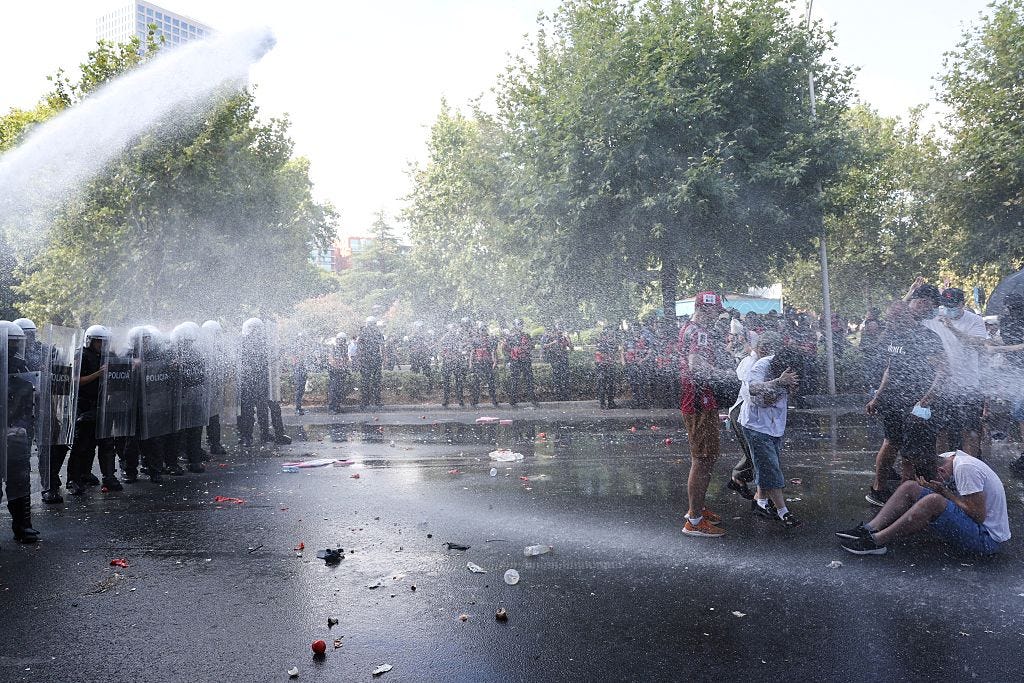
Protesters in Tirana demonstrating against Jared Kushner’s plan to destroy a protected Albanian ecosystem in order to build a resort met with a heavier-than-usual police response on Thursday, as Reuters reports:
AMERICAS
ECUADOR
At Drop Site, Camila Lourdes Galarza reports on a recent murder that may have had political, or geopolitical, connections:
Alexandra Bravo, the prosecutor assigned to investigate U.S. strikes on three Ecuadorian boats and the 36 survivors’ subsequent accounts of torture and kidnapping, was shot dead in the coastal city of Manta last month. According to police, on June 14 a hitman aboard a black motorcycle opened fire on Bravo as she and her sister were leaving a café at about 11 a.m. Bravo’s sister, who jumped to protect her, was also killed in the attack.
Upon arriving at the crime scene, officers say they found five 9mm shell casings and Bravo’s injured driver, but no sign of the police detail that had been assigned to protect her. The Police Directorate, which operates entirely under the executive branch, has launched a probe to determine if there’d been an internal security breach.
Bravo is the 26th member of Ecuador’s justice system to be assassinated since 2020 and the second individual investigating state crimes murdered that week. Besides her usual caseload of homicide and organized crime, Bravo had been working the Fiorella, Negra Francisca, and Don Maca cases—a series of drone attacks on civilian fishing ships exposed by Drop Site in April. Two of the boat’s crews returned home and reported being abducted, blindfolded, and starved for eight days by American gunmen in U.S. military uniforms aboard a U.S.-flagged patrol ship, before being abandoned in El Salvador. The UN Committee on Enforced Disappearances endorsed the calls for an investigation, demanding that the U.S. provide information on the whereabouts of the eight still-missing men and any involvement in the matter by April 27. To date, the United States has not responded.
Under Ecuador’s right-wing president Daniel Noboa—a Miami-born billionaire often characterized as a “U.S.-backed dictator”—the country has become a central testing ground for Operation Southern Spear, Washington’s extrajudicial bombing campaign purporting to target “narco-terrorists,” which has killed 221 people to date. There is no evidence that many of the victims, including those in Bravo’s investigation, had engaged in drug trafficking.
UNITED STATES
The Trump administration rolled out its new tariff package on Thursday, targeting 60 countries with levies between 10 and 12.5 percent on the claim that they have failed to enforce bans on exports manufactured by forced labor. These measures fall under Section 301 of the Trade Act of 1974 and are expected to be more legally robust than the tariffs that Trump imposed last year that the US Supreme Court struck down in February. The administration is likely to impose additional Section 301 tariffs but is still “investigating” those claims.
Finally, and on a related note, World Politics Review’s Judah Grunstein considers America’s apparently diminishing international prestige:
A closer look at the country-by-country results suggests that a good deal of the popular backlash to the U.S. stems from Trump’s tariffs, particularly in South and Southeast Asia. Seven of the nine countries where America’s favorability rating lagged that of China by 20 percent or more were hit hard by Trump’s trade war, including Malaysia, Indonesia, Sri Lanka and Bangladesh. Elsewhere, like Mexico and Canada, a combination of tariffs and sovereignty concerns due to Trump’s provocations and threats were likely factors.
The low favorability for the U.S. among its NATO allies suggests a reaction to Trump’s disregard for the alliance. That his confidence rating is near or below 20 percent in Italy, Greece and Turkey—where it is at just 6 percent—makes it clear that Trump’s close ideological alignment with foreign leaders does not necessarily endear him to their populations.
There is also something to be learned, however, from the countries where favorability of the U.S. not only outpaces that of China but remains solid and even high: Poland, the Philippines, South Korea, India, Japan and Israel. All face significant security threats on their land or maritime borders, and all except India* depend heavily on the U.S. for security guarantees, even as all except Poland were hard hit by Trump’s tariffs. This suggests that Trump could be turning the “Two Asias” phenomenon—developed by Evan Feigenbaum and Robert Manning back in 2012 to describe the region’s preference for security ties with the U.S. and economic ties with China—into a global dynamic.
We also shouldn’t ignore the five countries where respondents’ views of the U.S. and China were roughly equal and generally favorable for both: Brazil, Colombia, Nigeria, Kenya and Ghana. All have historically maintained relatively close political ties with the U.S., particularly Colombia and Kenya, but all have also benefited significantly from Chinese trade and investment.
One might expect popular opinions of the U.S. in these countries to be more negative, given America’s spotty historical record in South America and its general neglect of Africa. Instead, these countries’ populations clearly still consider America to have something valuable to offer. But their equal esteem for China suggests they do not wish to choose between the two global powers in what Washington has increasingly framed as a zero-sum strategic competition.
Though most of the shift appears to be Trump-related, Grunstein does note that US global support did begin to decline during the last two years of the Biden administration, likely related (at least in part) to its decision to enable Israeli atrocities in Gaza.