

You’re reading the web version of Foreign Exchanges. If you’d like to get it delivered straight to your inbox, sign up today:
TODAY IN HISTORY
July 21, 1774: The Treaty of Küçük Kaynarca ends the the Russo-Ottoman War of 1768-1774 on decidedly Russian terms. Although the Russians did agree to return territory they’d occupied in Moldavia and Wallachia, the Ottomans gave them control of the city of Azov and thereby satisfied a long-standing Russian desire for a Black Sea port. The Ottomans also agreed to recognize the “independence” of the Crimean Khanate, which in practice meant that it and the Crimean peninsula quickly came under Russian domination. But most significantly they agreed to allow Russia to build and “protect” an Orthodox church in Constantinople, a stipulation the Russians stretched to grant themselves a protectorate over all of the Orthodox subjects of the Ottoman Empire. That assertion, as well as concerns among the other European powers about the growth of Russia, eventually contributed to the Crimean War.
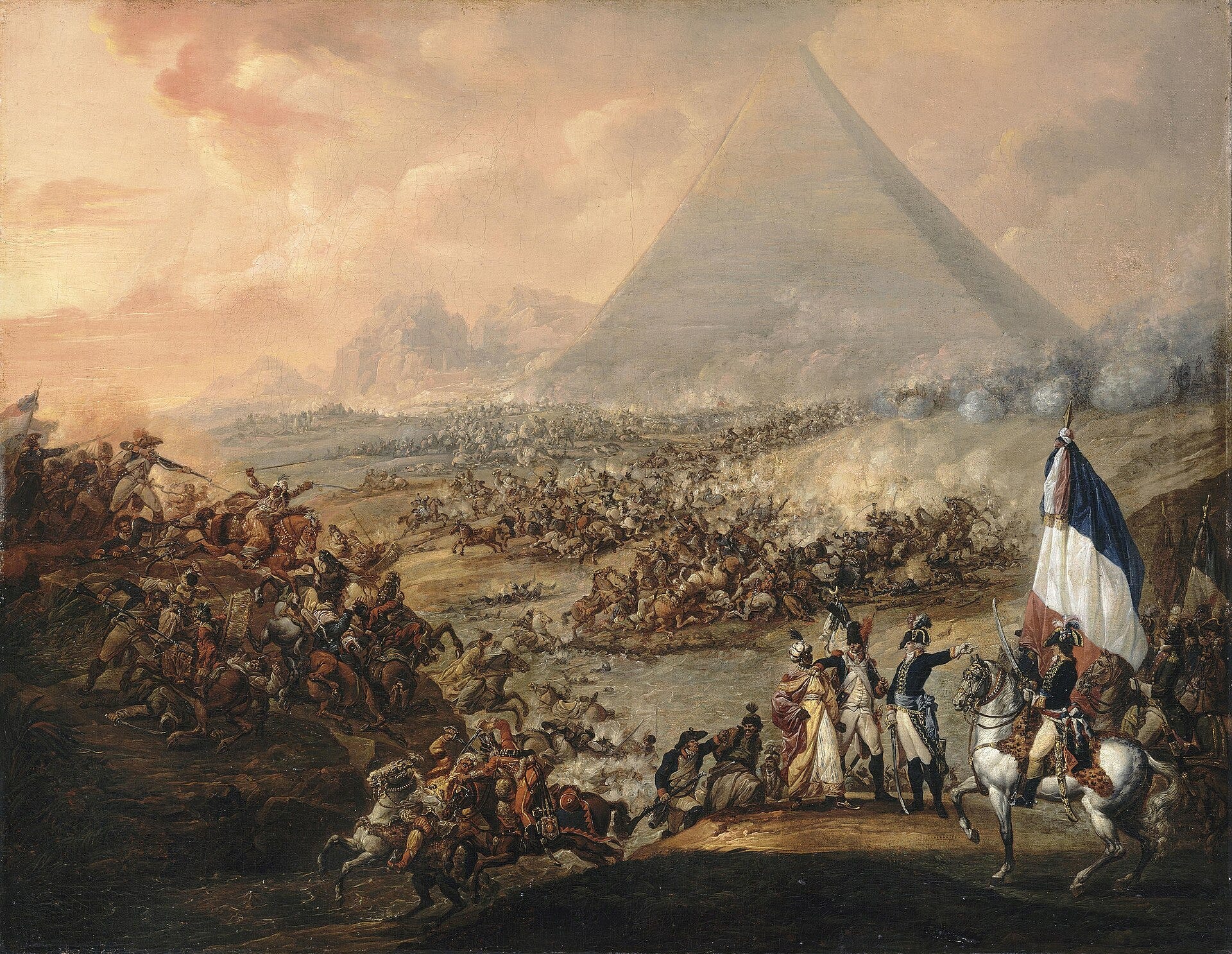
July 21, 1798: Napoleon’s expedition defeats the Egyptian Mamluks at the fancifully named “Battle of the Pyramids.” Unable to invade Britain, Napoleon determined that the best course of action for the French revolutionary government would be to conquer itself a major colony in the eastern Mediterranean that might, over time, threaten Britain’s hold over India. Napoleon also had dreams of conquering his own world empire in the image of Alexander. Egypt was nominally part of the Ottoman Empire but really ruled by the Mamluks and Napoleon believed it was ripe for invasion. His army overwhelmed the Mamluks at Imbaba, which was really too far away from the pyramids to name this the “Battle of the Pyramids” but I digress. Napoleon’s position in Egypt remained unassailable for about a week and a half before the British fleet destroyed his at the similarly misnamed “Battle of the Nile.”
MIDDLE EAST
LEBANON
The Lebanese army entered the village of Zawtar al-Gharbiyah on Tuesday to kick off the first phase of the “pilot program” under which the Israeli military (IDF) is supposed to gradually withdraw from southern Lebanon. According to The New Arab, “residents and local officials” are questioning whether the IDF was ever occupying the village in the first place, adding to speculation that its initial “withdrawals” from this and two other locations don’t involve any actual withdrawing. Lebanese units did apparently get close enough to nearby Israeli forces as they were entering the village that the latter fired “warning shots” to scare them off, so that does indicate that the IDF is at least in the area.
Lebanese President Joseph Aoun was at the White House on Tuesday, discussing Hezbollah’s disarmament and the IDF’s theoretical departure from Lebanon with Donald Trump. The only substantive outcome I’ve seen is that Trump announced that he’s authorizing US airlines to fly direct to Lebanon. The US government banned Lebanon’s flag carrier, Middle East Airlines, back in 1985 and since then travelers have had to make at least one stopover to fly between the two countries.
ISRAEL-PALESTINE
The IDF killed at least 12 people in Gaza on Tuesday, including six members of a single family in one overnight strike in Gaza city. According to the United Nations Human Rights Office, Israeli attacks killed at least 57 Palestinians in Gaza between July 13 and July 20. Many of those strikes have targeted residential districts or displacement camps and more than half (34) of the deaths have occurred in locations nowhere near the IDF’s “yellow line” security perimeter.
YEMEN
The Ansarullah/Houthi “naval blockade” of Saudi Arabia appears to be having immediate effect, as two tankers carrying Saudi oil in the Red Sea turned around on Tuesday after the group threatened to attack them. The vessels had been heading for the Bab el-Mandab strait near Yemen but now appear to be sailing north toward the Suez Canal. As both of them were bound for Asian ports the detour will significantly complicate their itineraries. The Houthis have also reportedly sent an email to shipping companies around the world advising them that “vessels are banned from loading or discharging cargo at or from any Saudi ports” and recommending “that [they] exercise due diligence and the utmost care in all [their] dealings.”
SAUDI ARABIA
The Wall Street Journal reported Tuesday night that the Trump administration has reached agreement with the Saudi government on a nuclear deal that could wind up giving the kingdom its own uranium enrichment program:
The new deal, which would last 30 years, is estimated to be worth tens of billions of dollars. It is designed to give American companies a central role in developing Saudi Arabia’s nuclear infrastructure while shutting out other foreign competitors.
A key provision of the new accord would have American companies build a uranium enrichment facility in Saudi Arabia if a joint U.S.-Saudi study determines such a step would be warranted.
That stipulation would give the U.S. influence over the Saudi nuclear program and, Trump administration officials argue, a way to prevent it from being misused for military purposes.
Yet the deal, which is expected to be submitted to Congress for review in the coming days, is certain to prove controversial among many lawmakers who oppose the spread of nuclear technology in the volatile Middle East.
Legislative opposition is irrelevant since Congress will have to actively vote to block the deal and even if it does Trump will be able to veto the block. But concerns about the Saudis weaponizing an enrichment program are just as valid as similar concerns about Iran’s enrichment program. The administration’s assurances that there’s no reason to be concerned don’t exactly carry a lot of weight given that a) this administration is generally incompetent and b) the Trump family is financially beholden to the Saudis.
IRAN
Donald Trump suggested to reporters on Tuesday that the US military could attack Iran’s “Pickaxe Mountain” (Mount Kolang) nuclear facility soon, and online chatter suggests that “soon” could be a matter of days or even hours as I write this. The Wall Street Journal reported earlier on Tuesday that “Israeli intelligence believes Iran moved thousands of uranium-enrichment centrifuges” into the “Pickaxe” facility after last year’s “12 Day War,” presumably with the intent of establishing it as a new, hardened enrichment facility. Trump has been hyping a potential strike on the facility for several days now. Given its location and estimated depth there is no consensus as to whether or not the US military has the capability to damage the site directly, but it can at least damage its external features and maybe hope to cause a landslide or other aftereffect that would render the site unusable even if it remains intact.
An attack on the “Pickaxe” facility could draw a significant retaliation from an Iranian government that has learned its lesson after responding fairly mildly to last year’s US strikes on its nuclear facilities only to wind up back at war a few months later. Whatever Trump decides to do from here, though, the really exciting news is that even his own intelligence agencies don’t think it will make any difference:
Iran’s government is unlikely to feel significant impact or soften its negotiating position as a result of new rounds of U.S. military strikes like those now underway, according to a new intelligence assessment described by current and former U.S. officials.
Analysts at American spy agencies also have concluded that Tehran and Washington are, for now, stuck in an indefinite limbo between peace and war, the officials said — an uneasy dynamic given the increasingly deadly nature of the tit-for-tat hostilities between the two nations. The current and former officials spoke on the condition of anonymity to describe the assessments because of their sensitivity.
The findings, which have been briefed to the administration, appear to underscore the dilemma President Donald Trump faces in a war that he and Israeli Prime Minister Benjamin Netanyahu began in late February.
Trump’s current course of ever-expanding attacks appears to have led to a stalemate. But with the war deeply unpopular at home, continuing escalation by the United States, such as the possible introduction of ground troops, poses political risks for the president with no guarantee of military success.
It may be trite to ask what we’re doing here, but really what are we doing here?
ASIA
INDIA
The leader of India’s “Cockroach Janta Party” protest movement, Abhijeet Dipke, announced in a press conference on Tuesday that his group will continue to protest against the Indian government but will no longer stage any marches through New Delhi. Protesters did attempt to march through New Delhi on Monday and wound up facing an intense police crackdown that, according to Dipke, left some 150 of the demonstrators wounded. The “CJP” is the result of mounting youth grievances around unemployment and cost of living, but of late it’s been calling for the resignation of Education Minister Dharmendra Pradhan after irregularities forced some 2.2 million medical school applicants to retake their entrance exams. The fallout of that snafu reportedly included at least 12 prospective students taking their own lives.
JAPAN
A Chinese destroyer apparently conducted live-fire drills in an area that the Japanese government claims as part of its maritime economic zone on Sunday. The incident took place in the context of a Chinese-Russian naval exercise around 180 kilometers off the coast of the island of Okinotori. Countries can claim “exclusive economic zone” rights up to 200 nautical miles offshore, which is around 370 kilometers. However, while Japanese officials have expressed concern over the drill, the Chinese government has pushed back, arguing that Okinotori—an atoll well south of the main Japanese islands—is a “rock” rather than an island and therefore does not have an EEZ. In fairness, other regional governments have also disputed that Japanese claim.
AFRICA
SUDAN
A drone strike killed at least 21 people in the town of Tina in Sudan’s North Darfur state on Tuesday. The Rapid Support Forces militant group was most likely responsible given that it has recently been stepping up its attacks on the town, which is controlled by the pro-military “Joint Forces” militia alliance. Tina’s location along the Chadian border makes it particularly attractive for the RSF. Further north, the Sudanese military has reportedly been deploying forces to the “tri-border” region in northwestern Sudan (a region that at various points borders Chad, Libya, and Egypt) in apparent preparation for an offensive there. The military withdrew from that region last June, leaving it to the RSF.
KENYA
Last week the CEO of the NGO Samaritan’s Purse, Franklin Graham, told Reuters that seven of the group’s employees were quarantining in Kenya after spending time in the Democratic Republic of the Congo supporting the Ebola response effort there. The US government recently imposed a 21 day “third country” quarantine requirement on any American leaving the DRC so that tracks. What doesn’t track is that the Kenyan government supposedly suspended construction on a US quarantine facility at Kenya’s Laikipia airbase late last month amid public outcry and several court orders to halt the project. Graham’s revelation made it clear that the facility has been built anyway and Kenyan activists are demanding some answers from the government.
EUROPE
RUSSIA
The Indian Foreign Ministry summoned Russia’s chargé d’affaires in New Delhi on Tuesday to protest the killing of four Indian nationals in Ukraine over the weekend. They were among the ten crew members killed when a Russian strike hit a cargo vessel as it was leaving Ukraine’s Odesa seaport. Kremlin spokesperson Dmitry Peskov told reporters that Indian and Russian officials are “in touch” about the incident.
UKRAINE
A Russian strike hit an apartment building and killed at least three people in the Ukrainian city of Zaporizhzhia on Tuesday. The attack came on the same day that the UN Human Rights Monitoring Mission in Ukraine released its official civilian casualty figures for the first half of this year, which as we’ve noted represent a substantial increase over the same period last year.
Ukrainian President Volodymyr Zelensky gave in to days of protests and public outcry on Tuesday by sacking top military commander Oleksandr Syrsky. There have been calls for Syrsky’s removal since Zelensky fired former Defense Minister Mykhailo Fedorov last week and insisted that personal animosity between the two men had made it impossible to keep them both on the job. Fedorov proved to have been more popular than Syrsky. Zelensky named Mykhailo Drapaty as Syrsky’s replacement and has reportedly offered Fedorov a new unspecified position in his government, though there’s no indication that Fedorov will accept it.
AMERICAS
ECUADOR
A new report from Human Rights Watch suggests that increasing US-Ecuadorian cooperation on security and counternarcotics operations has come, go figure, at a cost to the human rights of ordinary Ecuadorians:
The United States and Ecuador are deepening their security cooperation against a backdrop of serious human rights violations by Ecuadorian forces, unexplained drone attacks on fishing boats, and the disappearance of several fishermen, Human Rights Watch said in a report released today. The US Congress should urgently scrutinize these incidents and the broader security relationship between Ecuador and the United States.
The 94-page report, “A Dangerous Partnership: Abuses, Unanswered Questions, and US-Ecuador Security Cooperation,” documents serious human rights violations in a rural community on the Colombia-Ecuador border, as well as attacks on and the disappearance of fishermen at sea near the Galápagos Islands. Each incident either clearly implicates the US-Ecuador security partnership or surfaces questions about responsibility. Ecuadorian forces tortured and arbitrarily detained four farm workers, and later burned and struck a dairy farm, during what the United States called a “partnered operation.” And drones of unknown origin attacked two fishing vessels, injuring several crew members. A third vessel remains missing.
“US-Ecuador cooperation on security has been too opaque and too dangerous for Ecuadorians,” said Juanita Goebertus, Americas director at Human Rights Watch. “Before more harm is done, the US Congress should demand real answers and effective safeguards.”
CUBA
A US humanitarian aid flight headed to Cuba on Tuesday, the first sign of the $100 million aid package that the Trump administration promised to send to the island back in May. Hey no rush, I mean it’s not like conditions are bad there right now.
On Monday the US State Department published a report in which it decreed that Cuba is the “Capital of 21st Century Communism” and claimed that the Cuban government’s goal since the 1959 revolution that brought it to power has been “conquering the neighboring United States.” This is absurd even by normal US foreign policy standards, but hyping a country that can’t even maintain its power grid as an existential threat serves two purposes. First it attempts to justify a future US military operation, which is almost certainly coming if/when the administration finally ends its war with Iran or at least winds it down to a more manageable level. Second, it aims to tie the administration’s domestic opposition to a nefarious foreign enemy to justify a crackdown that also seems to be on the horizon.
CANADA
Canadian Prime Minister Mark Carney told reporters on Tuesday that he and Donald Trump have agreed “to accelerate trade talks” in an effort to avoid the 50 percent tariffs that the US is about to impose on Canadian products. They have until August 19, when those duties are supposed to take effect. They’re estimated to impact around $20 billion in Canadian exports to the US. The Trump administration is accusing the Canadian government of discriminating against several categories of US products including alcoholic beverages and automobiles.
UNITED STATES
Finally, in US news:
After his recent forays back into the wonderful world of tariffs with respect to Canada (see above) and Brazil, The Financial Times reports that Donald Trump intends to keep going. The across the board 10 percent tariff he imposed back in February, after the US Supreme Court terminated most of the tariffs he imposed last year, will expire on Friday and the administration has apparently been amassing what it expects to be a more legally rigorous package of duties to replace that one. Mainly they’re focused on “forced labor” claims (the actual forced labor being incidental to the justification for tariffs), but “other investigations” may offer Trump additional tariff latitude. It remains to be seen how wide-reaching these new duties are going to be, especially with the midterm congressional election looming and polling already suggesting that voters have soured on Trump over cost of living issues.
A new report from the Foundation for AIDS Research (amfAR) finds that the Trump administration’s foreign aid cuts have significantly disrupted HIV/AIDS relief efforts around the world, particularly with respect to programs related to HIV prevention. The report is based on a survey of organizations that are or were working with the President’s Emergency Plan for AIDS Relief (PEPFAR). It may underestimate the extent of the disruption, because local organizations that were critically impacted by the aid cuts may have been unable to respond to the survey or may not even exist anymore.
The Pentagon acknowledged on Tuesday that Iranian attacks have wounded nearly 100 US military personnel since the war resumed earlier this month. That admission came one day after The New York Times reported that Pentagon officials had been covering up “dozens” of injuries from recent Iranian attacks on US bases in Jordan alone. US military facilities have also suffered “significant” damage since the conflict resumed, according to The Intercept. The Pentagon’s Defense Casualty Analysis System does not appear to have been updated to reflect these latest casualties.
US Defense Secretary Pete Hegseth told a Senate Appropriations Committee hearing on Tuesday that the Pentagon estimates that the Iran war will cost “$37.5 billion through the end of September.” This is, to put it as elegantly as possible, a crock of shit.
The accusation that Cuba has been trying to conquer the United States isn't meant to be taken seriously by anyone. It's a taunt; to give a justification that literally no one believes is to say that you don't need a justification. There's something to be said about the starvation of Cuba shifting from a quiet cruelty to a spectacle of cruelty, and how supporters of the policy are so titillated by the impunity with which we pointlessly torture the island.