

TODAY IN HISTORY
July 17, 1203: In what could be considered a dry run of their later conquest of the city, the armies of the Fourth Crusade attack Constantinople and force the Byzantine Emperor, Alexios III Angelos, to flee into exile. The Crusaders had been enticed by Alexios’ nephew, also named Alexios, with promises of financial support if they put him upon the throne. A couple of things then went very wrong. First, the people of Constantinople restored the younger Alexios’ father, Isaac II, to the throne contrary to the Crusaders’ wishes (and despite the fact that Alexios III had blinded Isaac when he took power). Second, the now co-emperor Alexios IV found himself unable to make good on his financial promises, and his costly attempts to do so drew outrage from Constantinople’s residents. When Isaac died in January 1204 the people revolted and overthrew Alexios IV, prompting the Crusaders to launch another, substantially more consequential, assault on the city.
July 17, 1936: The Spanish military, led by a cadre of nationalist officers including Francisco Franco, begins a coup against Spain’s Popular Front government starting in Morocco, the Canary Islands, and the Balearic Islands. The intent was to secure those outlying areas before swiftly moving into Spain proper to oust the government the following day, but the effort quickly stalled and the result instead was the Spanish Civil War. Franco and the Nationalists ultimately won but only after hundreds of thousands were killed.
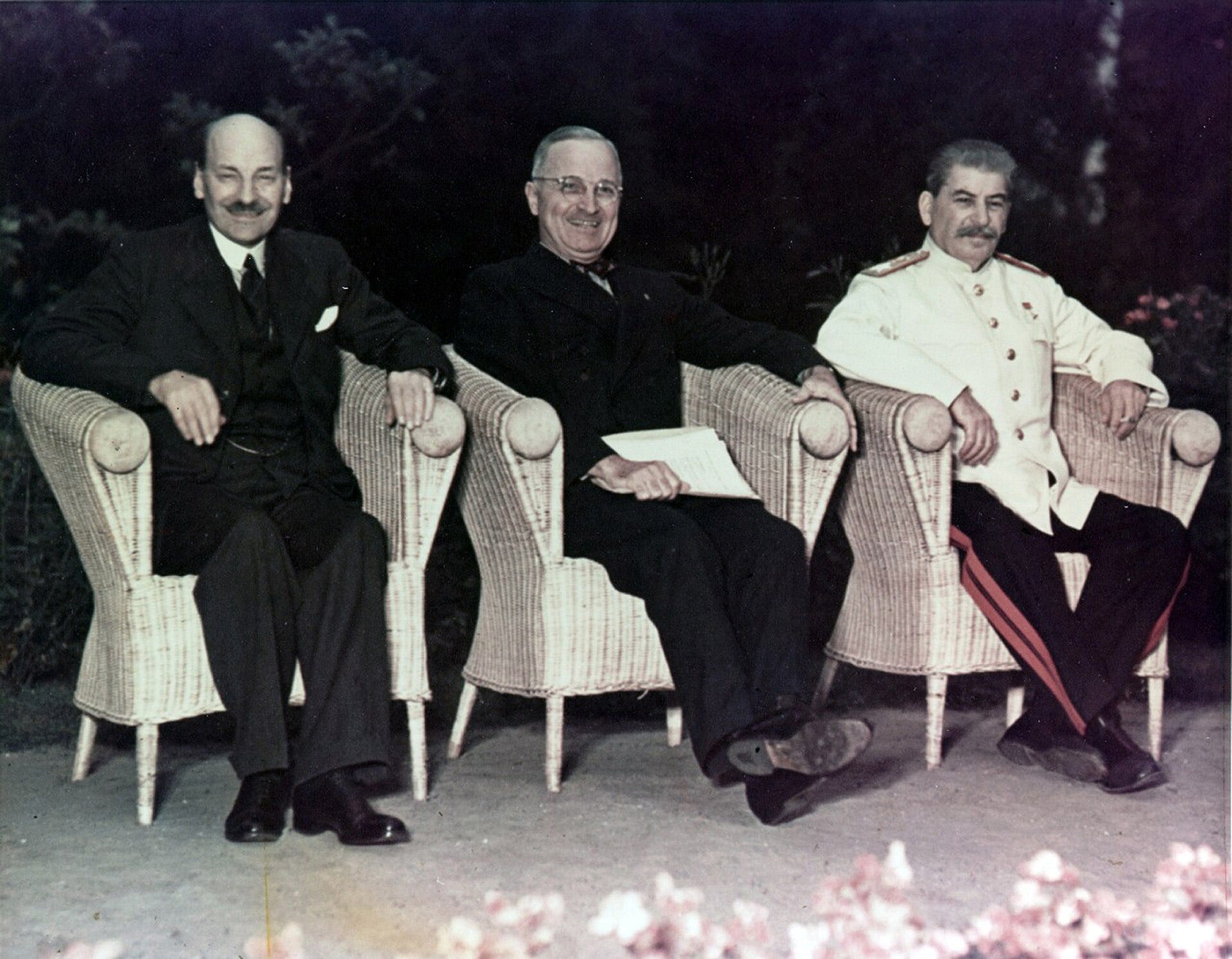
July 17, 1945: Leaders of the three Allied nations—Winston Churchill, Josef Stalin, and Harry Truman—meet in Postdam to hash out details concerning the end of World War II in Europe. On August 1 the leaders of the three countries—Churchill having been replaced by Clement Attlee in the interim because of the Labour Party’s victory in the UK’s July 5 election—released the “Potsdam Agreement,” which mostly set out terms for the post-war occupation and reconstruction of Germany.
July 17, 1968: In a bloodless coup sometimes called the “17 July Revolution,” the Iraqi Baath Party ousts President Abdul Rahman Arif and takes power under its leader, Ahmed Hassan al-Bakr. To this day the circumstances surrounding the coup remain murky, but the result is not—the Baathists controlled Iraq until the US invasion in 2003 ousted them. Bakr himself hung around until 1979, all the while slowly losing authority to his deputy, Saddam Hussein, until Hussein forced him out and assumed the presidency himself.
MIDDLE EAST
LEBANON
With the United Nations peacekeeping mission in Lebanon (UNIFIL) winding down toward closure at the end of the year, Foreign Policy’s Anchal Vohra reports on the options being considered for its replacement:
The United Nations has outlined three options, with proposed troop numbers varying from nearly 2,000 to around 5,500. Their ability to support the Lebanese military declines with the numbers and capabilities allocated.
This could be seen as a reformed UNIFIL. But different actors have different propositions in mind. Israelis prefer it to be an American enterprise. France wants to maintain its sway in the region and is forming a coalition of willing countries that may deploy troops post-UNIFIL. There is also chatter about a Turkey-led NATO-backed deployment.
These ideas are not mutually exclusive. Elements of each could ultimately be combined and turned into an international stabilization force— a model that hasn’t yet taken off in Gaza but is more likely in Lebanon, which has a functioning state and an army.
“It is possible to do this in Lebanon,” a senior European diplomat, speaking on condition of anonymity, told me. “Because it has a state, a government.”
The assertion that Lebanon “has a functioning state and an army” is at best debatable, but leaving that aside there’s a conundrum here. The Israelis and the US want any replacement force to take a more active role in combating Hezbollah than UNIFIL has been mandated to take, but none of the countries that might contribute to the replacement force wants to put its military personnel in a potential combat situation in the middle of a potential civil war. Even the US likely wouldn’t contribute personnel for such a mission.
