

TODAY IN HISTORY
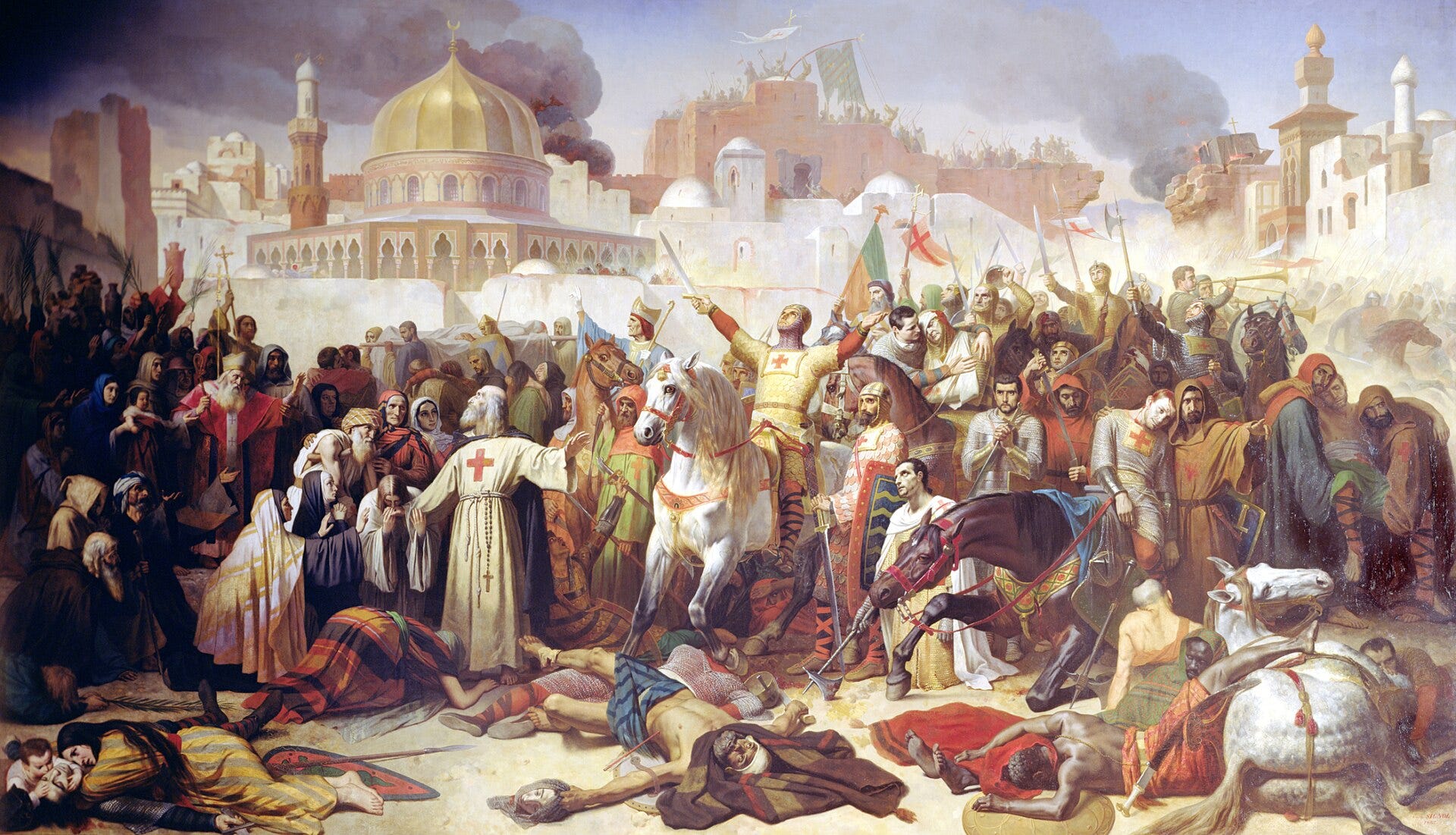
July 15, 1099: The army of the First Crusade emerges victorious from its Siege of Jerusalem, capturing the city and thus achieving its stretch goal. Despite a potentially calamitous lack of readily available fresh water, the Crusaders were fortified by a shipment of raw materials from Europe that enabled them to construct siege towers and overwhelm the city’s enfeebled Fatimid garrison. There is still some debate over the extent of the massacre that followed, partly due to the difficulty in separating deaths during the siege from deaths in the immediate aftermath of the siege.
July 15, 1799: An officer on Napoleon’s Egyptian campaign, Captain Pierre-François Bouchard, discovers an artifact later dubbed “the Rosetta Stone.” The stone, containing three versions of the same decree—in hieroglyphs, demotic Egyptian, and Ancient Greek—enabled scholars to finally translate hieroglyphs and was a landmark in the development of the field of Egyptology.
July 15, 1974: Greece’s military government engineers a coup in Cyprus in order to install a government favorable to union with Greece. The coup prompted Turkey to intervene to prevent Cyprus from joining Greece, partitioning the island and leaving it in a state of frozen conflict that continues to the present day.
MIDDLE EAST
LEBANON
Israeli and Lebanese negotiators wrapped up their sixth round of talks with US officials in Rome on Wednesday. Neither party has yet commented on the outcome, but according to the US State Department they “agreed on the structure and guidelines for the pilot zone process, to be finalized and implemented in the coming days.” In that process, the Israeli military (IDF) is supposed to withdraw from two areas in southern Lebanon while the Lebanese army moves into them. But the zones that have been proposed apparently don’t have a heavy IDF presence anyway, calling into question the nature of the “withdrawal.” It’s still not clear when (or whether) these territorial handovers are actually going to take place.
